
🔥 Would you like to save this?
The cigarette smoke hit you before you even found your seat. That’s the first thing anyone who flew in the 1960s will tell you, right after they describe the shrimp cocktail served on bone china somewhere over Nebraska. Commercial aviation was barely thirty years old and it was already the most glamorous thing most Americans had ever done. Boarding a plane meant something. What it looked like, smelled like, and cost like would be completely unrecognizable to anyone who’s recently wrestled a roller bag into an overhead bin. Here’s how different it actually was.
35. Everyone Dressed Like They Were Attending a Wedding, Not Catching a Flight
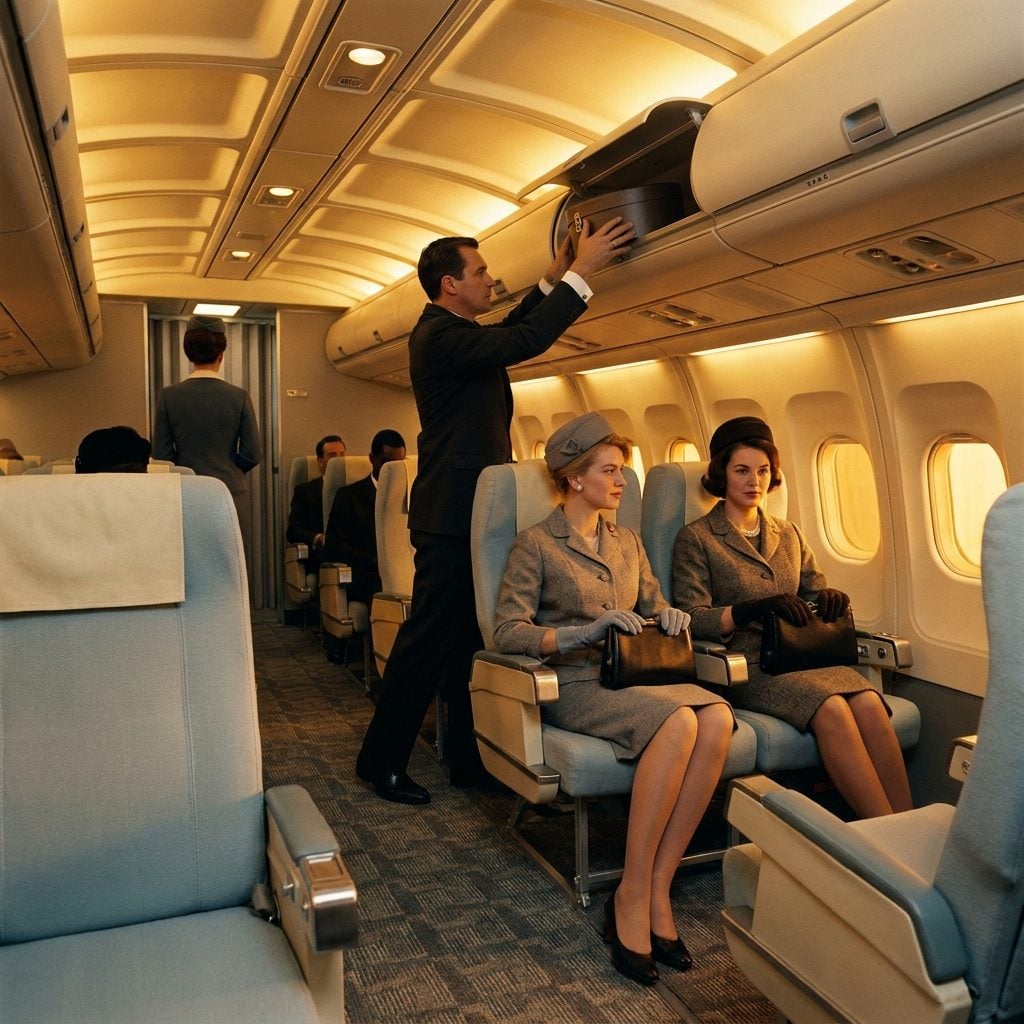
Nobody shuffled down the jetway in flip-flops and a hoodie. Flying in the 1960s was an occasion, full stop. Men wore suits and ties. Women wore gloves, heels, and hats that they kept on for the duration of the flight. Pillbox styles were particularly popular, and you’d see more cashmere on a Tuesday morning departure than at most contemporary black-tie events.
This wasn’t pretension. It was the prevailing social contract. Air travel was expensive enough that it still carried genuine status, and passengers dressed accordingly. There’s something both admirable and slightly exhausting about it, honestly. But even the most skeptical modern traveler has to admit: the cabin photographs from that era look extraordinary.
34. Smoking Sections That Weren’t Really Sections at All
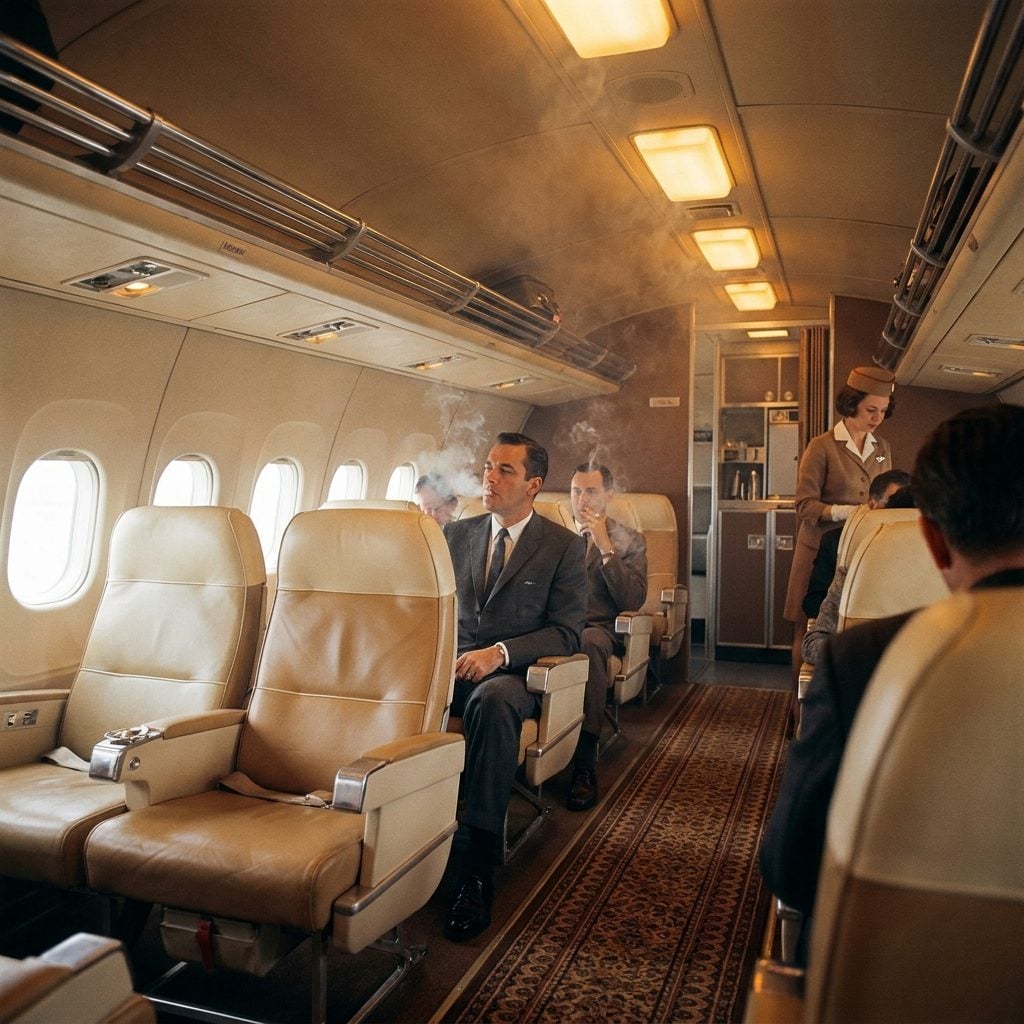
The smoking section was, technically, the rear third of the aircraft. In practice, cigarette smoke doesn’t read flight maps. It drifted forward through the entire pressurized cabin, settled into seat fabric, coated hair, and arrived with you at your destination. Passengers who didn’t smoke simply accepted this as part of the flying experience, the way you’d accept turbulence.
Ashtrays were literally built into the armrests. Every seat had one. The FAA didn’t ban smoking on domestic flights until 1988 for short routes, and transatlantic bans came even later. For about three decades, nonsmokers just sat there, breathing it in, and nobody thought that was particularly strange.
33. Real China, Metal Cutlery, and Glassware on Every Tray, Even in Coach
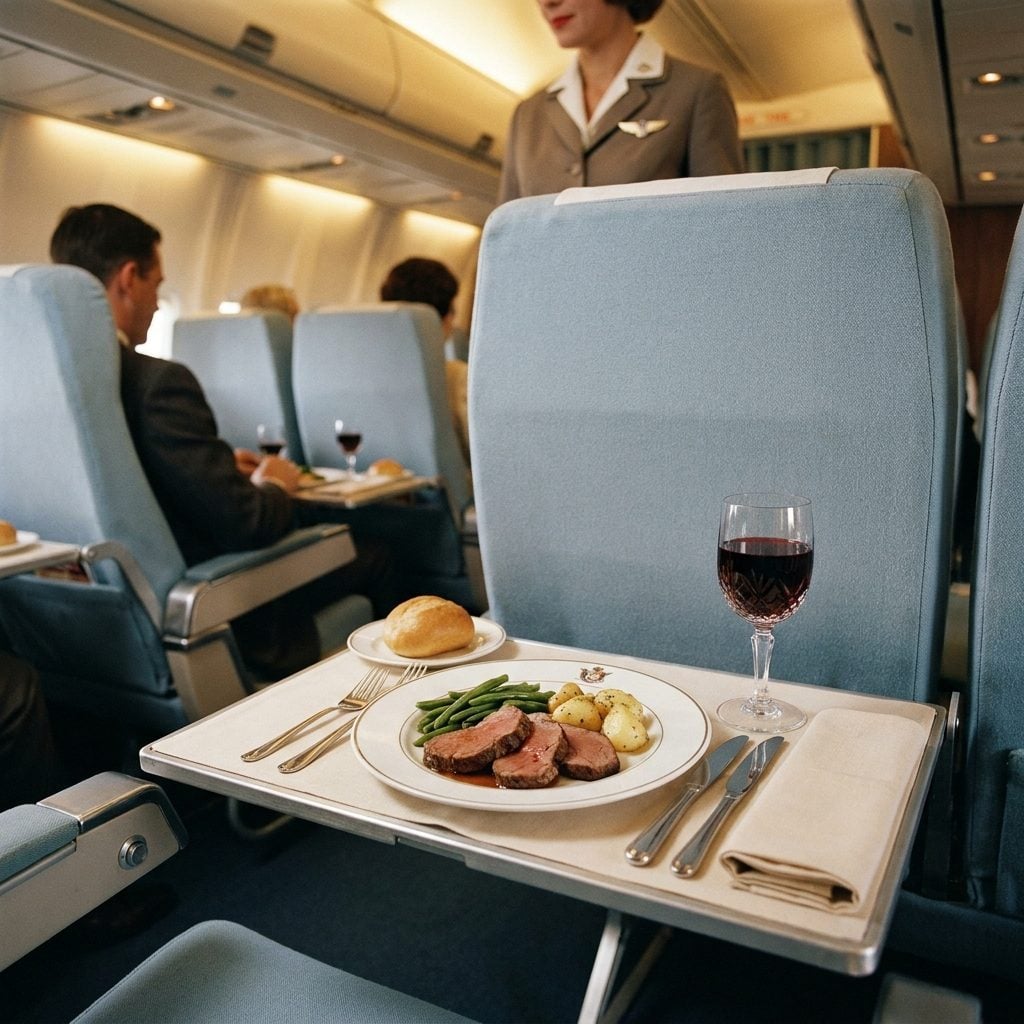
That tray in front of you came set with actual ceramic plates, real metal forks and knives, and a proper glass. Not a plastic cup wedged into a cardboard sleeve. Not a foil lid you had to peel back while elbowing your neighbor. A plate. With food arranged on it.
This was economy class. Standard service. Airlines competed aggressively on meal quality throughout the 1960s, and the food genuinely mattered to passengers choosing a carrier. Route monopolies were still mostly intact, so meals and service were the differentiators.
The whole thing disappeared gradually after deregulation in 1978, which broke open price competition and made cutting service costs the only game in town. By the mid-1980s, the china was gone and the metal cutlery was being quietly replaced with plastic. We noticed, but we kept buying the cheaper ticket.
32. Economy Class, Where the Trolley Came Around With Carved Roast Beef
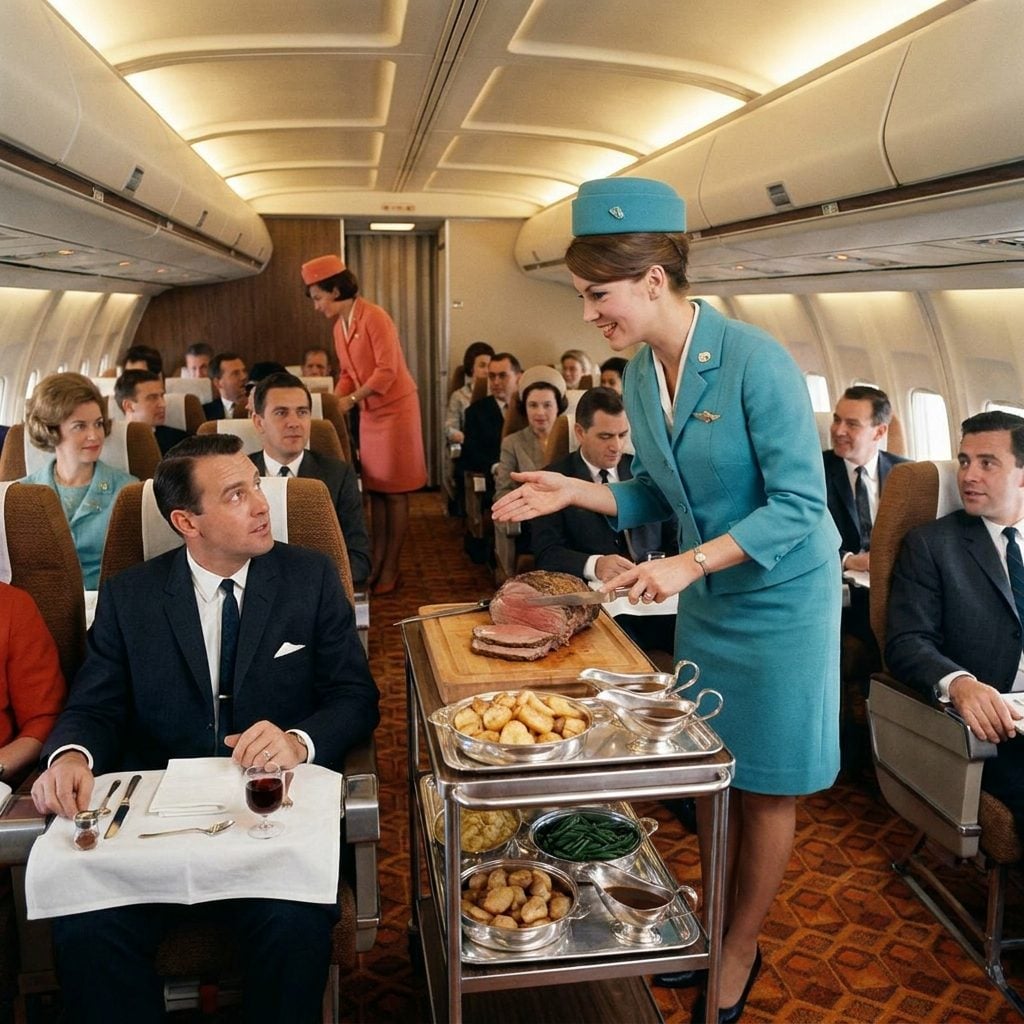
Not a pre-portioned slab reheated in a galley cart. An actual carved roast, sliced to order at the trolley, right there in the aisle. Several airlines operated this service through the mid-1960s on transatlantic and cross-country routes, and first-class cabin concepts had genuinely seeped downward into what we’d now call economy.
Pan Am’s economy service was particularly competitive. TWA wasn’t far behind. The airlines spent real money on this, partly because regulations had capped what they could charge per ticket, so impressing passengers mid-flight was one of the few levers available.
31. Stewardesses Faced Weigh-Ins, Height Checks, and a Hard Age Ceiling of 32
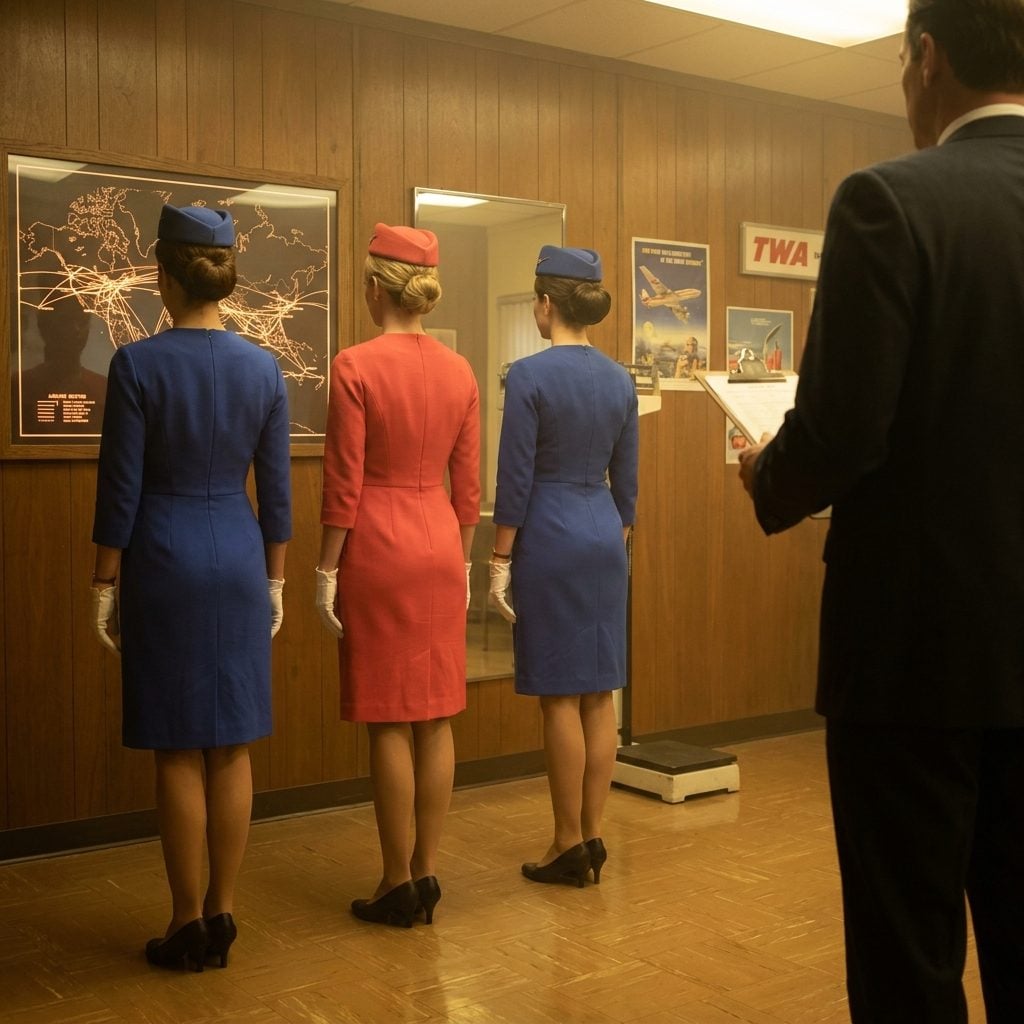
Airlines maintained remarkably specific rules about who could serve passengers in the air. Height between 5’2″ and 5’9″. Weight proportional to height and checked regularly. No glasses. Hair worn above the collar or pinned up. Makeup guidelines that specified, in some cases, exactly which shades of lipstick were acceptable.
Age cutoffs were standard across most carriers: typically 32 or 35, after which a stewardess was considered too old for the job. The entire framework treated the position as a performance as much as a service role. The women who held these jobs were undeniably skilled, and they were evaluated on far more than skill.
30. Marriage Was a Resignation Letter: Many Airlines Fired Stewardesses Who Got Married
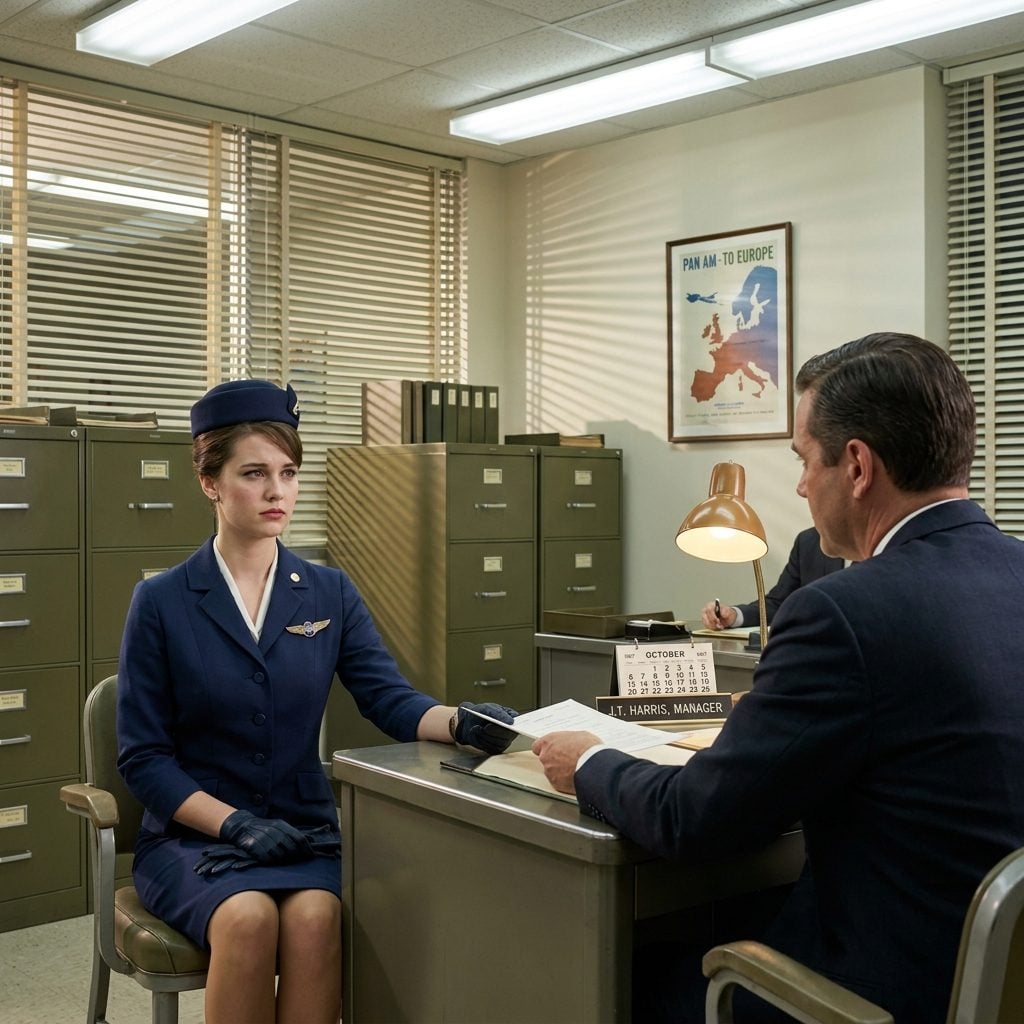
Several major U.S. carriers had written policies through the early 1960s requiring stewardesses to resign upon marriage. United, American, TWA. The logic, as airlines explained it, was that married women would be distracted or unavailable for the scheduling demands of the job. The actual logic was that youth and availability were considered part of what passengers were paying for.
Stewardesses organized and fought back. Dusty Roads, Kathleen Heenan, and eventually union actions through the mid-1960s began chipping away at the policies. By 1968, the EEOC had ruled the restrictions discriminatory, but individual legal battles continued for years after that ruling. Some women had already lost years of seniority and back pay they never recovered.
“They told me the ring on my finger meant I couldn’t do my job anymore. I’d been flying that route for four years.”
29. Your Whole Family Walked You to the Gate, Watched the Plane Push Back, and Waved
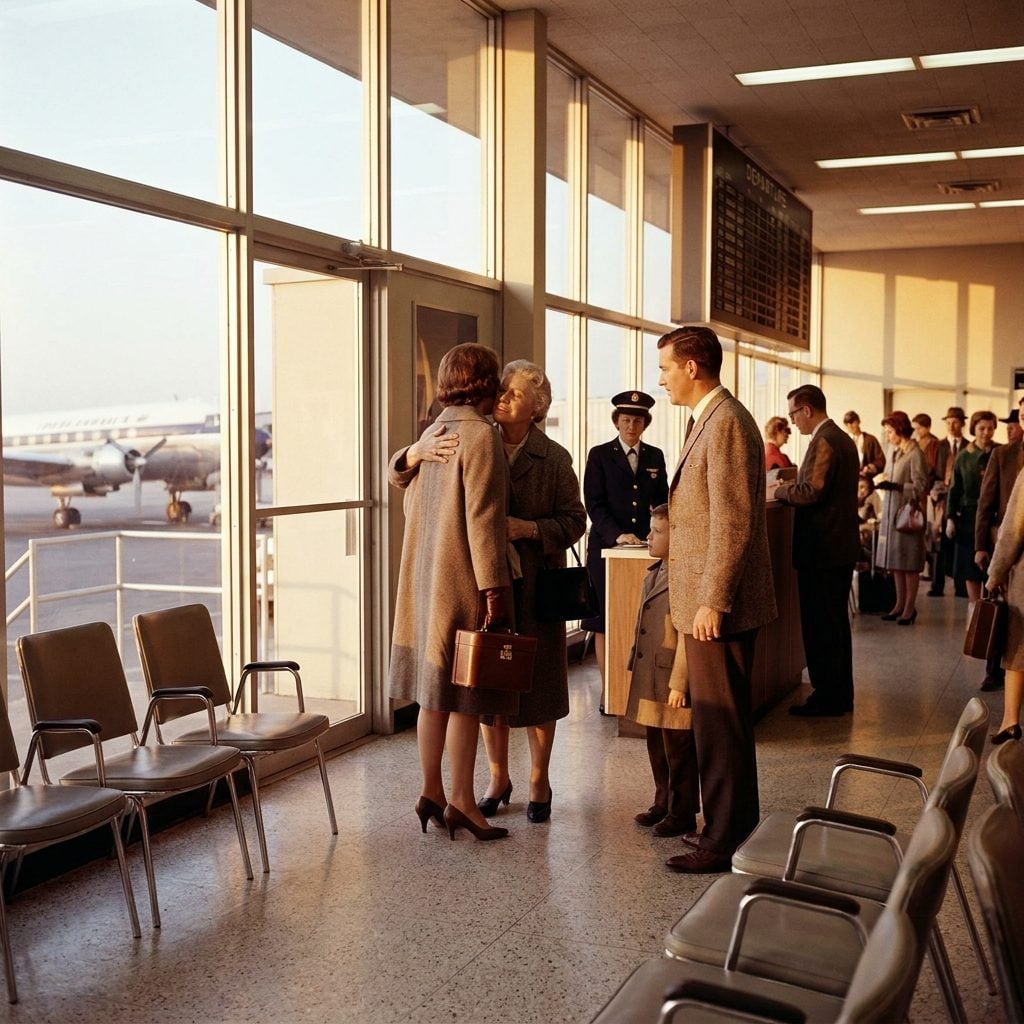
There was no security checkpoint between the front door of the airport and the gate. You walked in, checked a bag at the counter, and strolled to whichever gate your flight was leaving from. Anyone could come with you. Everyone usually did.
Families made it an event. Parents, grandparents, kids, sometimes a neighbor who happened to be free. They’d stand at the window and watch the plane until it turned onto the taxiway. The goodbye was unhurried. You had time for it.
Losing that particular ritual, the proper airport farewell, might be the single most underrated casualty of post-2001 air travel. The modern version, a hug at the curb before a rideshare pulls away, doesn’t come close.
28. Walking Into an Airport in 1965 Meant No X-Rays, No Shoe Bins, No Body Scanners
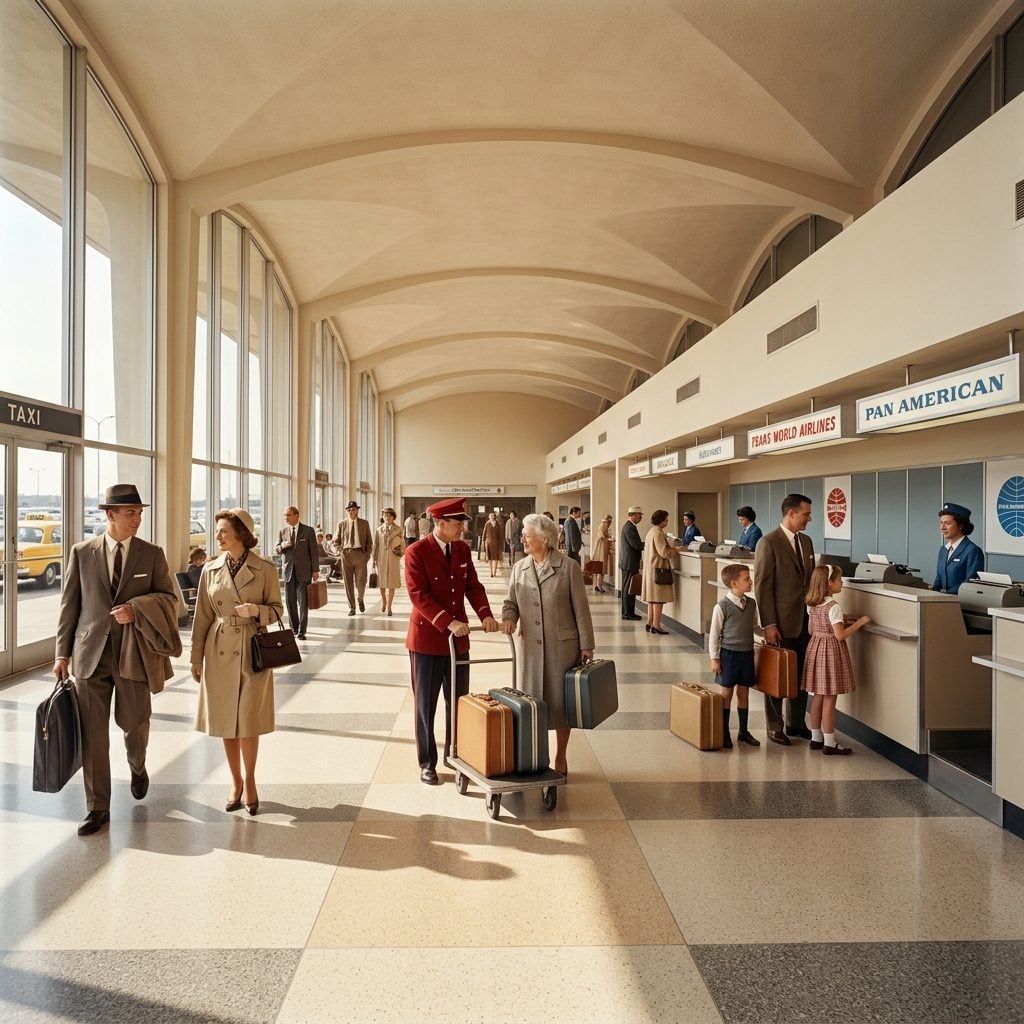
You walked in off the street, directly into the terminal. No bins. No belt. No removing your shoes, your watch, your belt, your laptop, your three-ounce liquids bag. No body scanner cycling through a full rotation while you stood with your arms raised like you were surrendering.
Ticket agents checked your name against a passenger manifest at the gate. That was more or less it for security on most domestic routes well into the late 1960s. The first federal hijacking regulations in the U.S. didn’t come until 1969, and the metal detector rollout that followed was modest by contemporary standards.
Modern air travelers have spent so long inside the current system that the 1965 airport lobby feels almost fictional. But it was real, routine, and, for a few decades, it worked fine.
27. You Could Board a Plane With Little More Than a Smile and a Ticket
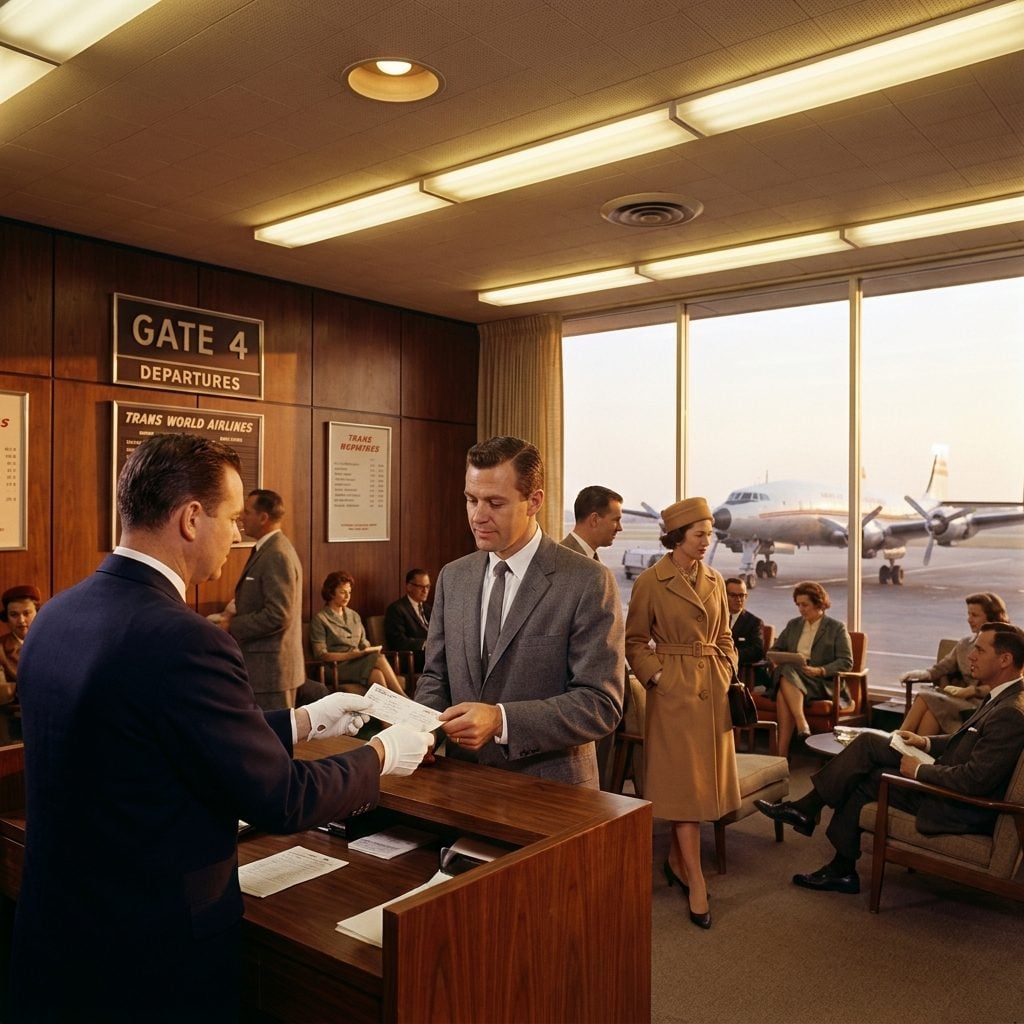
Walk up, hand over your ticket, find a seat. That was essentially the entire security process for most of the 1960s. No government-issued ID required, no baggage X-ray, no removing your shoes. A paper ticket with your name on it was considered sufficient proof that you were who you said you were, which is both charming and absolutely wild by any modern standard.
Airlines were still in the business of presenting themselves as a luxury service, and asking passengers to prove their identity the way a bouncer might felt deeply at odds with that image. The whole transaction was closer to buying a train ticket than anything we’d recognize today. For most of the decade, the biggest inconvenience at the gate was making sure your luggage tags were properly filled out.
26. Hijackings Got So Common That ‘Take Me to Cuba’ Became a Punchline
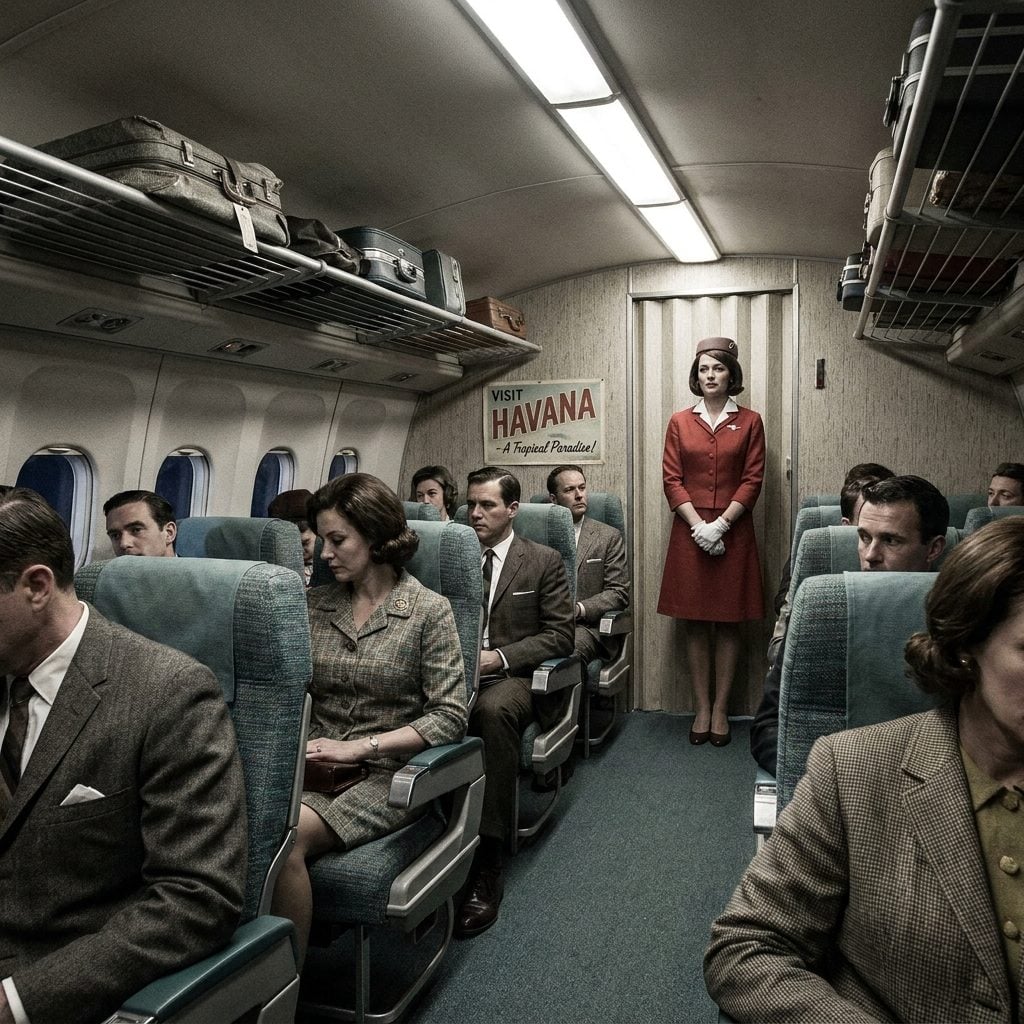
Between 1968 and 1969 alone, there were more than 130 hijackings of American aircraft. Not a typo. Skyjacking became such a routine feature of air travel that airlines quietly printed maps of Cuba in their operations manuals and the phrase “take me to Cuba” became a genuine comedy staple, used in late-night monologues and sitcom scripts as a reliable crowd-pleaser.
Most hijackings during this period were carried out by people seeking asylum in Cuba, and the Cuban government would typically hold the plane, return the passengers, and keep the aircraft for a while. Bizarre as it sounds, many passengers described the experience afterward as merely a lengthy inconvenience. The FAA didn’t begin mandatory passenger screening until 1973, which tells you everything about how the decade’s official response compared to the decade’s actual hijacking numbers.
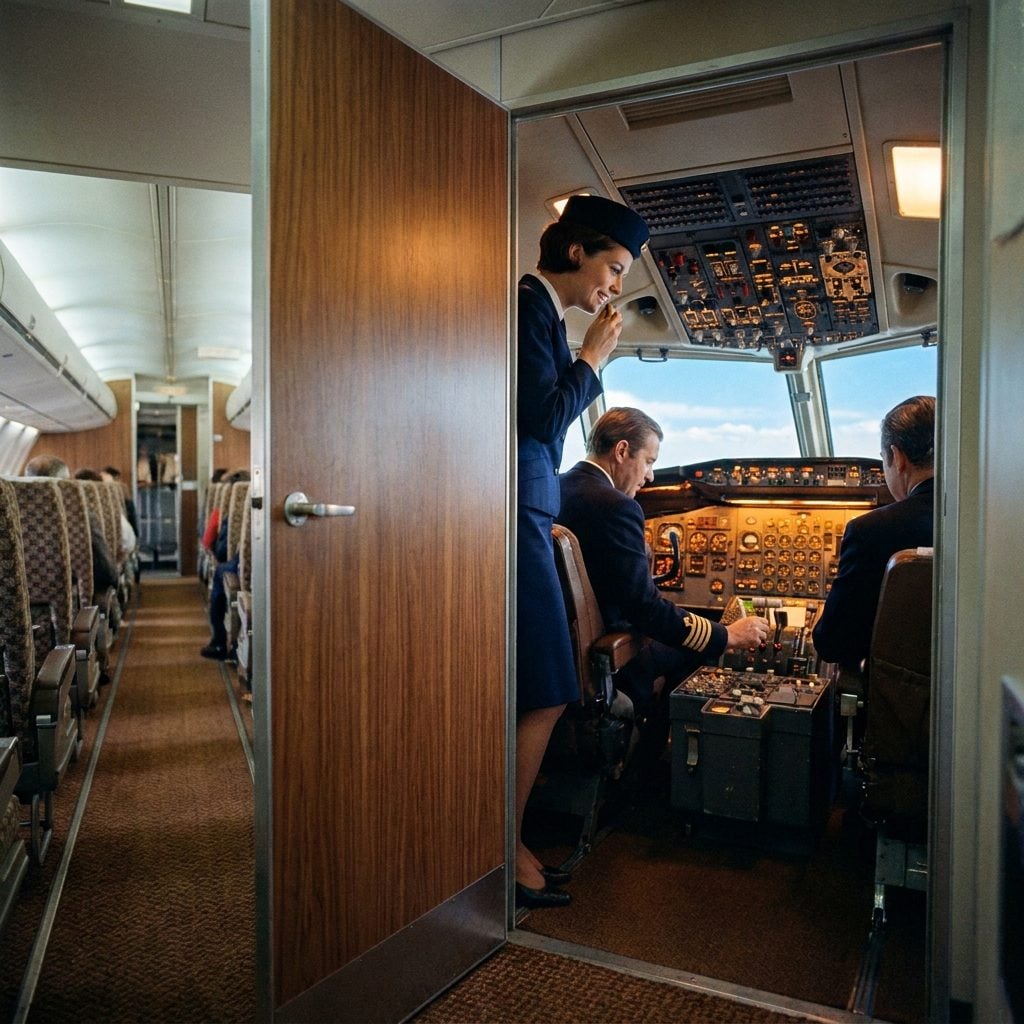
25. The Cockpit Door Was a Courtesy, Not a Barricade
🔥 Would you like to save this?
The cockpit door in the 1960s was frequently left open during cruise flight. Not propped open as a gesture of hospitality, but simply not shut, the way you might leave an office door open while working. Passengers near the front of the cabin could sometimes hear the pilots chatting, occasionally see the instrumentation glowing through the gap, and flight attendants moved through that threshold freely during the flight.
Post-9/11 reinforced cockpit doors with dual-latch deadbolts and bulletproof panels feel like science fiction compared to what those flimsy bi-fold doors actually were. Technically, they could lock. In practice, they often didn’t.
24. Kids Got Personal Cockpit Tours at 30,000 Feet, While the Plane Was Flying
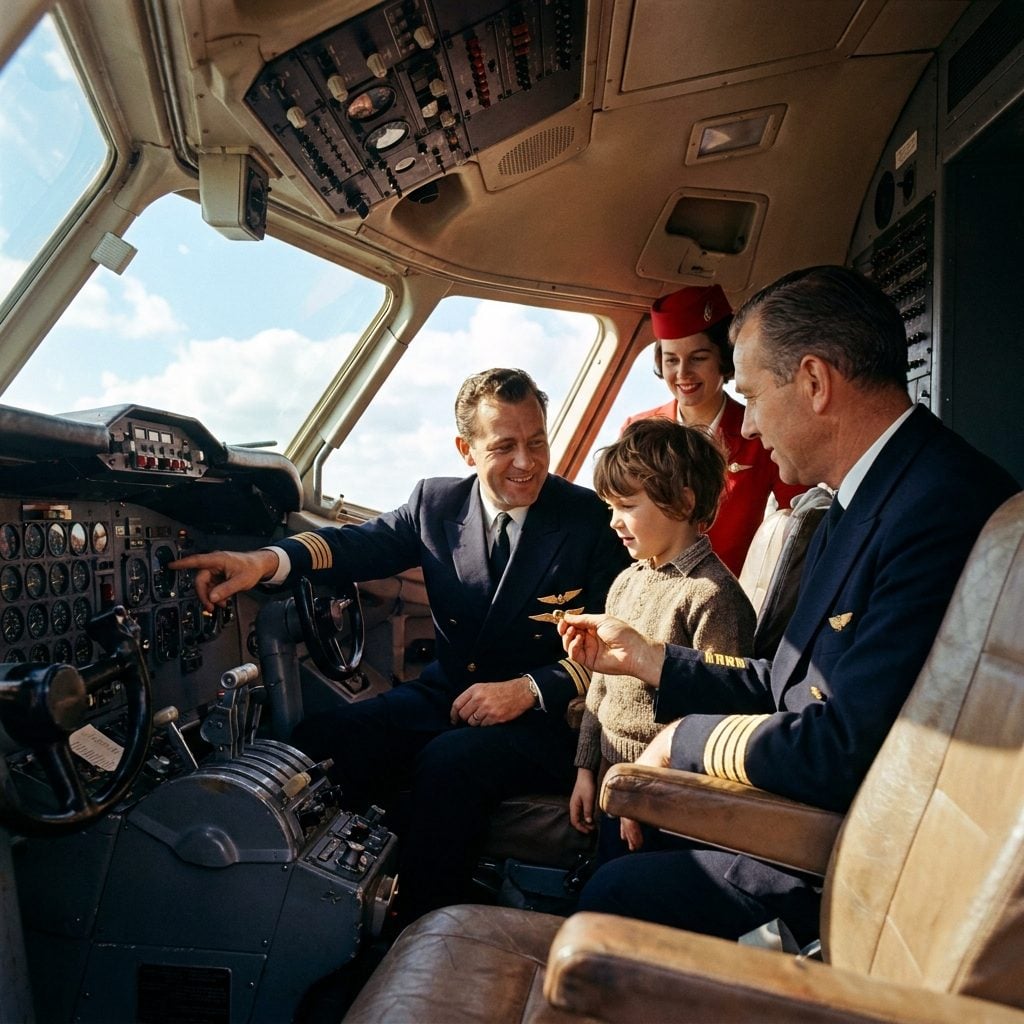
If you flew as a kid in the 1960s, there’s a decent chance a flight attendant walked you up to the cockpit mid-flight, knocked lightly on that not-particularly-fortified door, and introduced you to the captain. Who then handed you a pair of plastic pilot wings and let you sit in his seat for approximately three minutes while the plane cruised at altitude on autopilot.
It was the standard-issue magic trick airlines used to keep young passengers entertained, and it worked completely. Those plastic wing pins became sacred objects. A lot of adults who fly today trace their entire relationship with aviation back to one of those cockpit visits, which might be the most charming thing about how that era of air travel actually operated.
23. Yes, the Pilots Were Smoking. In the Cockpit. While Flying the Plane.
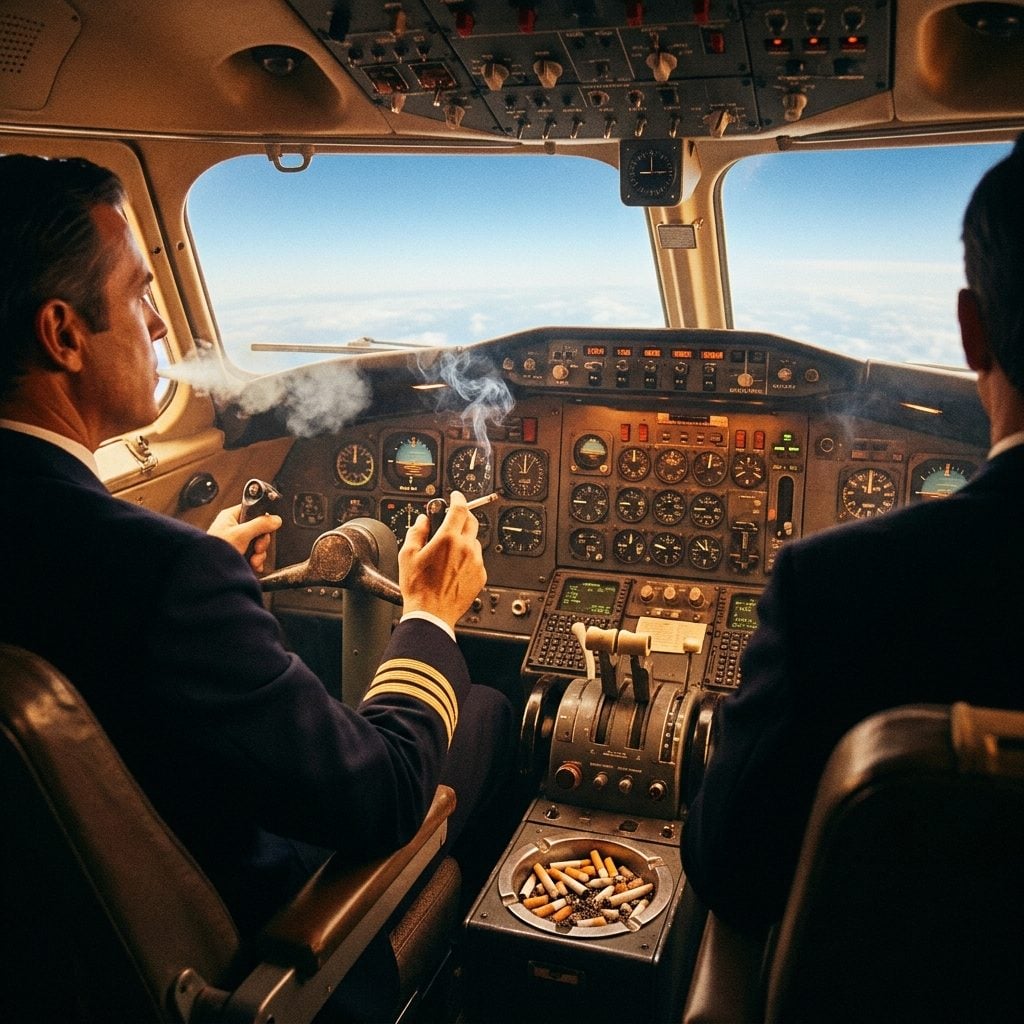
Cockpit ashtrays were standard equipment. Not a modification, not a personal addition some rogue pilot bolted in, but a factory-installed fixture built directly into the instrument console. The FAA didn’t prohibit smoking in cockpits until 1988, which means for the entire decade of the 1960s and then some, the two people responsible for the aircraft were entirely free to light up whenever the mood struck.
Pilots smoked during takeoff checklists. During cruise. During approach. It is genuinely difficult to picture now, but the ashtray was right there next to the altimeter and nobody found this arrangement worth questioning.
22. Cigars, Pipes, Cigarettes: The Cabin Was One Long Rolling Smoking Lounge
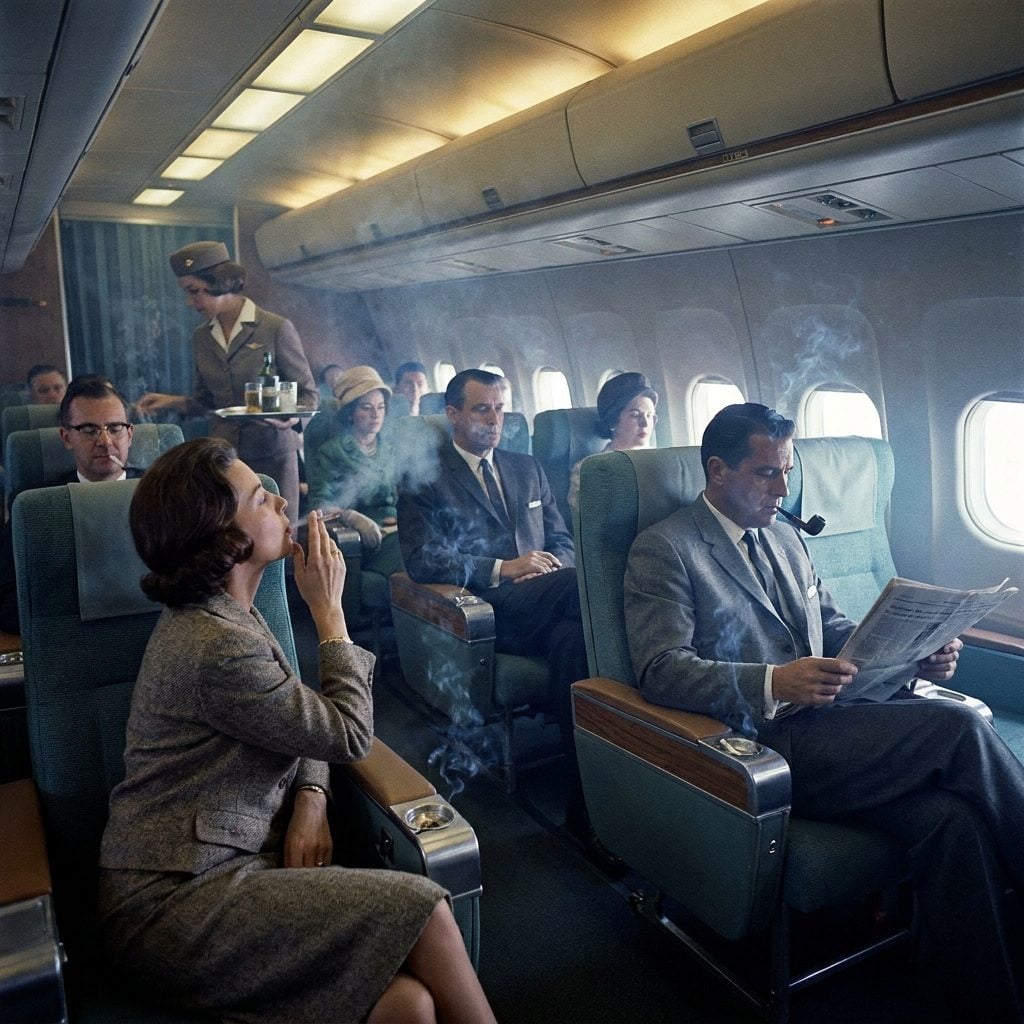
Not just cigarettes. Pipes and cigars too, and nobody asked anyone’s permission. Ashtrays were built directly into the armrests of nearly every commercial aircraft seat, folding out like a small chrome clamshell, and passengers used them openly for the entire flight. The aisles of a 1960s commercial jet on a cross-country route had the air quality of a casino floor in about 1994, except at altitude and inside a sealed tube.
Designated smoking sections didn’t appear until the 1970s, and even then enforcement was nominal at best. The idea that someone might object to a fellow passenger’s cigar on a four-hour flight was considered a personal sensitivity problem for the objector, not an issue the airline needed to manage.
21. The Smell of a 1960s Airplane Cabin Was Something Else Entirely
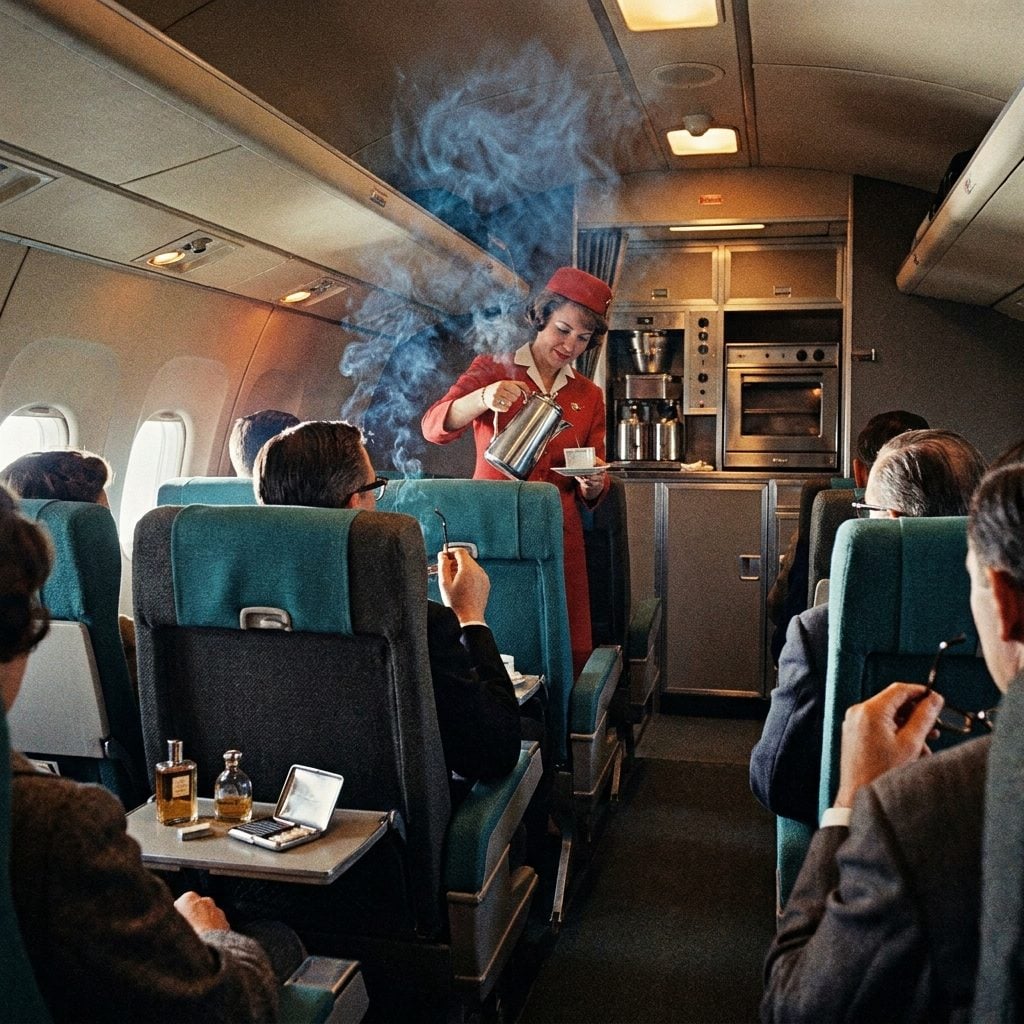
No other smell existed quite like the interior of a commercial aircraft in the mid-1960s, and if you were there you remember it even if you can’t quite name it. It was cigarette smoke threaded through wool fabric, jet fuel faintly in the ventilation, fresh coffee from the galley, the waxy floral punch of several different perfumes all operating simultaneously, and underneath all of that, something slightly mechanical and slightly industrial that the carpeting never fully absorbed.
It was not a pleasant smell by any clinical measure. And yet it was completely, totally the smell of going somewhere, which gave it a power that no amount of current-era recycled cabin air will ever replicate. Airports now smell like Cinnabon and hand sanitizer. Progress, technically.
“It was cigarette smoke threaded through wool fabric, jet fuel faintly in the ventilation, fresh coffee from the galley, and the waxy floral punch of several different perfumes operating simultaneously.”
20. Seats Were Wide Enough That You Didn’t Spend the Flight Apologizing to Your Neighbor
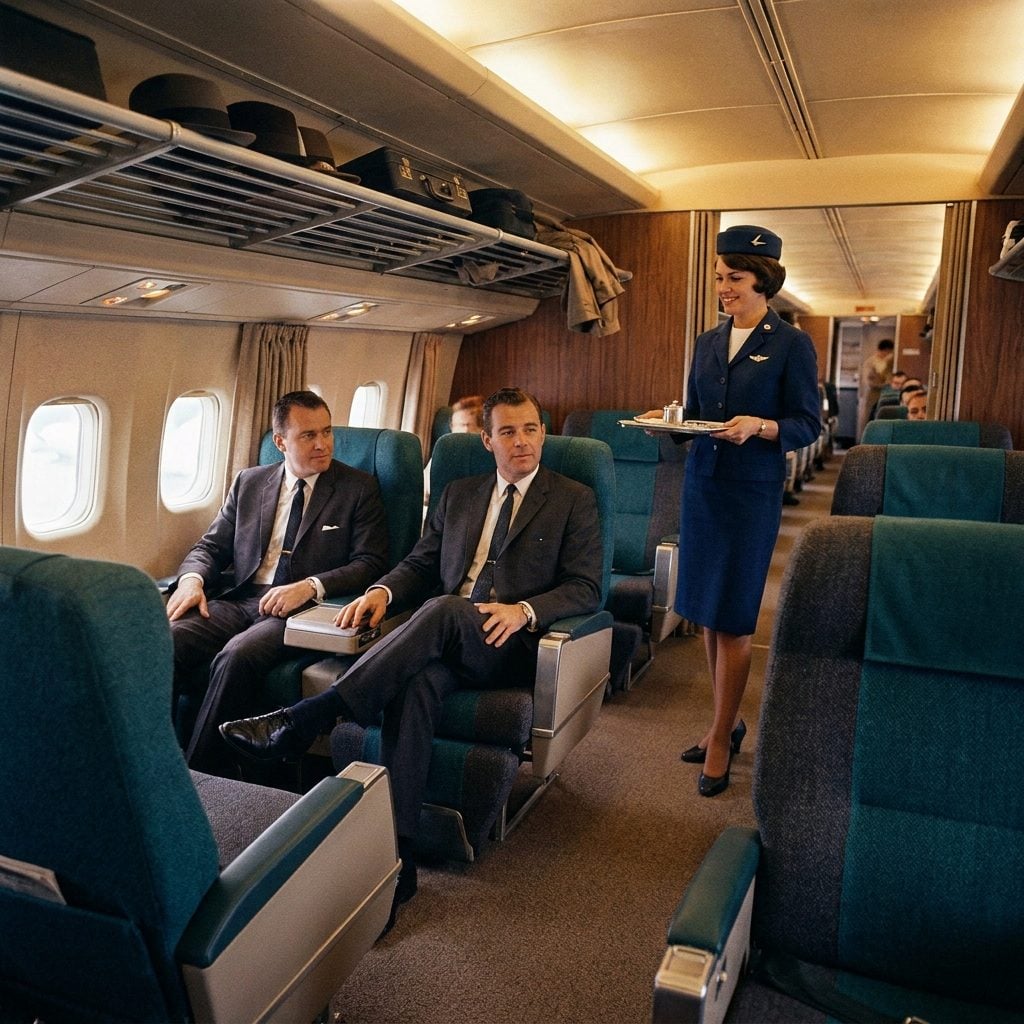
In 1960, a standard economy seat on a U.S. commercial airliner was typically around 18 to 19 inches wide with 35 to 36 inches of pitch between rows. Today the industry average in economy has drifted to roughly 17 inches of width and 31 inches of pitch on many carriers. That gap is the difference between a seat and a cattle pen, and anyone who flew in both eras knows it without needing to see the numbers.
The planes carried fewer passengers, which is the whole story. When a 707 carried 110 people on a route that a modern 737 might carry 180, the math on legroom worked out completely differently. First class in the 1960s had seats wide enough to feel like furniture from a good hotel. Economy felt like economy is supposed to feel, meaning like an airplane seat, not a complaint waiting to happen.
19. Flying Was a Financial Event, Not a Tuesday Commute
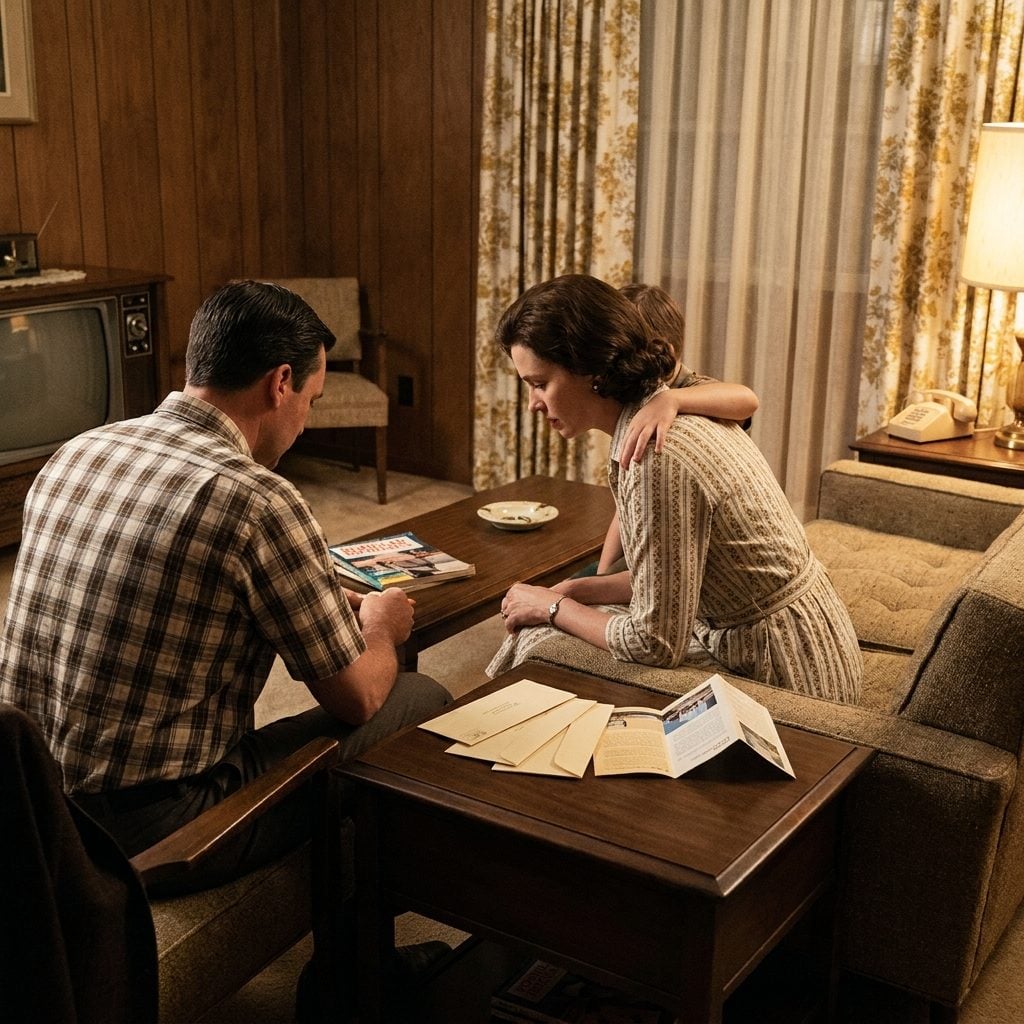
A round-trip coach fare from New York to Los Angeles in 1960 could run close to what a family spent on groceries for a month. People saved for it. They talked about it in advance. They dressed for it. When a family announced they were flying somewhere, the neighbors actually said something.
It wasn’t that air travel was inaccessible to the middle class, it was that it mattered enough to treat carefully. That relationship with travel, where the act of getting there carried its own weight, is almost impossible to explain to someone who’s booked a $49 Spirit fare on their phone while standing in a parking lot.
18. Price-Fixed Skies: Why Your Gin and Tonic Came With a Smile
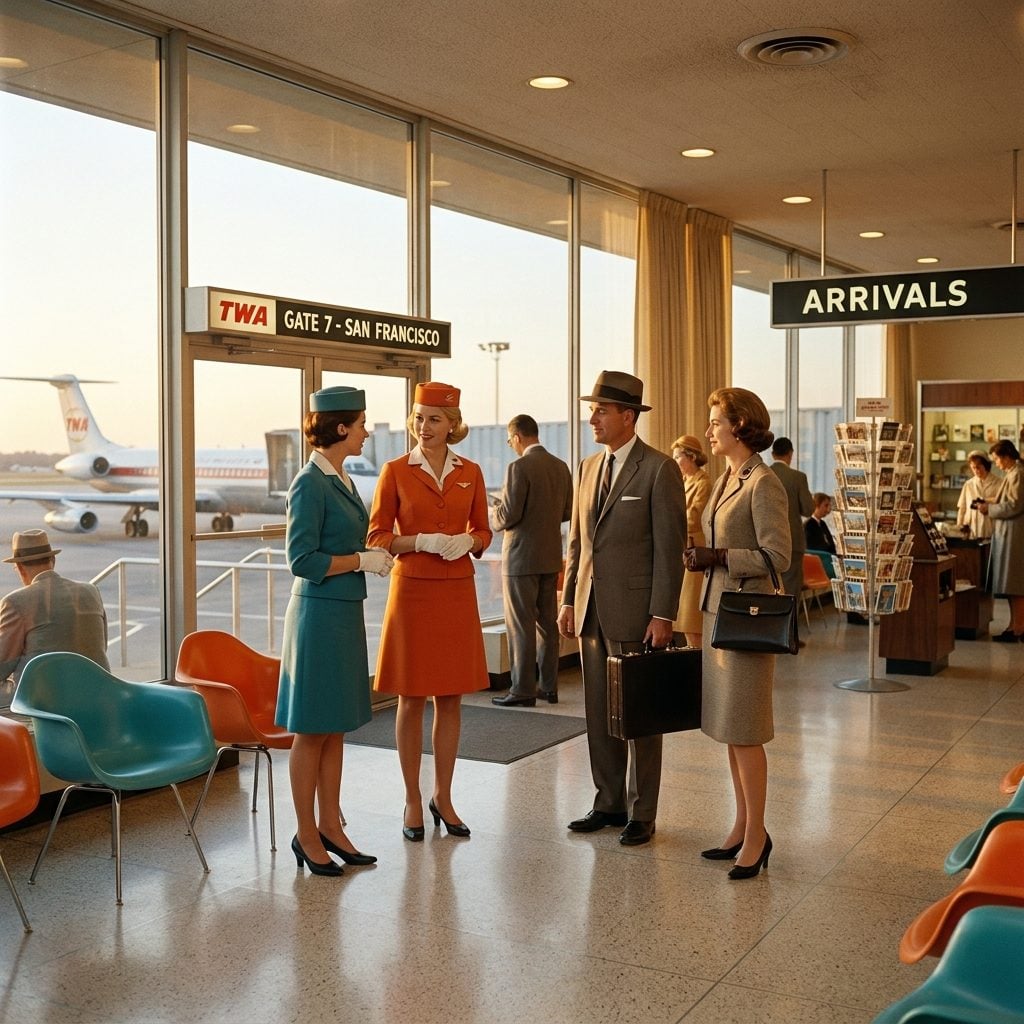
The Civil Aeronautics Board set ticket prices for domestic routes from 1938 until deregulation in 1978. Every airline charged the same fare for the same route. Full stop.
So the only battlefield was the experience. And airlines fought hard on it: better food, faster service, friendlier flight attendants, thicker steaks, fuller cocktail carts. Competing on price wasn’t an option, so competing on dignity was. Deregulation brought cheaper fares, and that’s genuinely a good thing. But it also ended the era when airlines had a structural incentive to make you feel like a person.
17. The Souvenir Haul You Got Just for Boarding the Plane
🔥 Would you like to save this?
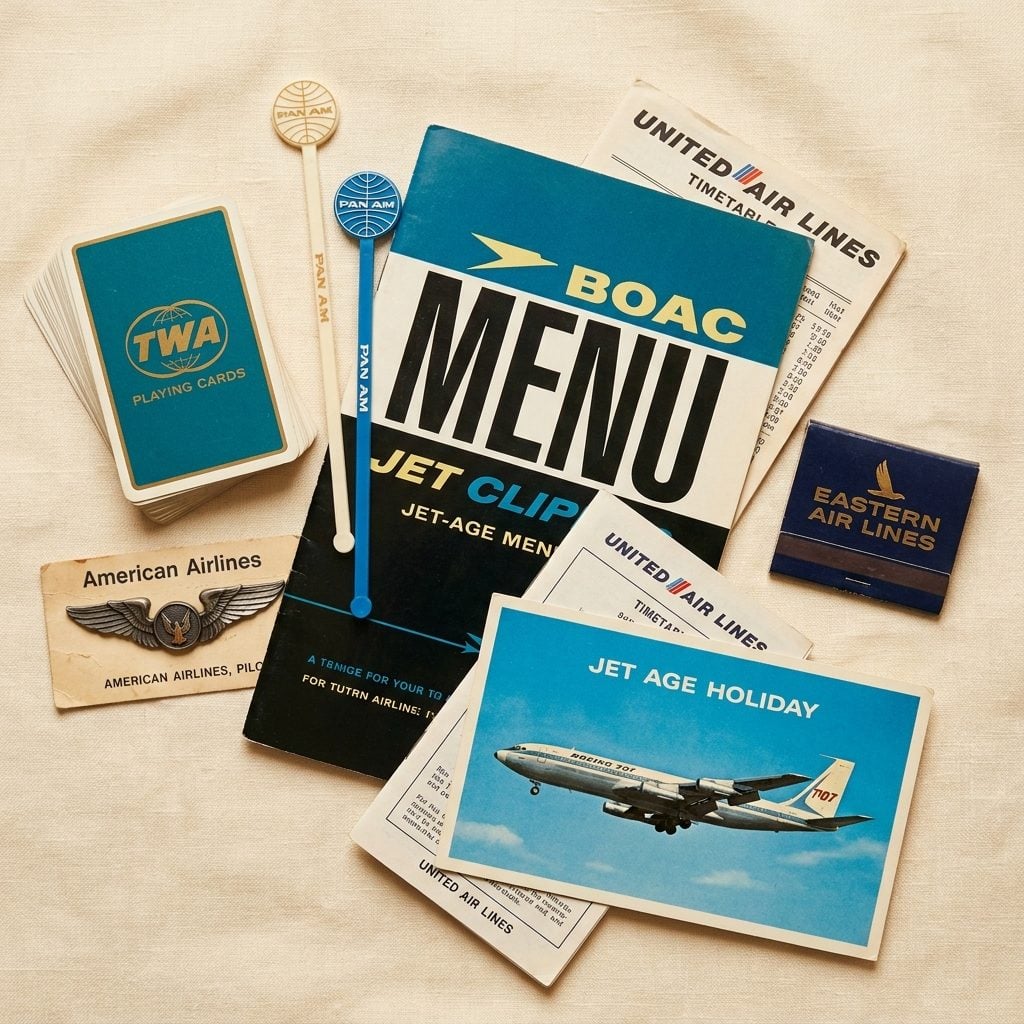
They gave you things. Just because you got on the plane. Decks of playing cards with the airline’s livery on the back. Postcards printed with a painting of the jet you were actually sitting on. Matchbooks, on an airplane, with the logo in gold foil. Metal wings for the kids. A printed menu you could keep.
Cocktail stirrers shaped like swizzle sticks with tiny plastic emblems. Airline timetable booklets slim enough for a suit pocket. None of it cost extra. None of it was a loyalty perk. It was just how you traveled.
People kept this stuff for decades. Whole collections got assembled from a childhood’s worth of flights. The playing cards alone showed up in kitchen junk drawers well into the 1980s.
16. The Cocktail Cart Wasn’t an Interruption, It Was the Point
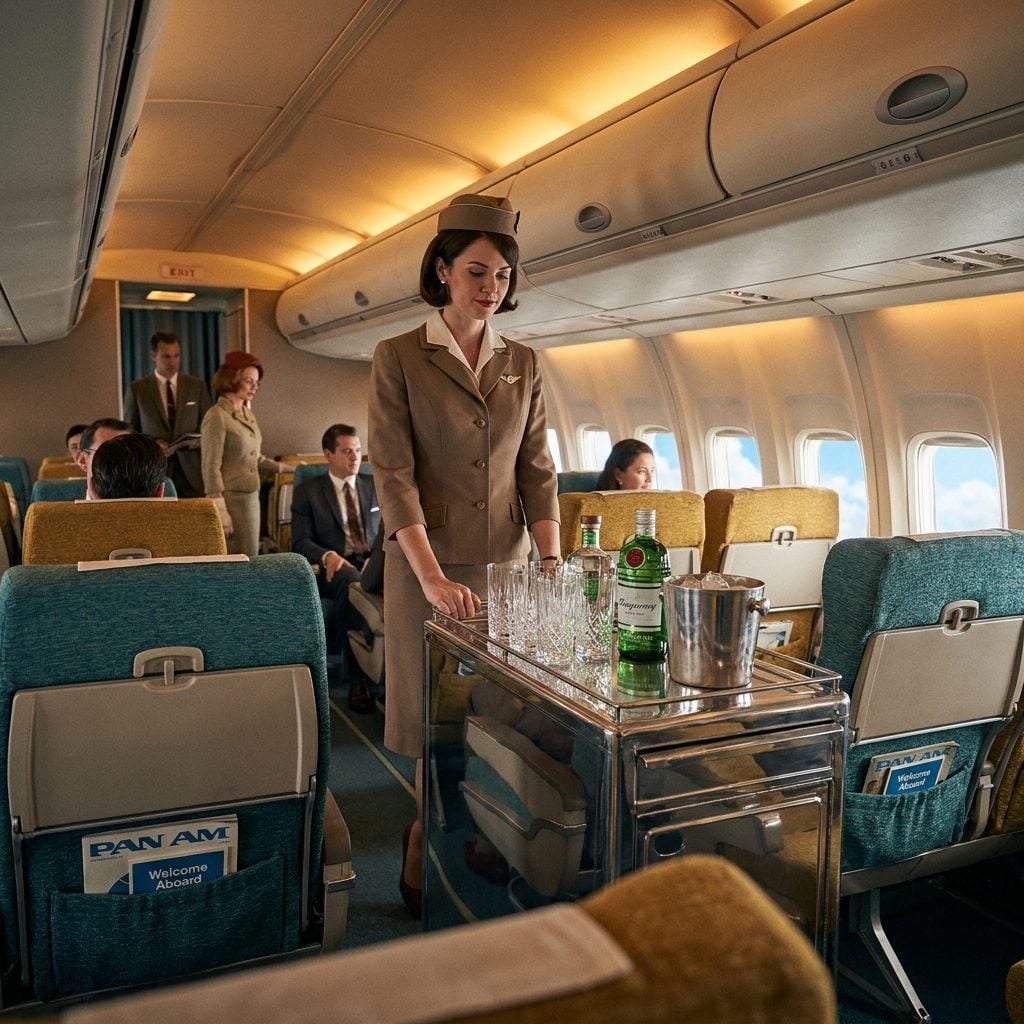
Passengers expected cocktails the way they expected a seat. You asked for a gin and tonic and got it in a real glass. The ice came from an actual ice bucket. Nobody charged you $14 for a tiny bottle of warm bourbon and a plastic cup. The drink was part of the fare, and the flight attendant poured it like they meant it.
The cocktail hour aloft had a particular social weight in the 1960s. It was when strangers talked. When business got started or concluded. When the flight became, briefly, a lounge in the sky. Losing the free drink didn’t just cut a cost, it cut the ritual that organized the whole social atmosphere of the cabin.
15. The Piano Bar at 30,000 Feet Was a Real Thing
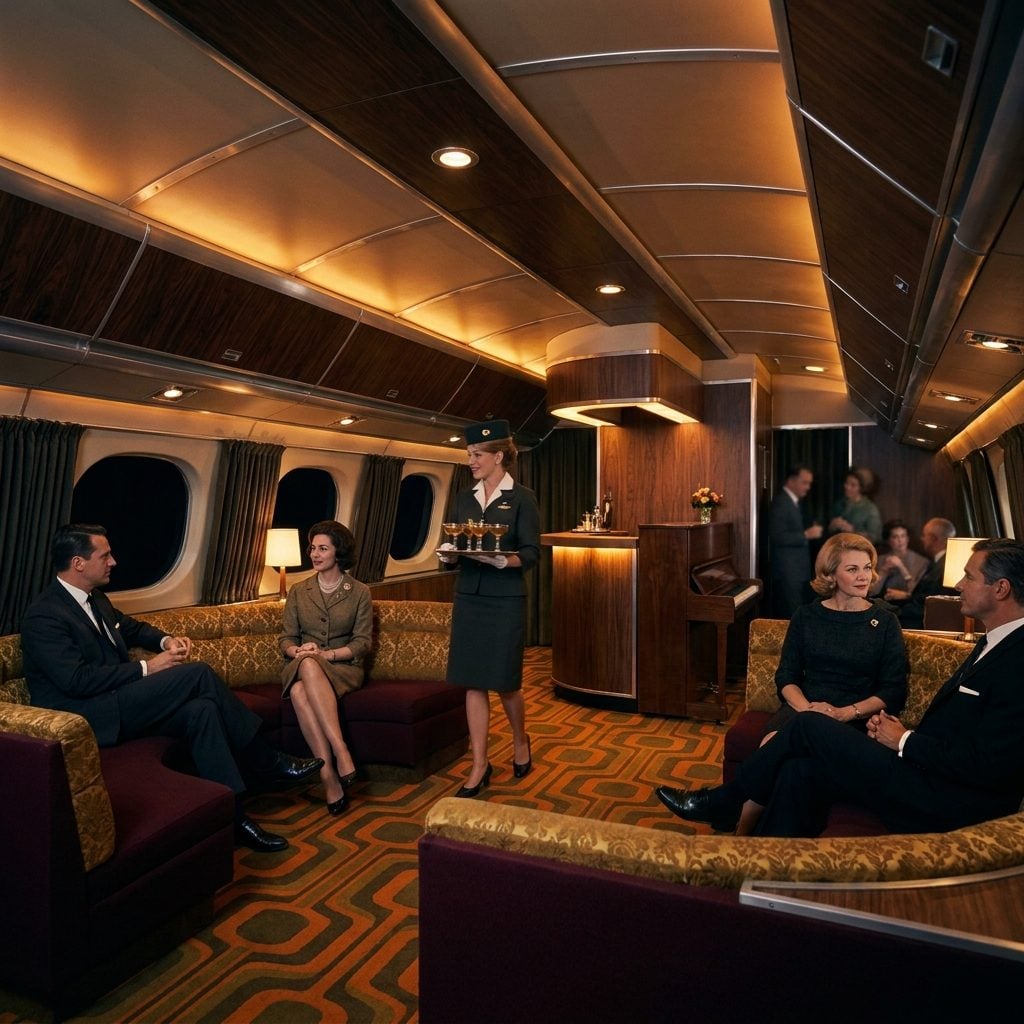
Boeing 707 interiors on some carriers had a dedicated lounge section. Pan Am’s first-class 747 configuration, which arrived just as the decade closed, included an upstairs lounge that became nearly mythological. Braniff hired Alexander Girard to design their entire cabin environment. There were flights with seating arrangements designed for conversation rather than just forward-facing transit.
A piano wasn’t even the strangest part. The stranger part is how thoroughly that ambition collapsed. The idea that a passenger aircraft could contain social architecture, a place to go, a bar to stand at, sounds like science fiction now. It was just Tuesday in 1968.
14. The Aisle Was a Social Space, Not an Obstacle Course
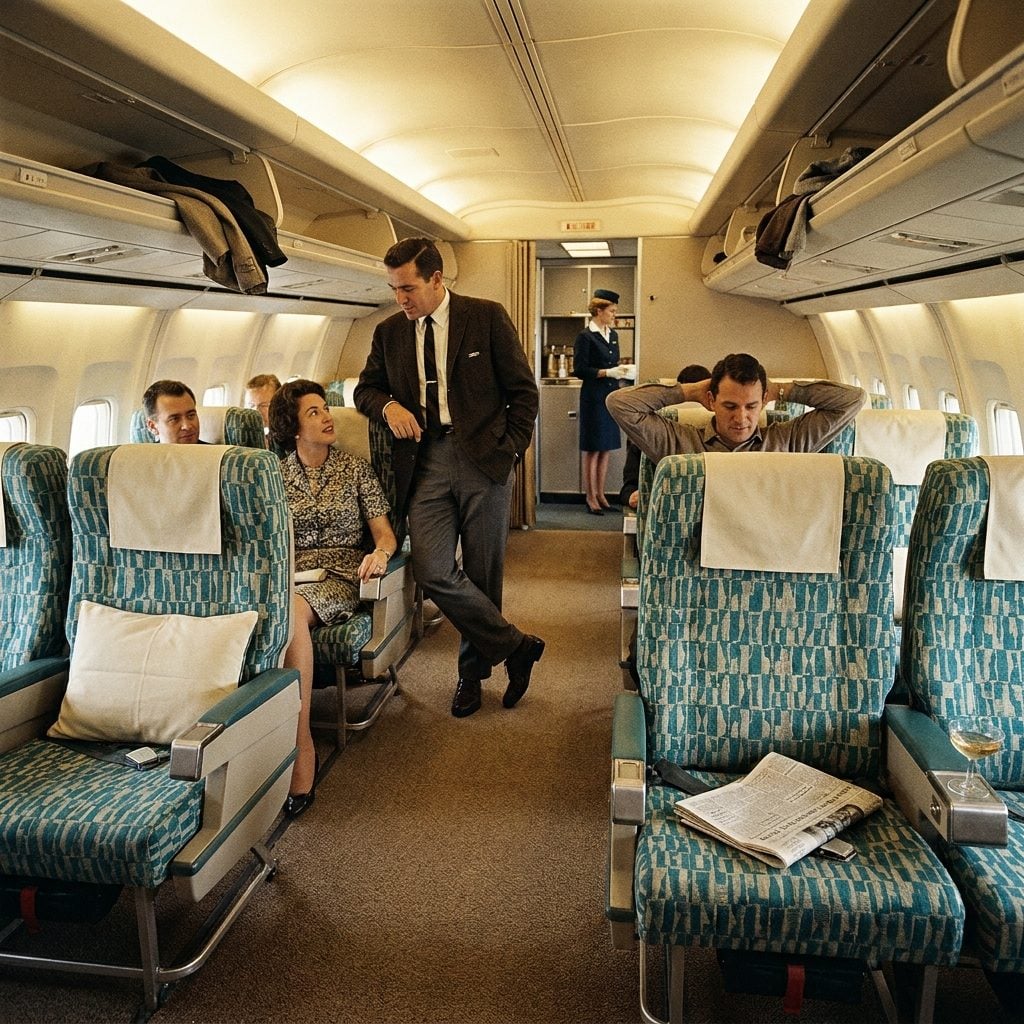
Seat pitch on 1960s jets, the distance between your seat and the one in front, was routinely 34 to 36 inches on coach. Today the industry average is closer to 30. That gap, six inches on paper, is the difference between a flight where you can cross your legs and one where you’re calculating how to open a laptop without elbowing a stranger.
People got up. They wandered. They talked to whoever they were sitting near because there was enough physical ease in the environment to make conversation feel natural instead of effortful. The cabin had a looseness to it that no amount of in-flight entertainment has replaced.
13. Your Whole Coat Fit in the Overhead Rack With Room to Spare
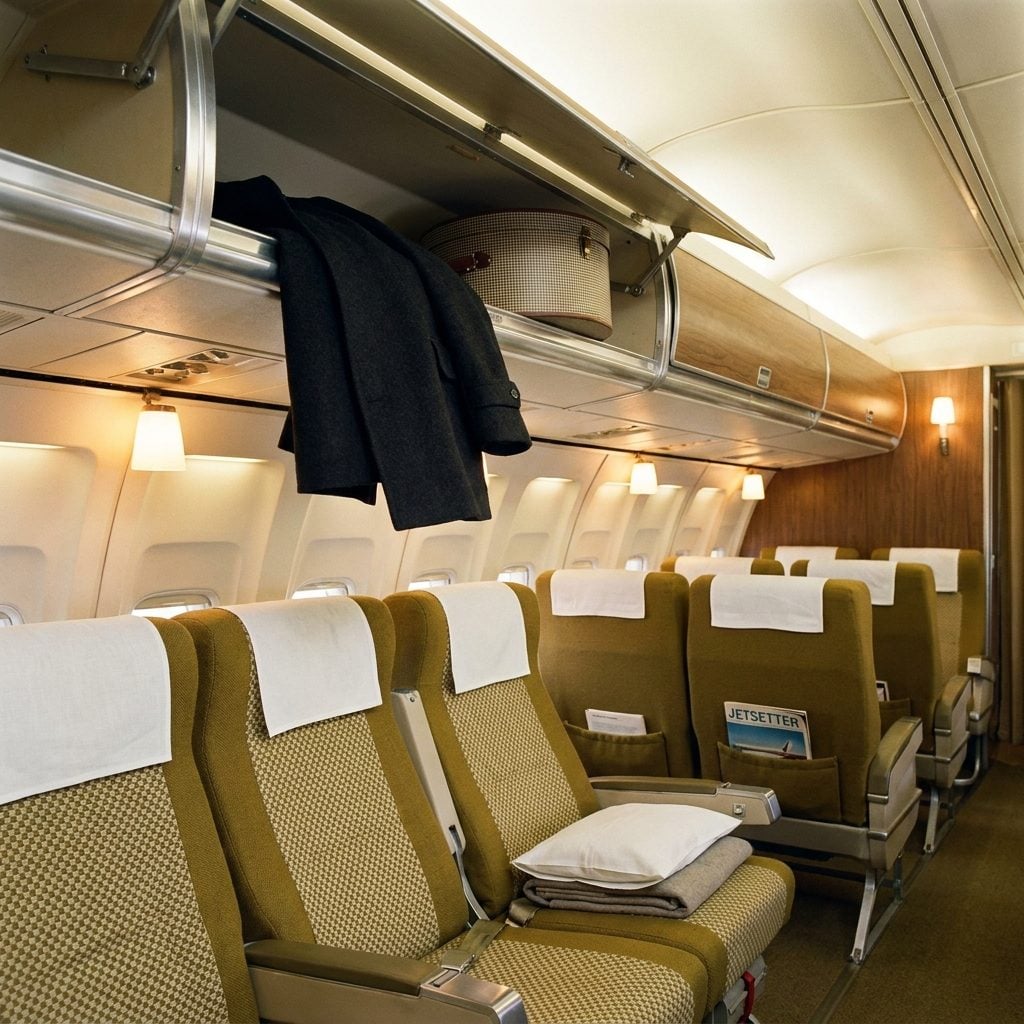
There was no bin war because there were no bins. Early commercial jets had open overhead racks, shallow shelves or coat hooks, essentially, and nobody was dragging a wheeled carry-on the size of a small refrigerator down the jetway. You brought what fit under the seat or in a modest travel bag, and you checked everything else.
This seems almost funny now, but the physics were different because the expectation was different. Overhead space was for coats, hats, and small personal items. The idea that passengers would routinely attempt to board with enough luggage for a week and squeeze it into a shared overhead compartment wouldn’t have made sense to anyone who flew in 1963.
12. Checked Bags Were Just Part of the Ticket, Not a Punishment Fee
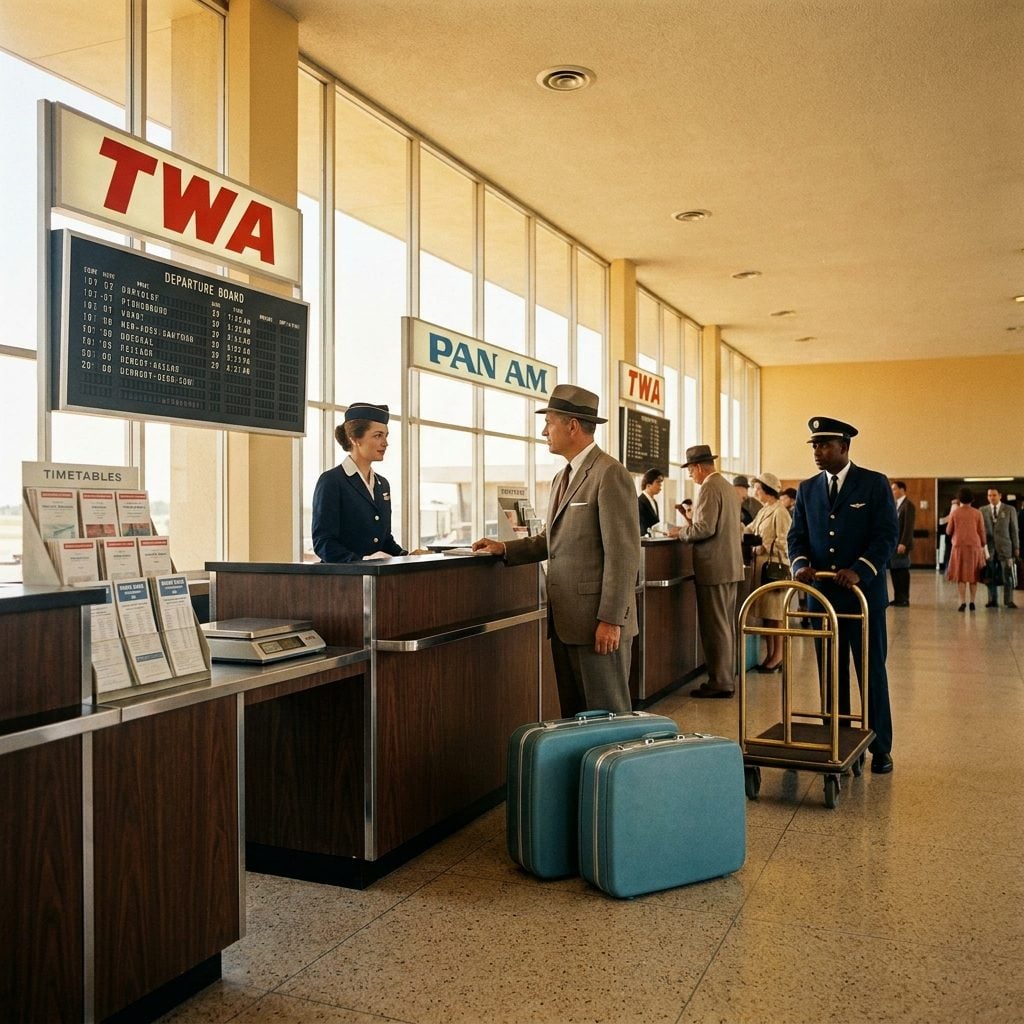
Checking two bags was just what you did. Nobody calculated whether it was cheaper to mail clothes ahead, or wore four layers onto the plane, or performed the overhead-bin shuffle of shame while 150 people watched. You handed your luggage to someone at the counter and walked to your gate carrying nothing but a handbag or a briefcase.
The fee appeared in the mid-2000s as fuel costs climbed and carriers looked for revenue lines passengers wouldn’t notice until it was too late. It worked, obviously. But it permanently changed how people pack, what they carry on, how long boarding takes, and how much low-grade stress accumulates before the plane even pushes back from the gate.
11. Everyone Checked Their Bags and the Overhead Bins Were Basically Empty
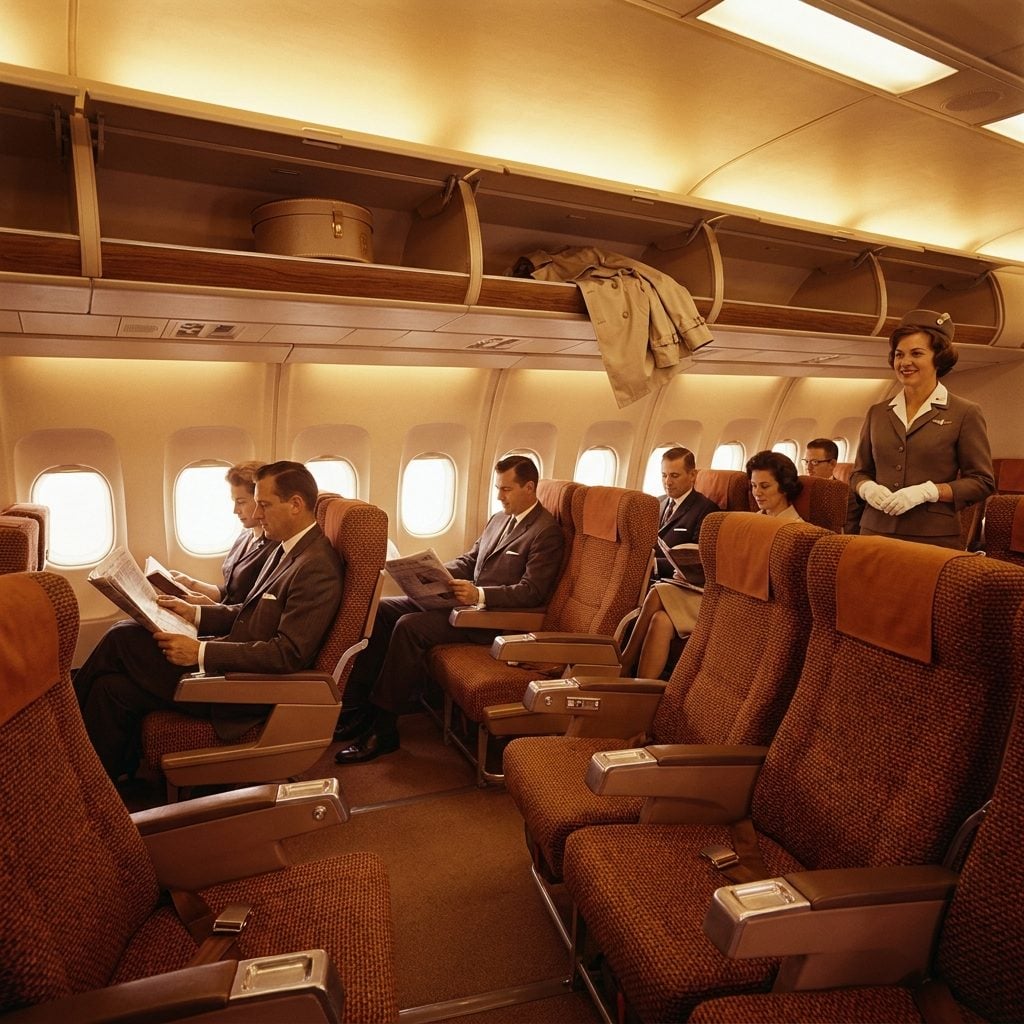
The overhead compartment in 1960s aircraft wasn’t a battlefield. It was basically decorative. A hat, maybe a coat, occasionally a small soft bag, that was the full inventory. Because everyone checked their luggage. Not because the airline made them, but because that was simply the understood arrangement. You had luggage, the airline had a hold, and that was the deal.
Rolling carry-ons didn’t exist yet, and hard-shell suitcases weren’t exactly candidates for overhead storage anyway. So passengers walked onto the plane with a handbag, a magazine, possibly a box of chocolates from the terminal gift shop, and they sat down. The aisle stayed clear. The boarding process took maybe fifteen minutes. The whole thing feels like a fever dream now.
10. The Boarding Pass Was a Stiff Little Card With Your Seat Number Typed on It
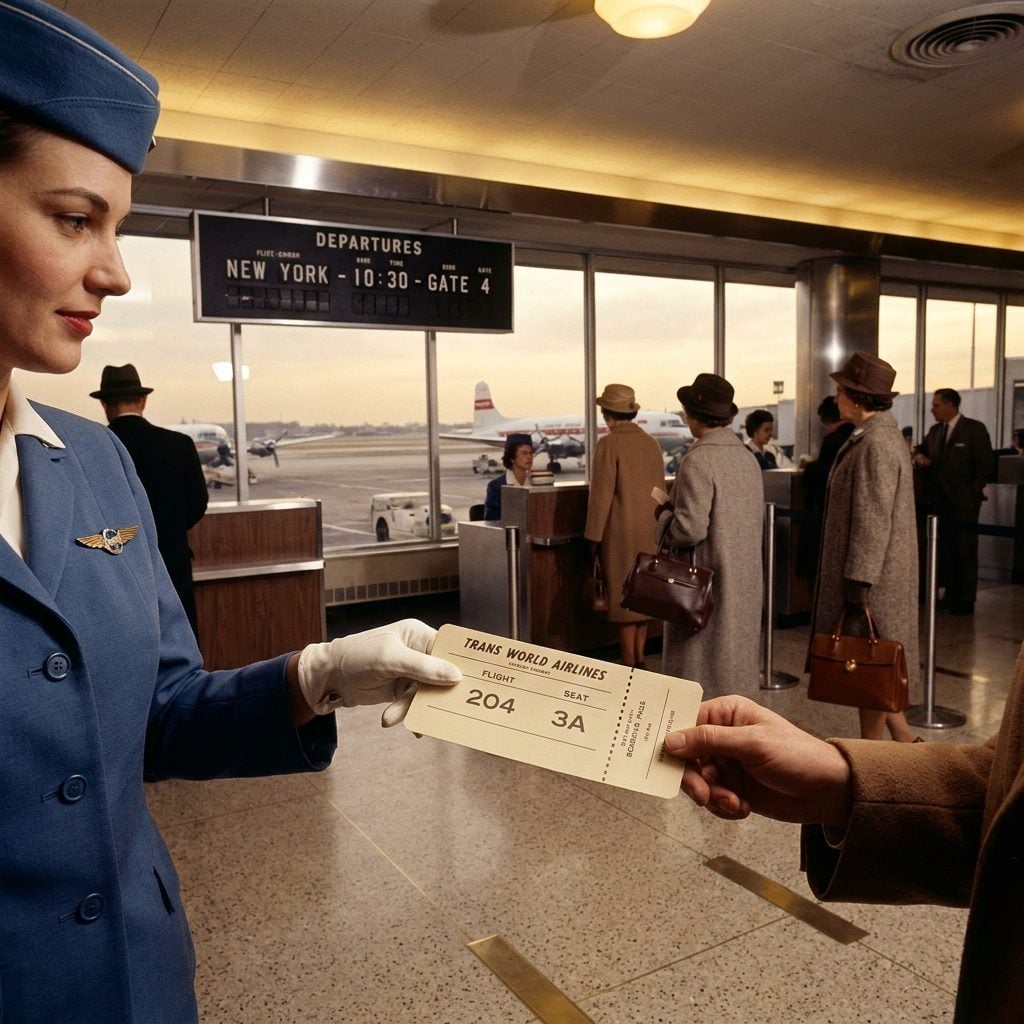
There was actual weight to it. The boarding pass in the 1960s was a proper printed document, thick card stock, typed characters, an airline logo that looked like it belonged on a cocktail napkin at a midcentury supper club. You tucked it into your breast pocket or your clutch and you felt, not unreasonably, like a person with somewhere important to be.
The gate agent tore the stub with a practiced snap. That small sound meant you were really going. No QR code, no phone screen rotated awkwardly under a scanner while the person behind you silently fumes. Just a piece of paper and a woman in a pillbox hat who looked like she had absolutely everything under control.
9. The Observation Deck Was the Airport’s Main Attraction (Even If You Weren’t Flying)
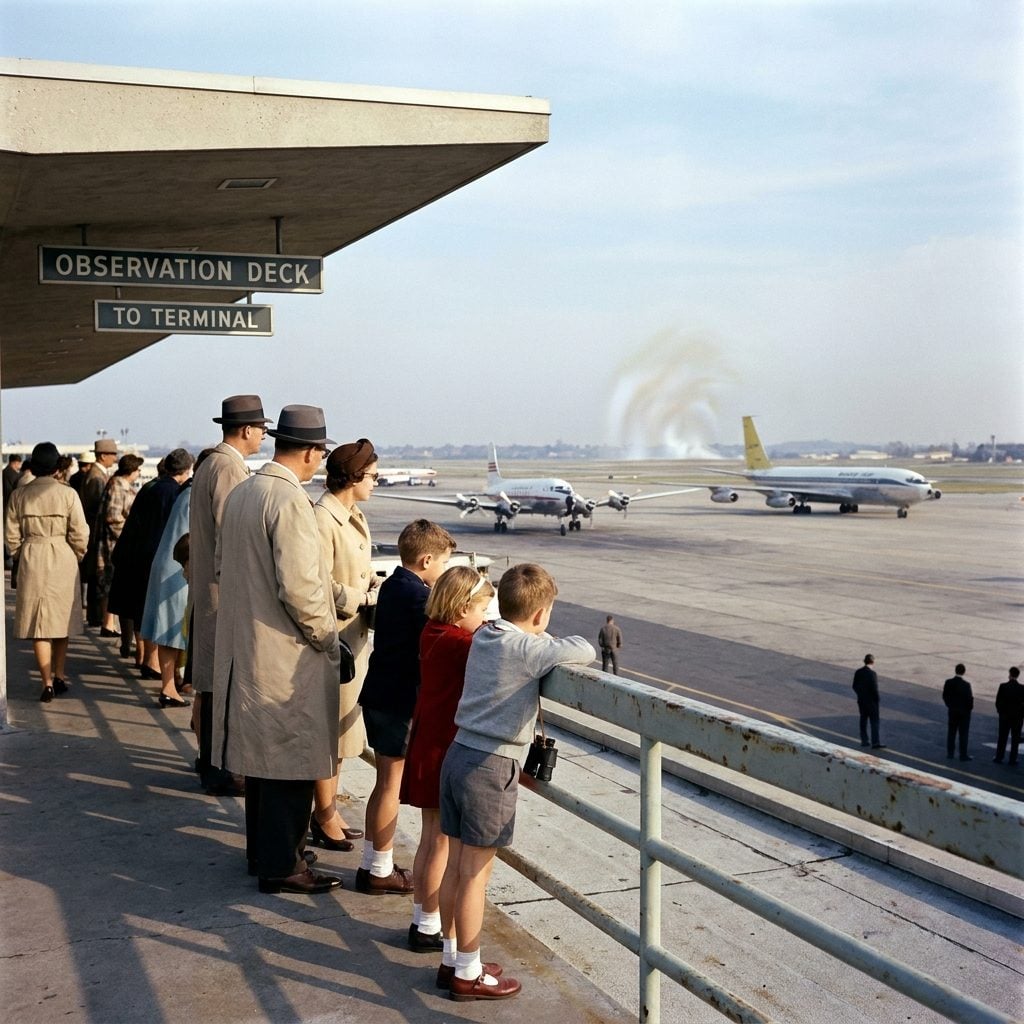
Families drove to the airport on Sunday afternoons with no intention of going anywhere. The observation deck was the point. You’d watch a DC-8 push back from the gate, feel the jet blast rattle the railing, and consider yourself thoroughly entertained. Kids pressed binoculars to their faces. Dads narrated airline liveries with the quiet authority of men who had memorized every tail fin in the fleet.
Almost every major American airport had one through the 1960s and into the 70s. LaGuardia, O’Hare, LAX, Midway, open to the public, sometimes with a snack bar. Security concerns killed them off gradually after the early 1970s, and now the closest most people get to watching a plane is a forty-dollar airport lounge window seat.
8. People Dressed for the Airport Like They Were Dressing for a Broadway Opening
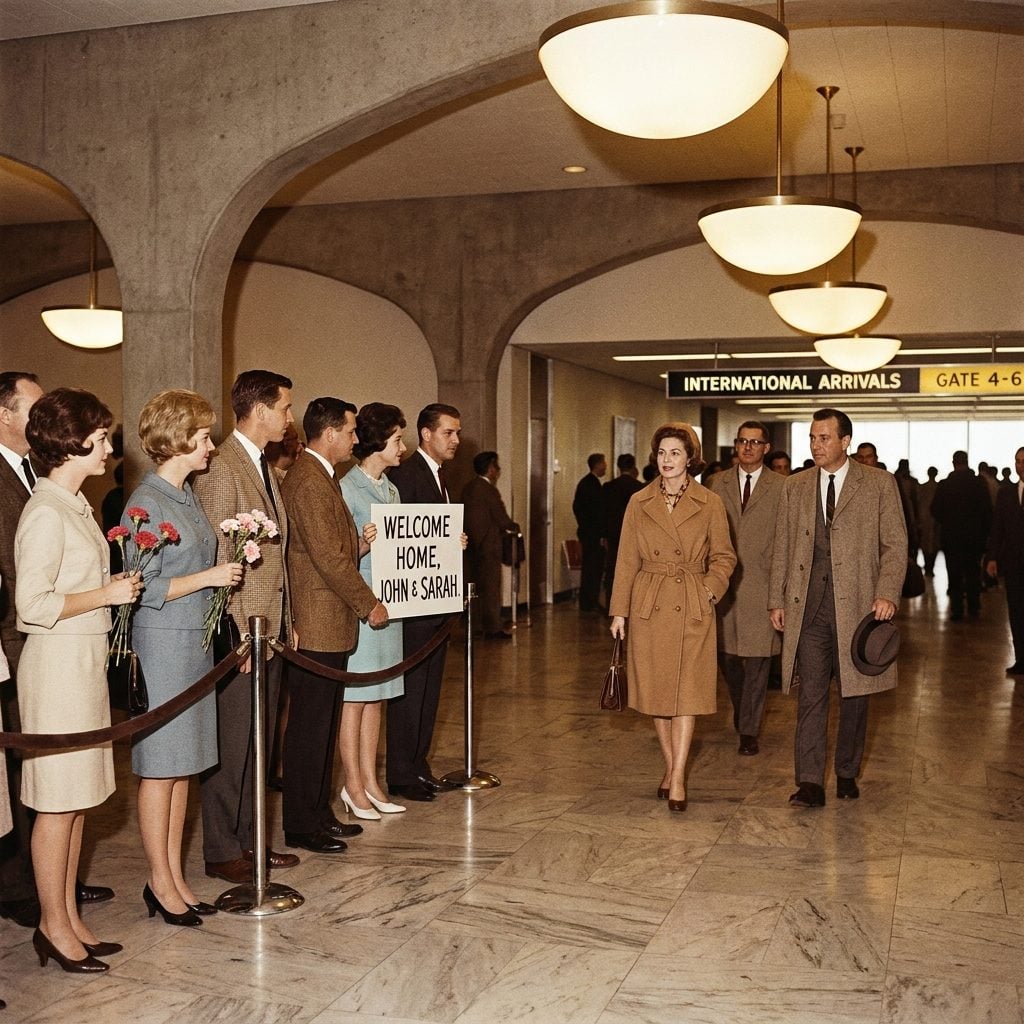
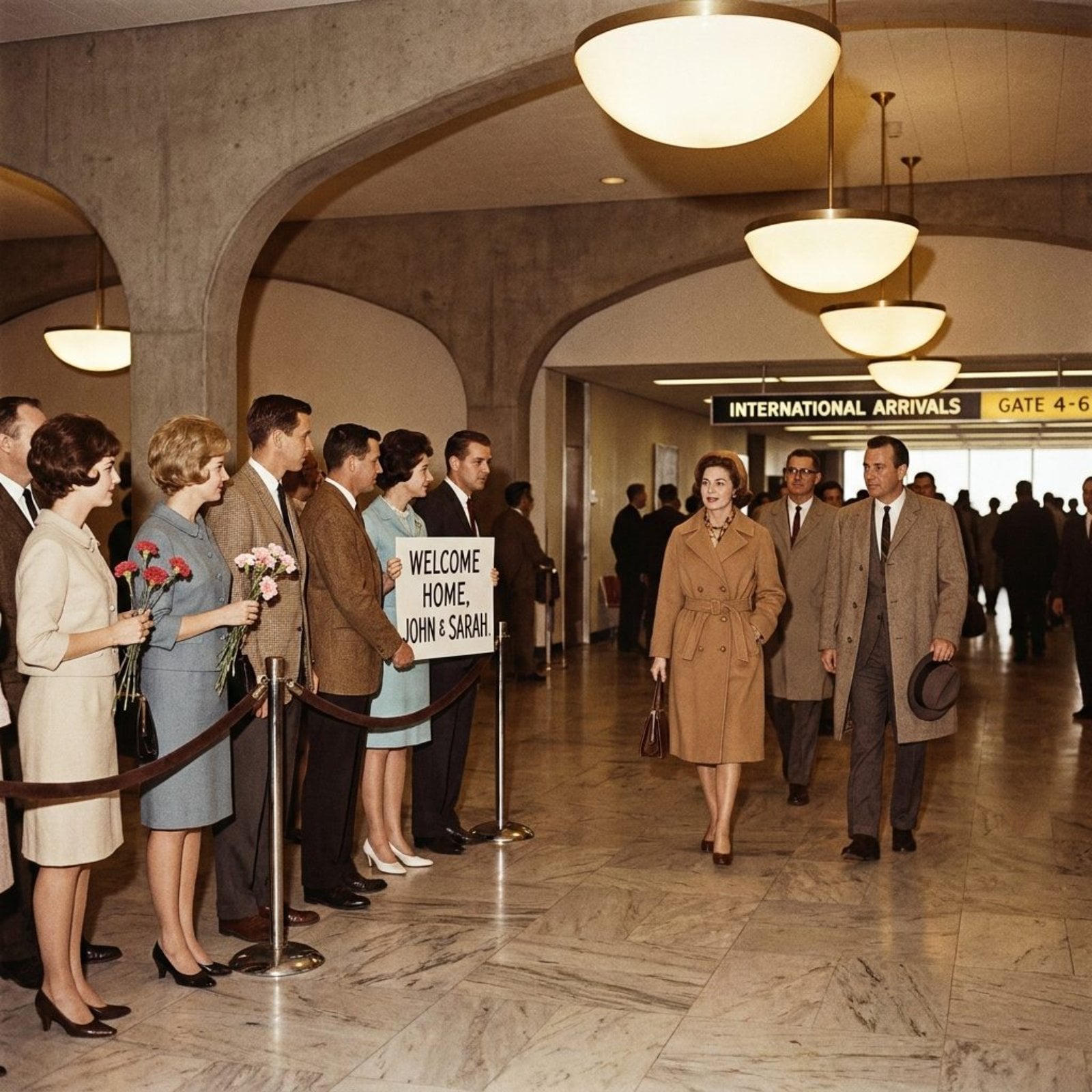
Flying somewhere in 1960 was not something that happened to you. It was something you did, deliberately, with full acknowledgment that it was a significant event. Which meant you dressed for it. Men wore suits. Women wore heels and gloves. Children were put in their good clothes and reminded to behave. And this applied not just to passengers, the people waiting at arrivals dressed up too.
Going to meet someone at the airport was a social occasion with its own etiquette. You brought flowers sometimes. You were on time. You looked like you’d made an effort, because the person stepping off that plane had crossed a significant distance and deserved a proper reception. The idea that you might collect someone from the airport in sweatpants would have been genuinely incomprehensible.
7. You Walked Across the Tarmac to Board, and Nobody Thought Twice About It
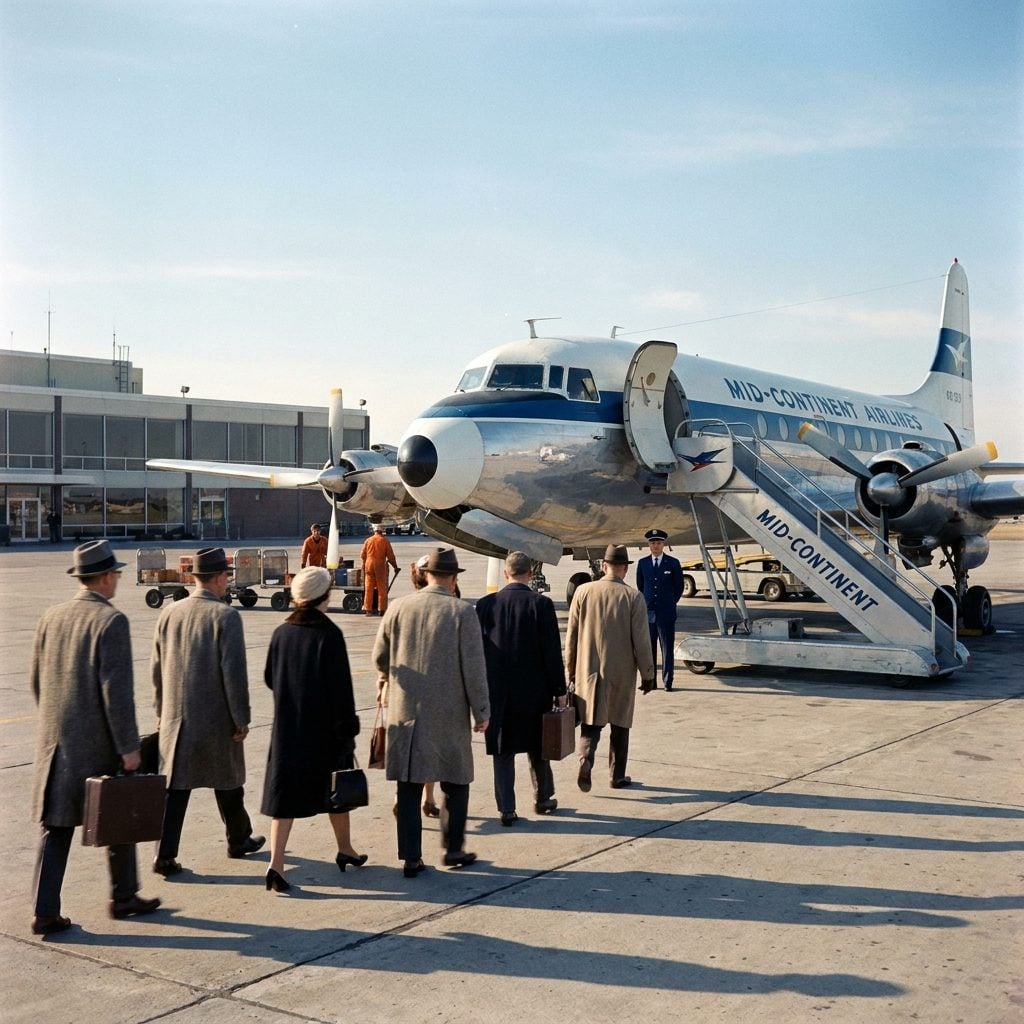
Jet bridges were a luxury, not a given. At most American airports through the 1960s, boarding meant walking out a door and crossing actual tarmac to the plane, up a rolling staircase, into a cabin door that felt like a portal into something extraordinary. The ground crew was right there. The engines were right there. The plane was enormous and loud and real in a way that a jet bridge completely insulates you from.
There’s something about standing on open concrete with a 707 parked twenty feet away that made the whole enterprise feel visceral rather than bureaucratic. The wind, the fuel smell, the sheer physical scale of the aircraft, none of that gets communicated through a carpeted tunnel. Passengers who grew up boarding this way often say modern jet bridges made flying feel smaller, somehow, not larger.
6. That First Shriek of Jet Engines on the Ground Was Part of the Experience
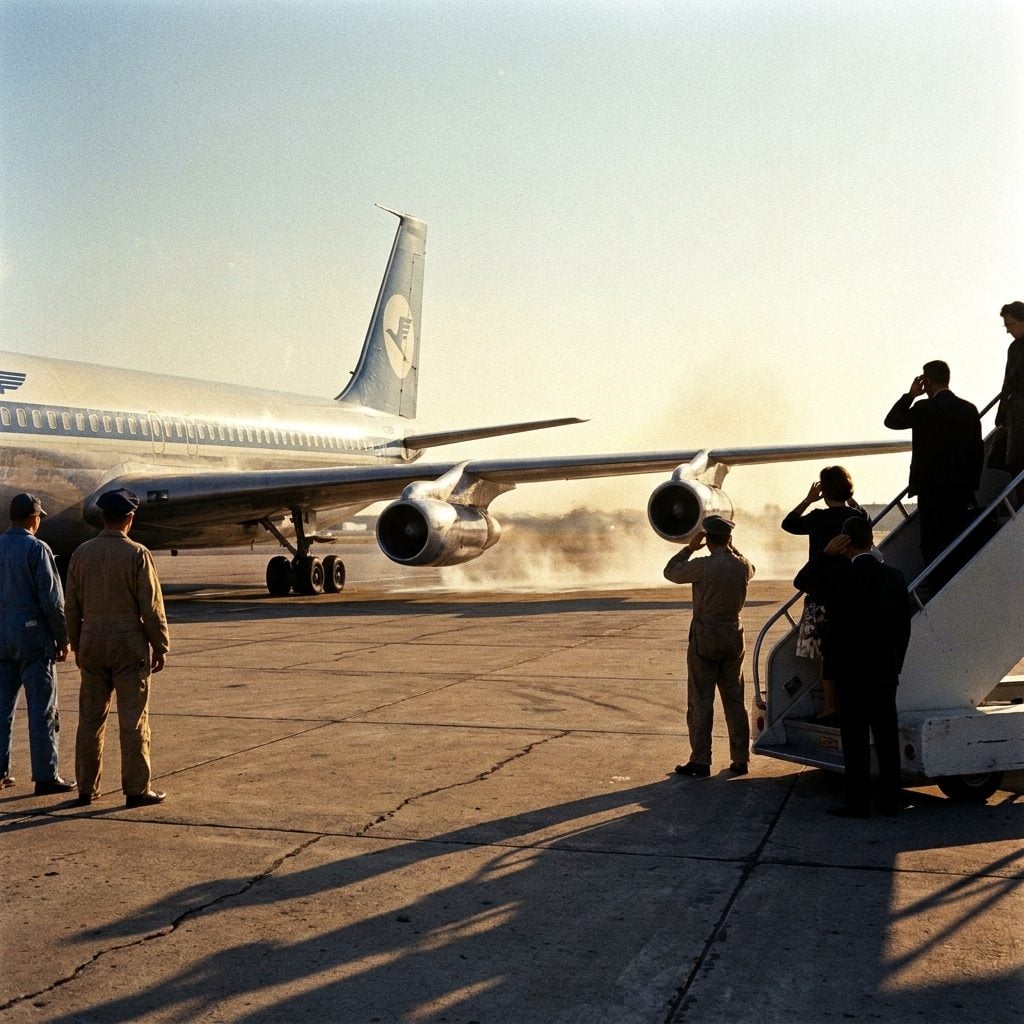
The first time a jet engine lights up thirty feet from where you’re standing, it’s not subtle. It starts as a thin, climbing whine and builds into something that sits in your chest rather than your ears. In the 1960s, passengers boarding via tarmac got the full version of this experience, unmediated, un-insulated, and completely unforgettable.
There was a specific quality to that moment that early jet travelers talk about decades later. Not fear exactly, but a kind of physical reckoning with the thing you’d agreed to board. The sheer power of it. The smell of it. The way conversation became impossible and everyone went briefly silent, looking at the engines with the same expression. It was the machine telling you clearly what it was. That honesty has largely been engineered out of the modern boarding experience, and something real went with it.
5. Turbulence Hit Differently When the Whole Idea of a Jet Was Still Basically New
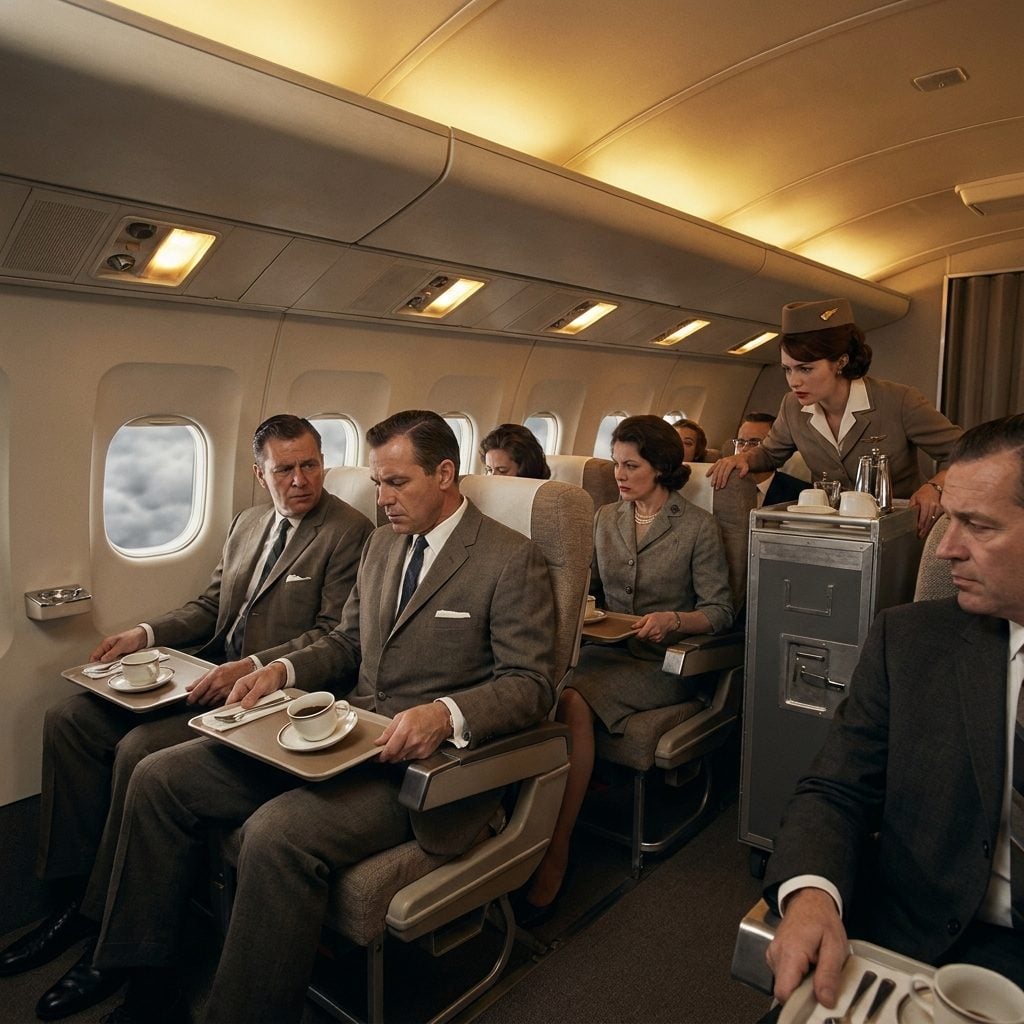
Statistically, commercial jet travel was becoming safer through the 1960s. Emotionally, that was not yet the broadly held consensus.
Commercial jet service had only launched in the United States in 1958. For passengers flying in the early-to-mid 1960s, these aircraft were genuinely new technology, and the instinct to trust them completely hadn’t fully calcified yet. So when the plane hit rough air and the coffee slid off the tray table, the nervous arithmetic going through the cabin was different from today’s reflexive irritation. People gripped armrests and looked at the flight attendant’s face for information. They read her expression the way sailors read the horizon. If she stayed calm, you stayed calm. If she looked worried for even half a second, the whole cabin felt it.
4. The Air Sickness Bag Was a Practical Tool, Not a Punchline
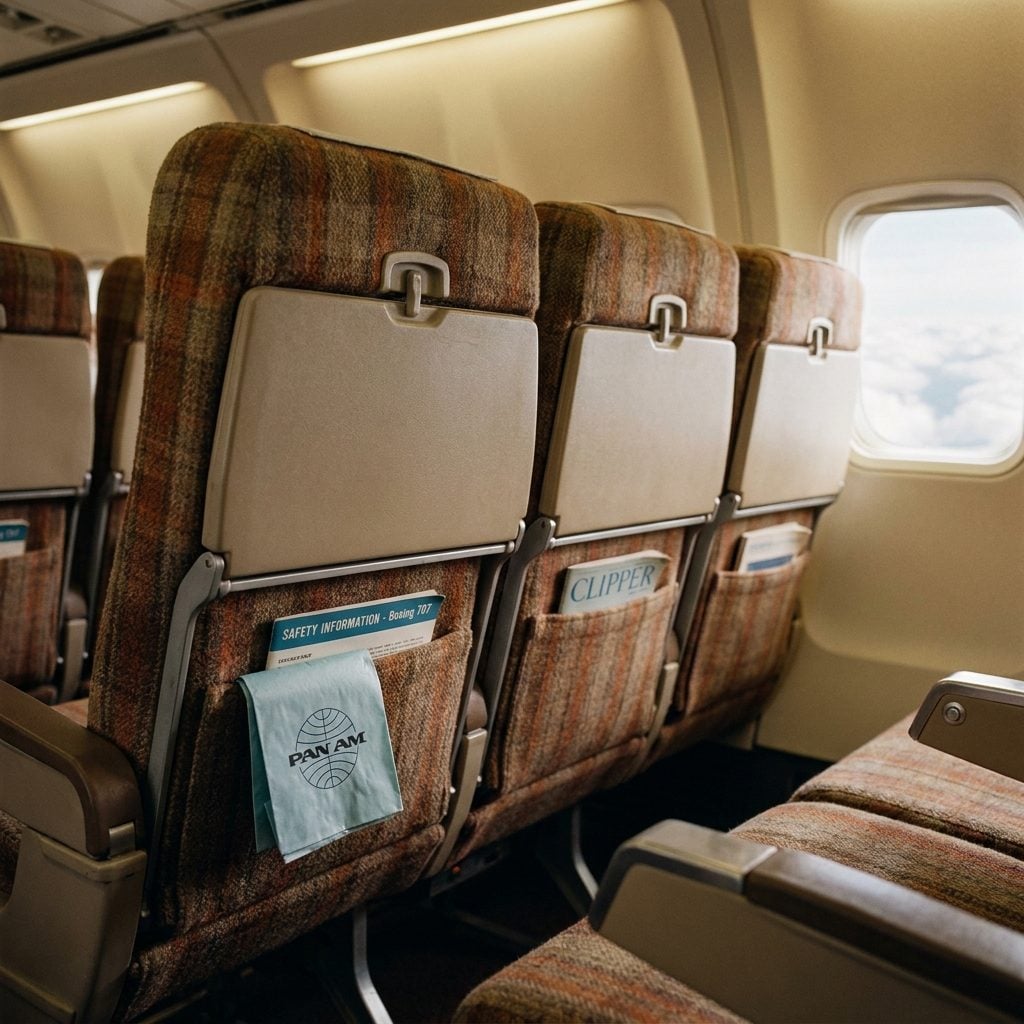
Nobody joked about the sick bag in 1960. It was infrastructure.
Early commercial aircraft flew lower and less smoothly than modern jets, often threading through weather rather than over it because the altitude ceiling was lower and routing was less sophisticated. Pressurization was functional but the rides were rougher. Motion sickness was common enough that the bag in the seat pocket carried the same quiet necessity as the seatbelt. Flight attendants were trained to assist passengers using them without drama and without the visible discomfort that a modern crew member might honestly struggle to conceal.
The bags themselves were printed with the airline’s name, a branding choice that, in retrospect, took a certain kind of confidence. Pan Am. TWA. Eastern. The logo right there on the side, completely unbothered by the association.
3. The Galley Was a Miracle of Human Effort (And Zero Robots)
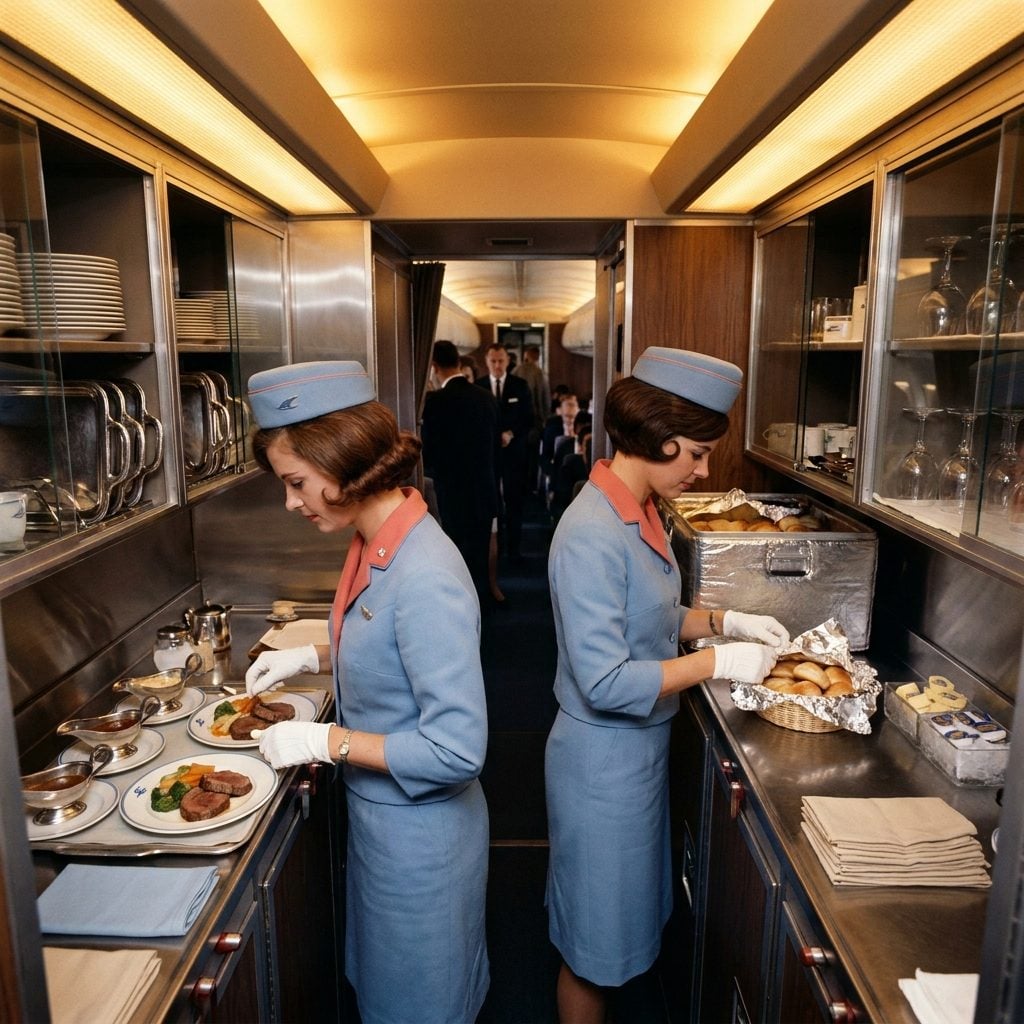
There was no conveyor belt, no automated oven sequencer, no pre-plated shrink-wrapped tray sliding out of a trolley. Flight attendants on 1960s flights plated actual meals, beef tenderloin, shrimp cocktail, warm rolls, by hand, in a galley roughly the size of a coat closet, at 30,000 feet, with the aircraft pitching through cloud banks over the Rockies.
China. Real silverware. Cloth napkins folded into shapes. Sauce served from a boat, not a foil pouch. The logistics of pulling this off, timing multiple courses for 80 passengers across two cabin classes while staying composed in a fitted uniform and heels, required a kind of physical intelligence that no amount of airline training fully explains. It’s worth pausing on: they were cooking and plating, essentially, in turbulence, for a full dining room, with no room to move.
2. The Ads Promised You’d Be Irresistible at 35,000 Feet, And Nobody Complained
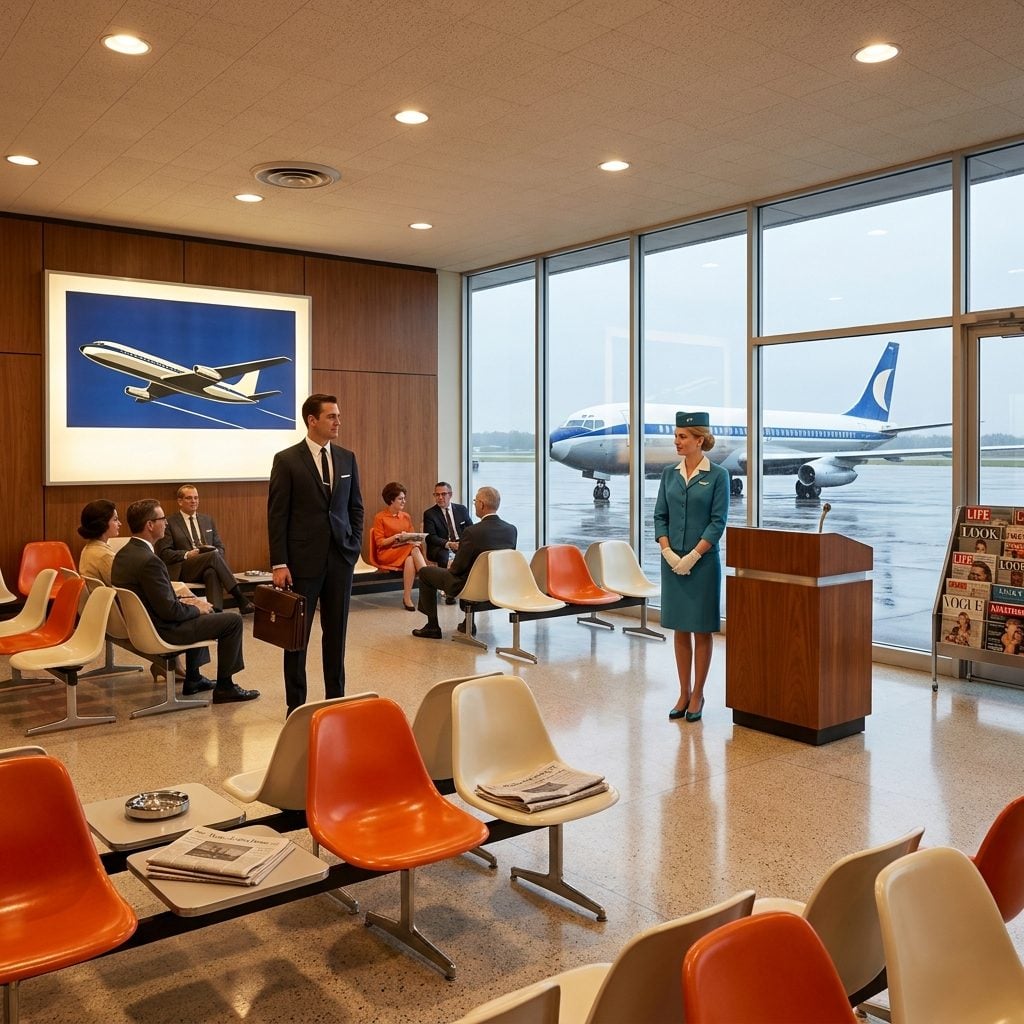
Pan Am ran ads that looked like perfume campaigns. Braniff painted its planes in Calder colors and dressed its crew in Emilio Pucci. Continental promised “the proud bird with the golden tail” with imagery so charged it barely bothered pretending to sell transportation. The product being sold, half the time, was the idea that flying made you someone.
Airlines openly competed on glamour, on the desirability of their staff, on the suggestion that the right flight could change your social orbit. Some of it was brazen by any standard. But the underlying message, that air travel was an event, a statement, an occasion that required you to show up as your best self, gave the whole industry a cultural weight it has never recovered since the fare wars of the 1980s stripped it down to a bus with wings.
1. Flying First Class in 1965 Felt Like Someone Had Accidentally Let You Into a Private Club
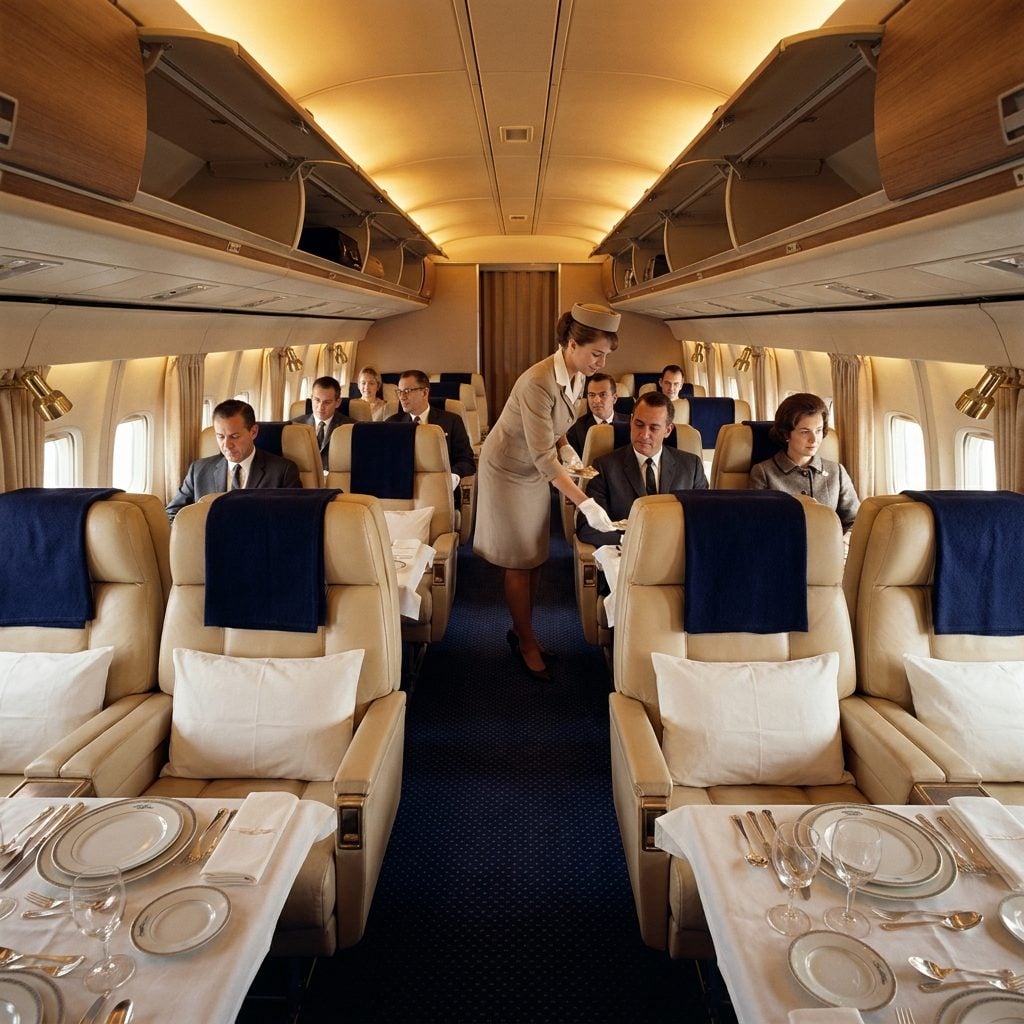
The seats were wide enough that two people could sit without touching elbows. The meal arrived on a tray that had been assembled, not assembled-from-a-pouch. The flight attendant knew your name because she had checked the manifest before boarding, there were few enough of you that this was possible.
Nobody was watching a Marvel film on a seatback screen. People read, talked, ate slowly, slept under actual wool blankets. First class in the 1960s wasn’t a premium product tier bolted onto a mass-market experience. It was a genuinely separate experience, priced so high that the people in those seats were, almost by definition, a self-selected group who treated the whole thing with a certain gravity.
The quiet had a different quality up there. The kind you can’t buy now at any price point, because it came from the era itself, not from noise-canceling headphones.
🔥 Would you like to save this?
Please note that some of the imagery in this article were created with the aid of AI image generators.