
🔥 Would you like to save this?
The car smelled like vinyl and warm orange Fanta, and somebody’s bare feet were on the back of the front seat. Every few hours, a hand-painted sign would appear on the shoulder: SEE IT! 2 MILES AHEAD! And Dad would slow down, because in the 1960s, the highway itself was half the vacation. Nobody needed a reason better than “World’s Largest” or “Live Gators” to pull over, pay a dollar, and stand in the sun for twenty minutes looking at something genuinely strange.
32. The World’s Largest Ball of Twine and Every Other “World’s Largest” Detour Dad Couldn’t Resist
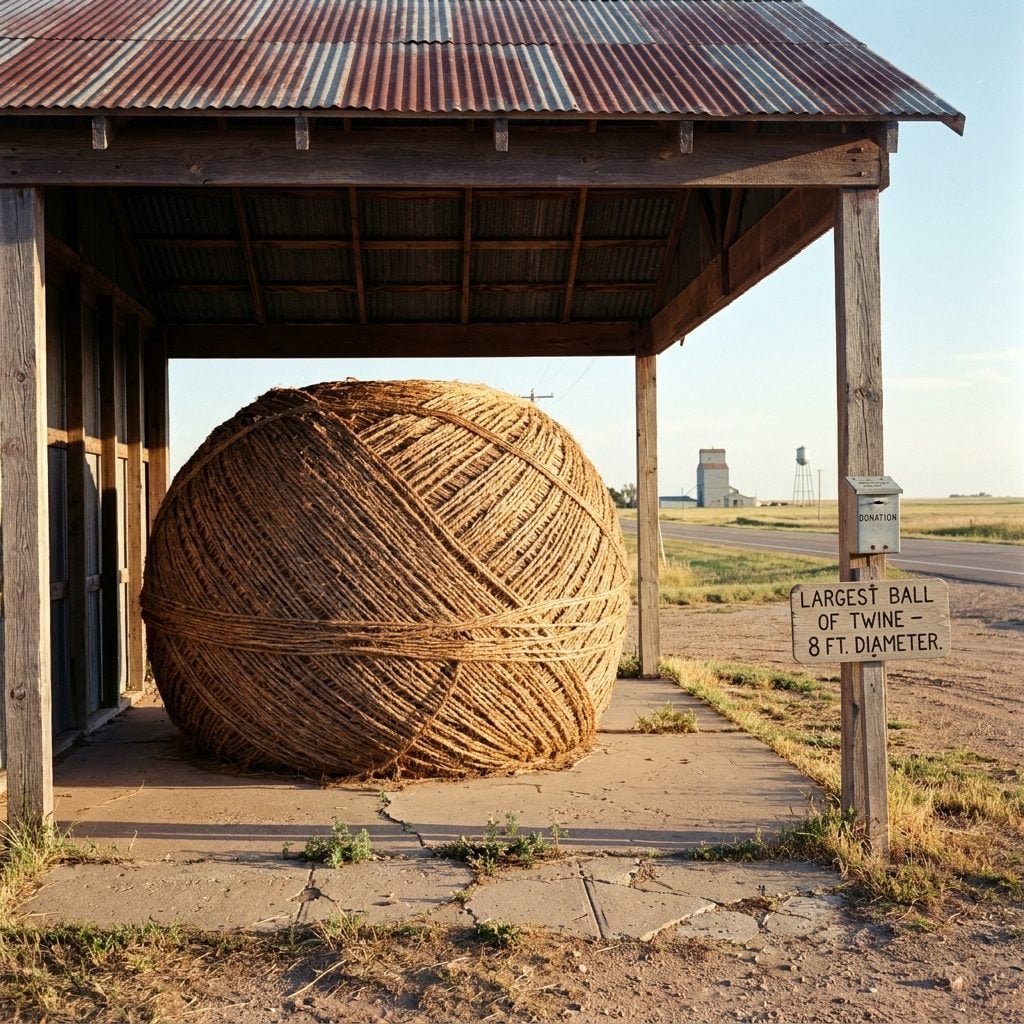
Somewhere around mile 400, when the backseat had gone quiet and the AM radio was pulling in nothing but static, a sign would materialize: WORLD’S LARGEST BALL OF TWINE, NEXT EXIT. And the car would slow. It didn’t matter that nobody in the family had strong feelings about twine. The promise of “World’s Largest” anything was a gravitational force in the 1960s.
You’d stand there in the sun, staring at eight feet of wound sisal, reading a hand-lettered sign about how many years it took one man to wrap it. There was no gift shop to speak of, maybe a card table with postcards. The whole visit lasted twelve minutes. But it counted. You’d been somewhere, seen something, and now you could tell the neighbors.
The genius of these stops was their pure commitment to a single pointless superlative. World’s Largest Shoe. World’s Largest Prairie Dog. World’s Largest Anything. The bar for “attraction” was low and the satisfaction was real.
31. Roadside Dinosaur Statues That Towered Over the Station Wagon
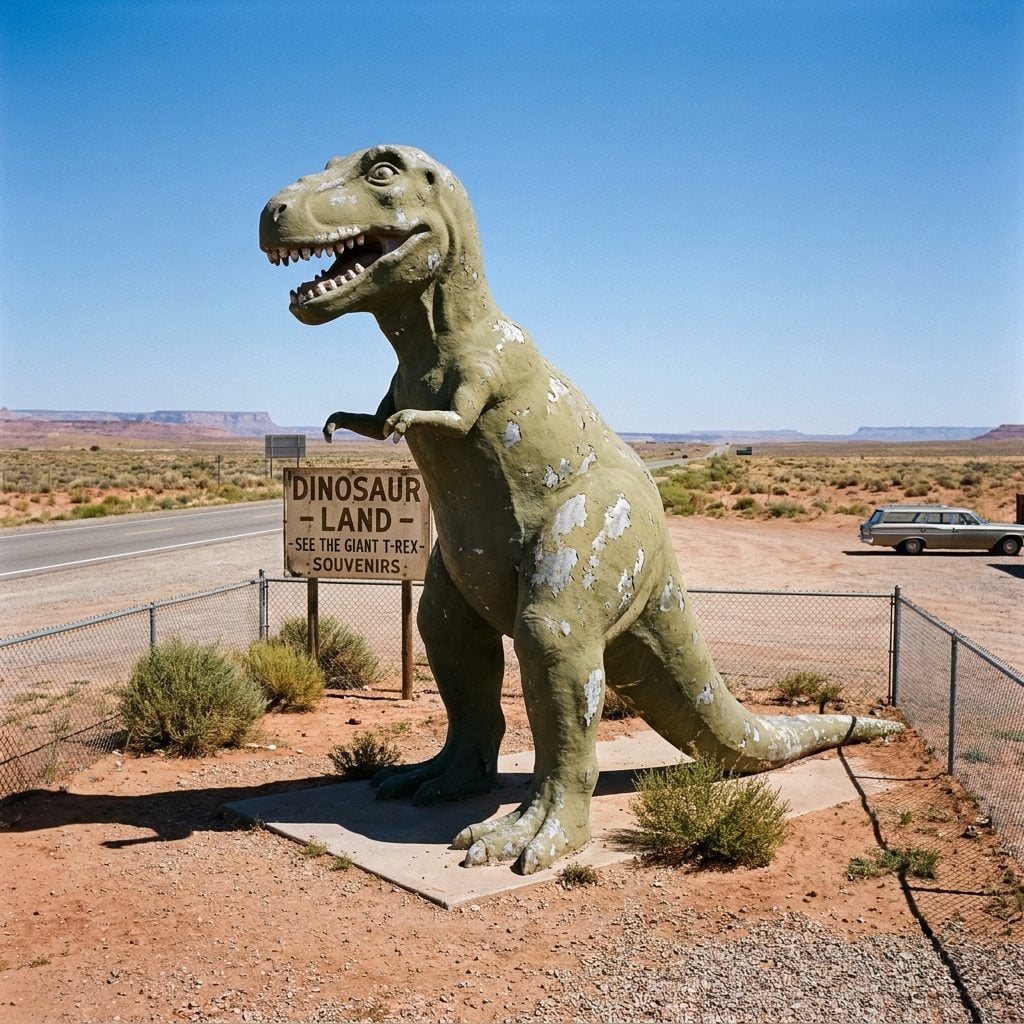
They were always visible from a quarter mile away. A green brontosaurus head rising above the mesquite, or a concrete T-Rex with its mouth frozen open beside a Shell station. These weren’t museum replicas. They were folk art in the truest sense: some local welder or cement worker who decided the highway needed a dinosaur, and then spent a year building one.
The proportions were never right. Tails dragged on the ground. Heads were too small or too large. The paint was always peeling somewhere. None of that mattered to the seven-year-old in the backseat who could see a dinosaur from the car window.
Most of these statues were free to look at. You’d pull over, take a Kodak Instamatic photo of the kids standing between the thing’s concrete legs, and be back on the road in ten minutes. The whole transaction was beautifully simple.
30. Giant Fiberglass Paul Bunyan Figures Standing Guard at Every Other Rest Stop
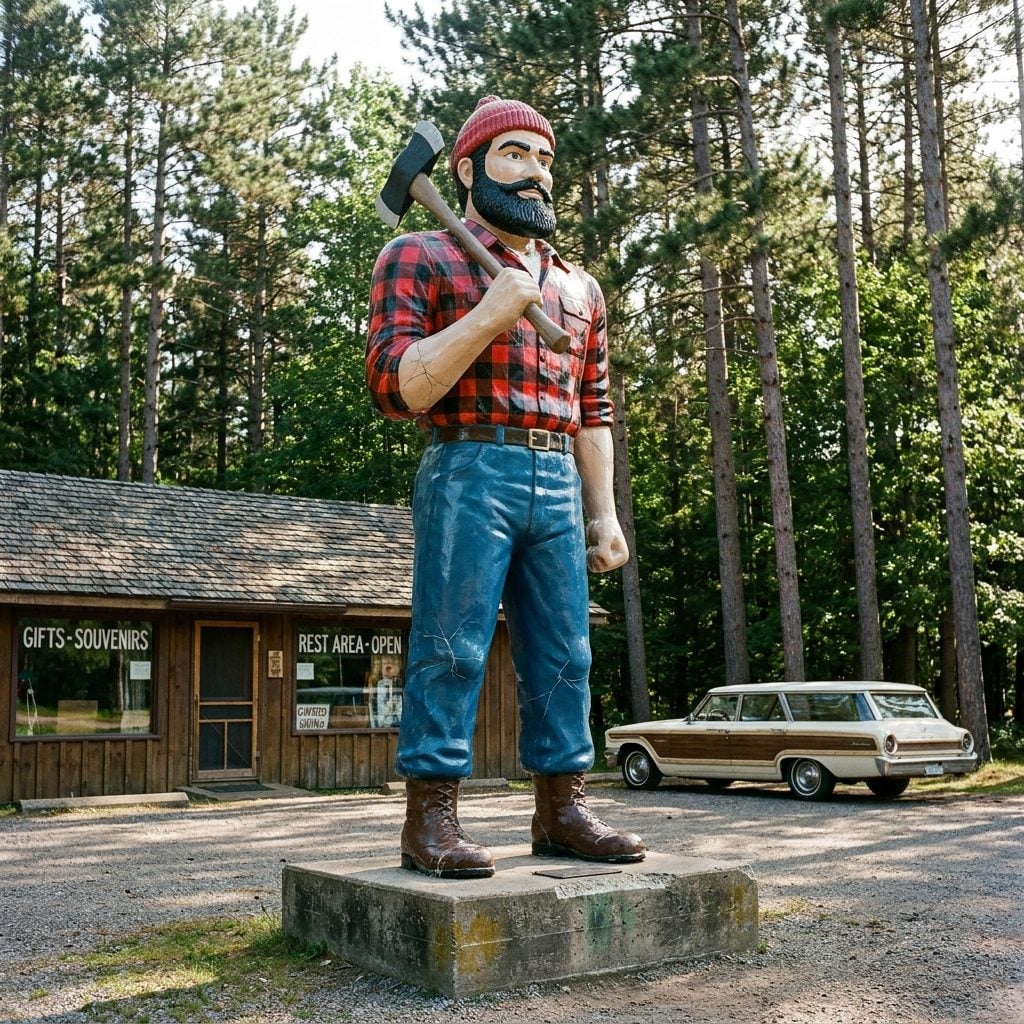
Eighteen feet of fiberglass and a painted-on smile that followed you across the parking lot. Paul Bunyan statues dotted the upper Midwest and Pacific Northwest like sentries, each one slightly different, each one claiming to be the original. Some held an axe. Some held a hot dog. One in Bemidji, Minnesota, had a blue ox named Babe beside him that kids could sit on for photos.
The fiberglass had that particular sheen, smooth and slightly warm to the touch on a July afternoon. The gift shops at their feet sold the same inventory everywhere: birch bark canoes the size of your hand, rubber tomahawks, penny candy, and postcards you’d address to your grandmother on a wobbly counter.
29. Mystery Spots Where Water Ran Uphill and You Couldn’t Stand Straight
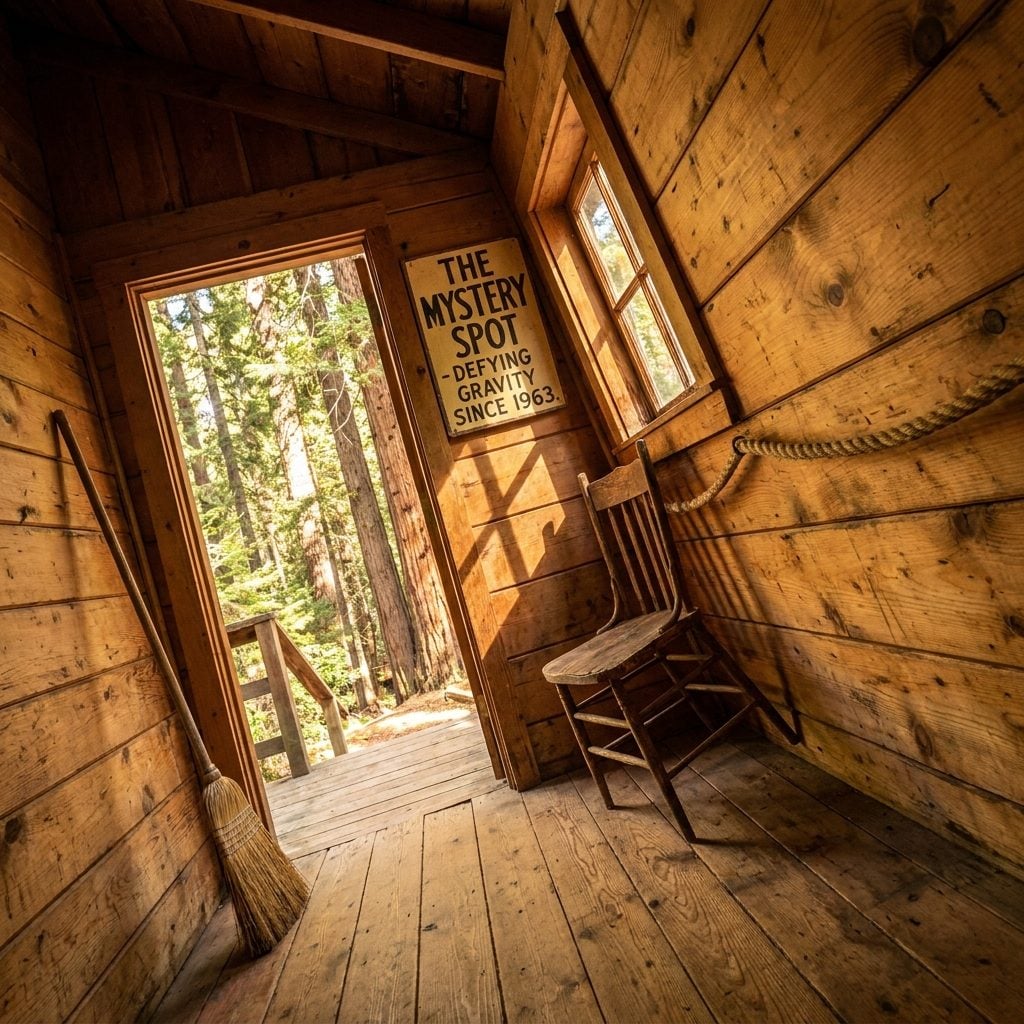
A broom standing on its bristles. Water rolling uphill in a wooden trough. You, leaning at a thirty-degree angle without falling over. The guide swore it was a genuine gravitational anomaly, something about magnetic forces in the hillside, and you were eleven years old, so you believed every word of it.
Mystery Spots thrived on the beautiful confidence of their presentations. The tilted cabin was always built on a slope, of course, and every “impossible” trick relied on the same optical illusions. But the guides delivered their lines with the straight-faced authority of college professors, and the experience worked. Your inner ear got confused. Your eyes told you something was wrong. For three dollars a family, you got fifteen minutes of genuine physical disorientation and a story to tell at school.
Santa Cruz had one. Oregon had one. The Ozarks had three. They all claimed to be the real one.
28. Drive-Through Trees That Required Folding In the Side Mirrors First
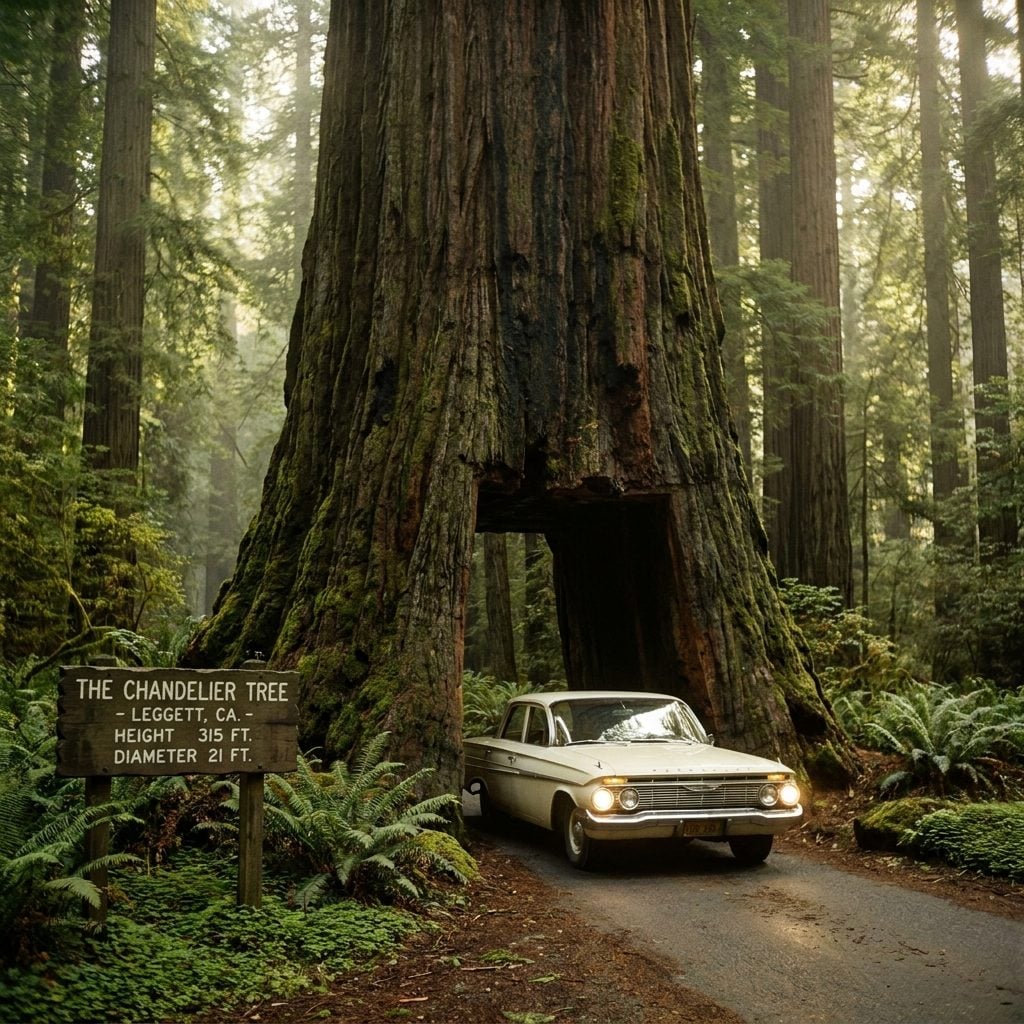
Dad folded in both side mirrors. Mom held her breath. The kids pressed their faces against the rear window to watch the bark inches from the fender. And then you were through, and it was over, and the whole thing lasted maybe six seconds.
Northern California’s drive-through redwoods were among the most perfectly 1960s attractions imaginable: a natural wonder that someone had made accessible by cutting a hole in it. The Chandelier Tree, the Shrine Tree, the Tour-Thru Tree. Each one charged a dollar or two, and each one delivered exactly the same experience. You drove through a tree. You backed up. You drove through it again so Mom could get the photo.
27. Trading Posts Selling Polished Rocks, Moccasins, and Rubber Tomahawks
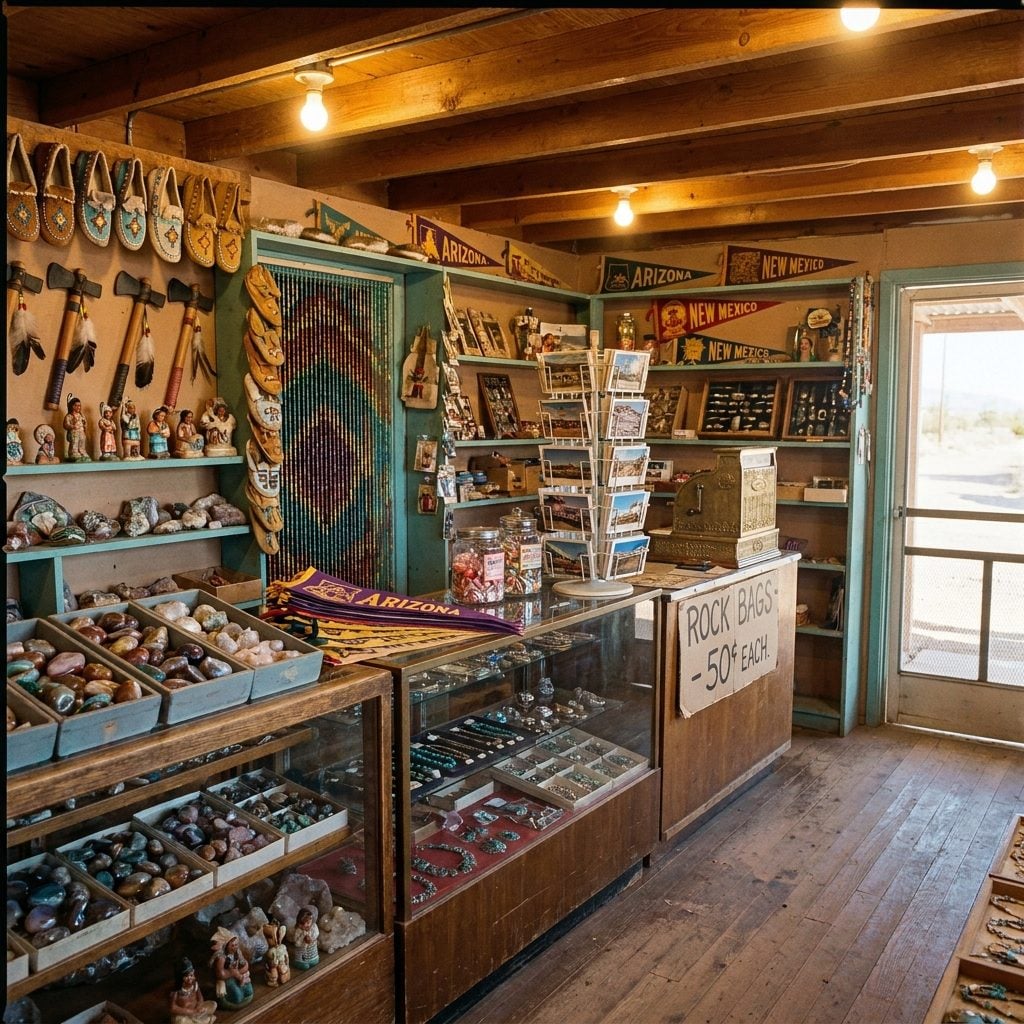
The screen door slapped shut behind you and you were in. Incense, or something that smelled like incense, or maybe just old wood and dust. Bins of polished agate and quartz lined every surface. A hand-lettered sign: FILL A BAG FOR $1. The moccasins hung from wooden pegs on the wall, real leather but sized for tourists, stiff and pale and nothing like the broken-in ones in the display case under the counter.
Every trading post between Albuquerque and Flagstaff ran the same inventory. Rubber tomahawks. Turquoise rings in a spinning glass case. Arrowheads that may or may not have been authentic. Felt pennants. Jackalope postcards. A jar of penny candy by the register that the owner would let you pick from if your parents bought something.
You always left with a small paper bag of rocks. Always. The rocks were non-negotiable. They’d rattle around the floorboard of the car for the rest of the trip and end up in a shoebox in your closet, where they’d stay for the next forty years.
26. Frontier Village Tourist Traps With Saloons, Stagecoaches, and Fake Gunfights
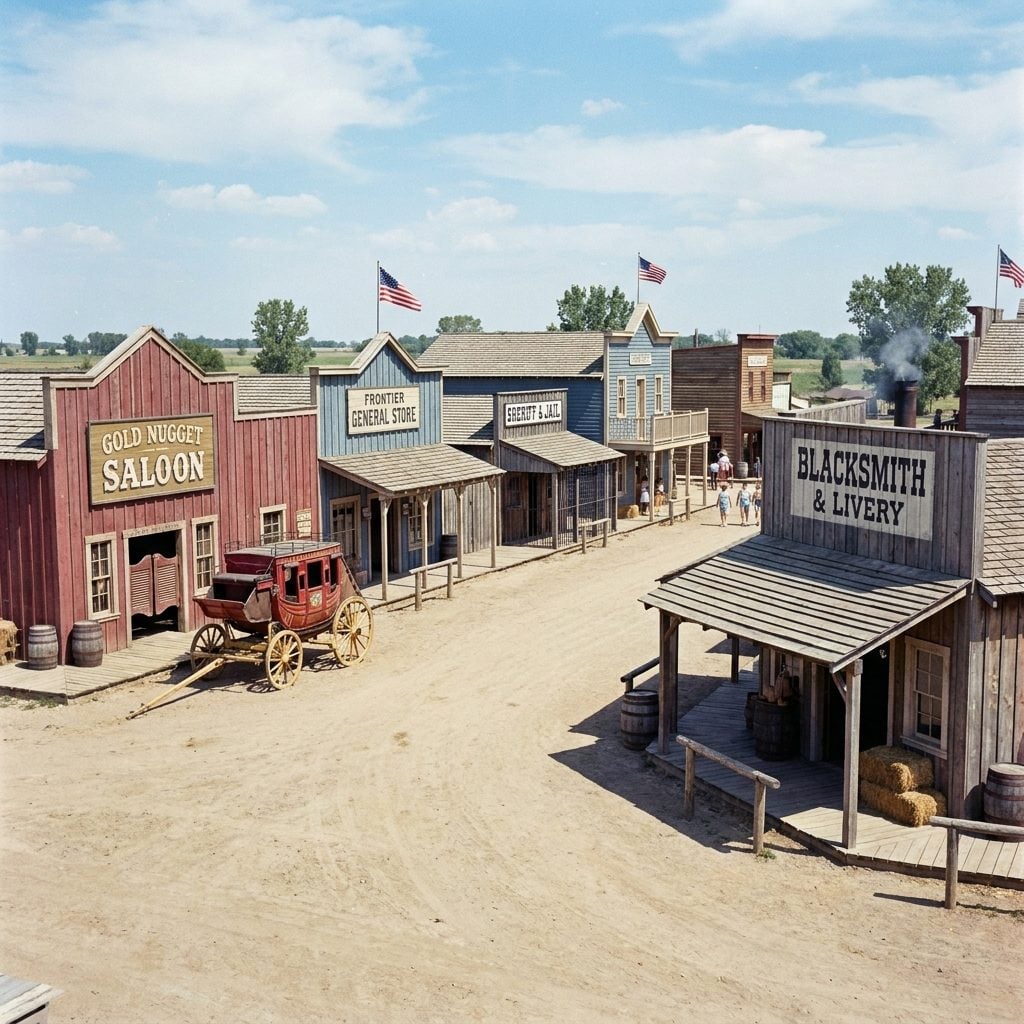
At noon sharp, two men in cowboy hats would square off in the middle of the dirt street, and one of them would fall down dead. The crowd clapped. The dead man stood up, dusted off his jeans, and walked back into the saloon to get ready for the two o’clock show.
Frontier Villages were everywhere in the 1960s. They cost maybe two dollars a head and offered a stagecoach ride, a pan of sand with planted gold flakes in it, and a general store selling rock candy and cap guns. The buildings were plywood behind the false fronts, and the jail cell was there specifically so Dad could take your photo behind the bars.
I’ll say this for them: the gunfight actors committed to the bit. Full falls into the dust, clutching the chest, the whole performance. Those guys earned their pay.
25. Roadside Ghost Towns Built Specifically for Tourists Who Wanted to Feel Spooked
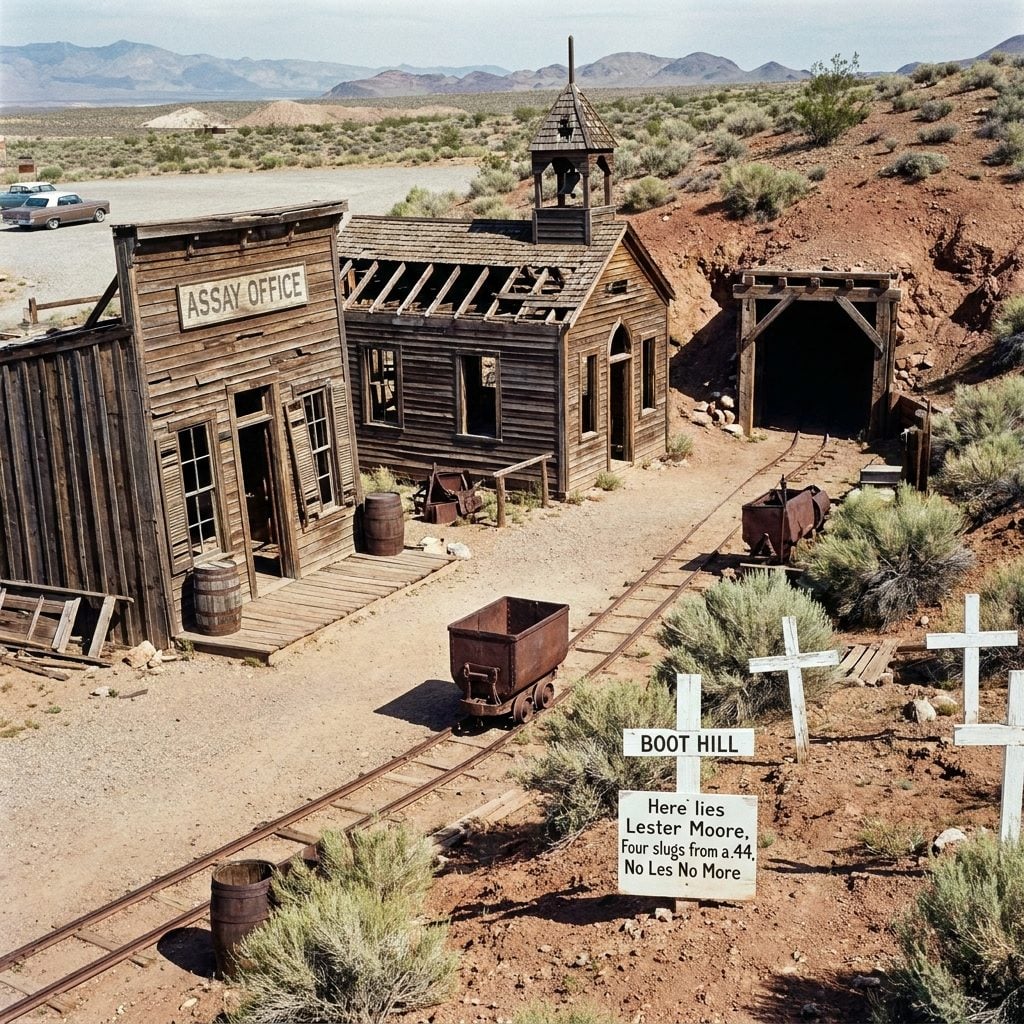
Some of them had been actual mining towns, abandoned when the silver ran out, then propped back up and given a ticket booth. Others were built from scratch in somebody’s back forty, with careful attention to making new wood look old. Either way, you paid your fifty cents and walked through a dozen rooms full of mannequins in period clothing and hand-lettered signs explaining who died of what.
The boot hill cemetery was always the highlight. Crooked wooden crosses with joke epitaphs. “Here lies Lester Moore, four slugs from a .44, no Les, no more.” That kind of thing. The comedy graveyard was a staple of 1960s roadside tourism in a way that’s genuinely hard to explain to anyone who wasn’t there.
24. Alligator Farms Where You Could Hold a Baby Gator for a Quarter
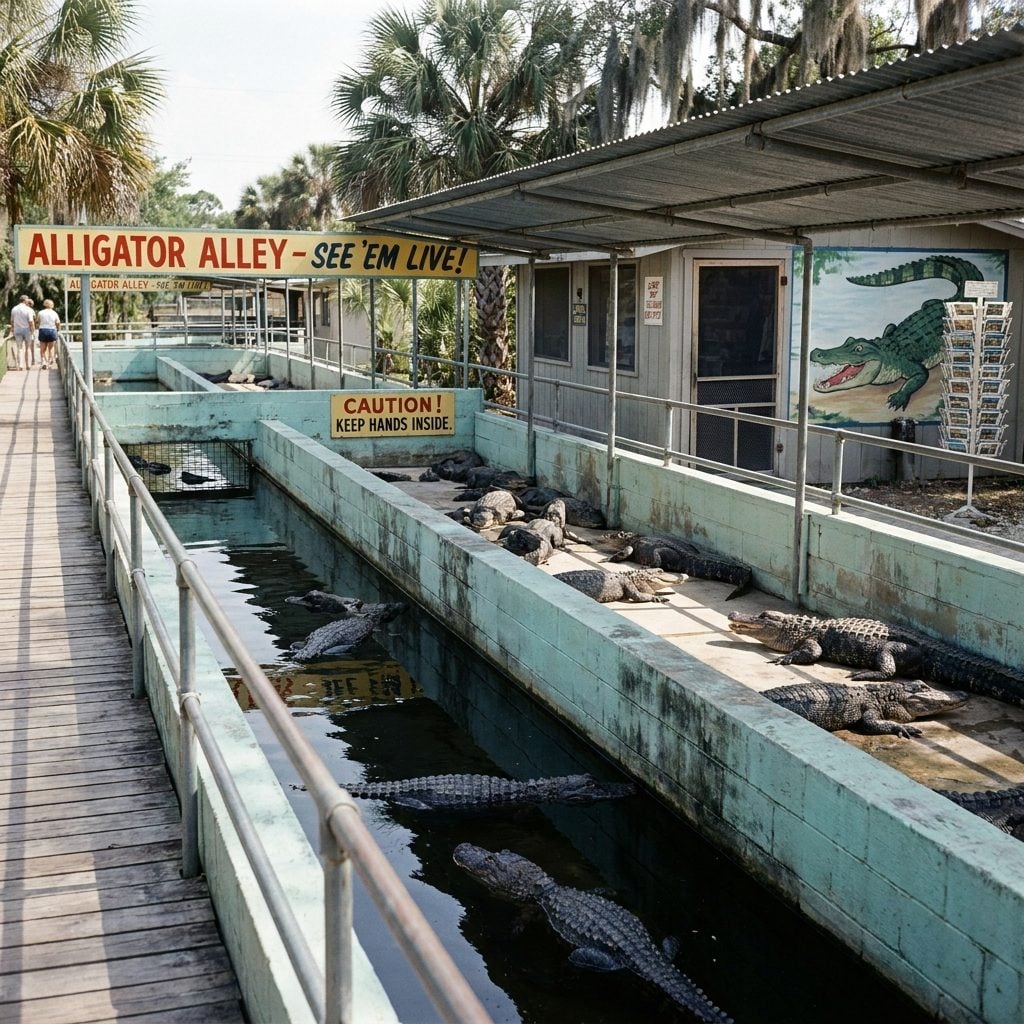
The smell hit you first. Warm, swampy, ancient. Then the sound, which was mostly silence punctuated by an occasional deep hiss that made your mother grab your arm.
Florida alone had half a dozen alligator farms by the mid-1960s, and the format was consistent: concrete pools, low walls, a boardwalk, and an attendant who would, for a quarter, place a baby alligator in your hands while someone took a Polaroid. The baby gator’s mouth was usually taped shut with a rubber band. You’d hold it for approximately four seconds, long enough for the photo, then hand it back with your heart pounding.
The gift shop sold alligator heads, alligator teeth on chains, and small alligators preserved in blocks of resin. You could also buy an ashtray shaped like a gator. The whole operation ran on a combination of genuine Florida weirdness and the understanding that tourists from Ohio would buy absolutely anything with an alligator on it.
23. Reptile Gardens Where a Man in Khaki Held a Rattlesnake and Narrated the Whole Thing
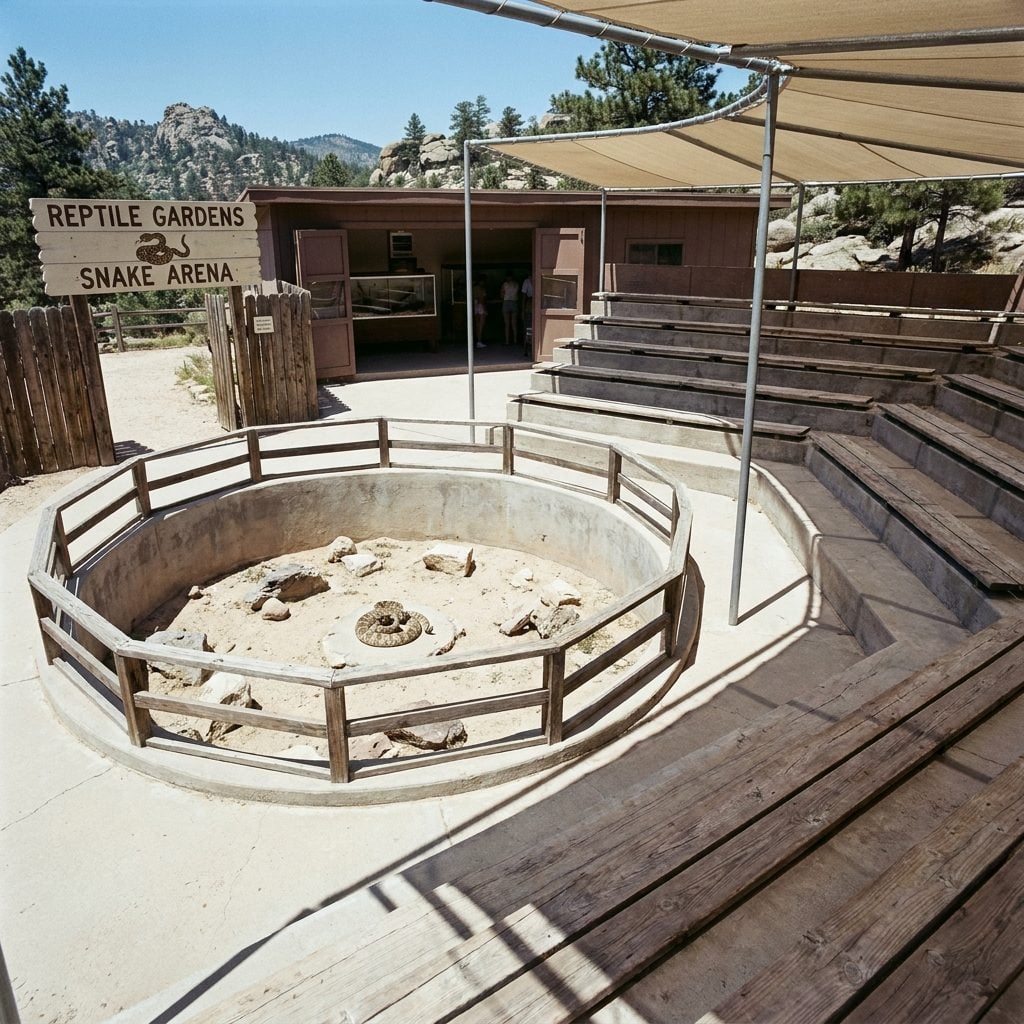
The man in the khaki shirt and the knee-high boots would reach into the pit with a hooked stick and lift a four-foot rattlesnake into the air like it was a garden hose. The crowd went silent. He’d talk the whole time, calm and steady, about venom yields and strike distances, holding the snake at arm’s length while thirty tourists sat on splintery wooden benches trying not to breathe too loud.
Reptile gardens were a particular subspecies of roadside attraction: educational enough to satisfy Mom, dangerous enough to thrill the kids. The terrariums inside were always dimly lit and slightly too warm, with hand-typed index cards taped to the glass identifying each species. Gila monsters. King cobras behind double-paned glass. A tortoise in a low pen that you could feed lettuce to.
South Dakota’s Reptile Gardens, which opened in 1937 and was still going strong through the 1960s, was the gold standard. But smaller operations dotted every warm-weather highway, each one run by a man who seemed completely unbothered by the fact that his job involved handling animals that could kill him.
The whole appeal was watching someone do something you would never, ever do yourself, narrated in the tone of a relaxed biology teacher.
22. The Wild West Stunt Show With Real Gunpowder and Questionable Safety Standards
🔥 Would you like to save this?
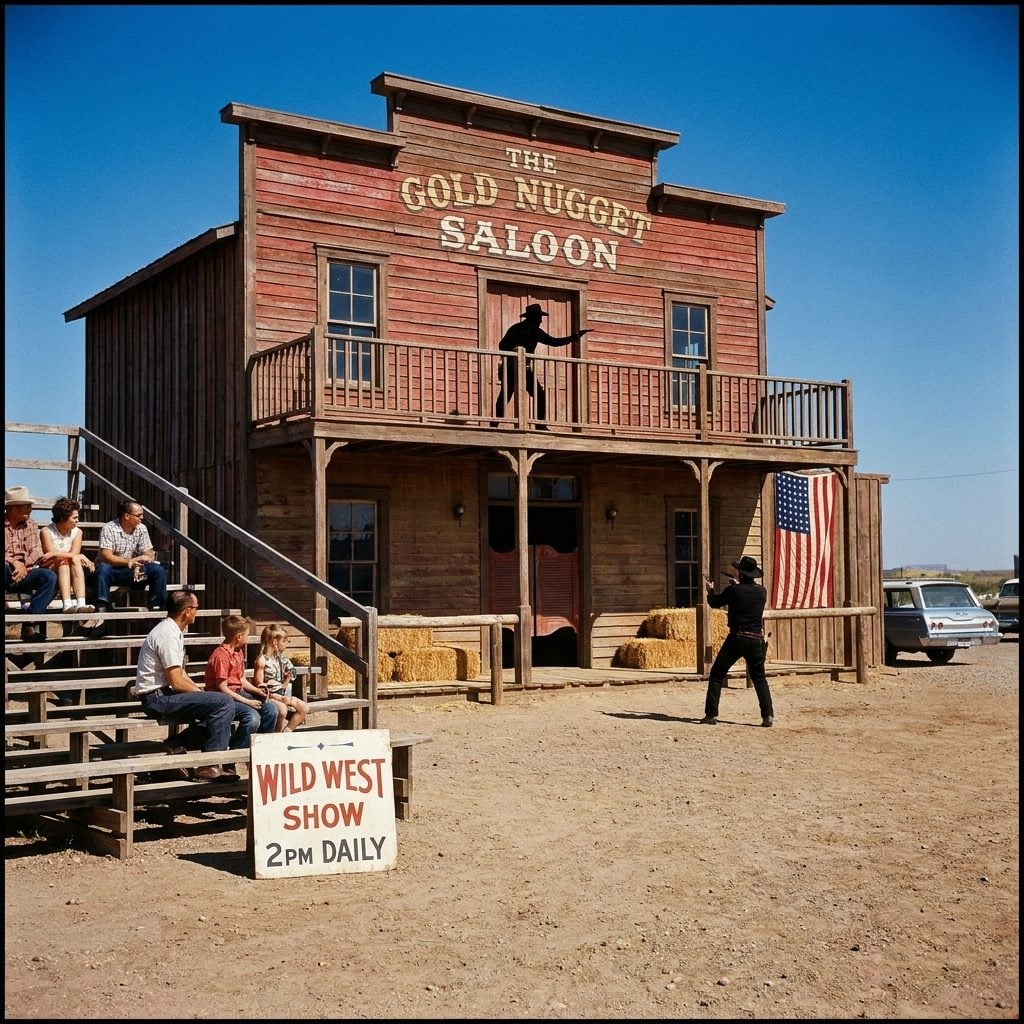
Blank cartridges cracking through dry desert air, a stuntman toppling off a saloon balcony onto a mattress hidden behind hay bales. Every Wild West stunt show along Route 66 and the Southwest corridors ran on the same formula: a sheriff, a bandit, a damsel, and enough theatrical gunfire to make your ears ring for the next fifty miles.
Kids sat cross-legged on splintered wooden bleachers, mouths open, completely sold on the whole production. The performers were usually local college kids or drifters who’d picked up the choreography in a week. Nobody wore ear protection. Nobody asked about insurance.
The best ones had a horse chase through the audience area, kicking up real dust that settled on your Kodak Instamatic. Dad always bought a souvenir sheriff’s badge from the gift shop on the way out, a tin star that cost fifteen cents and felt like treasure.
21. Miniature Golf Courses Shaped Like Castles, Windmills, and Anything Else Made of Plaster
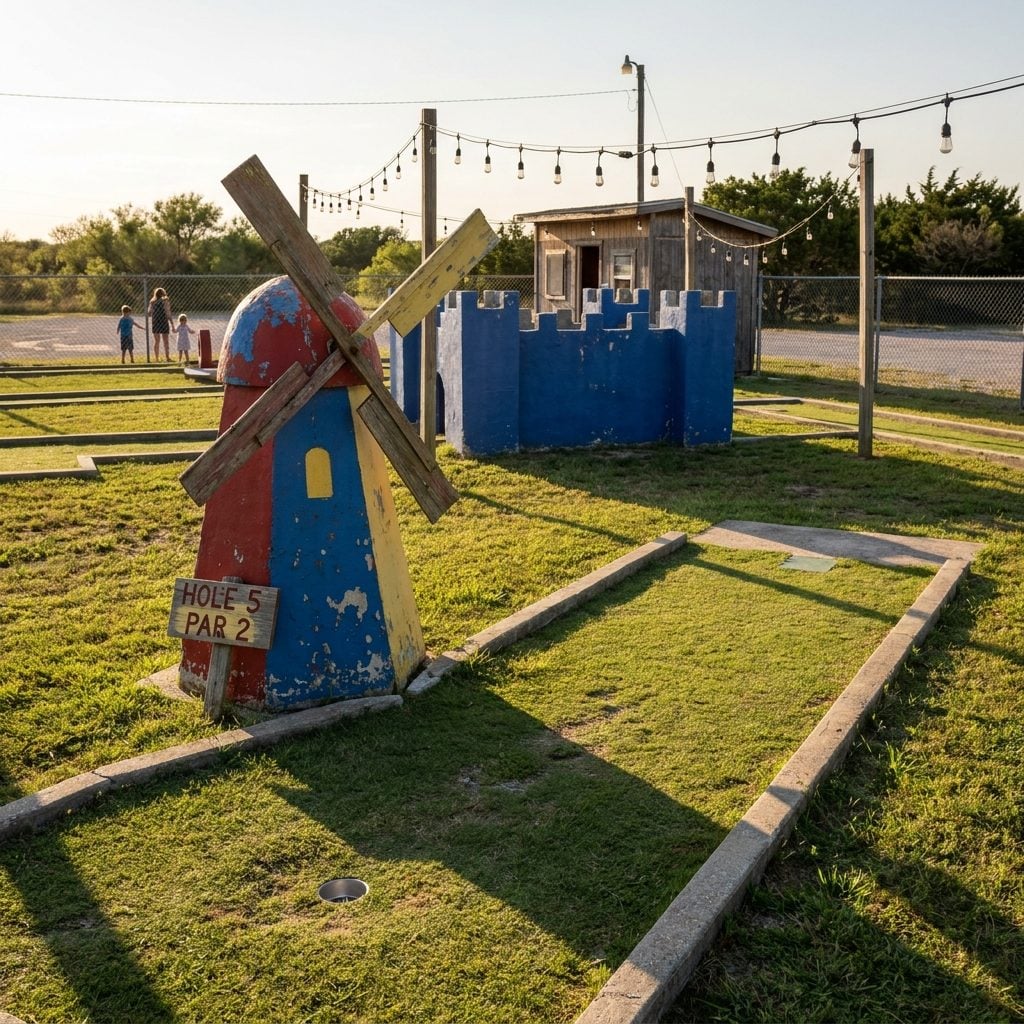
The windmill never actually worked right. One blade would catch and stick, then lurch forward with a groan that sounded like a screen door in a hurricane. But that was the whole charm of a 1960s roadside mini golf course: nothing was precise, everything was handmade, and the plaster castle on hole seven had a visible crack running through its turret that somebody had patched with what looked like cake frosting.
These places smelled like wet concrete and cut grass and the rubber of those communal putters with the electrical-tape grips. The ball return was just a trough. The pencils were always dull. The scorecard got damp in your back pocket by the third hole.
20. Roadside Teepee Motels Where the Whole Family Slept Inside a Concrete Cone
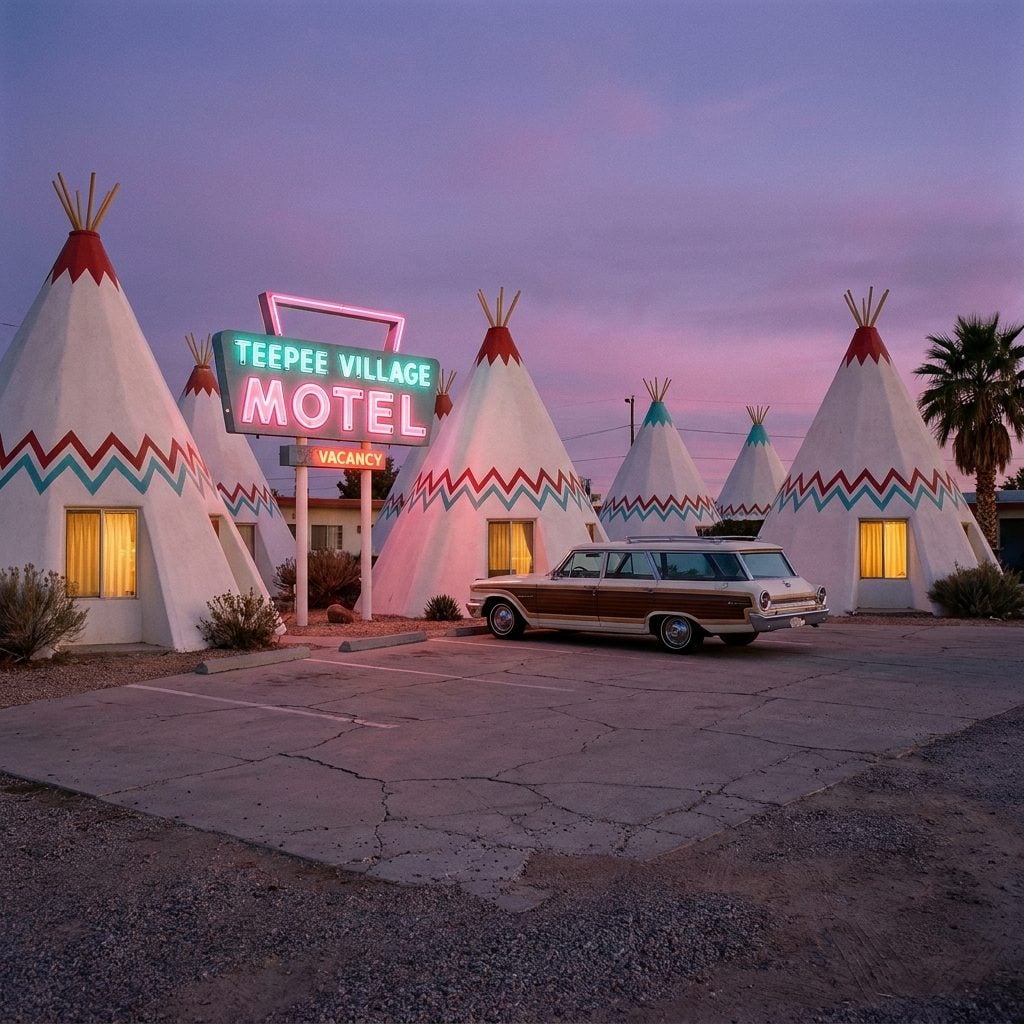
Sleeping inside a giant concrete teepee felt like the most exotic thing a seven-year-old could possibly experience in 1964. The Wigwam Village chain and its many imitators dotted highways from Kentucky to Arizona, each one a cluster of white stucco cones arranged around a parking lot, every teepee big enough for two beds and a nightstand.
Inside, the walls curved inward in a way that made the ceiling feel close. The bathroom was always tucked into the back of the cone, impossibly small. You could hear everything from the teepee next door.
But stepping out of the car after eight hours on the highway and seeing those pointed shapes against a pink desert sunset? That was the moment the vacation officially started. Mom would say “well, this is different” in a tone that could have meant anything, and Dad would grin because he’d been planning this stop since the AAA TripTik arrived in the mail.
19. The Mermaid Show Where Real Women Held Their Breath Behind Plate Glass
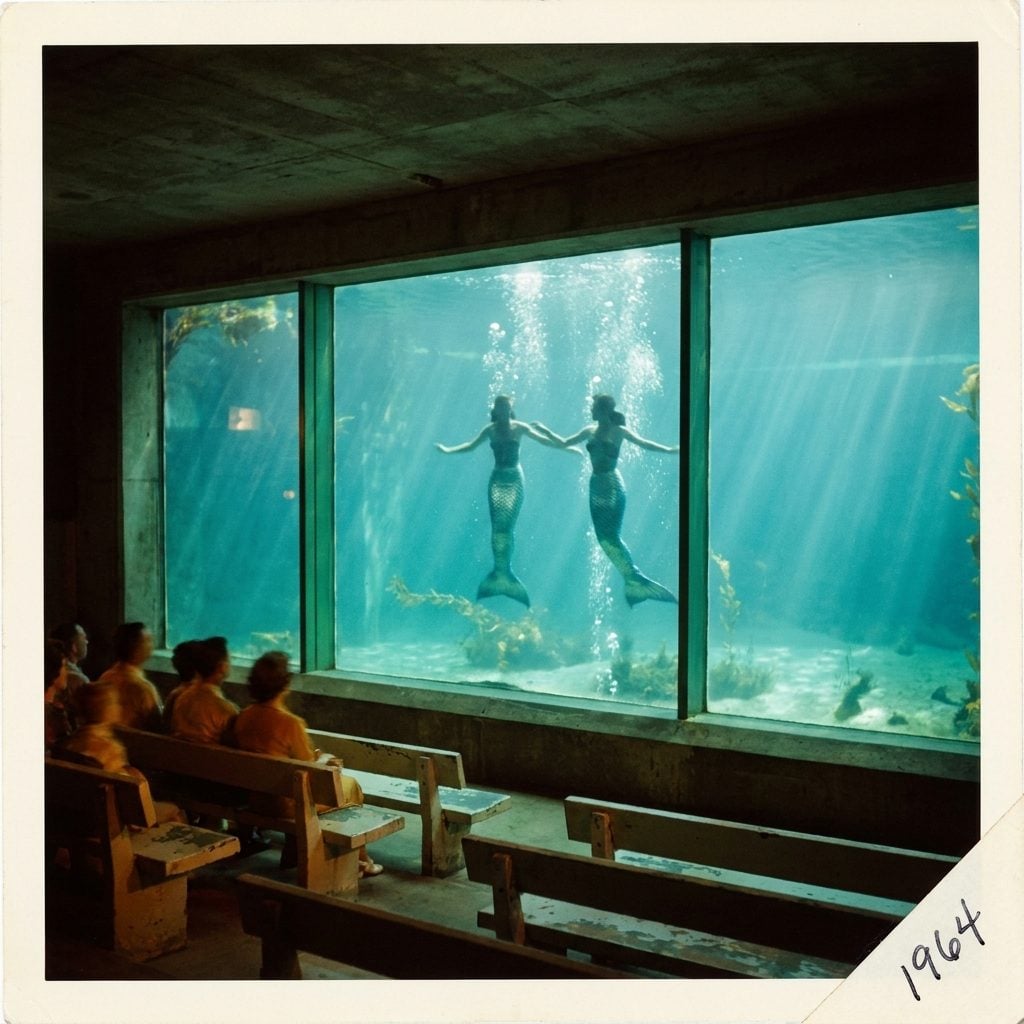
Weeki Wachee Springs wasn’t the only place, but it was the one everyone talked about. Women in shimmering fabric tails performed synchronized underwater ballet behind thick glass windows while families ate hot dogs in an underground theater. The mermaids smiled, drank from bottles, and performed choreographed routines, all while holding their breath or breathing through hidden air hoses.
What nobody talks about is how cold that spring water was. The performers trained for months. The smiles were real discipline.
Smaller mermaid attractions popped up at aquatic parks along Florida’s Gulf Coast and scattered through the Ozarks, most of them less polished but no less mesmerizing to a kid pressing their nose against algae-tinged glass. The gift shop always sold plastic mermaid dolls with brushable hair, and every little girl wanted one.
18. Fake Volcano Attractions That Erupted on a Timer Every Twenty Minutes
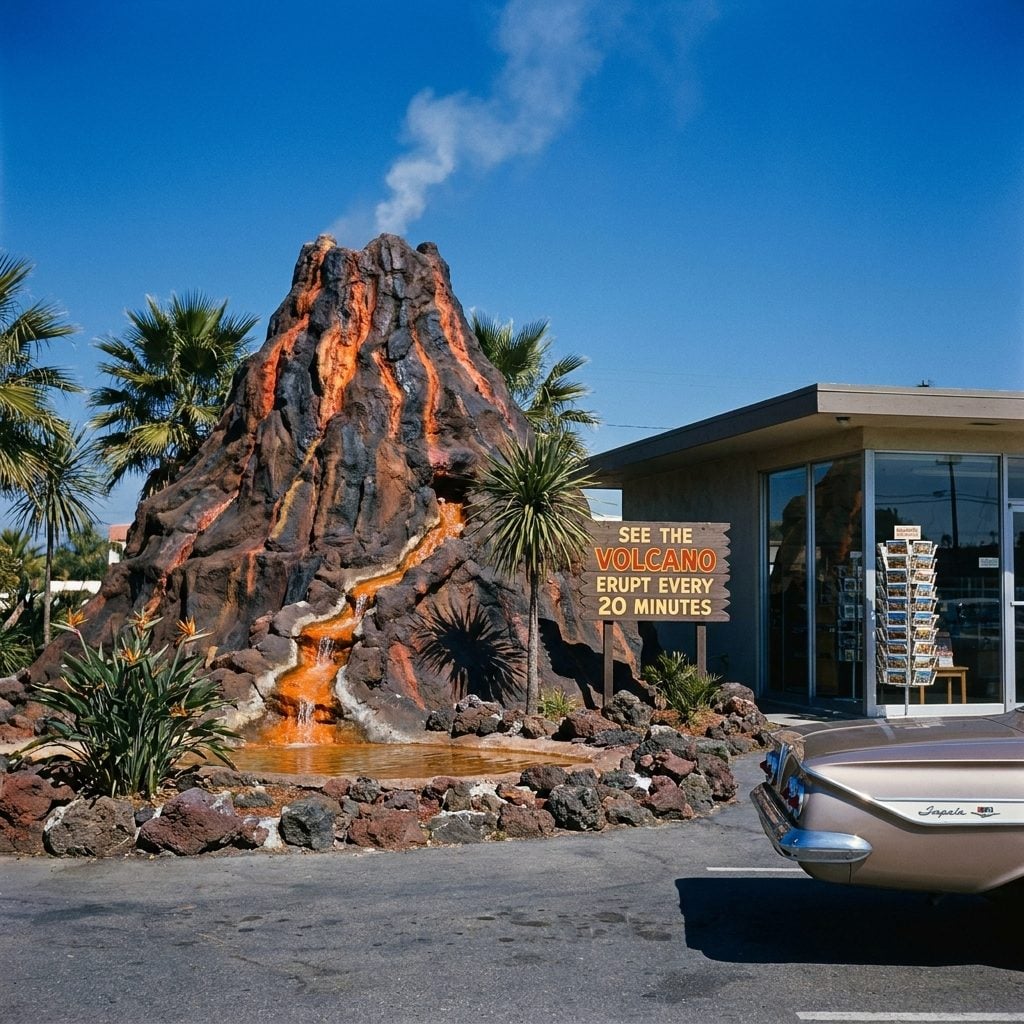
Orange-tinted water and a puff of theatrical smoke. That was the eruption.
Roadside volcano attractions in the 1960s were ambitious in concept and modest in execution. A mound of painted concrete, maybe twenty feet high, sat in a landscaped lot with tropical plants (real or plastic, depending on latitude). Every twenty minutes or so, a pump kicked on, red-dyed water cascaded down the sides, and a smoke machine coughed out a cloud that dissipated before it cleared the top.
The kids screamed every time like it was Vesuvius. Parents clapped politely. The whole cycle lasted about ninety seconds. Then everyone filed into the gift shop to buy geodes and polished rocks that had absolutely nothing to do with volcanoes but cost a dollar fifty and kept the backseat quiet for another hour.
17. The Petting Zoo Attached to a Gas Station That Somehow Also Sold Pecan Logs
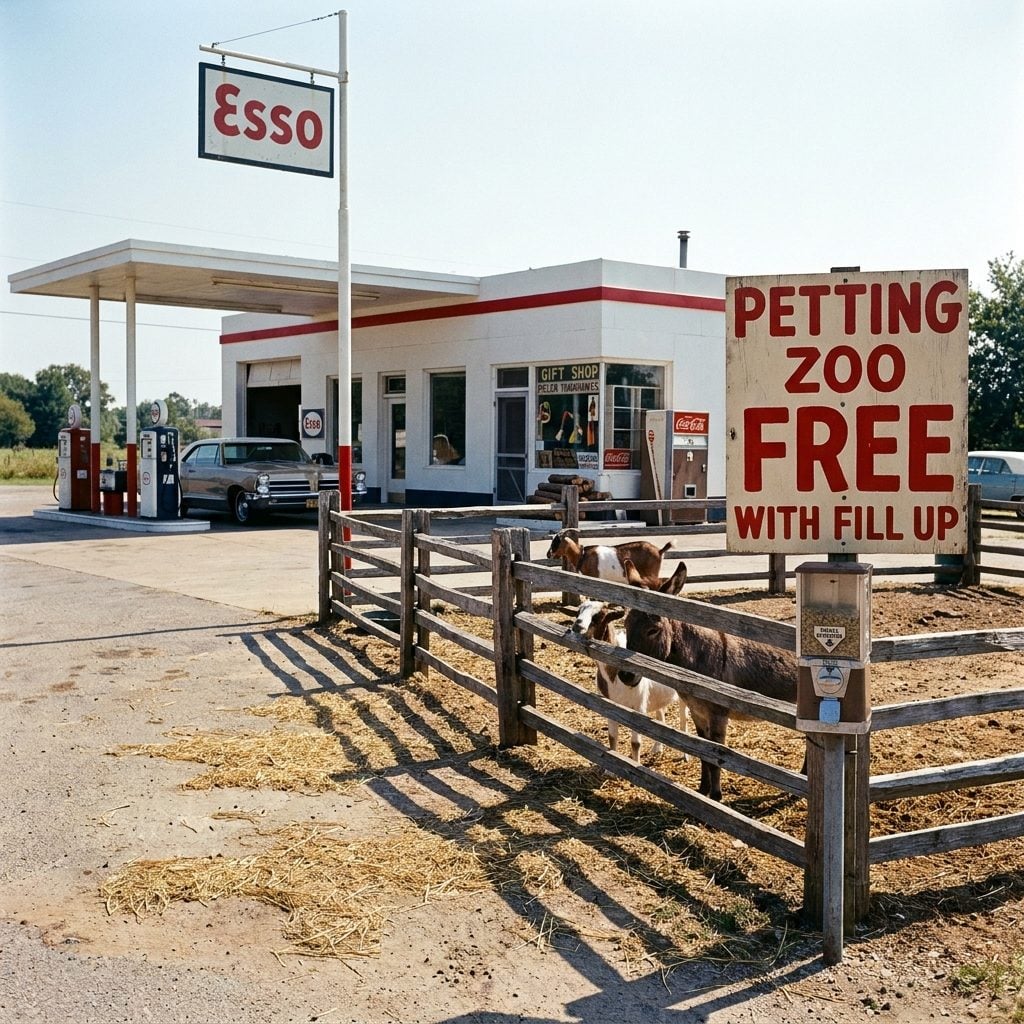
You stopped for gas. You left with a baby goat nibbling your shorts and a three-foot pecan log wrapped in cellophane. This was the natural order of things on a 1960s highway.
These hybrid gas-station-petting-zoo-gift-shop operations thrived in the space between major cities, usually run by one family who lived in a house directly behind the property. The animals were goats (always goats), maybe a donkey with a resigned expression, a pen of rabbits, and if you were lucky, a single bored llama.
The feed came from gumball-style dispensers that took a nickel. The goats had figured out the dispensers faster than the children had. The whole area smelled like hay and diesel and Stuckey’s pecan divinity. Mom stayed in the car. Dad pretended this stop was about the gas.
16. Western Photo Studios Where the Whole Family Dressed Like Cowboys for One Stiff Portrait
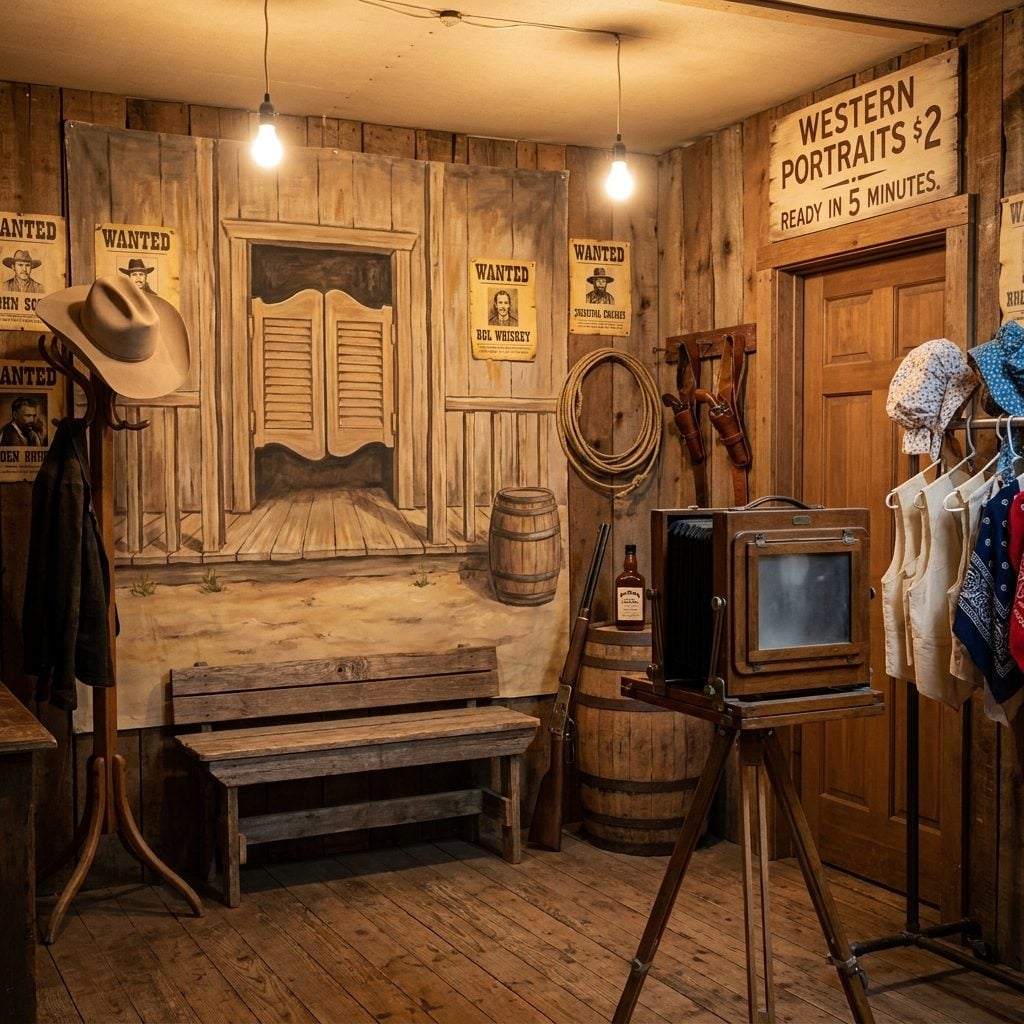
The hat was always too big. Every single time. They had one size, and it was built for a head that didn’t exist in nature. But you wore it, and you held the prop rifle, and you stood in front of the painted saloon backdrop with your siblings while a man with a box camera told you to look tough.
These portrait studios lined the main streets of every tourist town west of the Mississippi. For two dollars, your family got costumes (muslin vests, holster belts, bonnets for the girls), props (a whiskey bottle that was clearly a Coca-Cola bottle with the label scraped off), and one sepia-toned photograph that would hang in the hallway for decades.
Nobody smiled. That was the rule. You were supposed to look like you’d just ridden in from Dodge City, even though ten minutes earlier you’d been eating saltwater taffy on the boardwalk.
15. Wax Museums Where Kennedy Stood Next to Frankenstein and Nobody Found That Strange
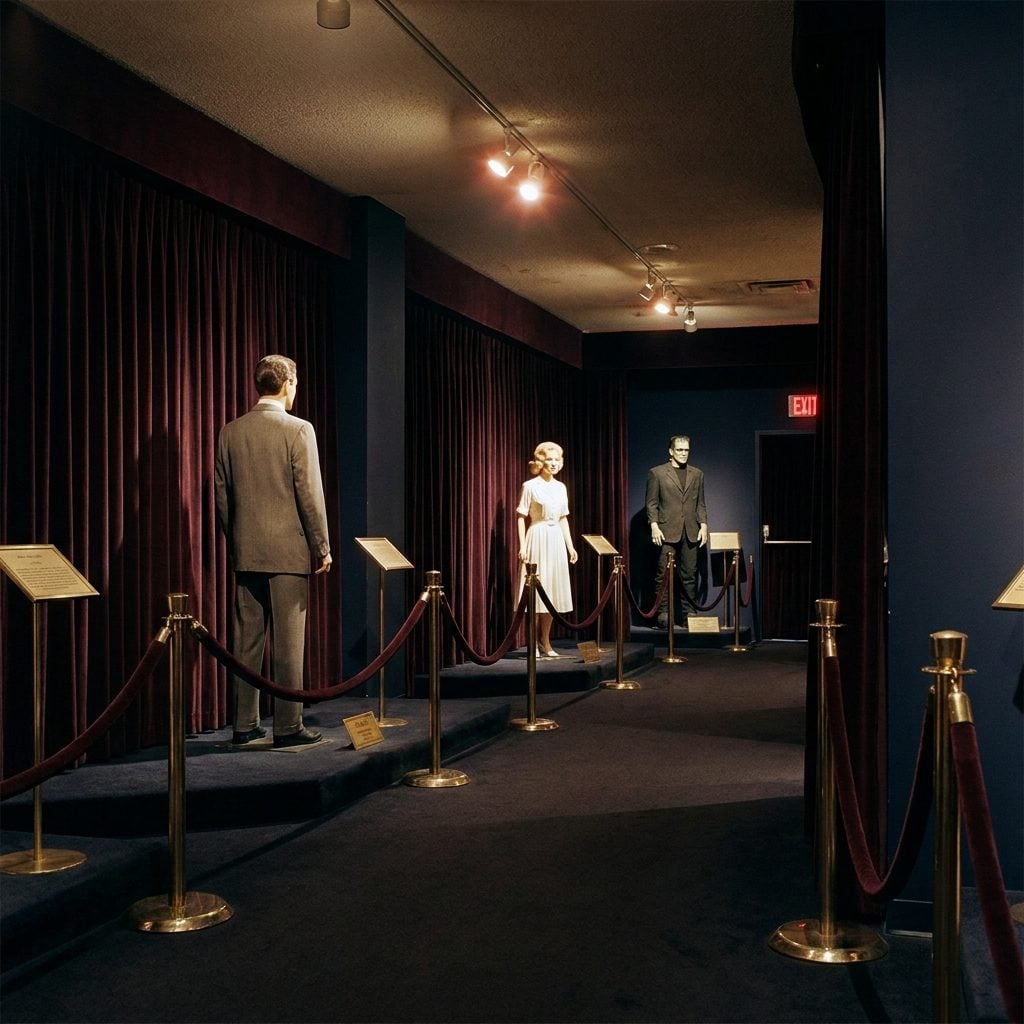
The lighting alone was enough to give you nightmares. Every wax museum of the 1960s was lit like someone had scattered floor lamps through a basement and called it atmosphere. President Kennedy stood three feet from Dracula. Marilyn Monroe melted slightly in the summer heat, her smile going lopsided by August.
These places charged a dollar admission and delivered exactly what they promised: famous people, rendered in wax, standing behind velvet ropes in rooms that smelled like floor polish and something vaguely chemical. The likenesses ranged from impressive to deeply unsettling, sometimes within the same figure.
Kids clung to their parents through the horror section, then begged to go through it again. The gift shop sold miniature wax busts and postcards of the figures that somehow looked more lifelike than the actual figures had.
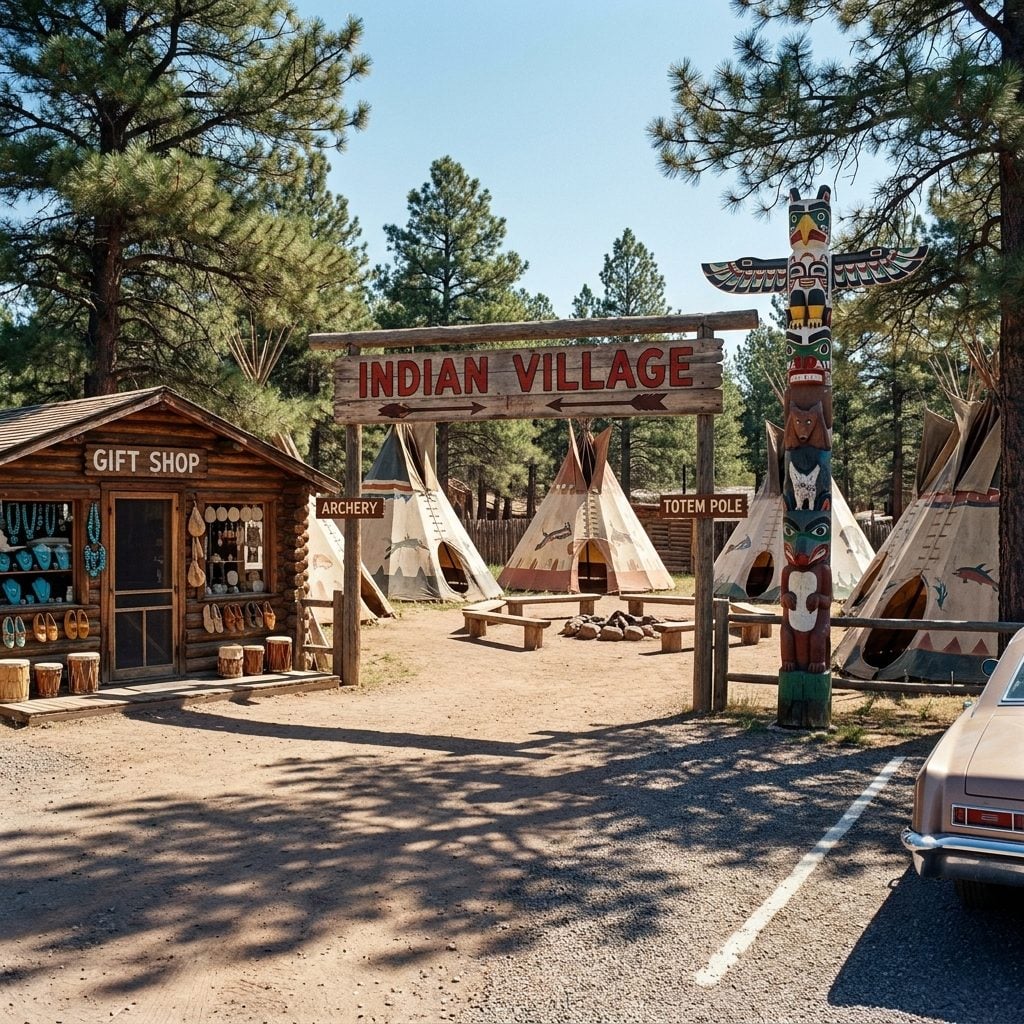
14. Indigenous Village Tourist Exhibits That Presented an Entire Culture as a Photo Opportunity
🔥 Would you like to save this?
A cluster of constructed tepees, a totem pole (often geographically wrong for the region), and a gift shop selling turquoise jewelry and rubber tomahawks. These “Indian Village” exhibits appeared along highways from the Catskills to the Rockies throughout the 1960s, and families stopped at them with the same casual curiosity they brought to seeing the world’s largest ball of twine.
Some employed Native American families who demonstrated crafts and dances. Others were entirely fabricated, built and staffed by non-Native entrepreneurs who’d assembled their understanding of indigenous culture from Western movies. The line between cultural presentation and caricature was one that most 1960s travelers simply didn’t think to examine.
The kids bought the rubber tomahawks. The parents bought turquoise rings. The slides went into the carousel projector back home, narrated as “we stopped at an Indian village,” with no tribe named because nobody had thought to ask.
13. Roadside Bear Attractions Where a Real Bear Sat Behind Chain Link and Drank a Bottle of Soda
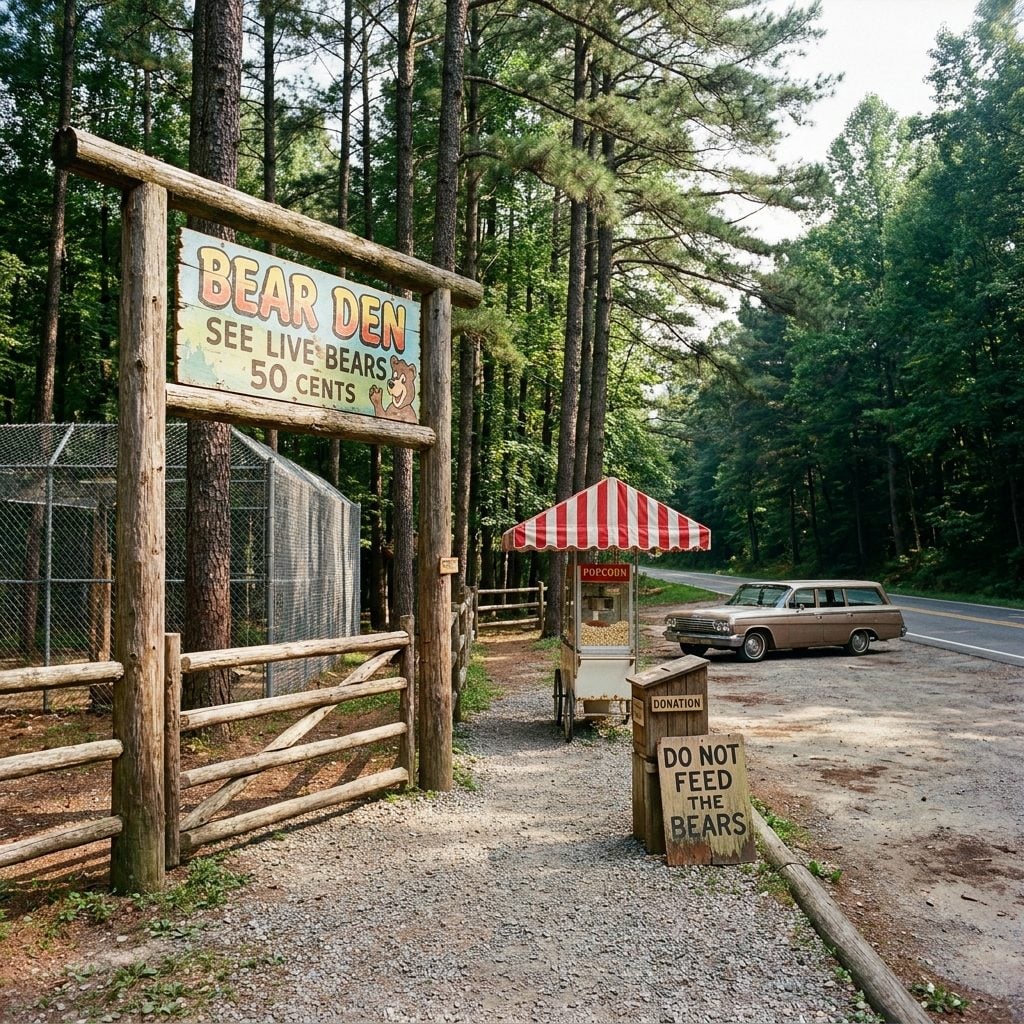
There was a black bear in a concrete pit behind a chain-link fence, and it was drinking a grape Nehi from a glass bottle. This was considered entertainment. This was considered normal. You paid fifty cents, and you watched a bear do things bears shouldn’t be doing, and your parents took a photograph.
These bear attractions were everywhere in the Smokies, the Ozarks, and along mountain highways in the Adirondacks and the Poconos. Some had a single bear. Some had several in enclosures that would make a modern person wince. The bears wrestled, rode tricycles in some of the more ambitious operations, and posed with tourists through the fence for tips.
By the late 1970s and into the 1980s, animal welfare awareness began closing many of these attractions. But for a solid two decades, “see the bears” was a legitimate reason to pull over, and the roadside signs advertising them, always with a cartoon bear waving, started appearing fifty miles out.
12. The Rock Shop Packed with Polished Stones, Geodes, and a Kid’s Life Savings
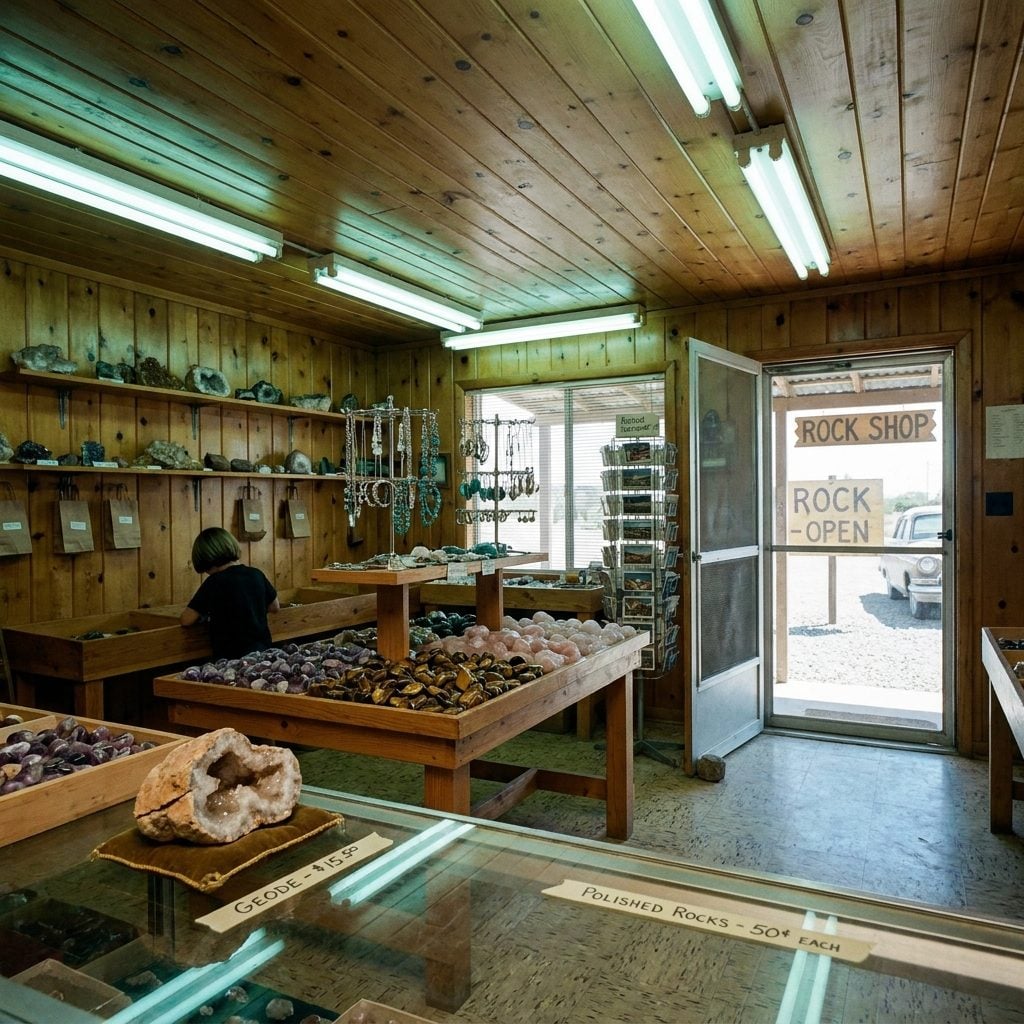
Every one of them smelled exactly the same: a cool, mineral-damp scent that hit you the second the screen door slapped shut behind you. Bins of tumbled amethyst and tiger’s eye, sorted by color and price, each piece slick under fluorescent light. The big geodes sat on velvet behind the counter, cracked open to reveal purple crystal cavities, price tags handwritten on masking tape.
Kids gravitated to the 25-cent bins near the register, agonizing over which polished agate to add to the paper sack already heavy with fool’s gold and a chunk of rose quartz. The whole transaction might run a dollar fifty. Dad stood near the door, arms crossed, scanning the turquoise jewelry display and trying to look patient. The rock shop never took more than twenty minutes, but it felt like a museum and a candy store fused together.
11. Roadside Waterfalls That Were 100% Man-Made and Nobody Minded
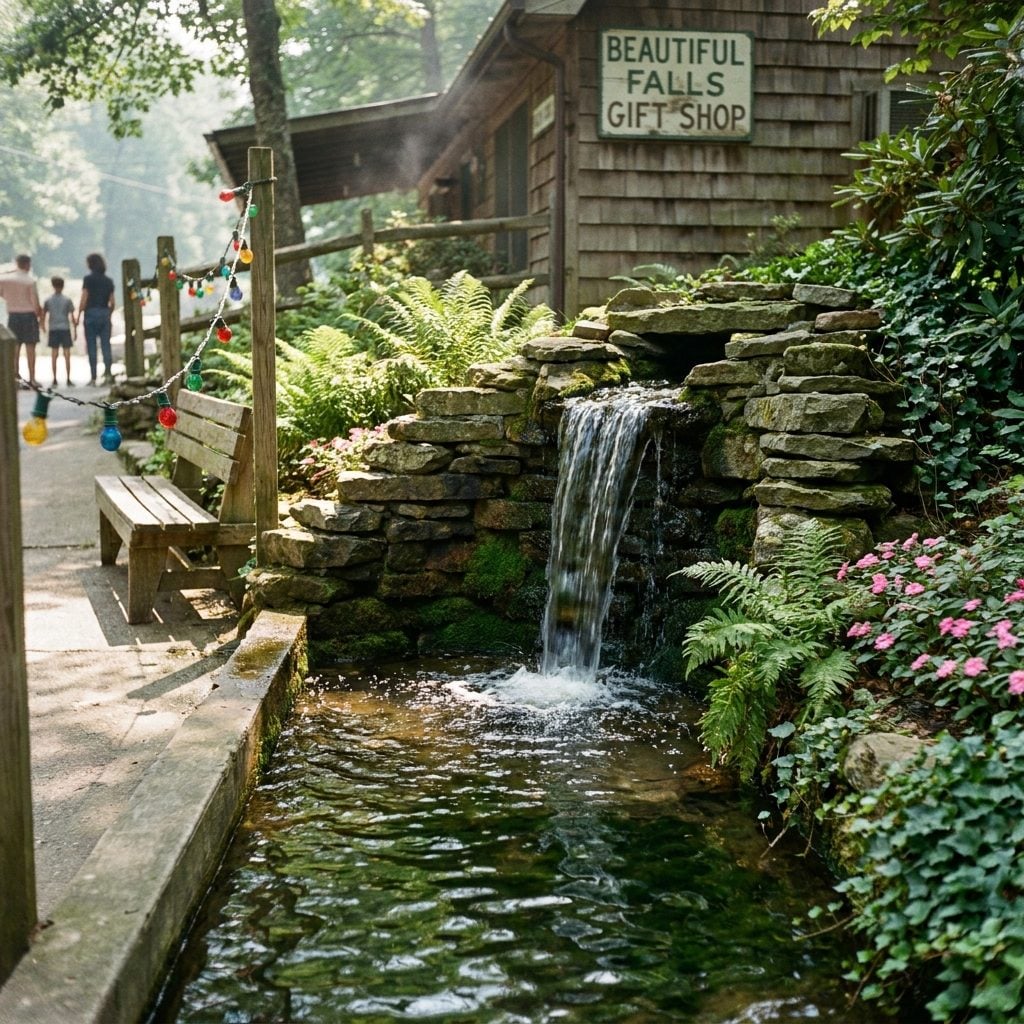
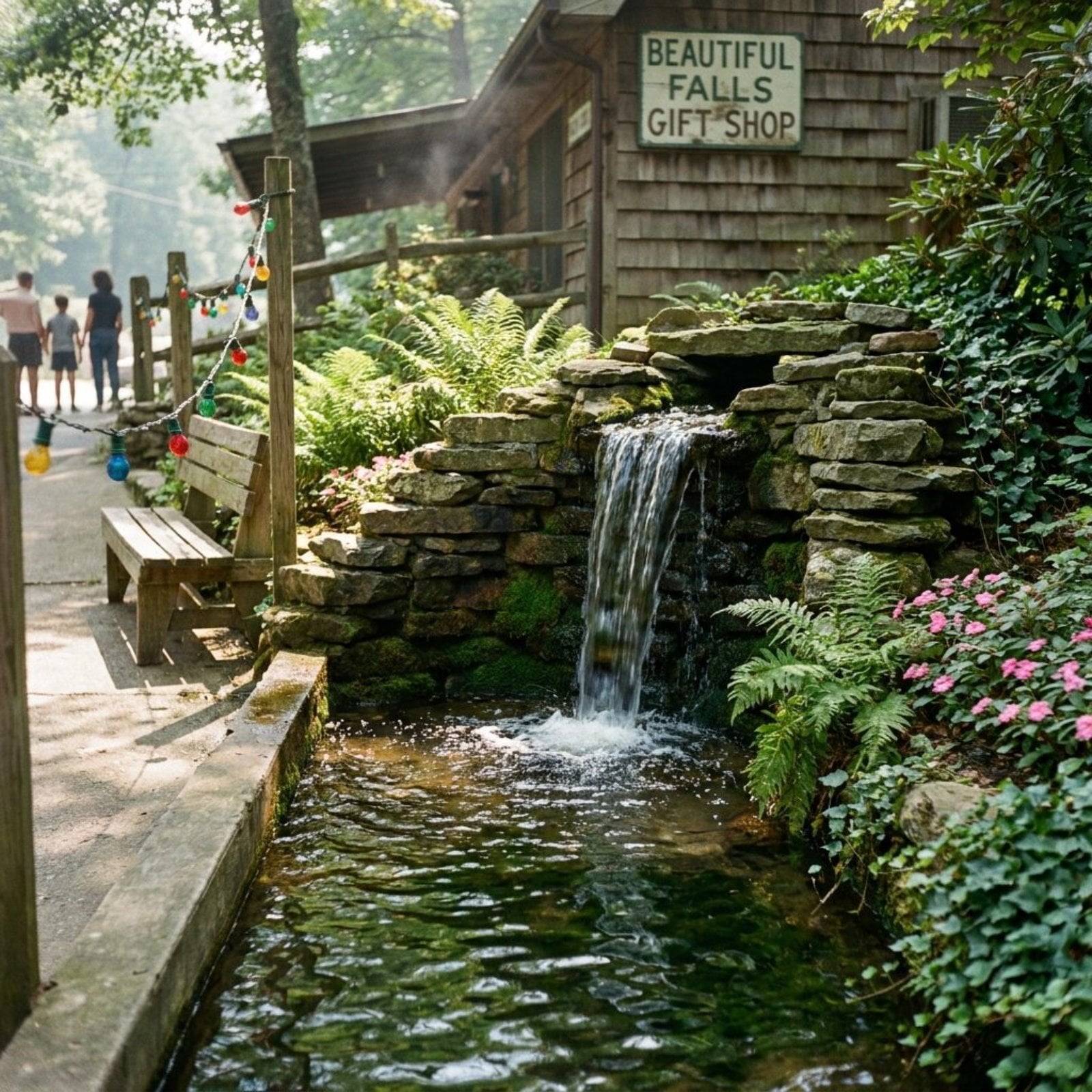
A hand-painted sign on the highway. BEAUTIFUL FALLS, NEXT EXIT. Admission fifty cents. And then you’d pull up to what was essentially a landscaped hillside with a recirculating pump and some strategically placed moss.
The water tumbled over stacked fieldstone into a shallow pool, maybe fifteen feet top to bottom. Ferns and impatiens planted along the edges. A concrete walkway with a single wooden bench. Someone had strung a few colored lights for the evening crowd. The whole production occupied maybe a quarter acre.
Nobody felt cheated. The falls were real enough, the mist felt good on a July afternoon, and the gift shop sold frozen orange bars out of a chest freezer. That was the contract: you gave them two quarters, they gave you something to look at and a place to stretch your legs. Honest transaction, honestly delivered.
10. Gold Panning Tourist Stops Where Every Kid Struck It Rich
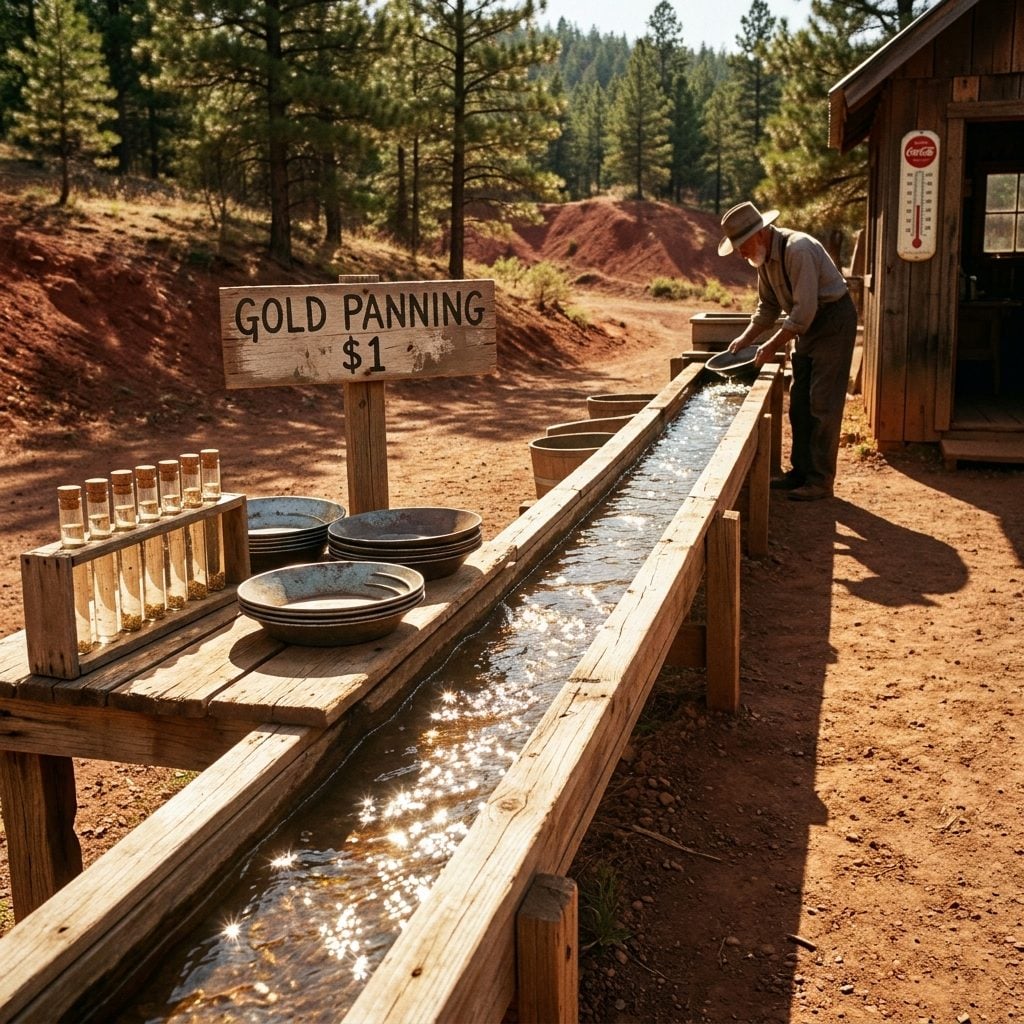
The genius was in the seeding. Someone had salted that creek bed with just enough flake gold and iron pyrite to guarantee every child would find something glinting in their pan within five minutes. The operation ran on simple mechanics: a diverted stream or a long wooden sluice, a stack of battered tin pans, and an old-timer in suspenders who demonstrated the swirling technique with the gravity of a man passing down ancient wisdom.
The real product was the glass vial. You’d transfer your flakes into a tiny corked tube filled with water, and they’d sell it to you for a dollar. Every kid on that trip believed, fully and without reservation, that they’d just earned their college fund. The vial rode home in a shirt pocket and lived on a bedroom shelf for years, the gold slowly settling into a thin bright line at the bottom.
9. Drive-Through Safari Parks Where Lions Stood on Your Station Wagon
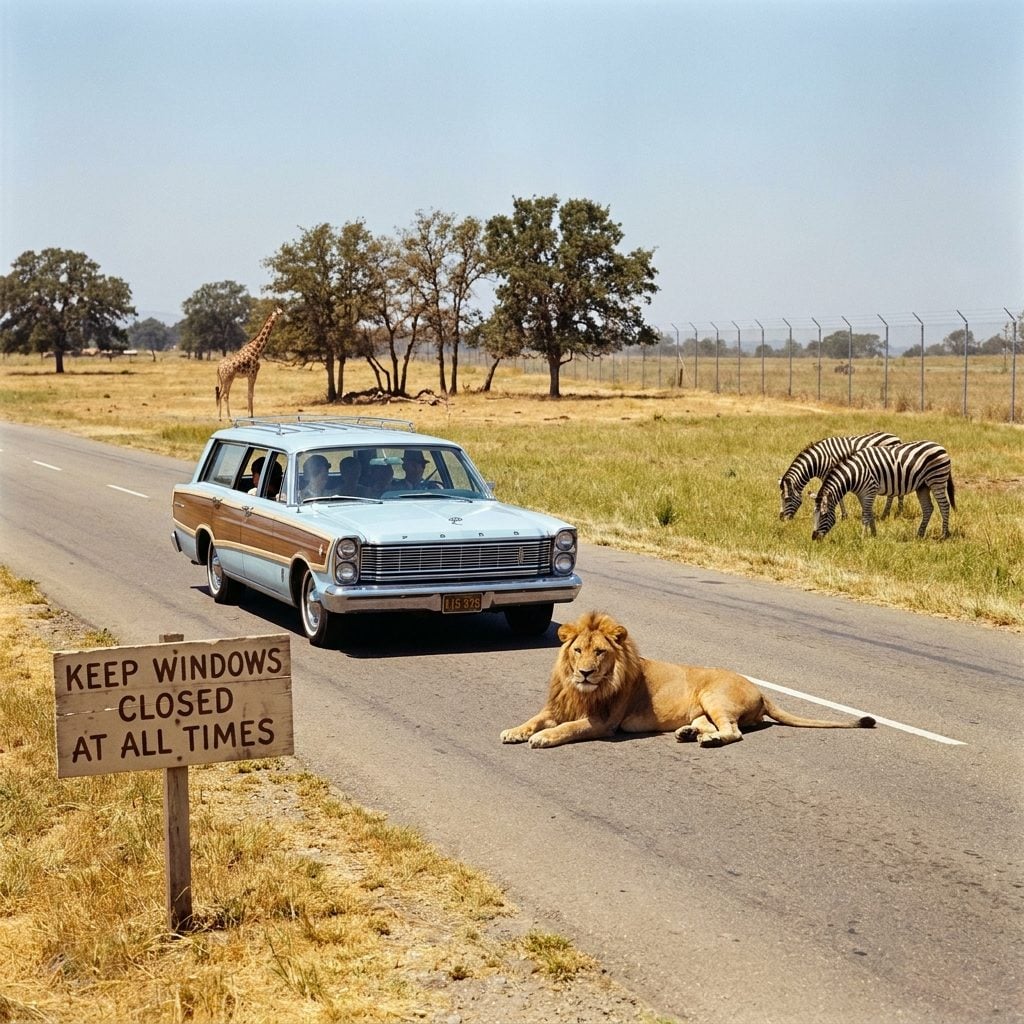
Windows up. That was the rule. Every car got the same warning from the attendant at the gate, delivered with the seriousness of a man who had seen things. And then you were through, rolling at five miles per hour through a fenced paddock in your Ford Country Squire while an ostrich pecked at the side mirror and a camel regarded you with open contempt.
The lions were the draw, of course. They lounged on warm asphalt or, if you were lucky, climbed onto the hood of someone else’s car two vehicles ahead. Zebras wandered between lanes. A baboon sat on a fence post pulling apart a tennis ball. The whole experience lasted maybe forty minutes, and you spent it in a state of genuine amazement that this was happening on a county road in New Jersey or central Florida.
These parks were wild in every sense. The liability questions alone would keep a modern insurance underwriter up at night. But in 1964, you just rolled through with your kids pressed against the back window and called it the best day of the trip.
8. Roadside Ghost Caves and Mystery Caverns with Questionable Geology
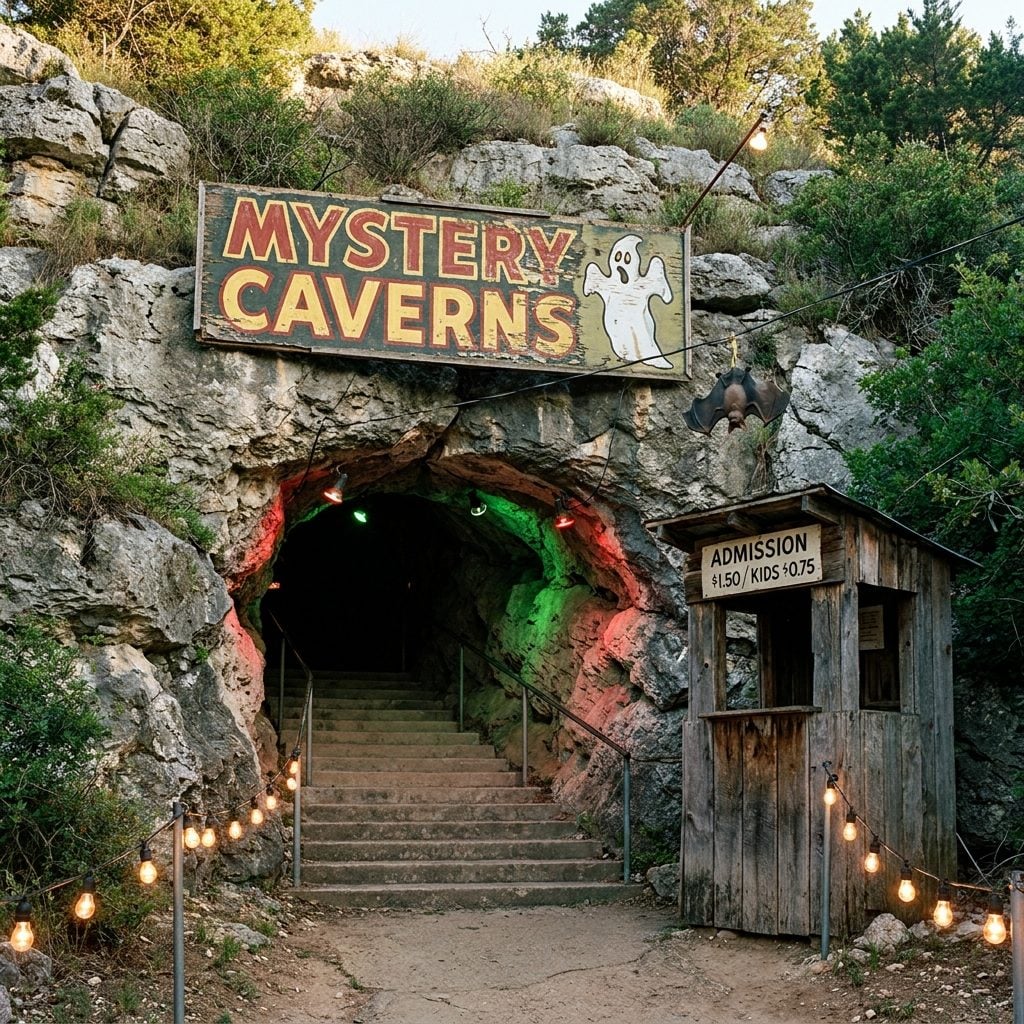
Cool air rolling up from a concrete staircase. A hand-lettered sign promising ANCIENT MYSTERIES BELOW. And down you went, past a turnstile and a bored teenager collecting quarters, into a world of colored spotlights, dripping walls, and narration that blended genuine geological fact with outright folklore.
Some of these were real caves with creative marketing departments. Others were man-made tunnels punched into hillsides, dressed up with plaster stalactites and a few strategically placed animal bones. The “ghost” was usually a mannequin in a corner alcove, lit by a single green bulb. Nobody screamed, but nobody complained either.
The gift shop at the exit sold rubber bats.
7. Mammoth Fiberglass Animals Visible from a Quarter Mile Down the Highway
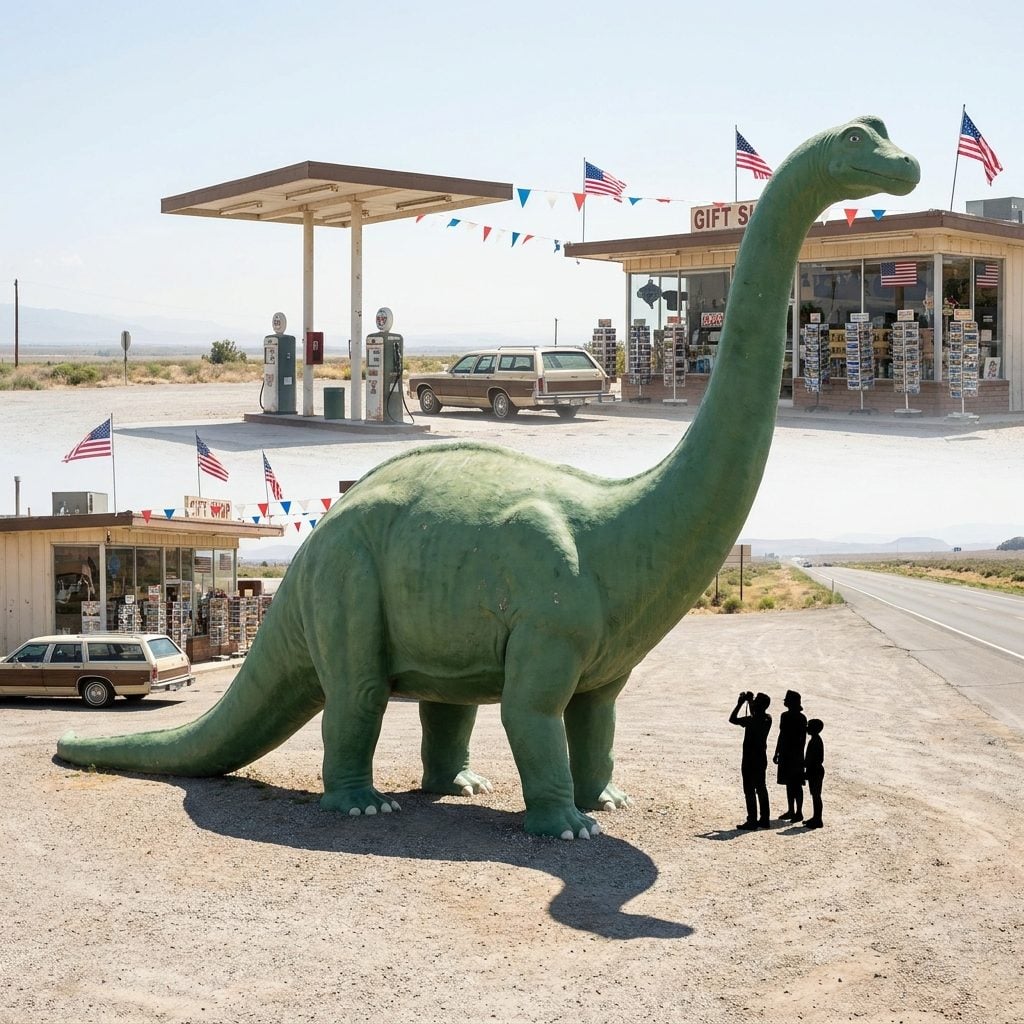
You saw the dinosaur before you saw the gas station it was advertising. That was the whole point.
Fiberglass fabrication shops in the late 1950s and early 1960s turned out an astonishing menagerie of oversized creatures for roadside businesses: thirty-foot brontosauruses, Paul Bunyan figures with axes raised, giant chickens outside fried chicken joints, and massive catfish promoting bait shops. The material was perfect for the job. Lightweight, weather-resistant, and capable of holding paint colors so vivid they registered at highway speed. A good fiberglass dinosaur cost a business owner somewhere around two thousand dollars, less than a single billboard lease for the year.
Families pulled over for the statue and stayed for the gift shop. The photograph in front of the giant animal was mandatory. Mom posed the kids. Dad worked the Kodak Instamatic. The statue itself was warm to the touch from sitting in the sun all day, and the paint was always just slightly chalky under your fingers.
6. Old Steam Train Tourist Rides That Smelled Like Coal and Creosote
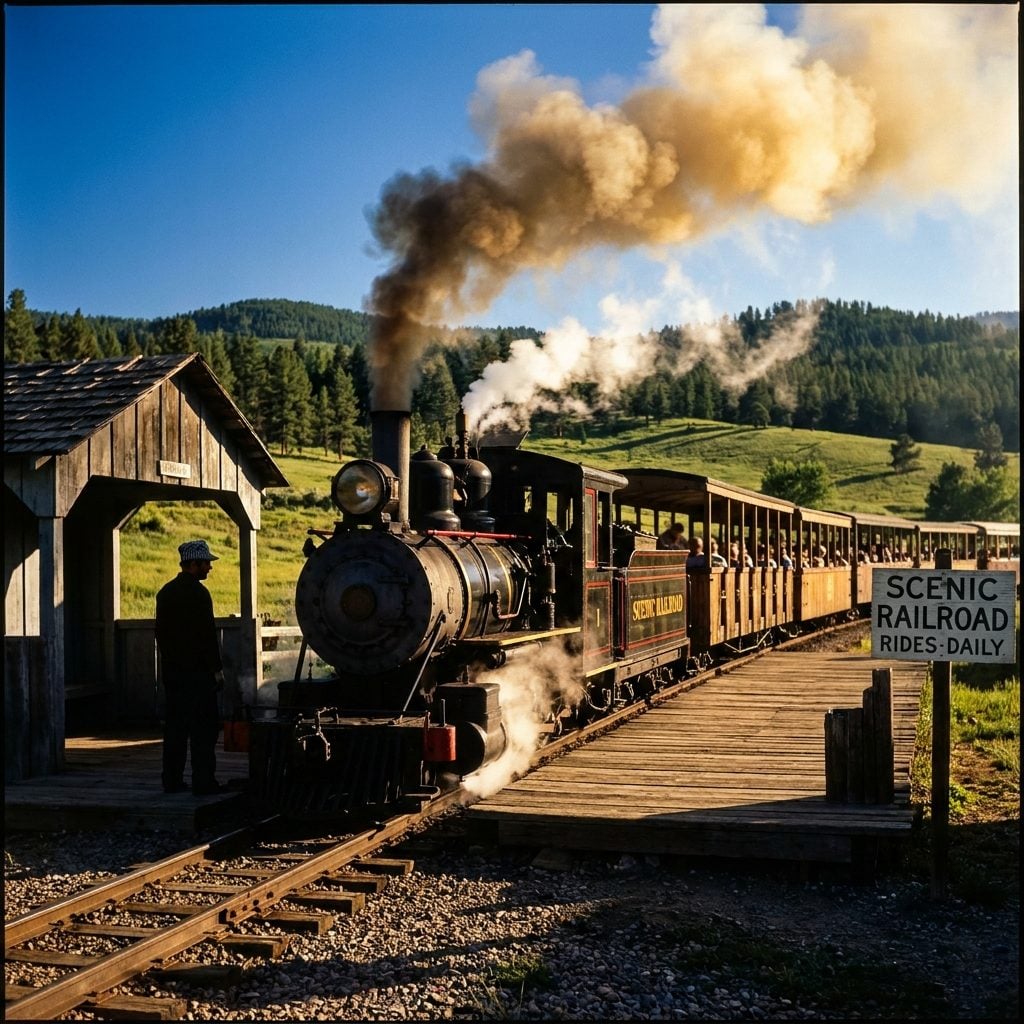
Coal smoke and hot iron. That’s what hit you on the platform before you ever boarded. The locomotive was small by railroad standards, often a narrow-gauge engine pulled from some defunct mining operation, repainted in glossy black with gold lettering and pressed into a second career hauling tourists through three miles of countryside.
The coaches were open-air or had windows propped wide, and the whole ride lasted maybe twenty-five minutes. Long enough to cross a wooden trestle over a creek, round a bend through a stand of pines, and hear the whistle blow at a crossing where no traffic waited. The conductor wore a striped cap and punched your ticket with a metal punch that left a little half-moon hole. Kids collected those punched tickets like currency.
Something about the rhythm of a steam engine on track, that particular syncopated chuffing, made adults go quiet and stare out the window. Grown men who drove brand-new Impalas home every night would stand on the rear platform of a tourist train car and look genuinely moved.
5. Roadside Museums Dedicated to One Magnificently Odd Topic
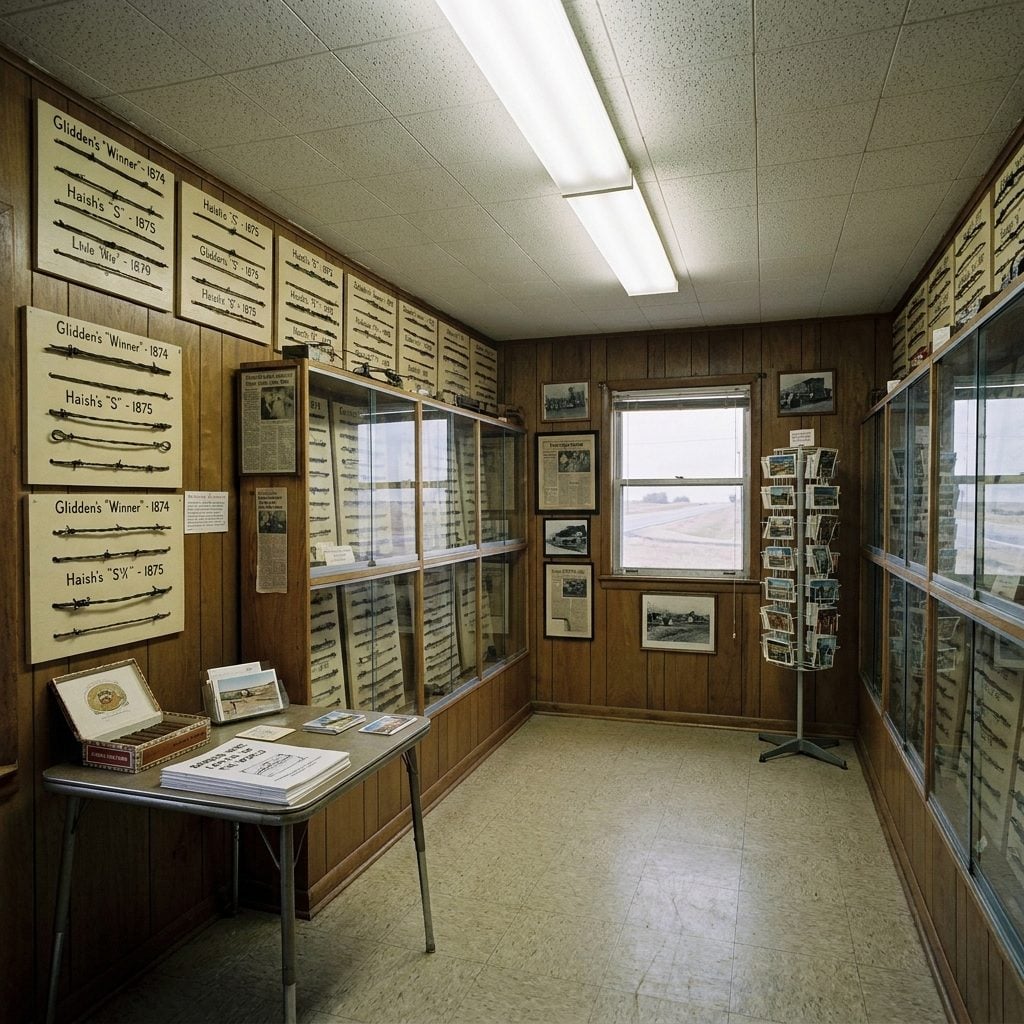
Barbed wire. That was the subject of an entire museum in La Crosse, Kansas. Not a wing of a museum. Not a display case. The whole building, floor to ceiling, devoted to the history and variety of barbed wire.
The 1960s highway system supported hundreds of these hyper-specific collections, each one the obsession of a single person made public. A museum of salt and pepper shakers. A museum of pencils. A building full of nothing but antique clocks, all ticking at once, all slightly out of sync with each other. The curator was almost always the collector, and they’d talk your ear off with genuine passion about the differences between Glidden’s Winner and Brinkerhoff’s Riveted Splicer if you gave them half an opening.
The admission was always a dollar or less, and the gift shop was usually just a card table with some postcards and a cigar box for making change.
These places existed because someone cared enough to build a building around the thing they loved. No market research, no focus groups. Just one person’s conviction that the world needed to see their collection of ceramic frogs or antique dental tools.
4. Glass-Bottom Boat Attractions Where You Could See Exactly Six Fish
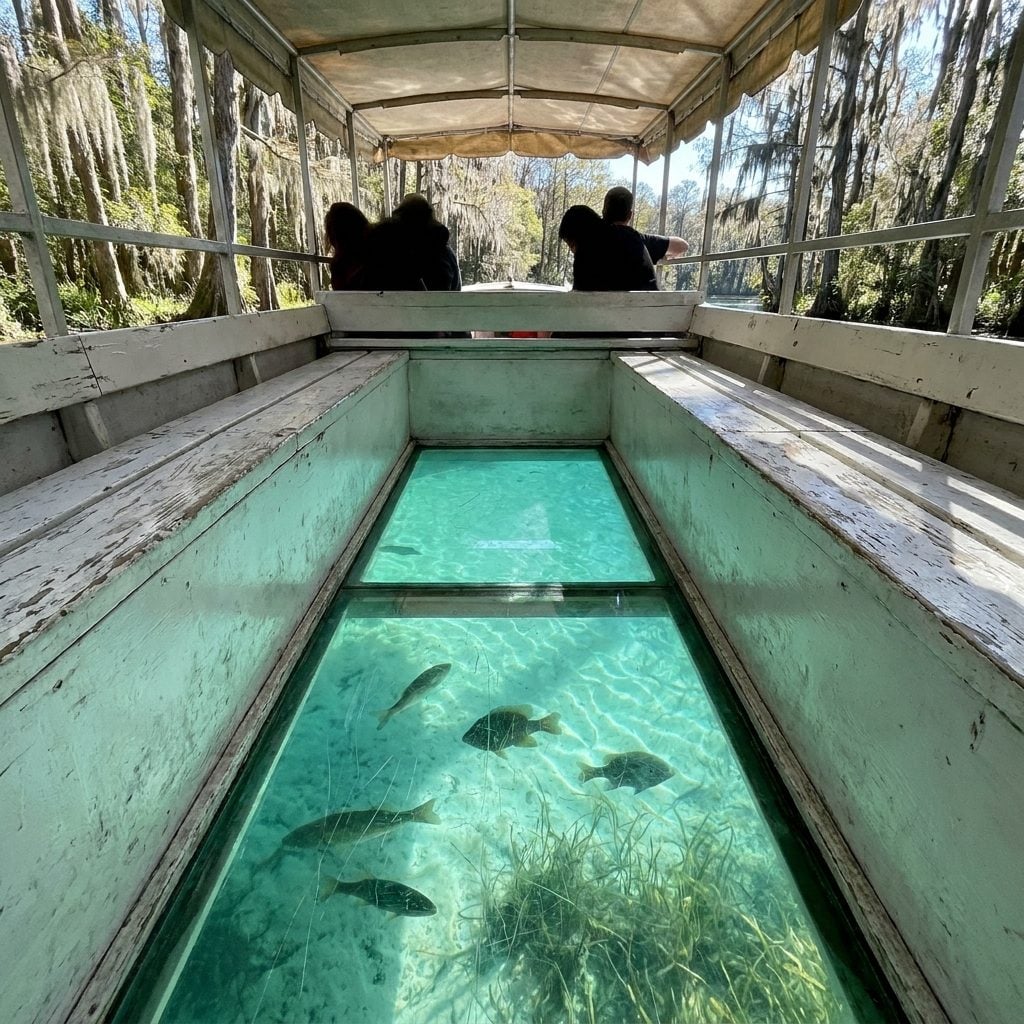
The glass was thick, scratched, and slightly green. You peered down through it from a wooden bench seat while the boat drifted over springs so clear the sand rippled twenty feet below like it was right under your hand. Silver Spring, Florida. San Marcos, Texas. Catalina Island, California. Each one promised an underwater world, and each one delivered something quieter and stranger than you expected.
The boats moved slowly, guided by a pilot who doubled as narrator. “On your left, ladies and gentlemen, a largemouth bass.” Everyone would lean. The boat would tip slightly. The fish would drift away with perfect indifference. Turtles were the reliable stars, hanging motionless near submerged logs, tolerant of their celebrity.
3. Fake Ghost Town Attractions Attached to Roadside Diners Where the Pancakes Were Real
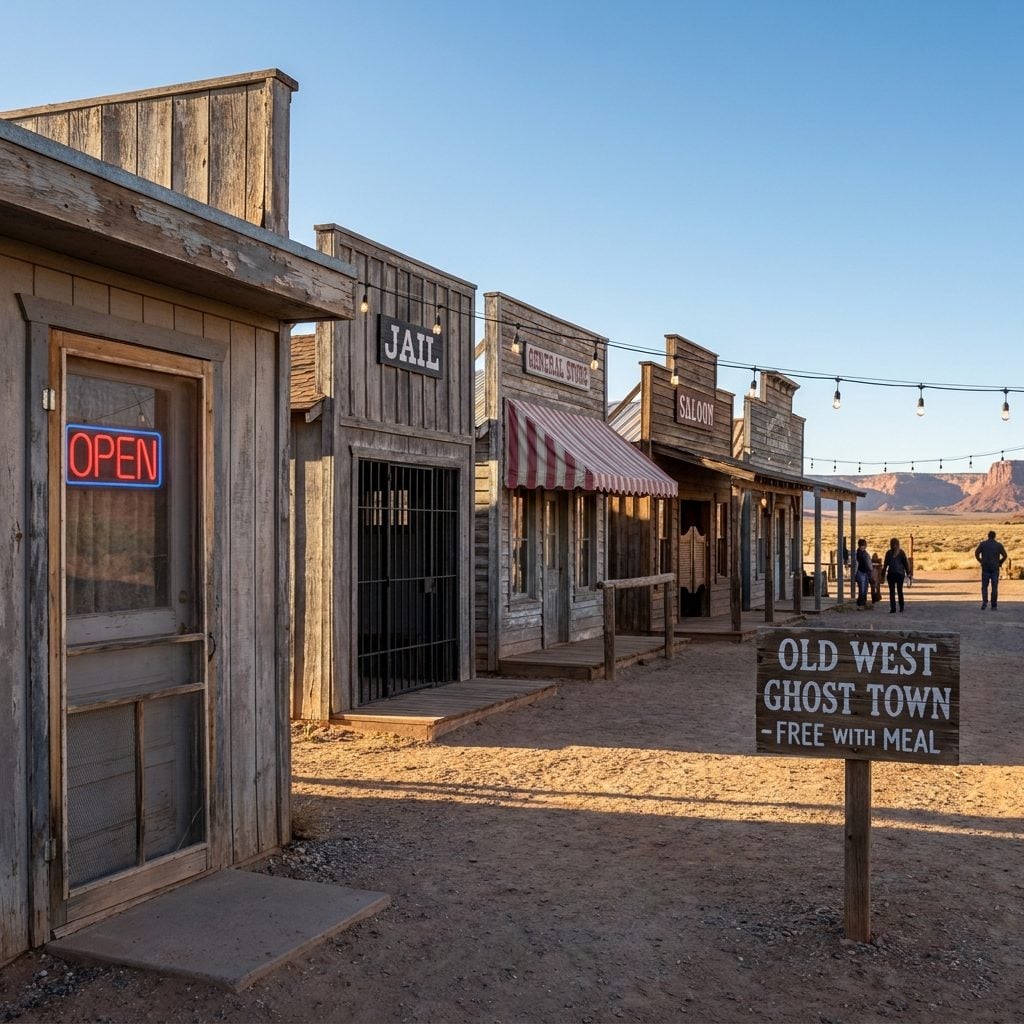
The ghost town was always out back, through a screen door past the restrooms. Six or eight weathered-look buildings arranged along a dirt path: a jail with prop bars you could pose behind, a general store stocked with penny candy, a saloon with swinging doors and a player piano that ran on a quarter. None of it was old. Most of it was built in the late 1950s from new lumber distressed with blowtorches and chains to look aged.
But the diner up front was legitimate. Counter service, vinyl stools, a short-order cook visible through the pass-through window. The pancakes came on heavy ceramic plates, three high, with a pat of butter already melting. Coffee was a nickel for refills, and the waitress called everyone “hon” because that was just how things worked along Route 66 in Arizona or Highway 40 in New Mexico.
The Real Business Model
The ghost town got families off the highway. The diner kept them long enough to spend money. And the gift shop, always positioned between the dining room and the fake town, sold turquoise rings, rubber tomahawks, and souvenir plates with the state name painted in gold script. The whole operation was a masterpiece of American roadside economics: entertainment as a loss leader for eggs and souvenirs.
2. The Hillbilly Village Where Everyone Posed Barefoot by a Moonshine Still
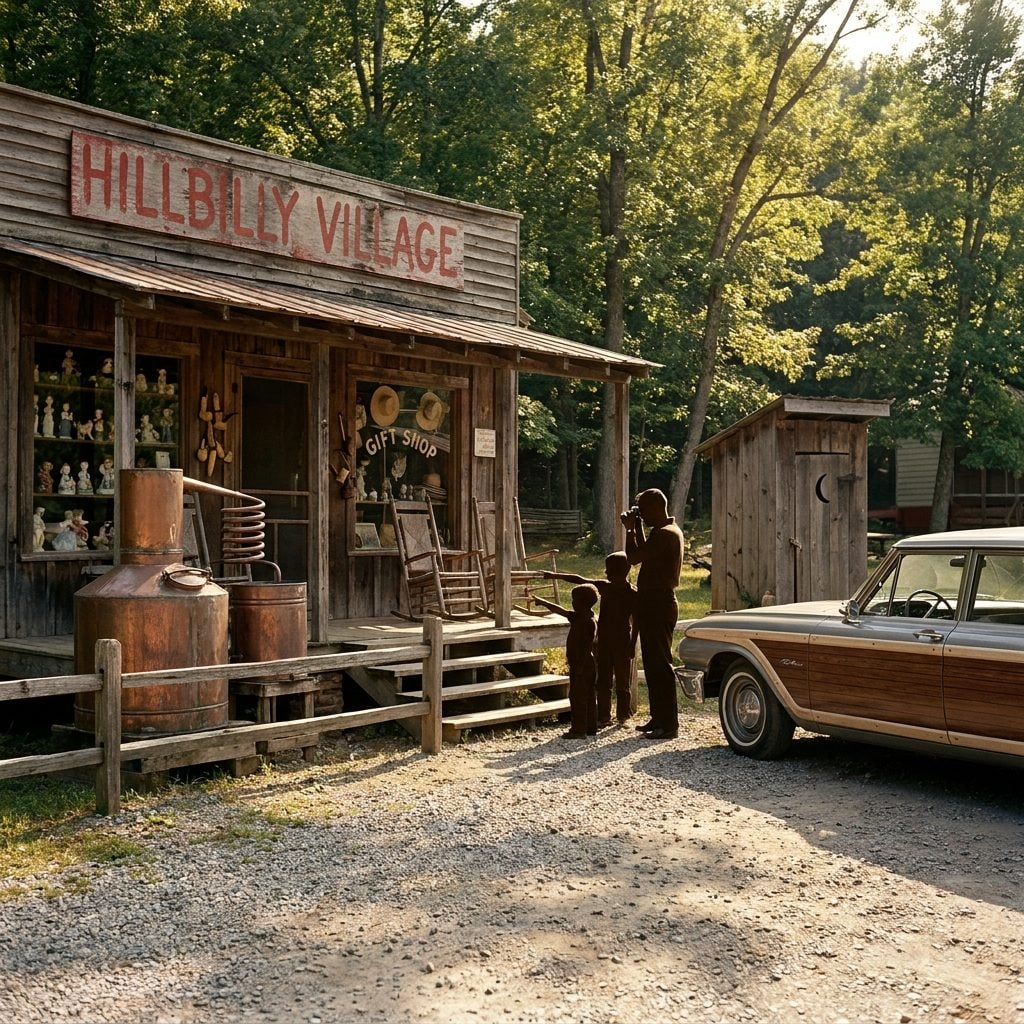
Somewhere between Gatlinburg and Branson, a family station wagon would slow down for a cluster of hand-painted signs advertising a “Genuine Hillbilly Village” — corn cob pipes, rocking chairs on a sagging porch, and a fake moonshine still you could stand next to for a photograph. These places dotted the Appalachian corridor and the Ozarks like dandelions: little curated hamlets of exaggerated rural life with outhouses, split-rail fences, and employees in overalls and straw hats who’d ham it up for the camera.
Dad always bought a jug of apple cider labeled “XXX” to take home. The gift shop sold corn cob pipes for a quarter and ceramic hillbilly figurines perched on tiny outhouses, and kids got a kick out of the “jail” where you could stick your head through a wooden cutout. Half the family photos from those trips look like stills from Hee Haw, and nobody minded.
The whole concept leaned hard into a cartoon version of mountain culture, built for flatlanders passing through on two-lane highways. Most had either folded or reinvented themselves as something slightly more dignified by the mid-seventies. But in 1963? Pulling off Route 441 to watch a man in a fake beard pretend to sleep on a porch was a legitimate family activity, and nobody thought twice about it.
1. The Coin-Operated Fortune Teller in the Glass Case Who Knew Your Future for a Dime
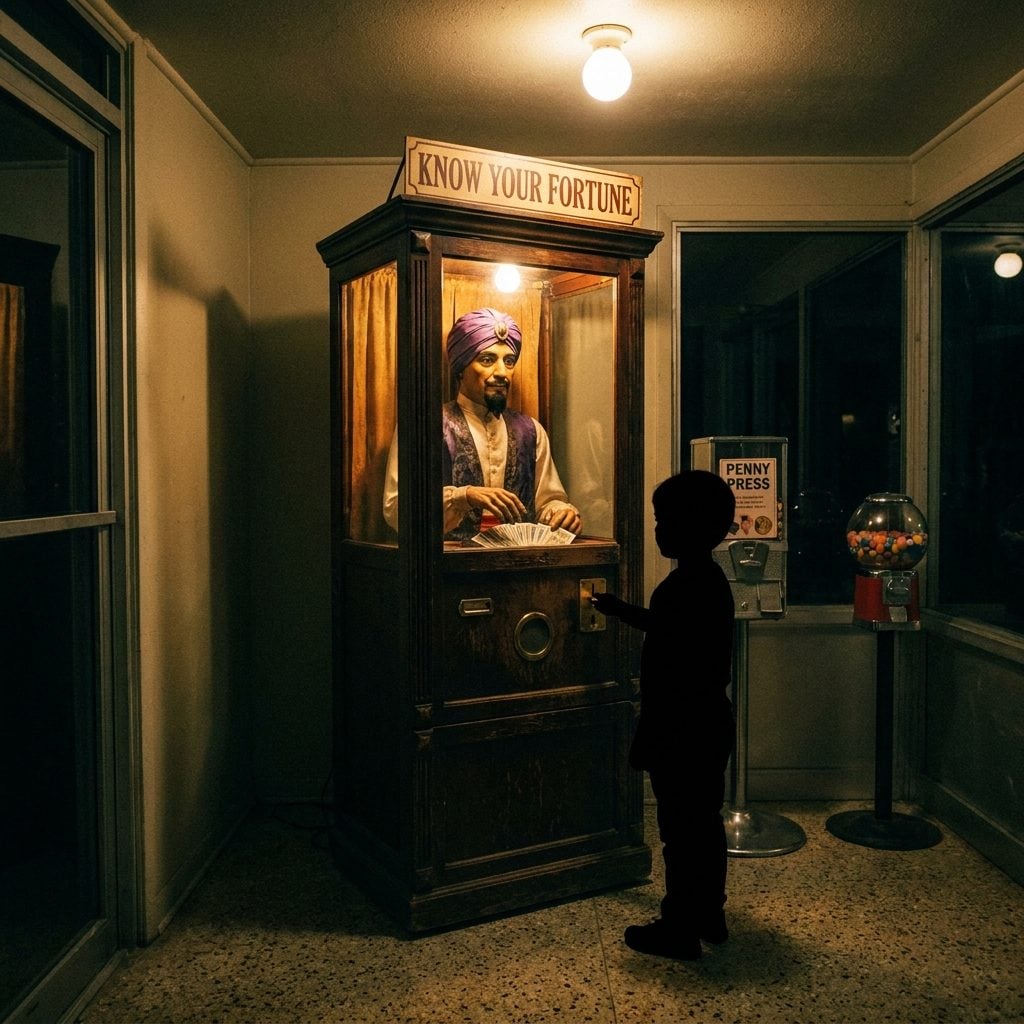
She sat inside a wooden cabinet with a glass front, usually near the exit of whatever attraction you’d just left, wedged between a penny press machine and a bubblegum dispenser. Zoltar’s more modest ancestor. These mechanical fortune tellers had wax or papier-mâché heads and turbans in faded purple or red satin — and glass eyes that caught the light in a way that was genuinely unsettling to a seven-year-old.
You dropped a dime in the slot. Her hand would creak over a set of cards, something inside the cabinet would grind and click, and then a small printed card would slide out of a brass slot at the bottom. The fortunes were always vague and cheerful: “A surprise awaits you on a long journey” or “Your wish will come true before the leaves fall.”
That card became a souvenir you’d tuck into your pocket and forget about until laundry day.
But the machine itself — that was the draw. Standing in front of that dim glass case, watching the mechanical figure slowly move its arm, hearing gears turn inside the wooden housing. It felt genuinely mysterious, even when you understood it was clockwork and printed cardstock. Would a kid today give it a second glance? Probably not. But in 1964, it held you completely still for fifteen seconds. And at that age, on a road trip, fifteen seconds of absolute stillness was close enough to a spell.
🔥 Would you like to save this?
Please note that some of the imagery in this article were created with the aid of AI image generators.