
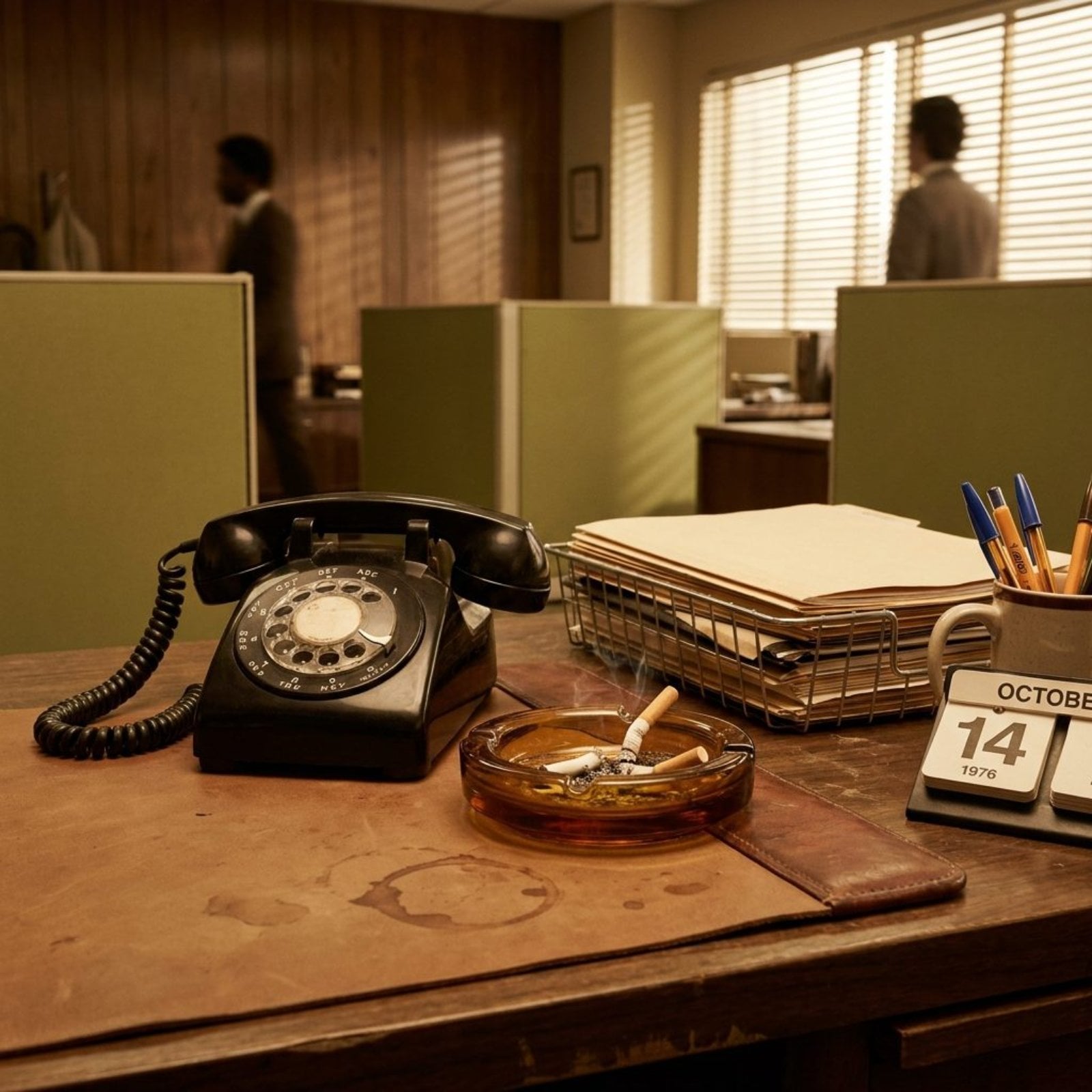
The smell hit you before you even reached your desk. Correction fluid drying on paper, the faint chemical burn of a mimeograph warming up, cigarette smoke baked into drop ceiling tiles. The 1970s office was a working machine in the most literal sense, full of equipment that clunked and hummed and jammed at the worst possible moment. Every single task that a smartphone now handles in seconds once required its own dedicated piece of hardware, its own ritual, its own learning curve. Here’s the equipment that kept it all running.
Would you like to save this?
The Ashtray Permanently Fused to the Desk Beside the Phone
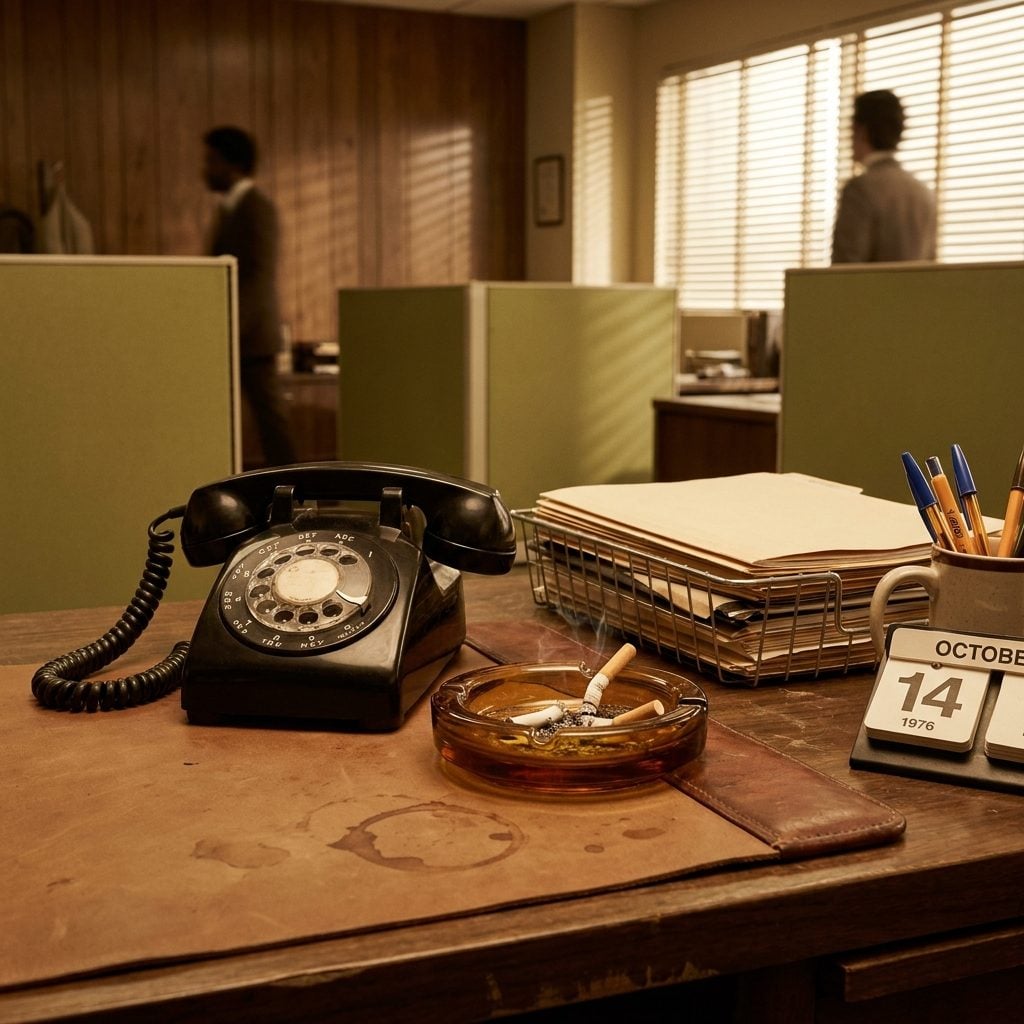
Nobody asked whether you minded. The ashtray was just there, the way the stapler was there, the way the phone was there. It sat between the rotary and the notepad and it was never moved, not even when someone was cleaning, because cleaning meant emptying it and putting it right back in the same spot, the same scorched ring burned into the desk blotter beneath it.
Lighting up while you were on a long call was so standard it barely registered. The phone tucked against one shoulder, a cigarette in the other hand, a legal pad balanced somewhere in between. This was multitasking, 1974 style. Nobody used the word multitasking. Nobody needed to.
The Dictation Machine With the Tiny Cassette Tapes Secretaries Could Recite From Memory
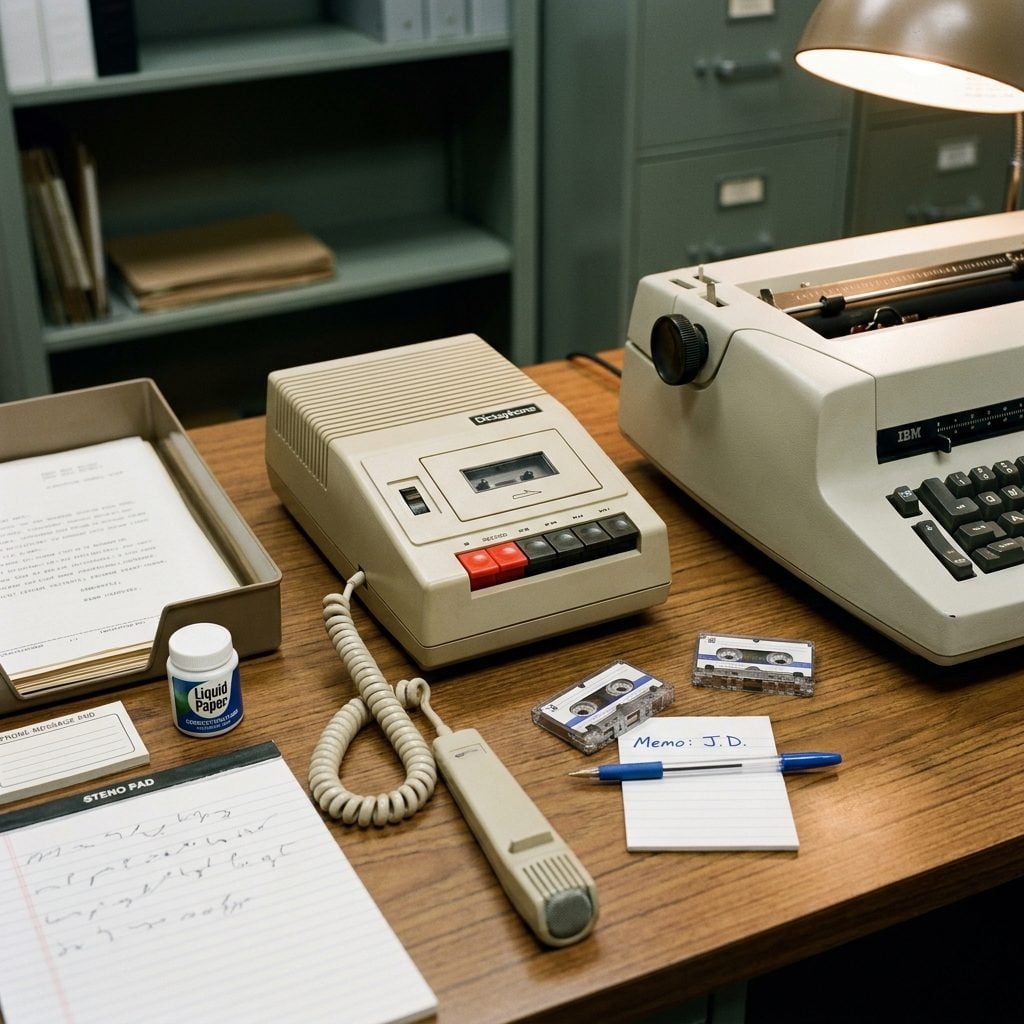
The boss talked into it in his car, or at his desk with the door half-shut, and by the time it landed on the secretary’s desk it was a tiny tape the size of a matchbook containing three letters, two memos, and one rambling thought he’d want deleted. She’d thread the earpiece in, hit play, and translate the whole thing into clean typed copy without once asking for a repeat.
The Dictaphone and the Norelco both made versions. The tapes were called microcassettes and they were easy to lose and expensive to replace and someone in every office was always looking for one.
The Filing Cabinet Drawer That Announced Itself Every Single Time
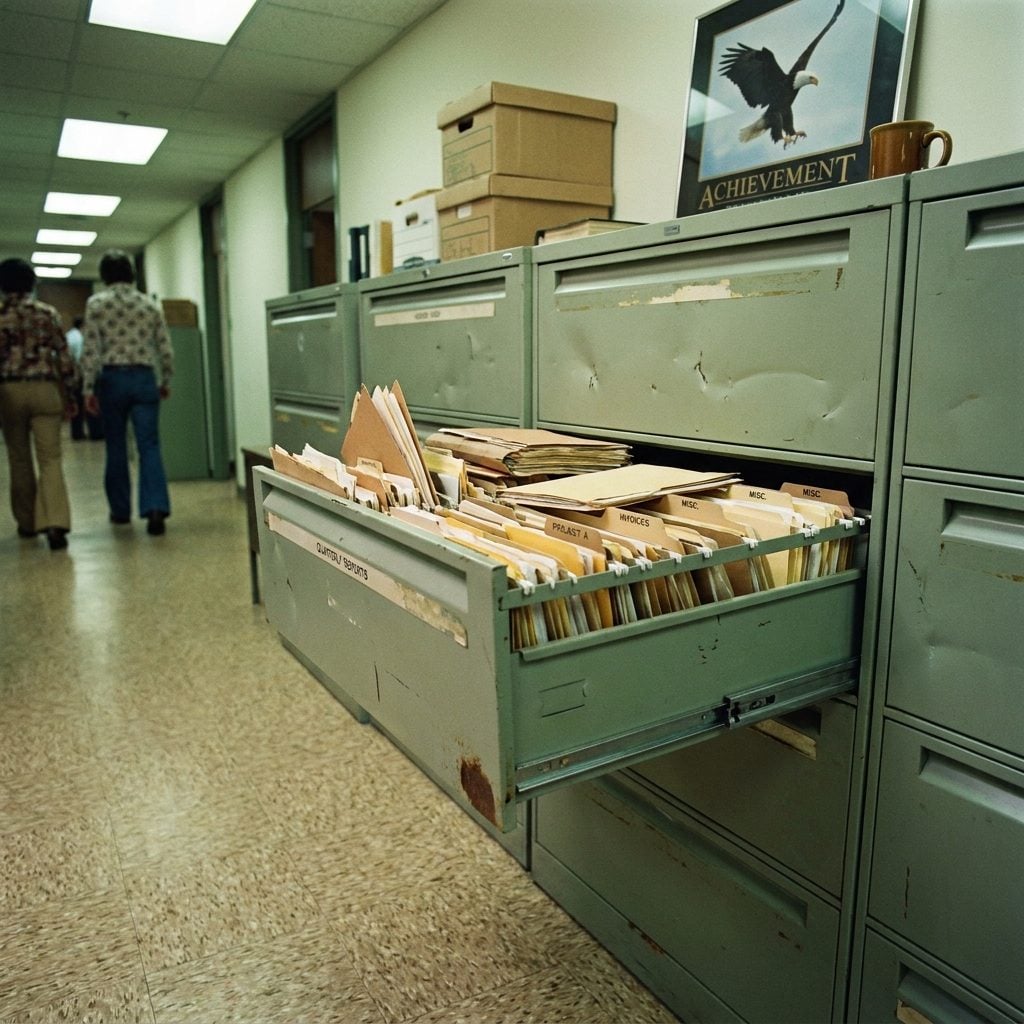
Every office had the one. The drawer that had been misaligned since roughly 1971 and nobody had ever fixed because fixing it would mean actually calling building maintenance and nobody wanted to do that. So it shrieked, every time, a long metal-on-metal groan that made the person on the phone three desks over flinch without even looking up.
The cabinets were almost always Steelcase or Kardex, painted that specific shade of grey-green that exists nowhere in nature. They weighed approximately as much as a Buick. When the office moved floors, three men and a dolly and two arguments were required to get one down the hall.
The Swingline Stapler Heavy Enough to Double as a Doorstop
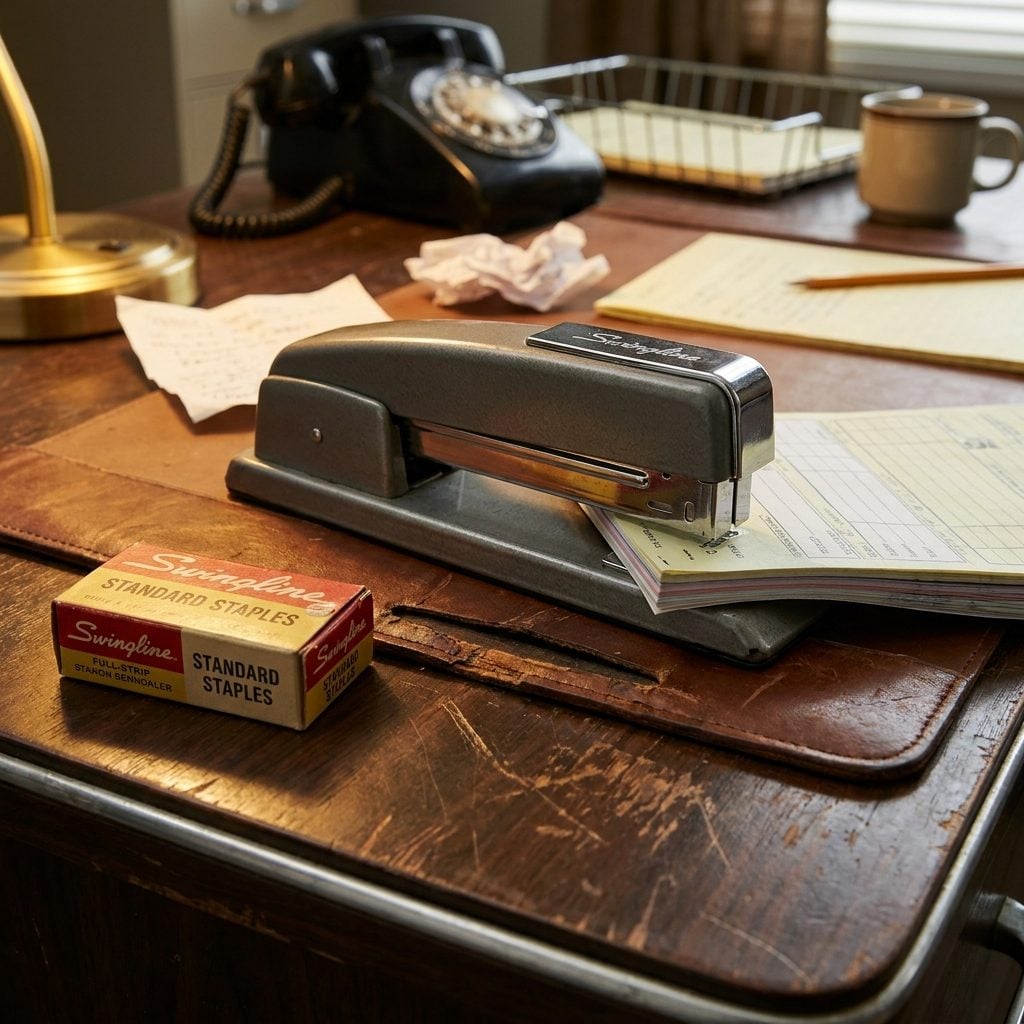
A good 1970s desk stapler had real mass to it. The Swingline 747 was the benchmark, all metal, no plastic nonsense, heavy enough that when you set it down it landed with a thud you could feel in the desk. You loaded it with a full strip of staples and it would fire through six pages without a second thought.
Staple jams happened roughly once a week and required a letter opener, a muttered word, and about ninety seconds of focused irritation. The staple remover lived in the top drawer. It had fangs and everyone knew not to lose it.
The Mimeograph Machine and the Ink Smell Nobody Wanted to Admit They Liked
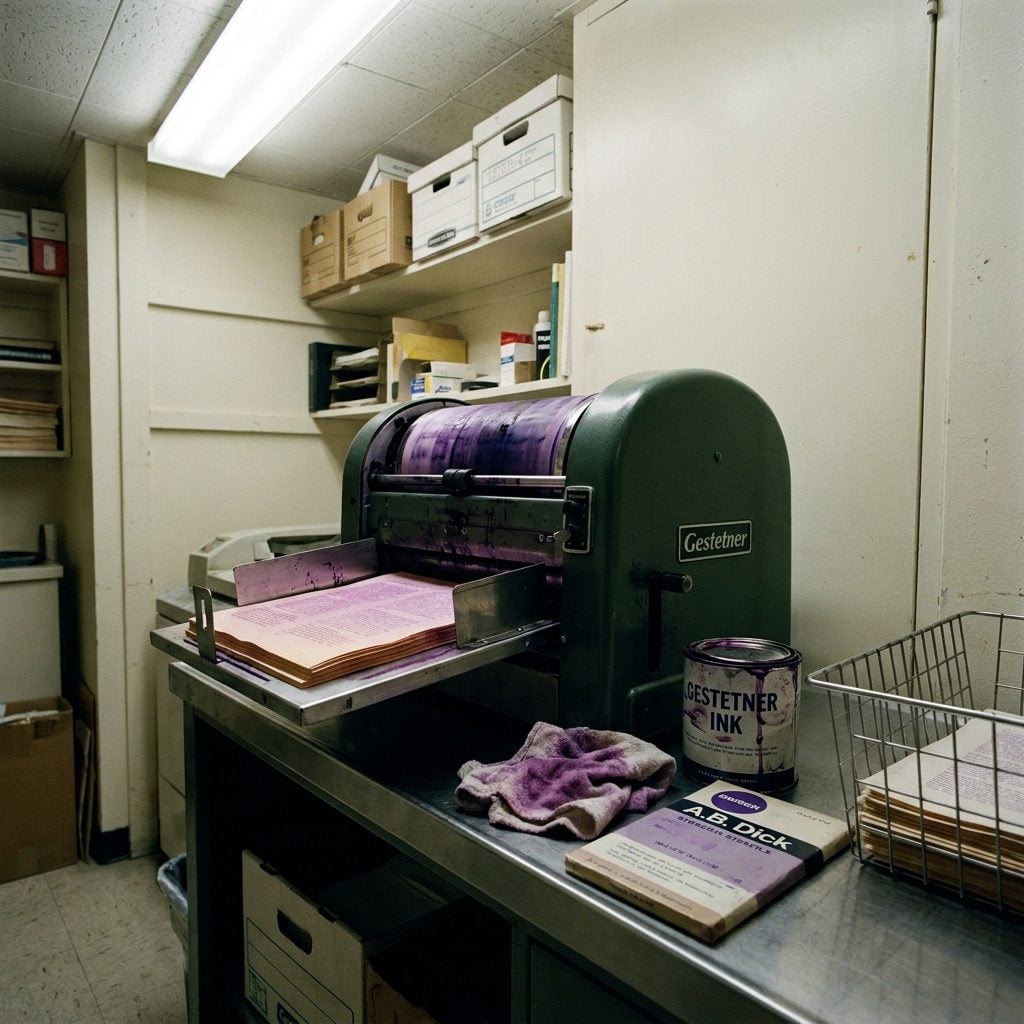
The second those freshly mimeographed pages came off the drum, half the office found a reason to walk past the copy room. Nobody admitted why. The smell of that purple-blue ink, slightly chemical, slightly sweet, was genuinely intoxicating in a way that office workers of a certain era will still describe with suspicious enthusiasm.
Mimeograph output had a texture to it, slightly waxy, slightly soft, and the ink would smear if you weren’t careful. The color was always that same dusty purple-blue. It looked like something between a letter and a ghost of a letter, which suited most company memos just fine.
“The second those pages came off the drum, half the office found a reason to walk by.”
The Slide Projector That Turned Every Conference Room Into a Cave
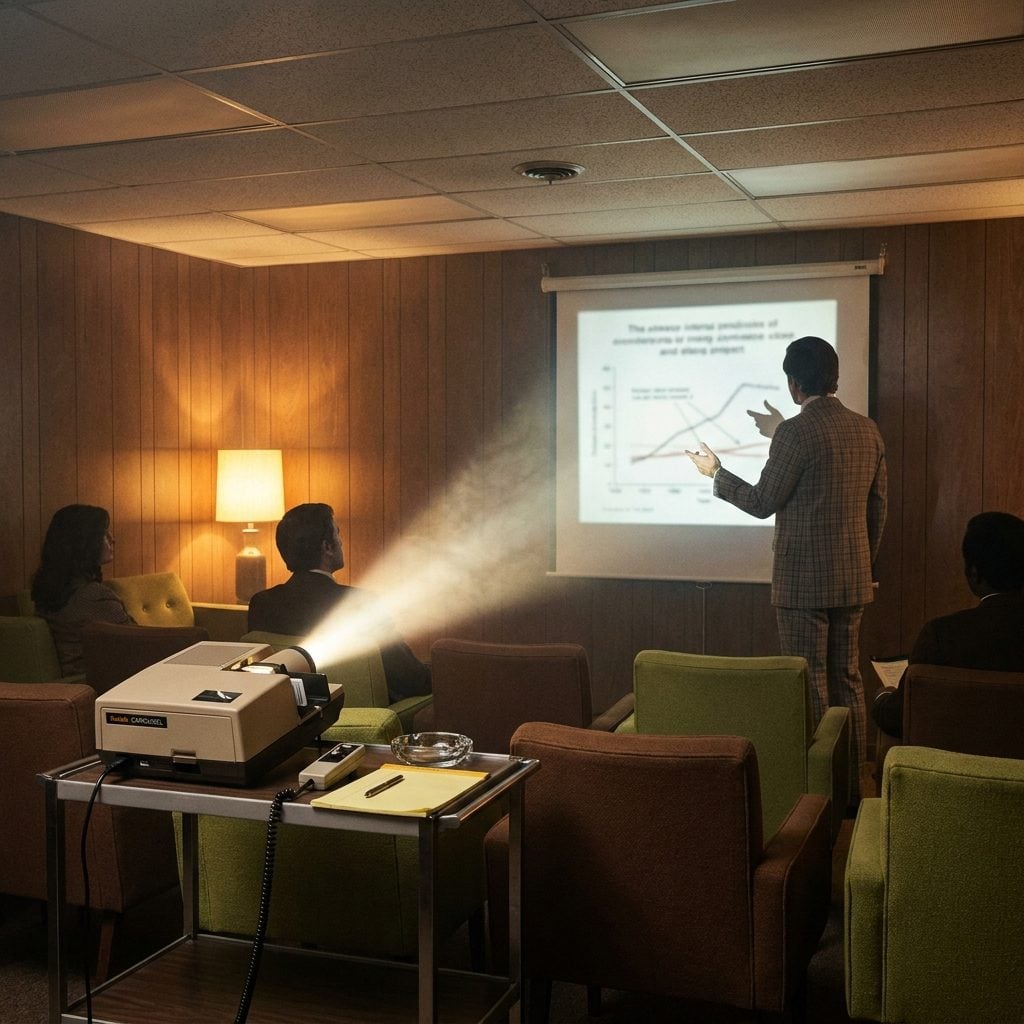
Someone would spend twenty minutes getting the carousel loaded in the right order, and there was always one slide in backwards, always, discovered at the exact moment it appeared upside-down in front of twelve people who had been sitting in the dark for forty minutes.
The Kodak Carousel was the projector everyone had. The round tray held eighty slides and made a satisfying mechanical chunk with each advance. The remote was a small handheld box on a long cord that got tangled in the presenter’s feet approximately every third slide.
Presentations ended when someone switched the lights back on and everyone sat there blinking, temporarily blind, while the fan inside the projector kept running for another two minutes with a sound like a small aircraft preparing to land.
The Punch Clock by the Door That Made Time Feel Visible and Slightly Threatening
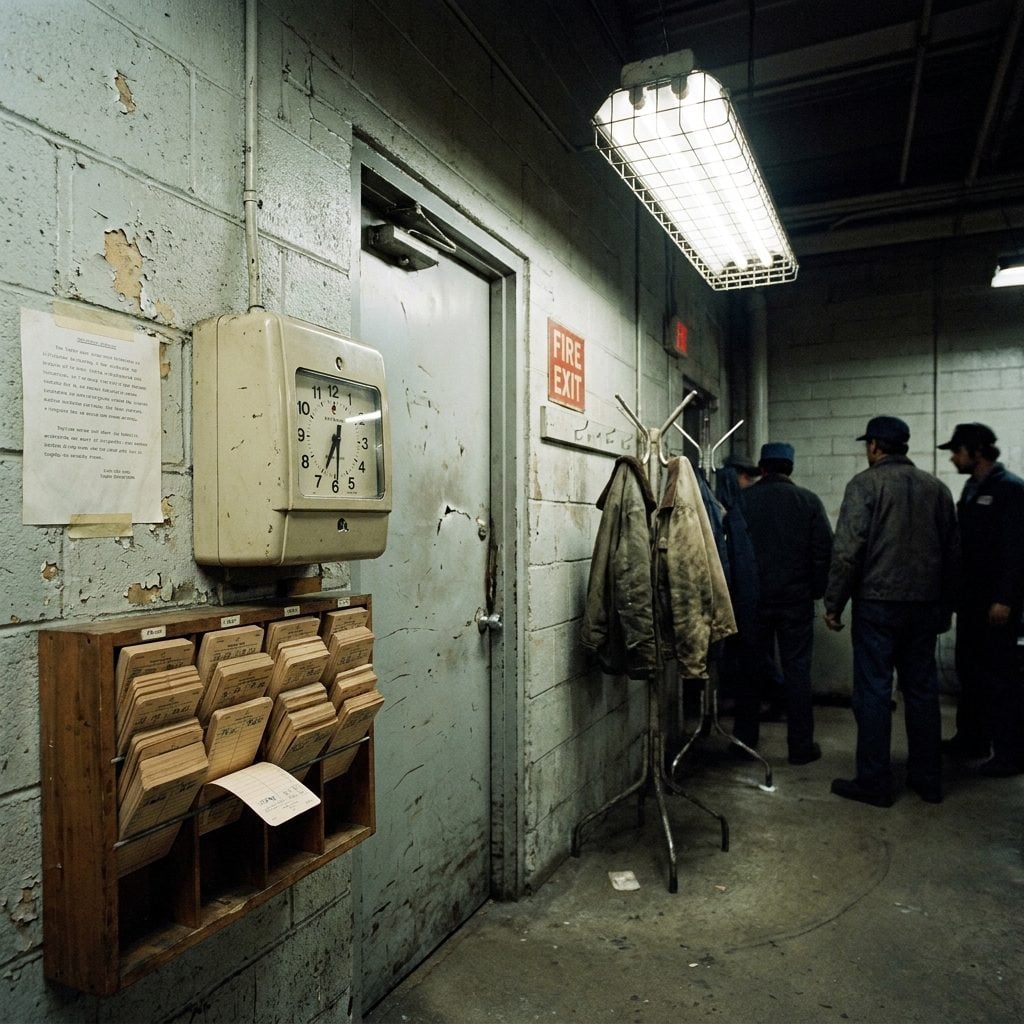
Eight-oh-two was not eight o’clock and everyone knew it and nobody was going to pretend otherwise. The punch clock didn’t negotiate. You slid your card in, it stamped the time with a mechanical chunk that you felt in your chest a little, and that was the official record, whatever the official record happened to say.
Time cards were collected on Friday and turned in to payroll. Losing yours was a problem nobody wanted. Punching in for someone who was running late was a fireable offense that happened constantly and was almost never reported.
The Cork Bulletin Board So Overloaded the Bottom Row of Memos Was Basically Archaeological
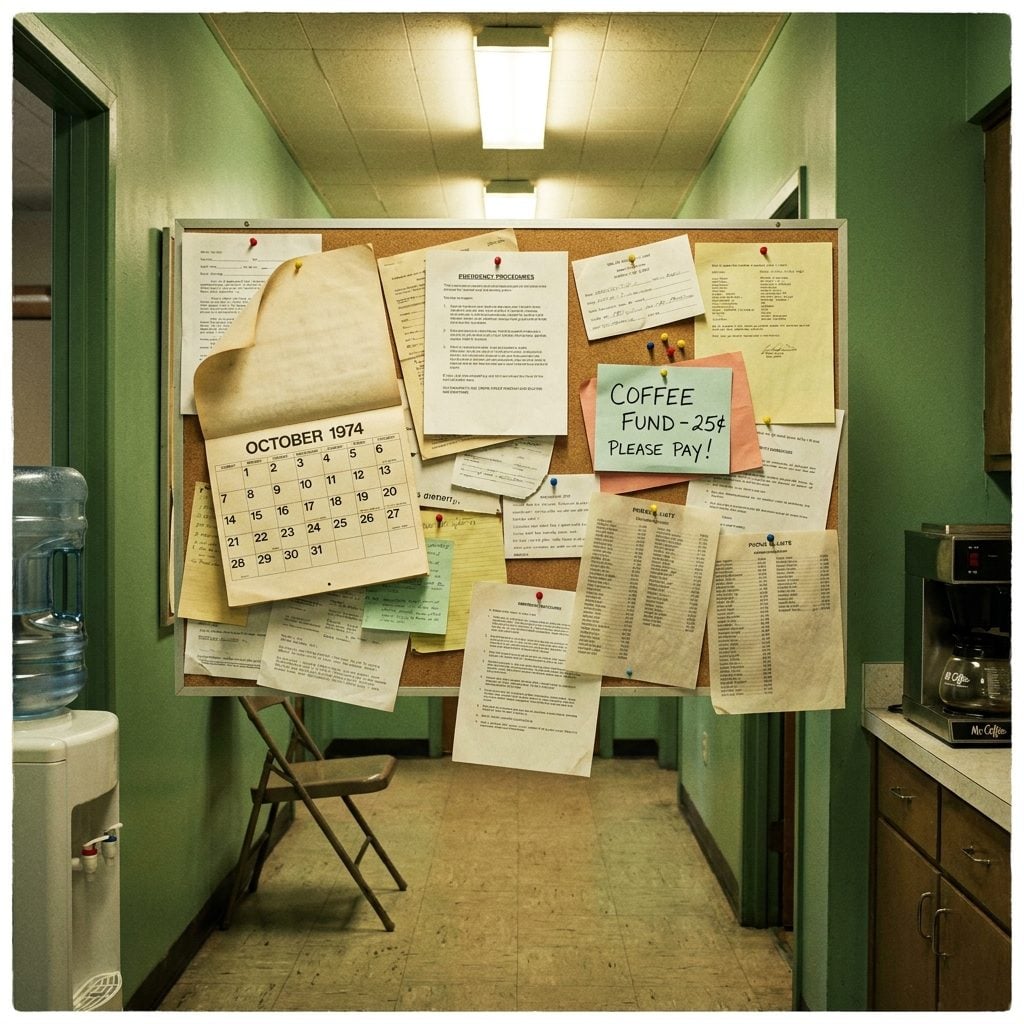
The top layer was current. Everything below that was history. Somewhere in the third or fourth stratum was a memo about the 1973 Christmas party and a sign-up sheet for a potluck that had already happened twice since, still collecting new pushpins on top of it because nobody wanted to deal with what was underneath.
The cork itself was soft and perforated from years of pins, the surface texture more hole than board in the high-traffic zones. Important notices got lost on these boards constantly. Urgent things got pinned next to a reminder about washing your own dishes, and both notices received equal attention, which is to say none.
The Coffee Percolator That Scorched the Same Pot From 9 AM to Quitting Time
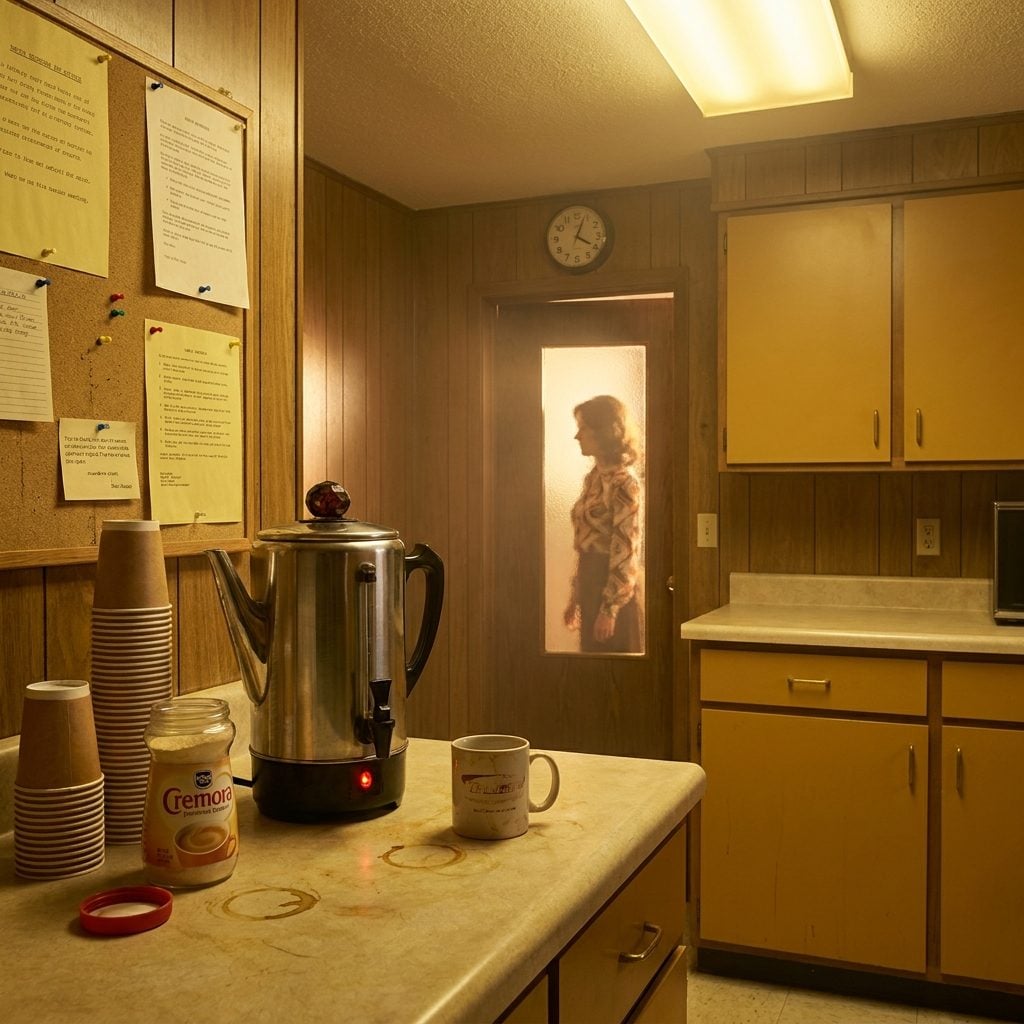
By 2 PM it wasn’t coffee anymore. It was a scorched, slightly oily reduction that had been sitting on the heating element since morning, cycling through burnt and more burnt with every passing hour. Nobody made a fresh pot. Nobody turned it off. The percolator just sat there on the break-room counter, gurgling faintly, filling the hallway with that particular smell: part café, part ashtray, part existential dread.
There was always one person who drank it anyway. Black. No complaint. Five cups deep by noon.
The Postage Meter That Required a Certified Operator and Possibly a Graduate Degree
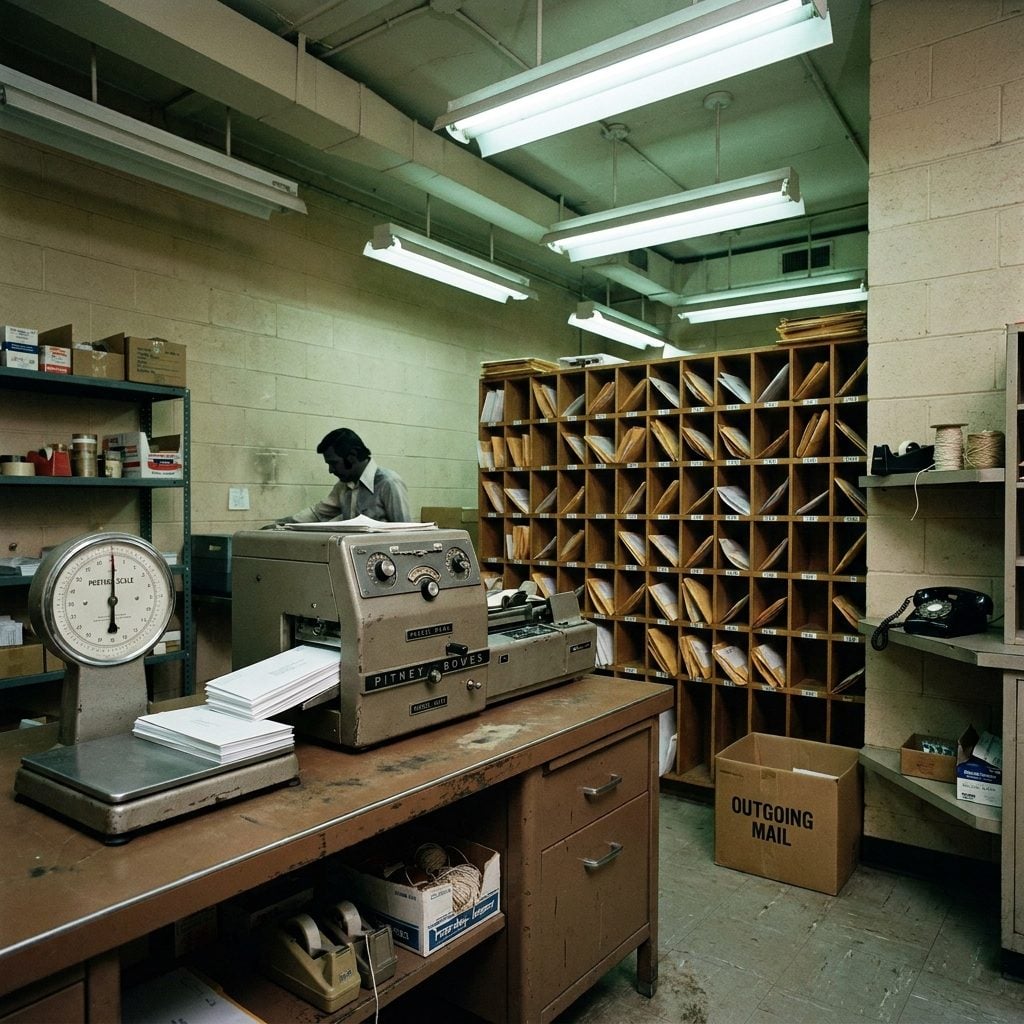
It sat in the mailroom like a small mechanical bureaucracy. Dials, levers, a feeding slot that jammed if you breathed wrong, and a reset procedure that required the laminated instruction card that someone had knocked behind the cabinet in 1974 and never retrieved. Only one or two people in the whole office actually knew how to operate it with confidence. Everyone else ran their envelopes by those people like penitents approaching a shrine.
Renting postage meters from Pitney Bowes or Friden was standard practice for any office with real mail volume. The postal rate changes in 1975 meant a panicked recalibration and at least one batch of mis-stamped envelopes that somebody had to hand-stamp at the post office anyway.
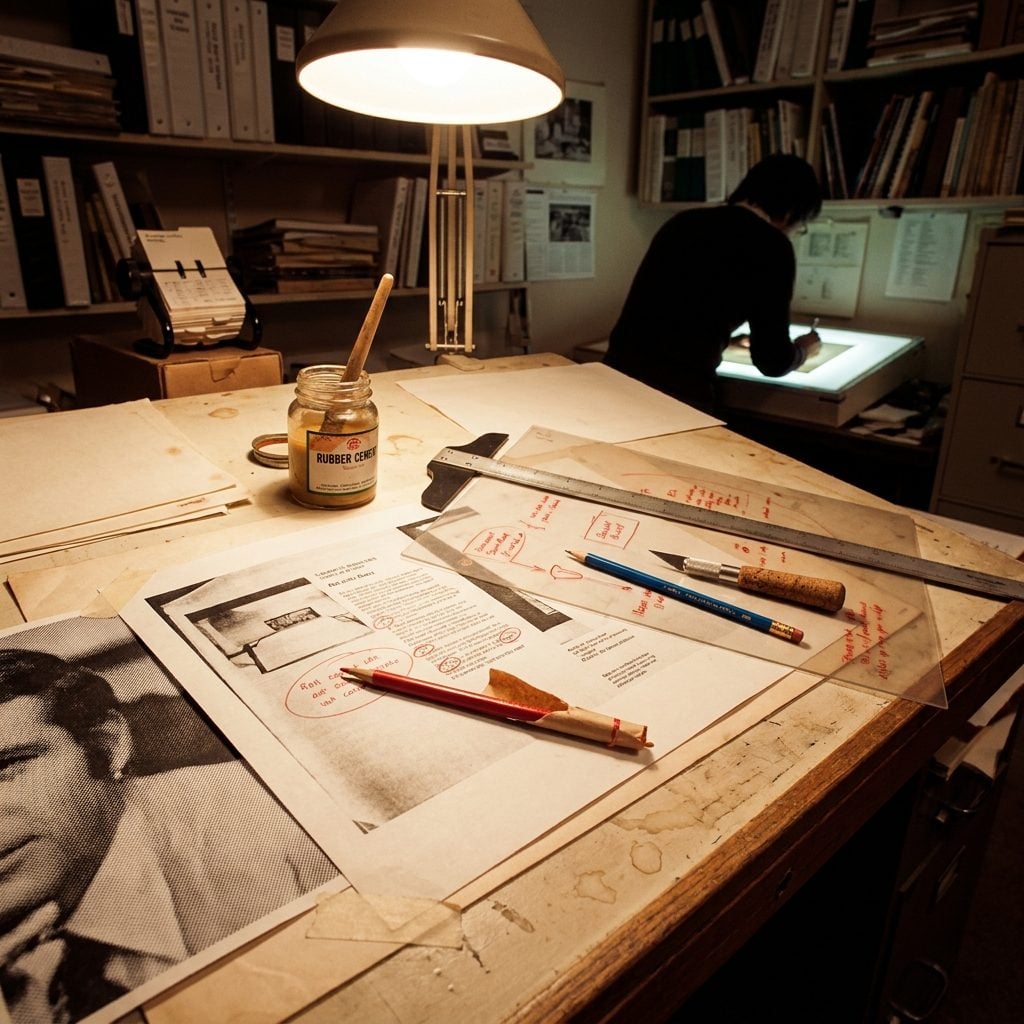
The Grease Pencil That Marked Up Every Layout, Proof, and Piece of Film That Passed Through the Office
Would you like to save this?
Pull back the paper wrapper, drag that waxy red tip across a layout, circle a widow on a typeset proof, mark a crop line on a photostat. The grease pencil was the editorial correction tool of the pre-digital office: it wrote on anything, wiped off film and acetate without scratching, and left a mark bold enough to survive being passed through three departments and a light table.
Art departments kept them in a jar like paintbrushes, a dozen half-unwrapped in various colors. Red for corrections. Blue for non-repro notes. You’d find ghost wax smears on every surface of a real working paste-up desk.
“It wrote on film, on glass, on anything short of your dignity.”
The Fan-Fold Computer Printout That Arrived From Data Processing and Confused Absolutely Everyone
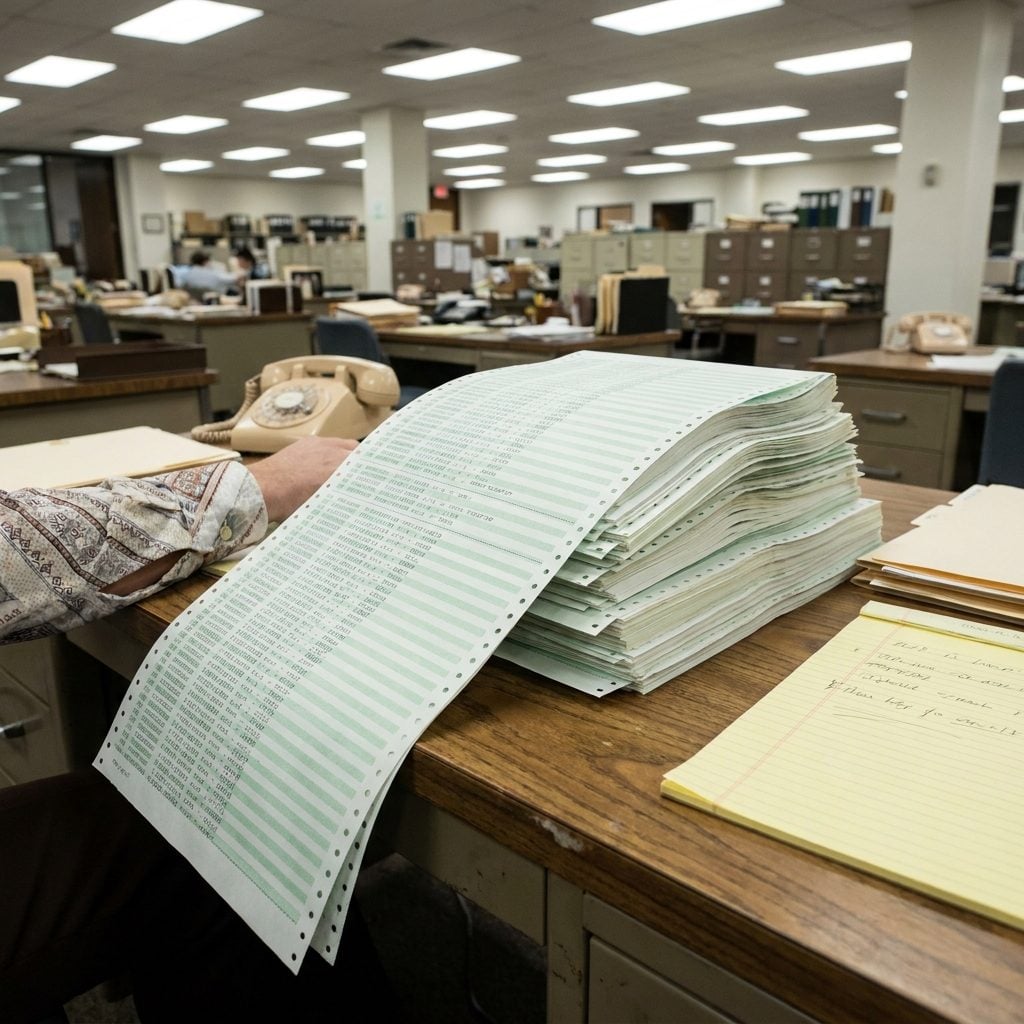
It would arrive from the data processing department in a box or under someone’s arm: an accordion-folded brick of green-bar paper, warm from the printer, smelling faintly of toner and something industrial. The dot-matrix columns ran for pages. There were numbers. A lot of numbers. Column headers abbreviated past comprehension. Most people who received these reports would page through a few sheets with a look of studied concentration, nod slowly, and set it on the credenza.
Genuinely understanding one required either a background in COBOL or a close working relationship with whoever ran the IBM 360 downstairs.
The Desk Blotter That Doubled as a Phone Directory, Doodle Pad, and Accidental Diary
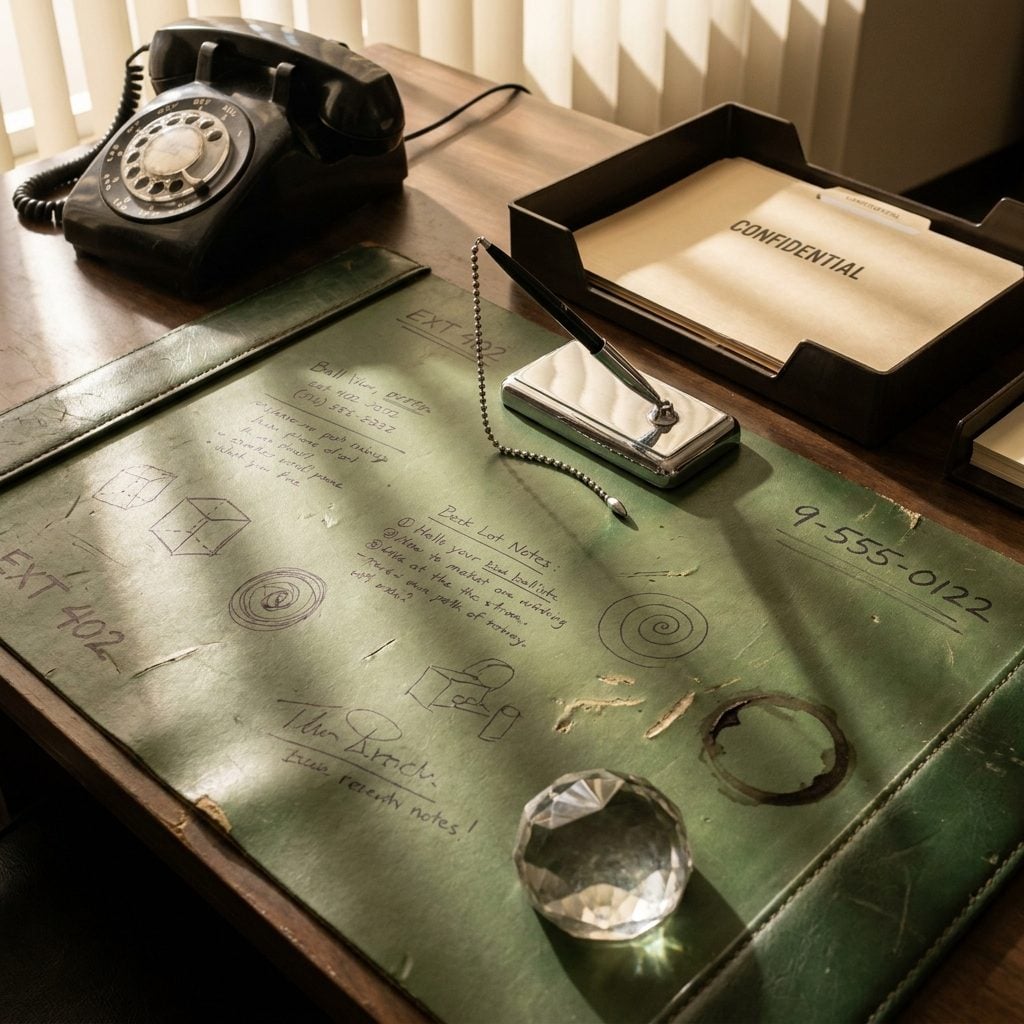
Every phone number that mattered was on the blotter. Not in a Rolodex, not in a directory, on the blotter, scrawled at whatever angle the pen happened to be moving when the call came in. Bob in Accounts, his extension crossed out twice as he’d moved desks. The vendor number for the paper supplier. Someone’s wife’s work number. A reminder to call someone that stopped being relevant in 1973 but never got crossed out.
The blotter was replaced once a year, maybe. When it finally came off, it took six months of institutional memory with it.
Coffee stains were honest markers of where the hard conversations happened.
The Fluorescent Desk Lamp That Buzzed Like a Trapped Insect From the First Day to the Last
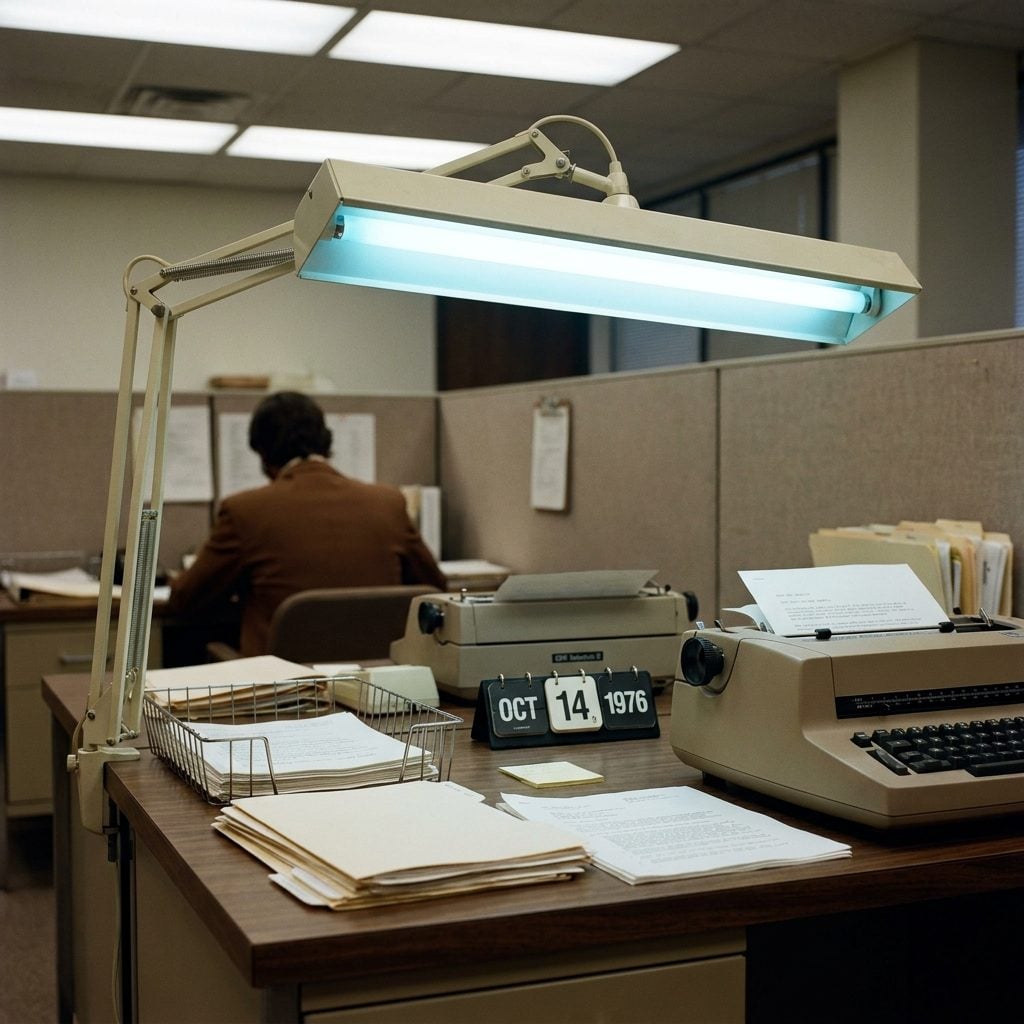
It hummed. Not always loudly, not always noticeably, but constantly, a thin, high-frequency buzz that you stopped consciously hearing after the first week and then somehow heard again every single afternoon around 3 PM when the rest of the office got quiet. The fluorescent desk lamp was standard issue for anyone doing close work: typing, proofing, drafting, accounting. The light it threw was efficient, shadowless, and completely merciless about showing every typo.
When a tube started going, it would flicker rhythmically for days before anyone requisitioned a replacement. Facilities moved at their own speed.
The Rolodex That Held Every Relationship the Company Had Ever Built
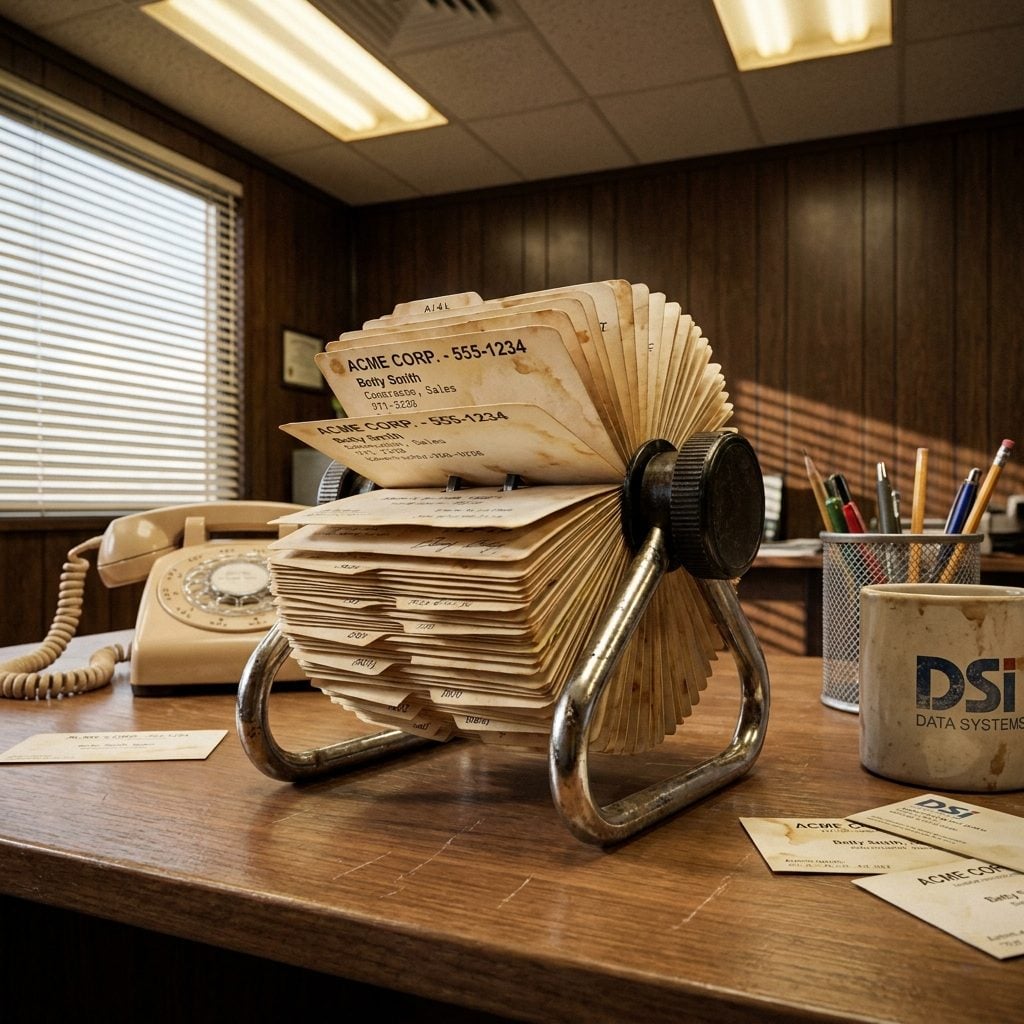
Every salesman, every account manager, every office manager worth the title had one, and nobody touched anybody else’s. The Rolodex was personal infrastructure. Flip, flip, flip — that soft clicking of metal tabs rotating through alphabetized cards was the 1970s equivalent of scrolling through your phone contacts, except slower and somehow more satisfying.
Some cards had typed entries, clean and official. Most had handwritten additions in three different ink colors, phone numbers crossed out and rewritten, cryptic marginalia like “wife’s name Linda” or “ALWAYS calls back after 2.” Lose the Rolodex, lose the business. People guarded these things the way we guard passwords now — maybe more fiercely, because you couldn’t reset a Rolodex from your email.
The IBM Selectric Typewriter and Its Hypnotic Silver Ball
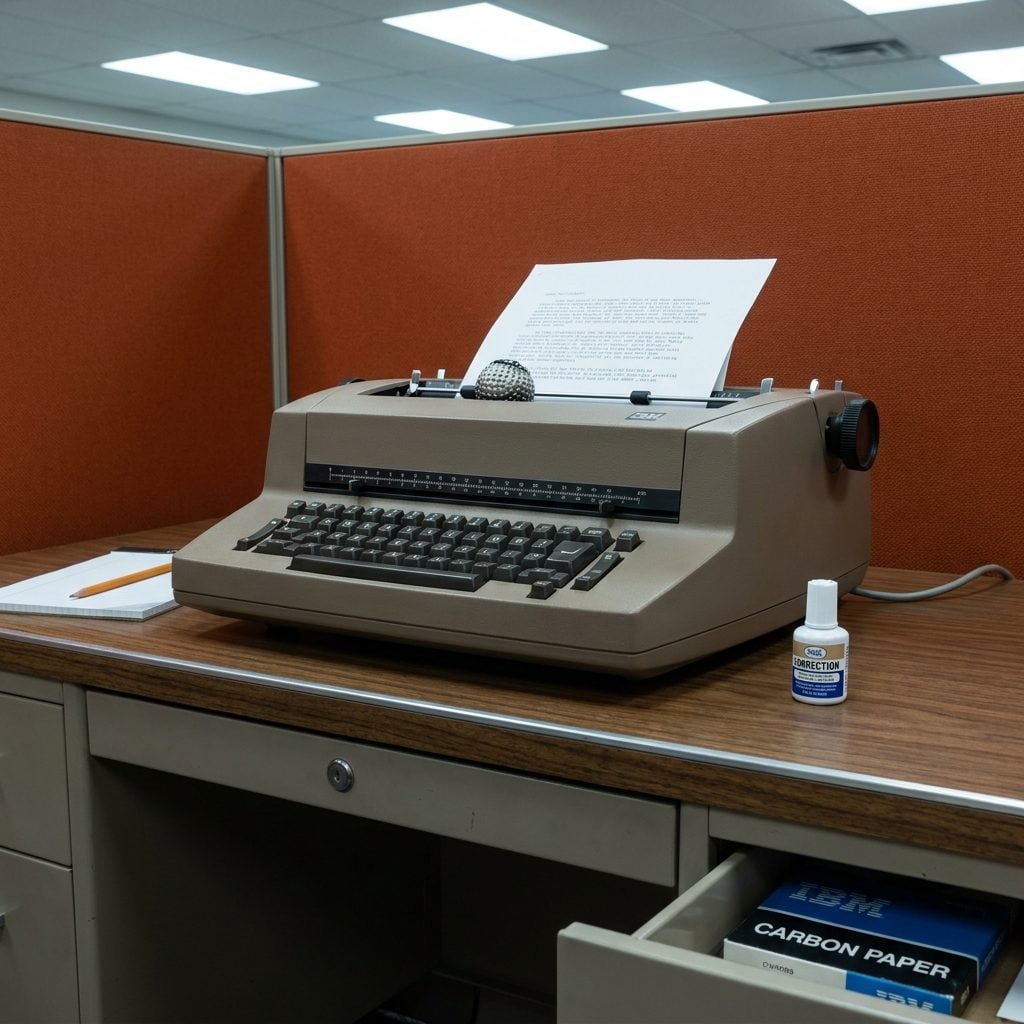
That humming ball of type, spinning and tilting with mechanical precision before striking the ribbon — mesmerizing. A good secretary could make it sing at seventy words a minute, the carriage staying perfectly still while that silver sphere did all the traveling. Nothing in a modern office has that same kinetic appeal.
The Selectric changed the entire soundscape of an office. Gone was the slow clack-and-ding of manual typewriters, replaced by a rapid, muffled tapping that became almost musical when someone who really knew the machine got going. Need a different font? Pop out the typeball, snap in another. Two seconds. The whole concept felt absurdly futuristic for something powered by ribbon and paper.
The Carbon Paper That Stained Your Fingers for the Rest of the Day
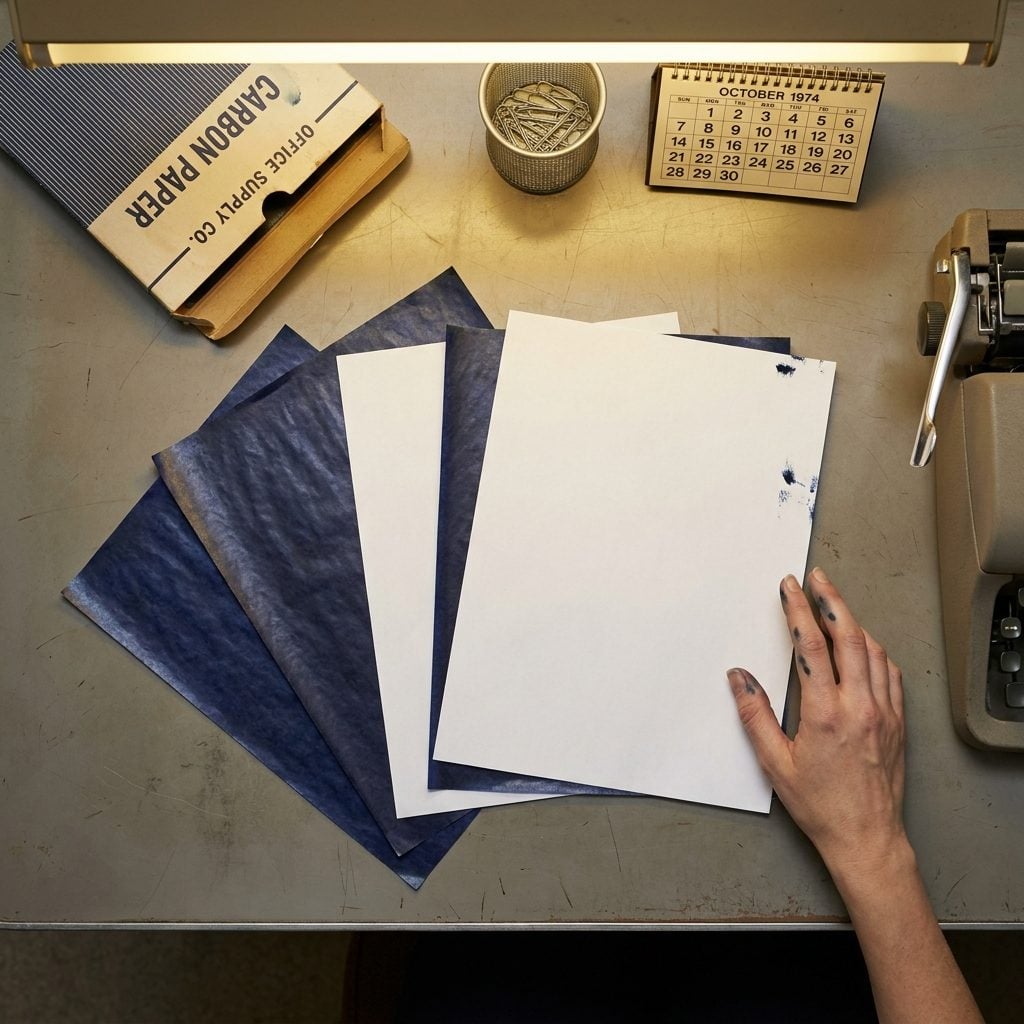
Blue-black fingers. That was the price of duplication before Xerox machines colonized every hallway. You sandwiched that thin, waxy, impossibly messy sheet between two pieces of typing paper and prayed you didn’t smudge the original while feeding it into the carriage.
Three copies meant two sheets of carbon paper, perfectly aligned, and a single typo meant correcting every layer individually — a punishment that seemed specifically designed to make you a better speller. The stuff migrated everywhere: your blouse, the desk, the phone receiver. Crumple a used sheet and the ink transferred to whatever it touched next, like some vindictive office-supply hex that followed you home on your cuffs.
The Paper Cutter With the Giant Blade That OSHA Would Weep Over Today
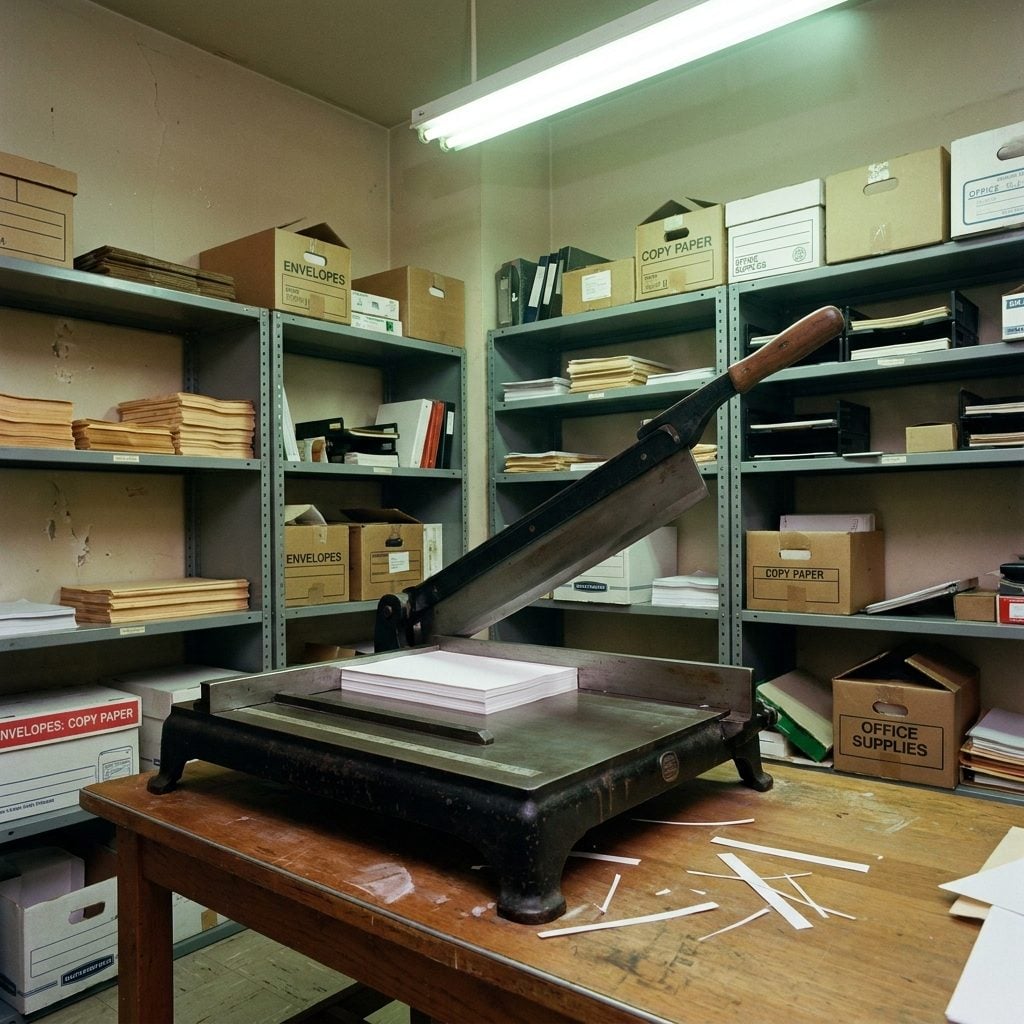
No guard. No lock. No warning label. Just a two-foot blade on a cast-iron arm that could take a finger off cleaner than any surgeon, sitting in the supply room like it was a stapler.
Everyone used it and nobody was trained on it. You lined up your stack of paper, brought the blade down with a satisfying thwack, and hoped your other hand was somewhere safe. The entirety of the safety protocol was the secretary who’d yell “Watch your fingers!” from across the room. Somehow we all came through intact, though I’m genuinely not sure how.
The Intercom System That Let the Boss Summon You Like a 19th-Century Butler
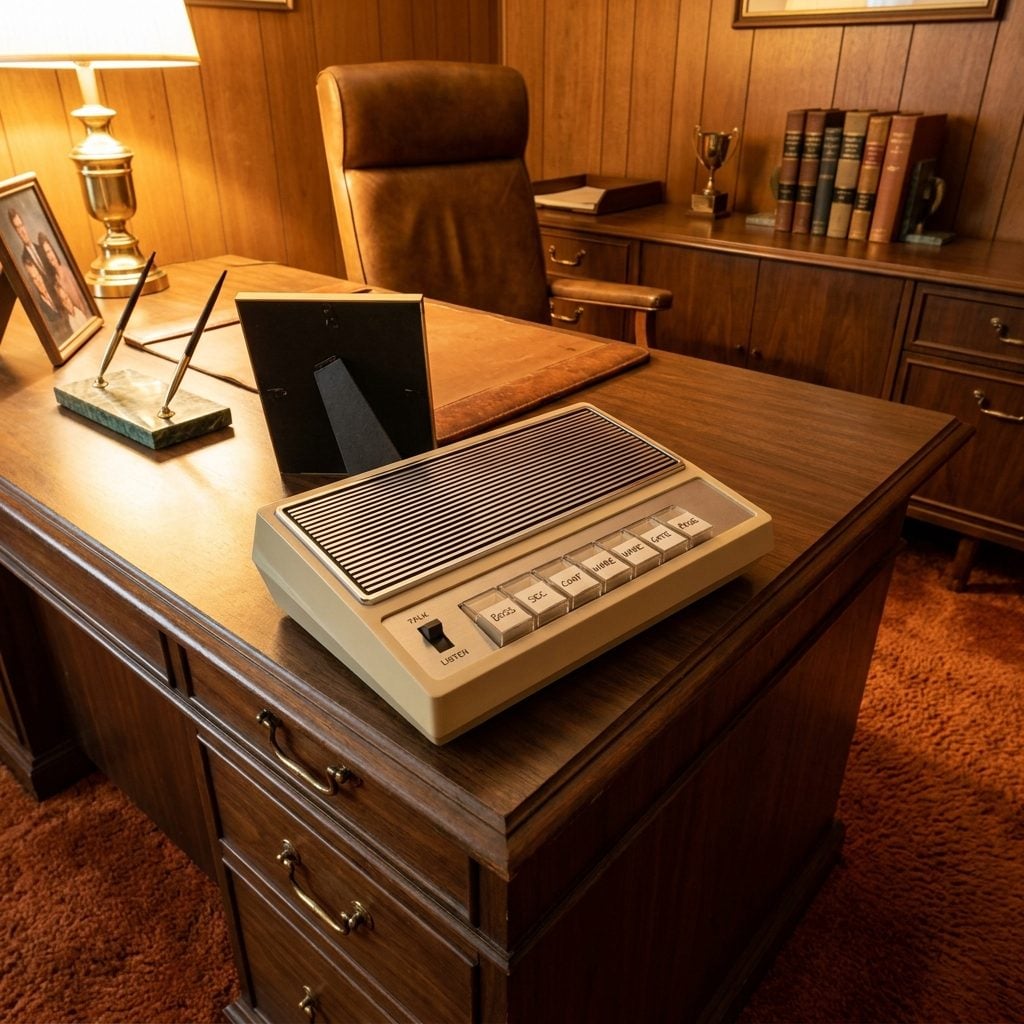
“Margaret, come in here.”
Tinny. Slightly distorted. No greeting, no please — just a command broadcast through a speaker the size of a playing card. The intercom was the boss’s favorite instrument, and everybody else’s least favorite sound in any building.
You couldn’t ignore it or pretend you hadn’t heard. The thing sat on your desk like a one-way surveillance device, and when that light flickered on and the speaker crackled to life, your stomach dropped a little. Worse? The whole office heard it too. Whatever dignity you’d built up that morning evaporated the moment your name came barking out of that chrome grille. Privacy was never part of the spec.
The Liquid Paper Correction Fluid and Its Chemical Perfume
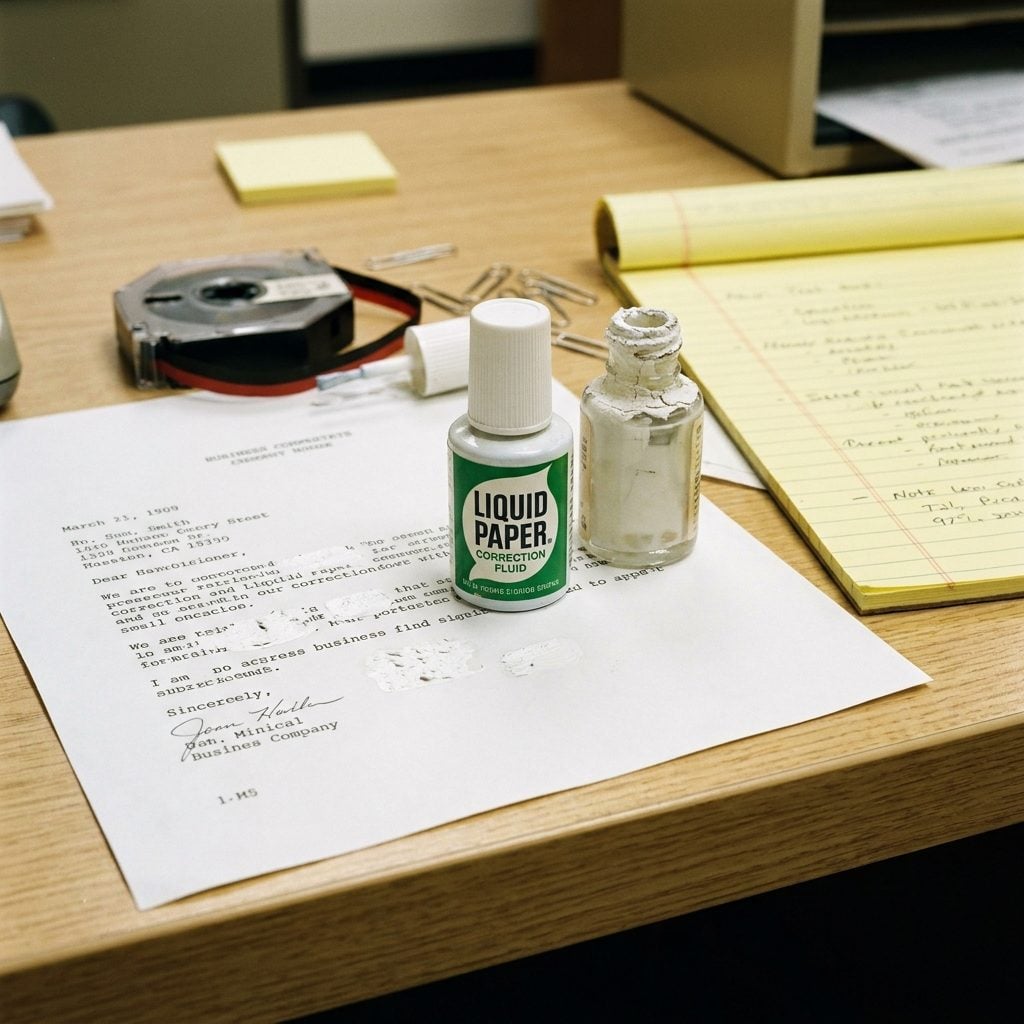
That little green bottle with the built-in brush. The white goop that never quite matched the paper color. And the smell — lord, the smell — like nail polish remover’s more industrial cousin, wafting across the typing pool every time someone made a mistake. You’d dab it on a typo, blow on it, wait, roll the page back into alignment, and retype over the spot. Half the time you could still see the ghost of the original letter lurking underneath.
By Friday afternoon, some pages looked like they’d weathered a small blizzard. Bette Nesmith Graham invented the stuff in her kitchen, by the way — secretary, single mom, working with a blender and tempera paint. She eventually sold the company to Gillette. Did spectacularly well for herself.
The Adding Machine That Spit Out Paper Tape Like a Ticker at the Stock Exchange
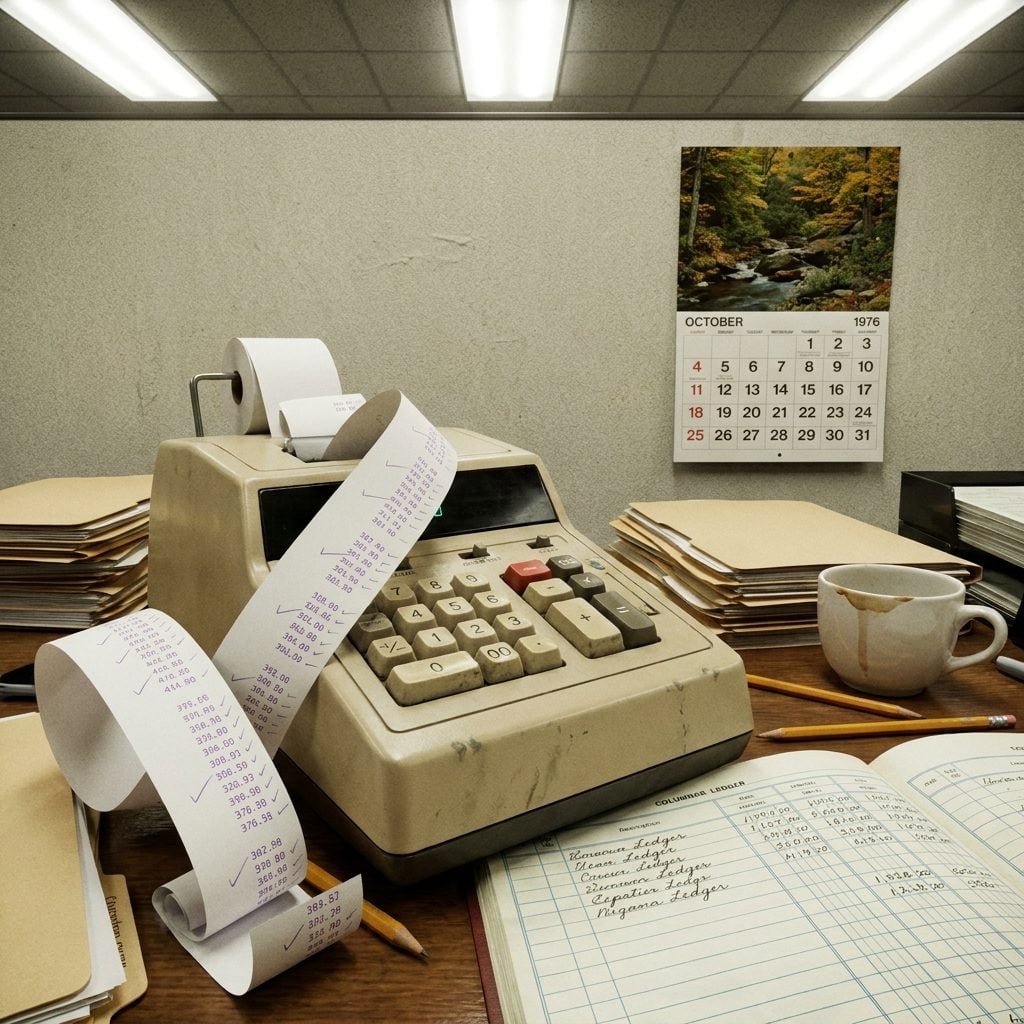
The accounting department sounded like a room full of tiny jackhammers. Ka-chunk, ka-chunk, ka-chunk, TOTAL. Paper tape kept coming and coming, curling off the machine and pooling on the desk in loose white ribbons nobody asked for.
People saved those tapes religiously — stapled them to invoices, filed them in folders, draped them over their arms while walking to the boss’s office like a lawyer carrying exhibits. The purple ink faded fast, which meant you had maybe two weeks before your proof became a blank strip of nothing. And still, the accountant would swear by the number on that tape over any calculator display. Irrational? Sure. But that was the culture.
The Rubber Stamp Collection That Sat in a Rotating Rack Like a Miniature Armory
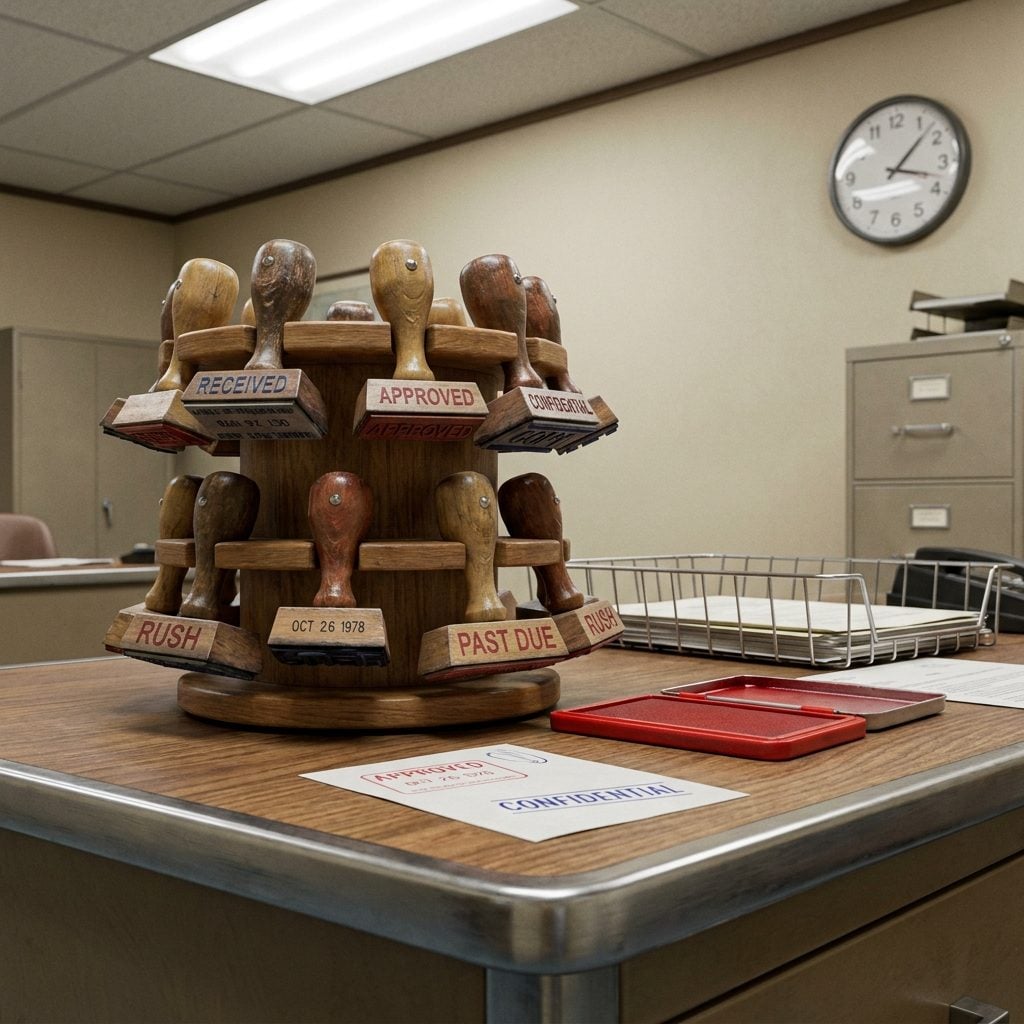
RECEIVED. APPROVED. CONFIDENTIAL. PAST DUE. RUSH. Each in its own slot, handles up, ready for deployment. A little carousel of bureaucratic force.
There was a ritual to it. Pull the stamp. Press it firmly into the ink pad — two firm presses, always two. Then bring it down on the document with your whole forearm, because a weak impression was an embarrassment nobody forgave. The date stamps were the most satisfying part of the whole setup: those little rotating rubber bands you’d click into position each morning, carefully lining up month, day, and year before the first envelope got opened. Mundane work, but it had a quiet ceremony to it that I think people actually enjoyed, even if they’d never admit it.
The Three-Ring Binder System That Organized an Entire Department’s Knowledge Into Vinyl-Covered Spines
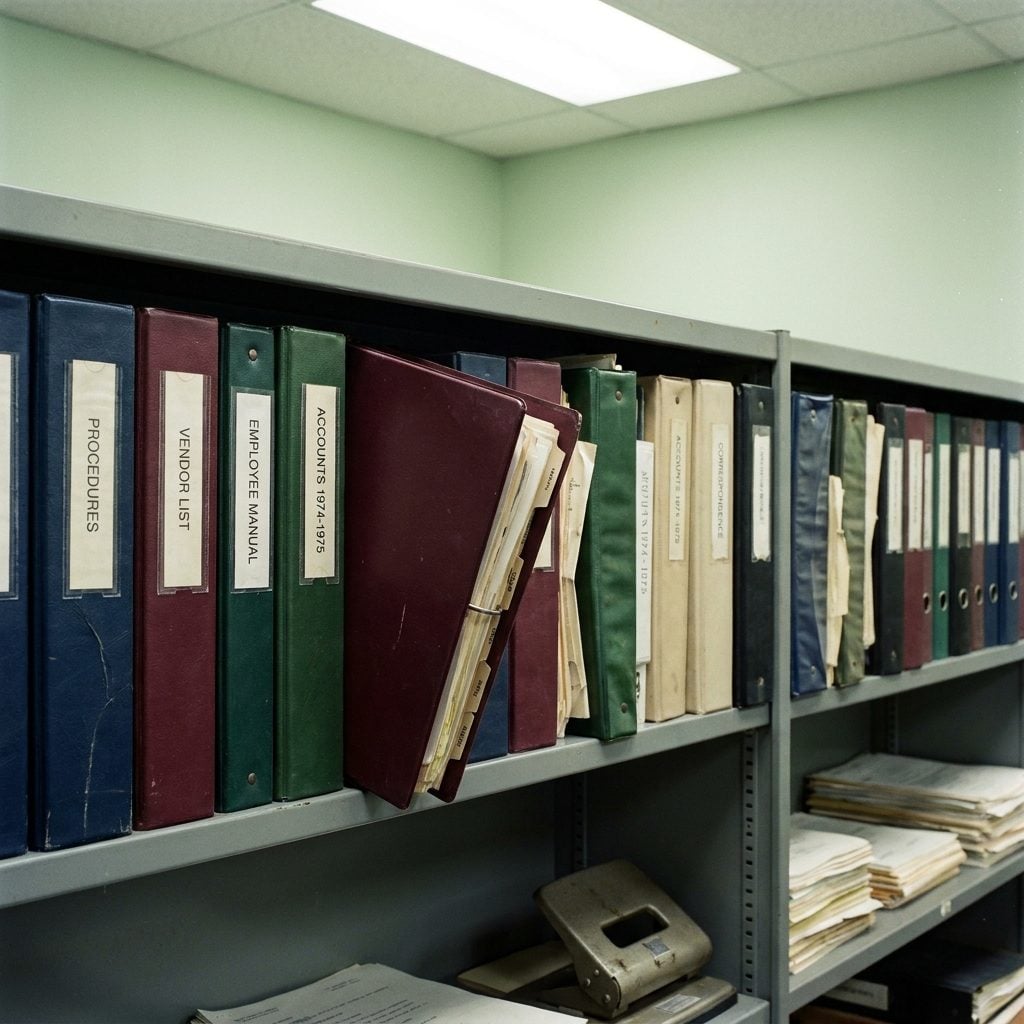
Before databases, before shared drives, before anything resembling a cloud, there were binders. Walls of them. Shelves groaning under the weight. Each one a small encyclopedia of institutional knowledge that somebody, at some forgotten point in history, had painstakingly typed, hole-punched, and sorted behind labeled tab dividers.
Finding anything meant knowing which binder, which tab, and roughly how far back. “It’s in the blue binder, third tab, about halfway back” counted as precise directions. New employees spent their entire first week just learning the system.
The three-hole punch was the binder’s loyal companion. And the universal frustration? Paper that tore free from the rings and slid to the bottom, lost until someone did the annual cleanout. Which never happened annually. Sometimes never happened at all.
The Message Pad With the Pink “While You Were Out” Slips That Were the Only Voicemail That Existed
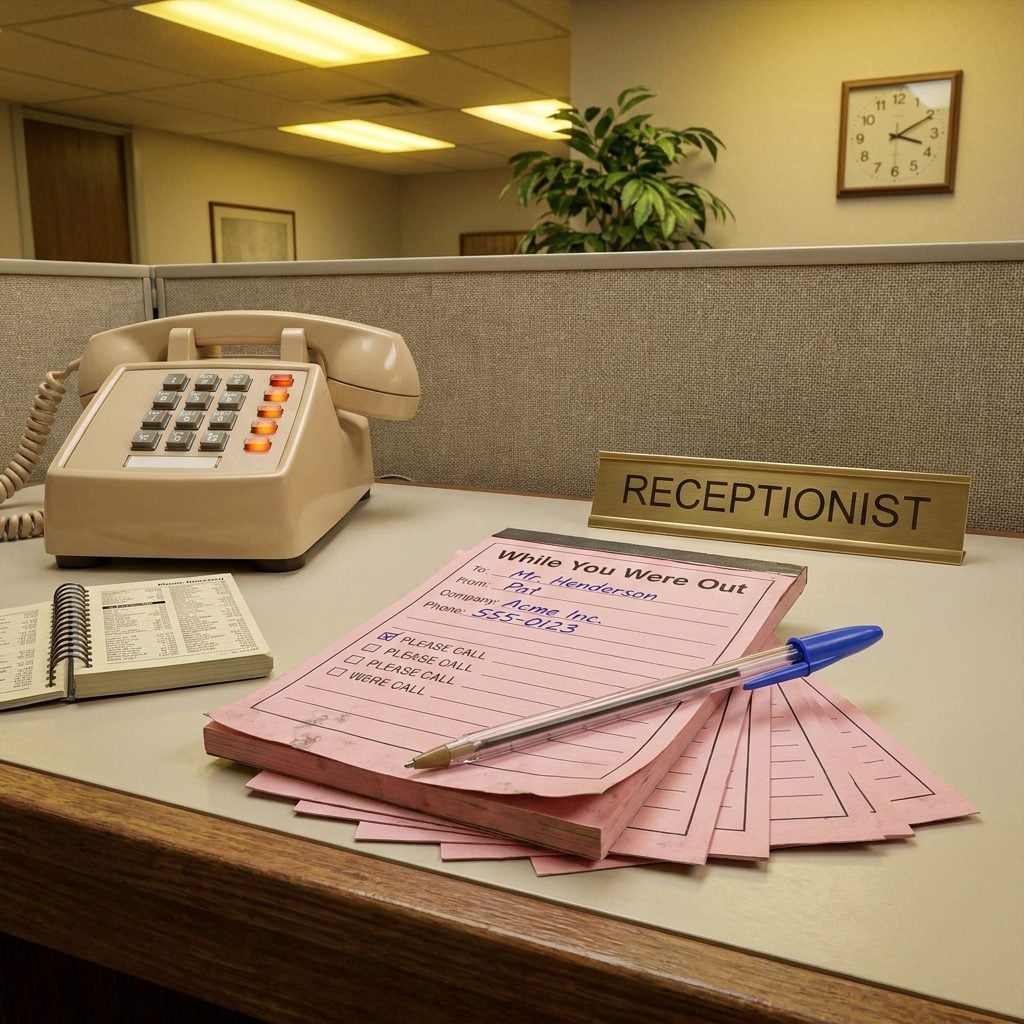
You came back from lunch and there they were: a small pink stack of destiny sitting on your desk. Sometimes one slip. Sometimes six. Each a tiny mystery — who called, what they wanted, and then the most ominous checkbox of all: URGENT.
The receptionist’s handwriting determined your entire afternoon. A legible slip with a clear callback number? Great, you’re in business. A slip that read “Mr. Smthng called, no number, wants you to call back”? Good luck. There was always — always — at least one where the “please call” box was checked but the phone number field sat completely blank. Just a name floating on pink paper, daring you to figure it out.
The Telephone Message Spike That Impaled Every Pink Slip Into a Tower of Unreturned Calls
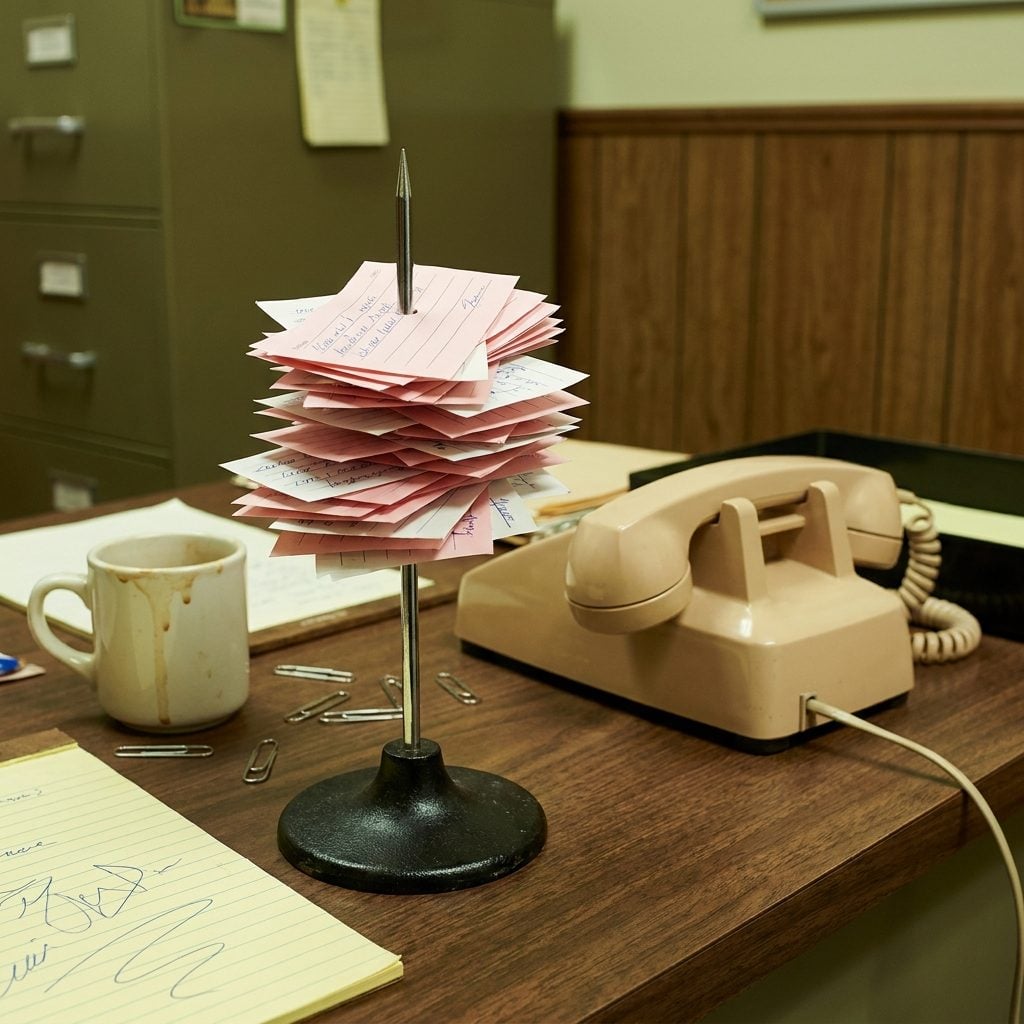
Before voicemail, before email, before any digital anything, there was a chrome needle on a heavy base — and every message you ignored got stabbed onto it. The spike was brutally honest. You couldn’t mark something as unread and pretend you hadn’t seen it. That paper tower just sat there, growing, silently judging you from the corner of your desk.
Pulling a slip off the middle without tearing it required the surgical precision of a bomb technician. Most people didn’t bother. They let the stack grow until the spike physically couldn’t hold any more, then started a second spike — the 1970s equivalent of declaring inbox bankruptcy. I knew people who had three going at once. No shame whatsoever.
The Rotary Pencil Sharpener Bolted to the Wall Like It Might Try to Escape
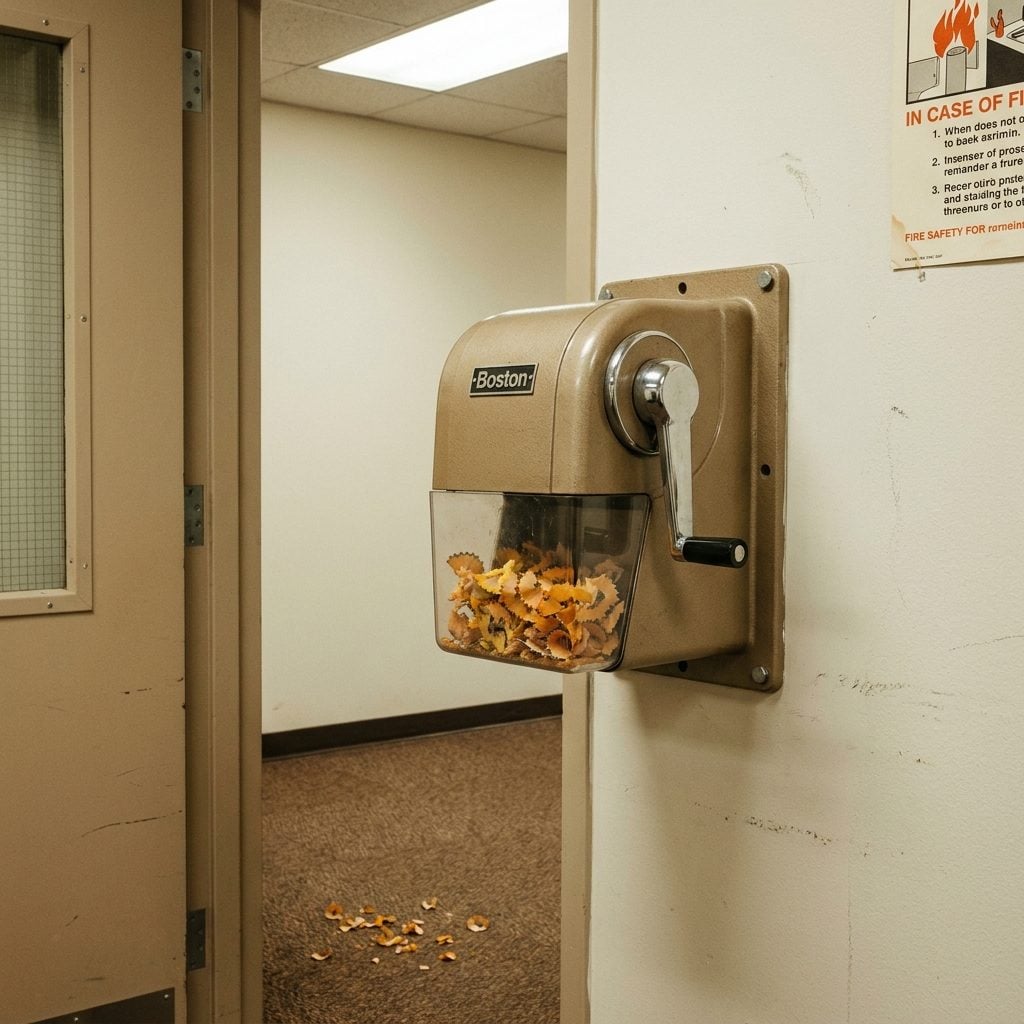
That grinding sound. You could hear someone sharpening a pencil from three offices away, and it always lasted ten seconds longer than necessary because everyone gave it a few extra cranks for good measure — a ritual, really, not a function. The Boston or Apsco wall-mount was bolted into the drywall with screws that suggested the building’s architect had personally specified its location. Removing it would’ve left structural damage.
Nobody ever emptied the shavings receptacle until it was physically overflowing. Cedar-scented curls would scatter across the carpet like confetti from the world’s least interesting party, and there they’d stay for days, because vacuuming was somebody else’s problem.
The Leroy Lettering Set That Turned Every Draftsman Into a Calligrapher Whether He Wanted to Be or Not
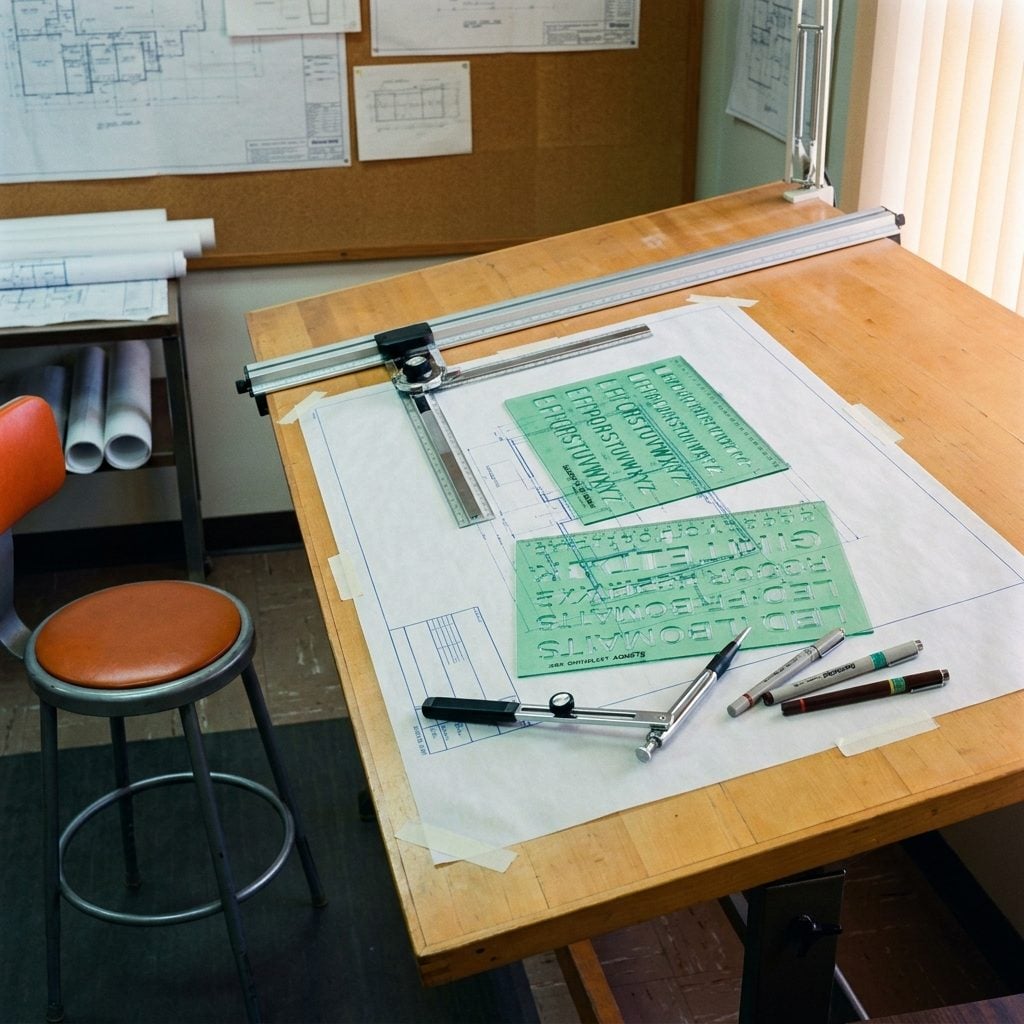
If you worked anywhere near a drafting department, you knew the Leroy set. Green plastic templates with precisely routed letter guides. A chrome scriber with a pen attachment. And the expectation that your hand would remain perfectly steady for hours — one wobble and the whole title block looked like it was written during an earthquake.
Draftsmen spent years developing a personal relationship with this system: learning which template sizes matched which pen nibs, how fast to move the scriber, how much ink pressure kept things clean. It was the most analog form of font selection imaginable. You didn’t scroll through a dropdown menu. You reached into a flat wooden case and pulled out the right plastic strip, and if someone had borrowed it and not returned it, God help them.
The Dictaphone Belt Recorder That Made Every Executive Sound Like He Was Narrating a Film Noir
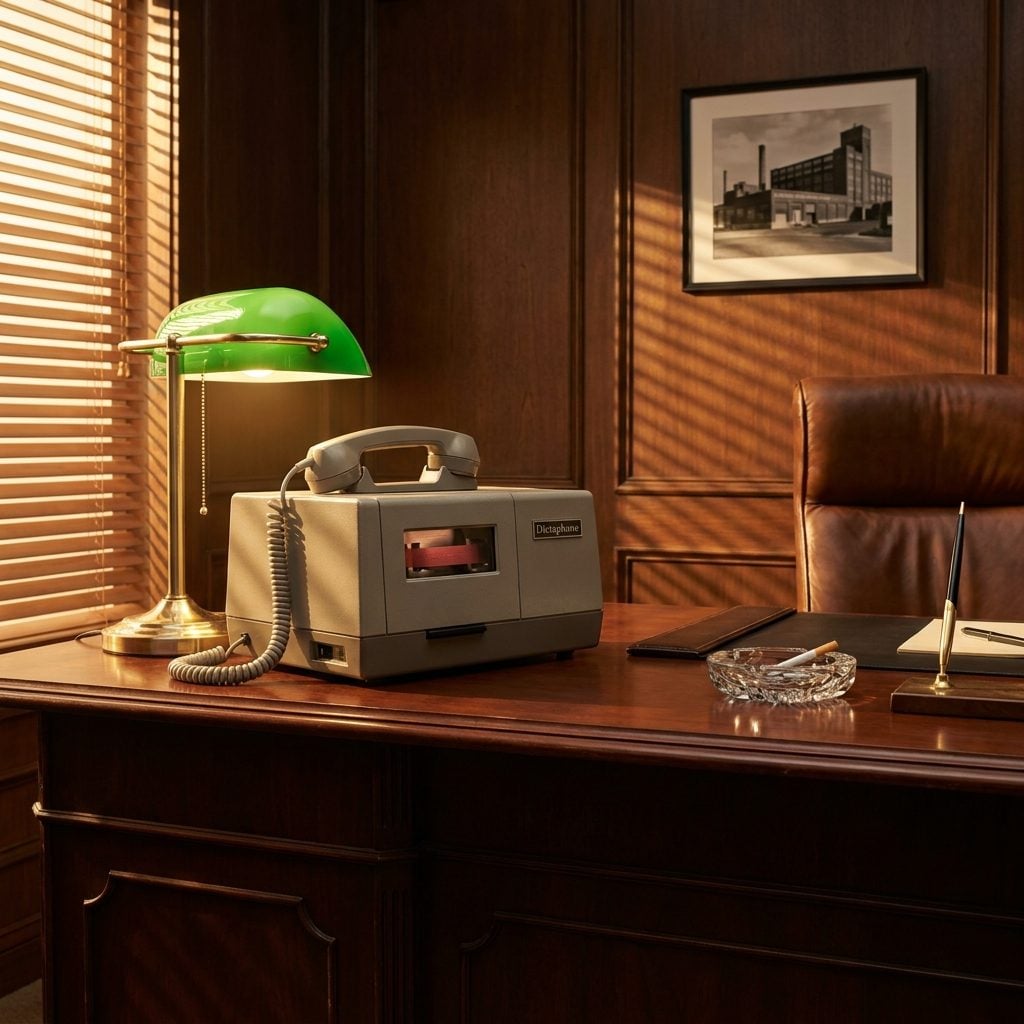
Not the mini-cassette machines the secretarial pool used. This was the belt recorder — the one that sat on the boss’s desk like a small appliance of authority. He’d pick up the handheld mic, press the button, and launch into that particular cadence people only adopt when speaking to a recording device: slow, slightly theatrical, with exaggerated pauses for punctuation.
“Dear… Mister… Henderson… comma… Thank you for your letter of November… fourteenth… period.”
The transcriptionist on the receiving end had to decode this performance through headphones connected to a playback unit that looked like it belonged on a submarine. Speed control was a foot pedal. Rewinding was an art form. Genuinely amazed any of those letters came out coherent — and yet they did, hundreds a week, perfectly formatted on company letterhead.
The Water Cooler That Was the Only Reason Anyone Knew What Was Actually Happening in the Company
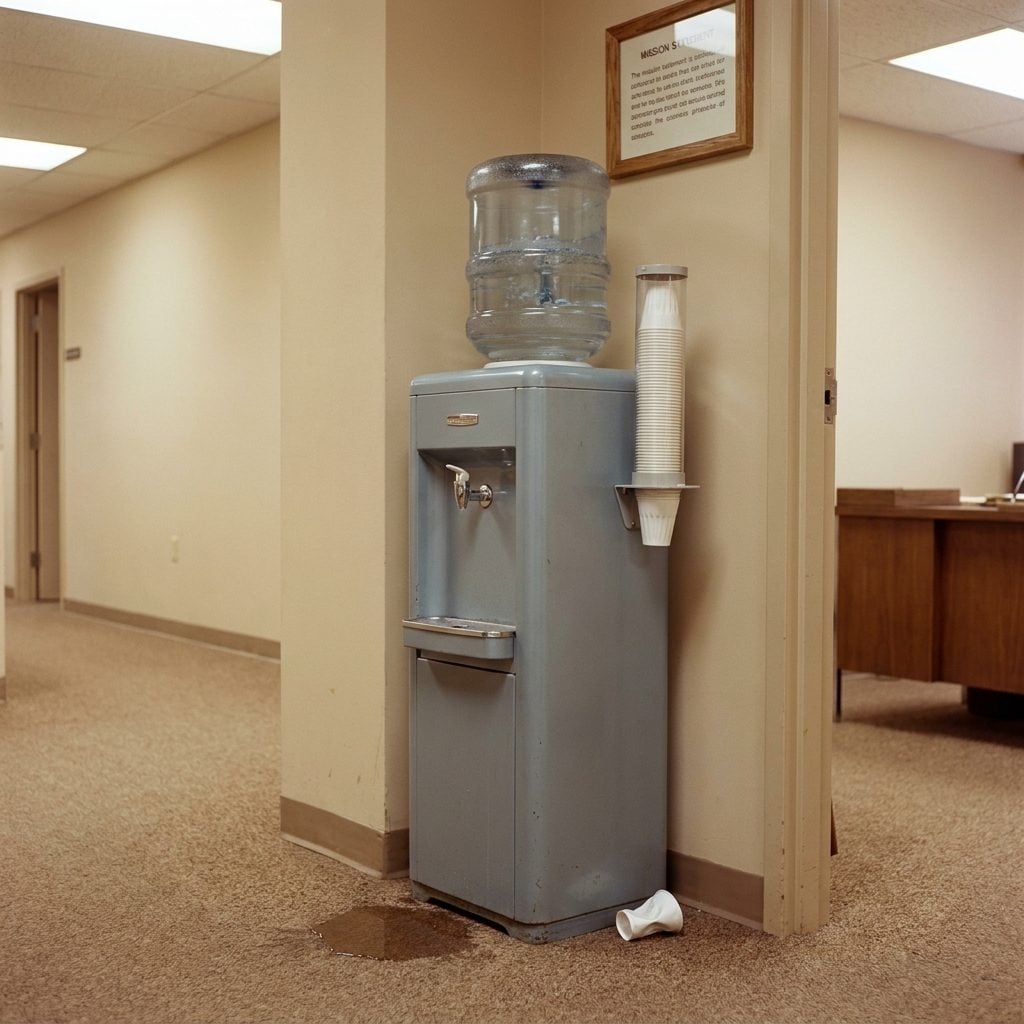
Every piece of real information in a 1970s office traveled through this thing. Not memos. Not meetings. The water cooler. Someone would wander over, pull one of those tiny pleated paper cone cups from the wall dispenser, fill it with water that was always slightly too cold, and suddenly you’d learn that accounting was getting reorganized, Jim in sales was leaving, and the Christmas party budget had been gutted.
The glass bottle on top made those satisfying glug-glug-glug bubbles whenever someone drew water — an announcement to the entire floor that the gossip channel was open. People who weren’t even thirsty would drift over. A two-minute water break could easily stretch to fifteen if the news was good enough, and management never figured out that their most effective communication tool was a piece of plumbing in the hallway.
Would you like to save this?
Please note that some of the imagery in this article were created with the aid of AI image generators.