
There was a smell to the 1980s garage that no candle company has ever had the courage to bottle: motor oil, dry concrete, WD-40, and something vaguely rubbery that you never quite traced to a source. If your dad had a garage, it was basically a museum of confident improvisation, a place where nothing was ever thrown away because it might come in handy, and where the organizational system made complete sense to exactly one person. Gen Z wouldn’t know what to do with half of it.
Would you like to save this?
The Chest Freezer Full of Mystery Meat in White Butcher Paper
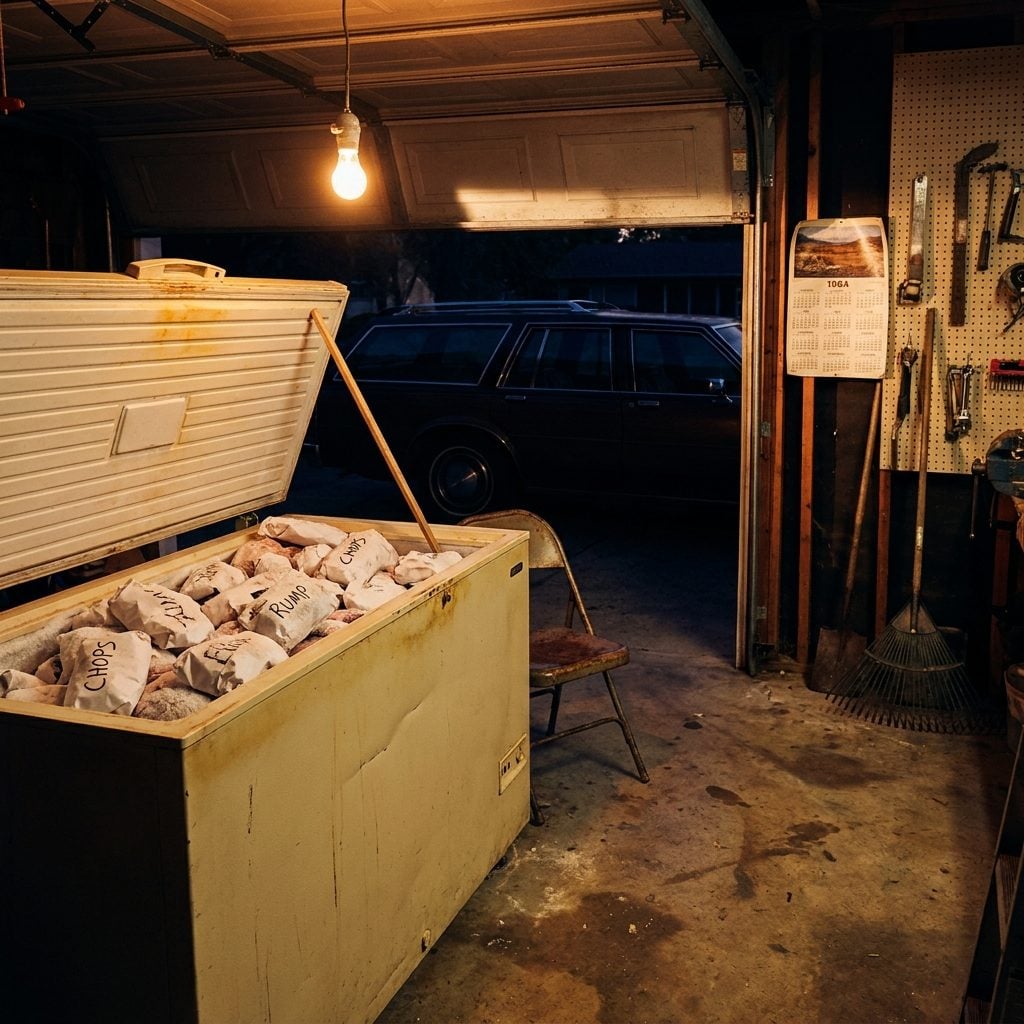
Nobody knew what was in those packages. Dad didn’t know. Mom definitely didn’t know. The system, if there was one, had collapsed somewhere around 1979. You’d dig past three solid layers of frost-burned mystery bundles looking for the pork chops and come up with something that had been in there so long the marker had completely bled away. The rule was: if you couldn’t identify it, it went back under.
The chest freezer was its own ecosystem. Half the stuff in there came from a hunting trip or a half-cow purchase from a guy your dad knew. The other half was leftovers from a dinner party nobody remembered throwing. And yet nothing ever got thrown away, because wasting food was a sin on par with leaving lights on in empty rooms.
The Shelf of Half-Empty Oil Cans in Various States of Resignation
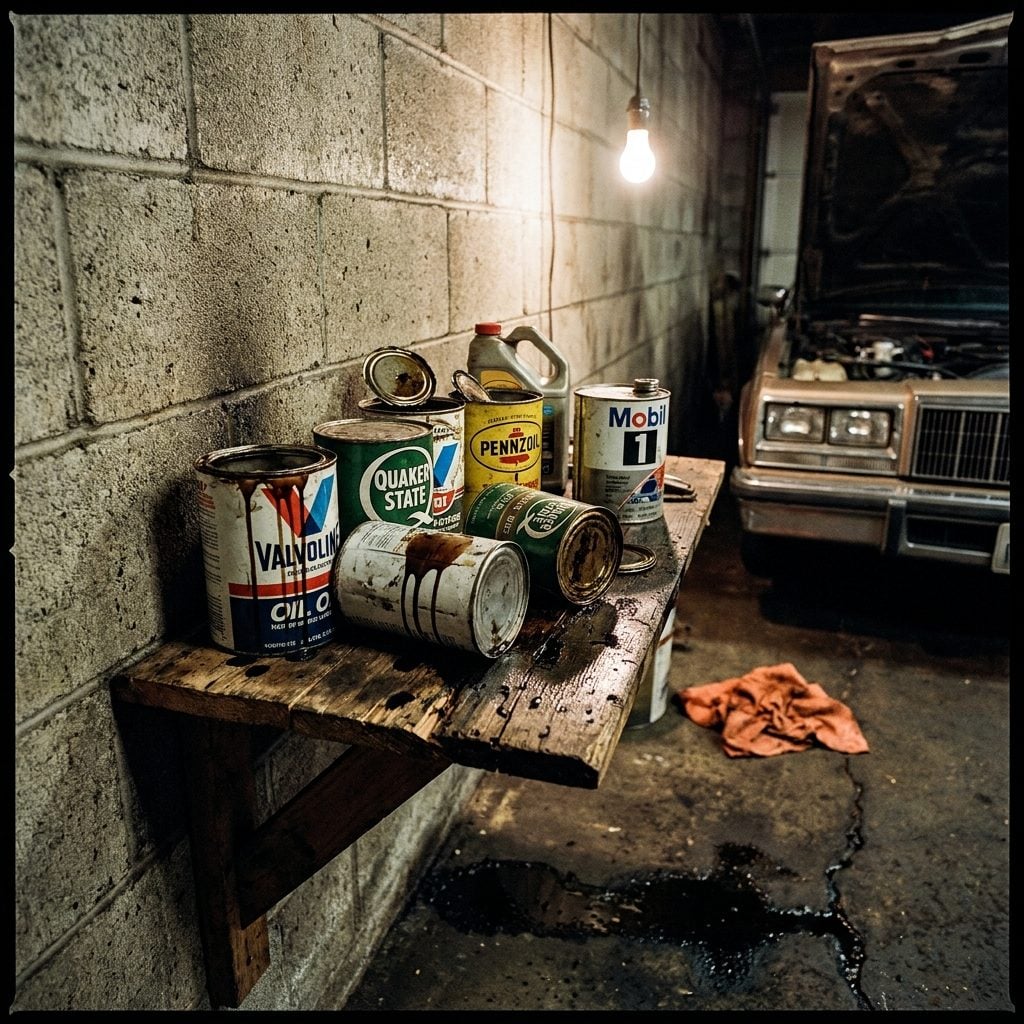
Every oil brand had its own can design back then, and somehow every garage had all of them. Pennzoil yellow, Quaker State green, Valvoline gold. None of them had more than a third left. Nobody ever threw out a partial can because there was always theoretically enough for a top-off someday, and someday never came.
They sat there for years, growing tackier on the outside, collecting the particular grime that only garage shelves produce. If you were a kid, you were not allowed to touch them. You also absolutely touched them.
The Coffee Can of Screws That Was Basically an Archaeological Site
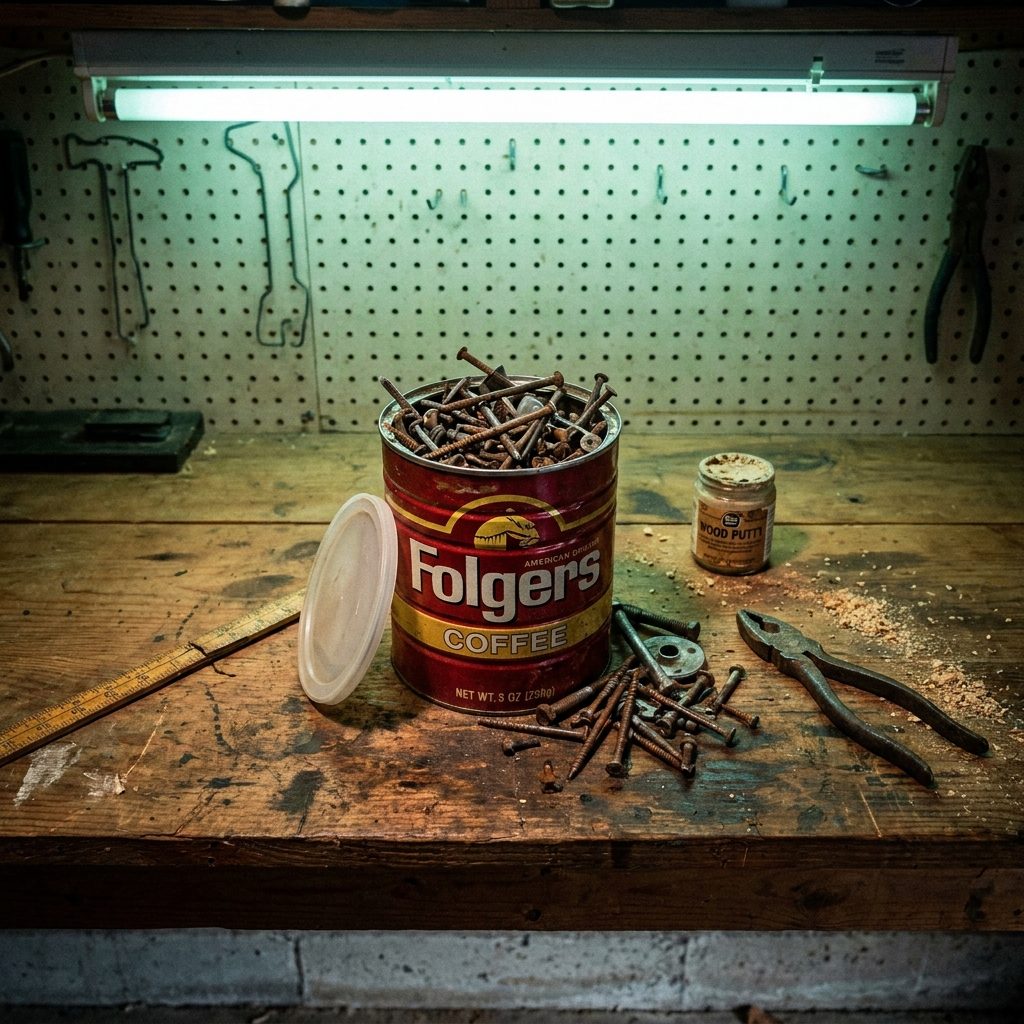
The coffee can was the garage’s version of a junk drawer, except worse, because at least a junk drawer had some organizational optimism built into it. The coffee can had none. It was a monument to the idea that you should save every screw from every project forever, in case you needed that exact size again, which you never did, except for the one time you desperately did and couldn’t find it in the can anyway.
Dumping the can out to search for a specific bolt was a five-minute commitment and an immediate lesson in how many unidentifiable metal objects one household could accumulate. Drywall screws mixed with machine bolts mixed with picture-hanging hardware mixed with something that might have been from a lawnmower. The whole thing smelled like metal and old coffee.
The Garage Fridge: Warm Beer, Flat Soda, and Zero Apologies
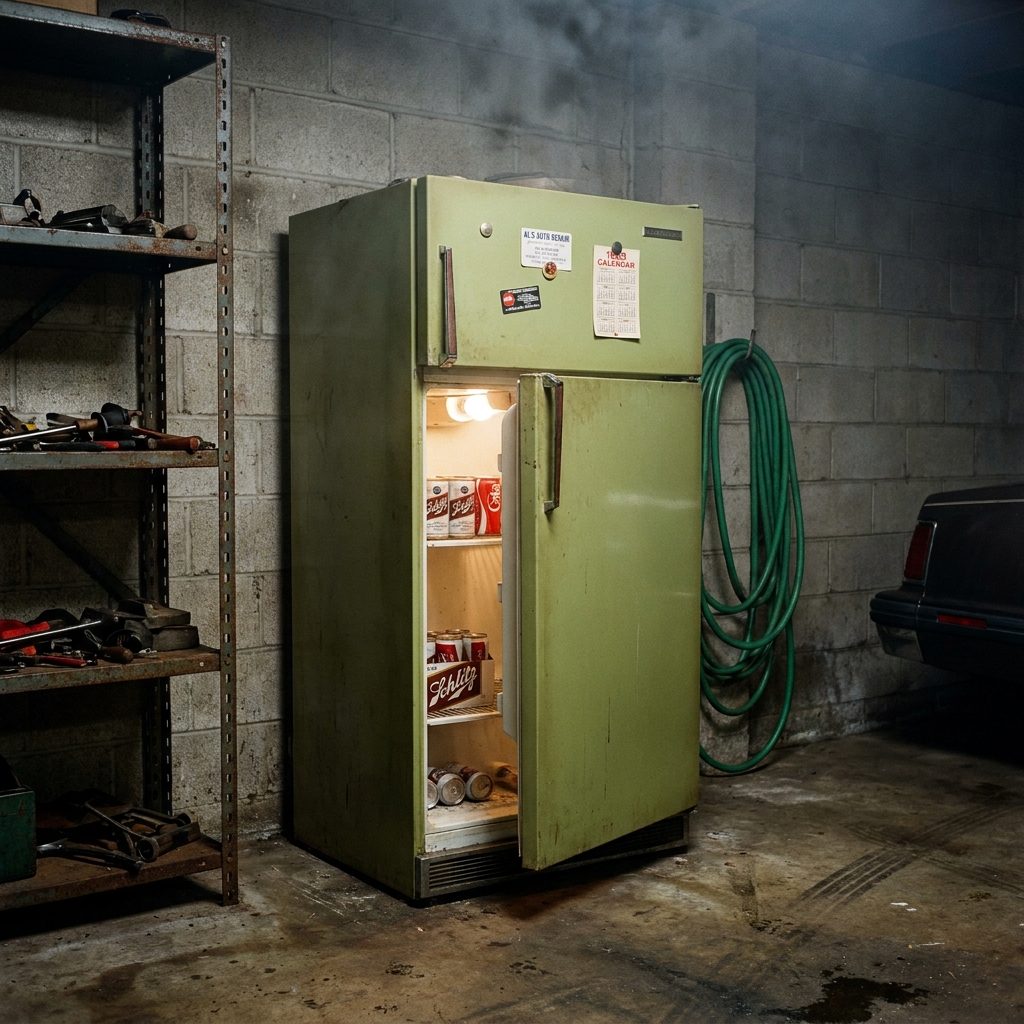
It was always an older model, usually the color of something you’d find in a 1970s kitchen: avocado, harvest gold, the particular off-white that had yellowed past redemption. It had been demoted to the garage when the kitchen got a new fridge, and it lived out its remaining years in honorable service to lukewarm beer storage.
The beer was technically cold in winter. In August it was somewhere in the high sixties, and nobody really complained. That fridge also held: the soda your dad bought on sale six months ago, one mysterious jar with no label, and occasionally a fish someone had caught and not yet figured out what to do with.
The garage fridge wasn’t a convenience. It was a philosophy. Cold enough is cold enough.
The Station Wagon Seats Leaning Against the Wall for Absolutely No Reason
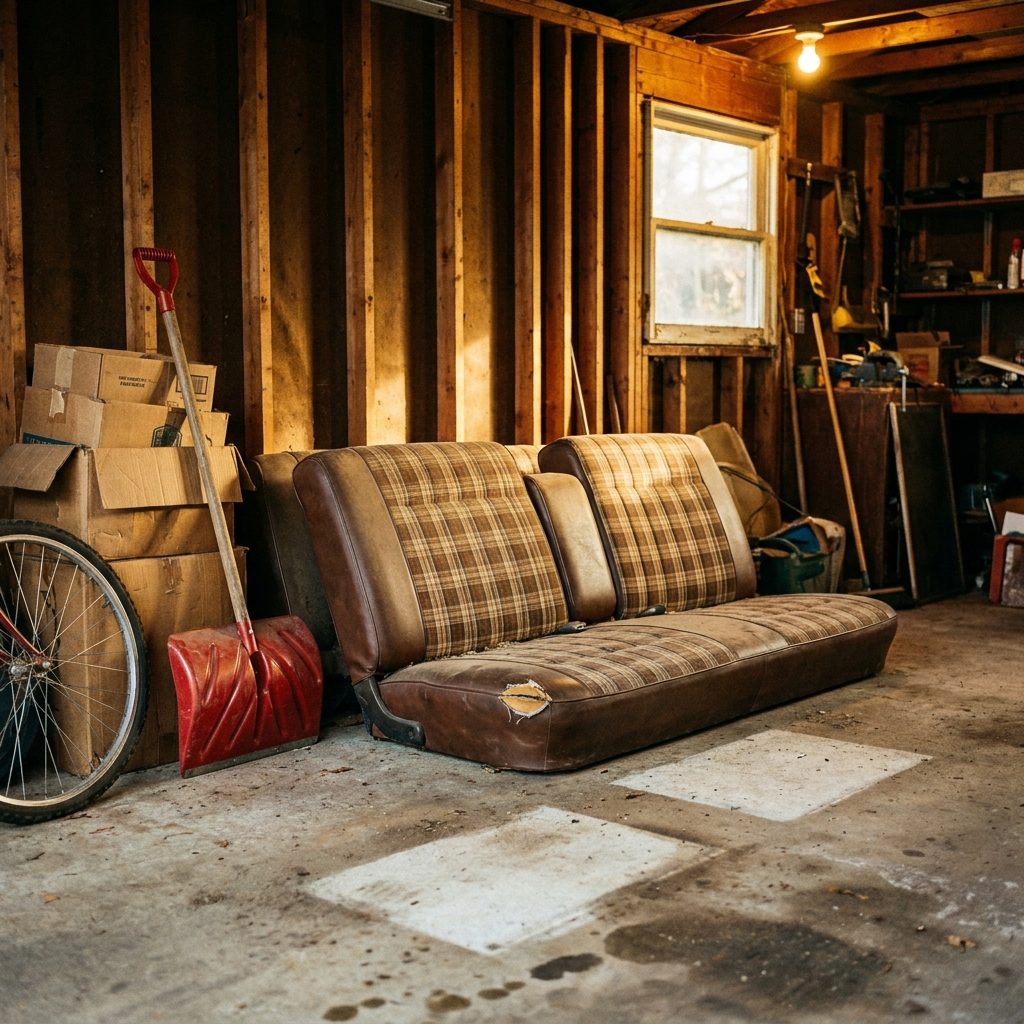
They were just there. Had been there for years. Nobody moved them. Nobody threw them out. Asking why they were there got you a look that communicated, very clearly, that you didn’t understand how garages worked.
The seats had been pulled out for a camping trip, or to haul something that needed the flat space, or because Dad was going to reupholster them, and then they just became part of the garage’s permanent geography. By the time you were in high school they had their own layer of dust and felt as permanent as the walls themselves. Removing them would have been like demolition.
The Pegboard With Painted Tool Outlines and Suspiciously Empty Hooks
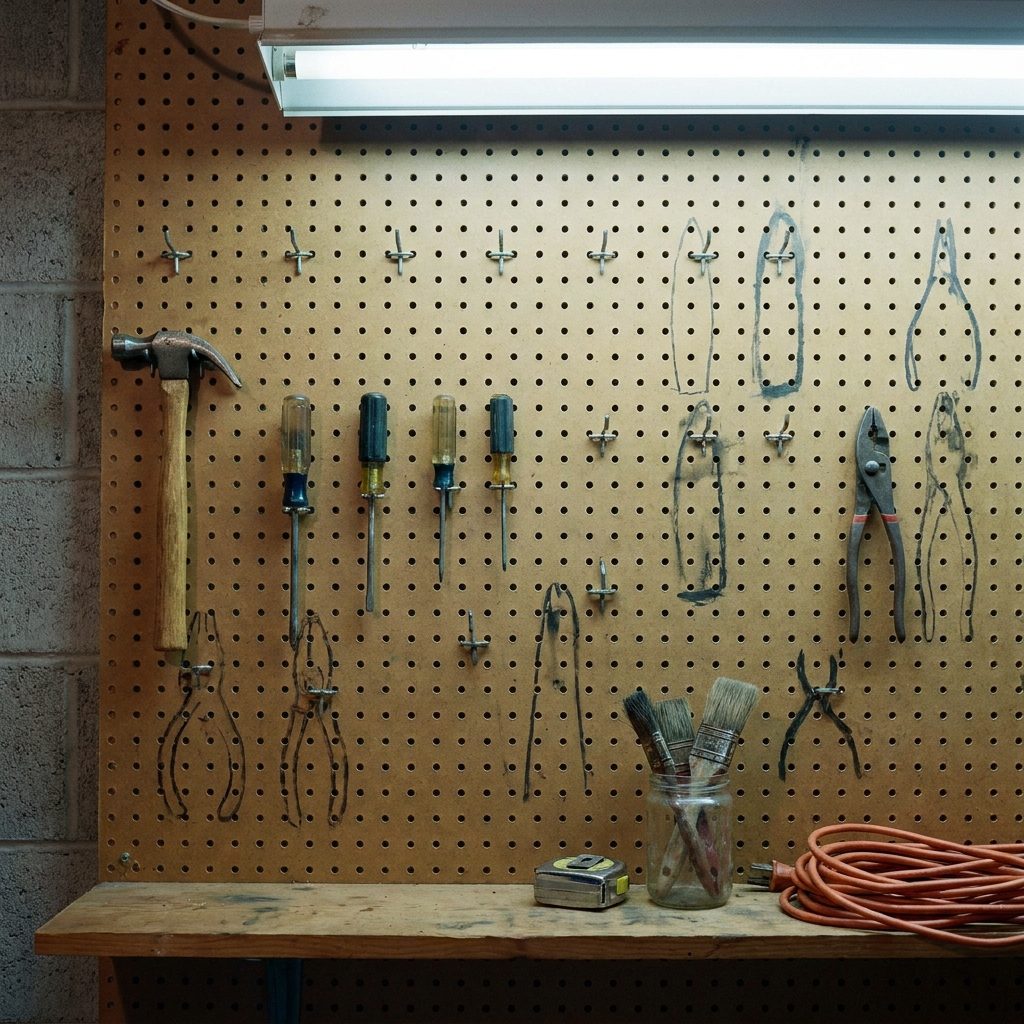
Whoever drew those outlines had vision. You could almost see them standing there with a black marker on a Sunday afternoon, completely convinced this was the system that would finally bring order to the garage. Every tool in its place, silhouette on the board, no excuses.
And for maybe two weeks it probably worked. Then one screwdriver migrated to the kitchen, the needle-nose pliers went inside with someone’s craft project, and the hammer ended up in the back of the car after a tailgate assembly job. The outlines stayed, accusatory and hollow, for the next decade.
The pegboard system is one of those things that was either perfectly maintained (usually by the one guy on the block who also kept his gas cans labeled) or was just a map of everything that was currently missing. Ours was absolutely the second kind.
The Extension Cord That Had Definitely Seen Better Decades
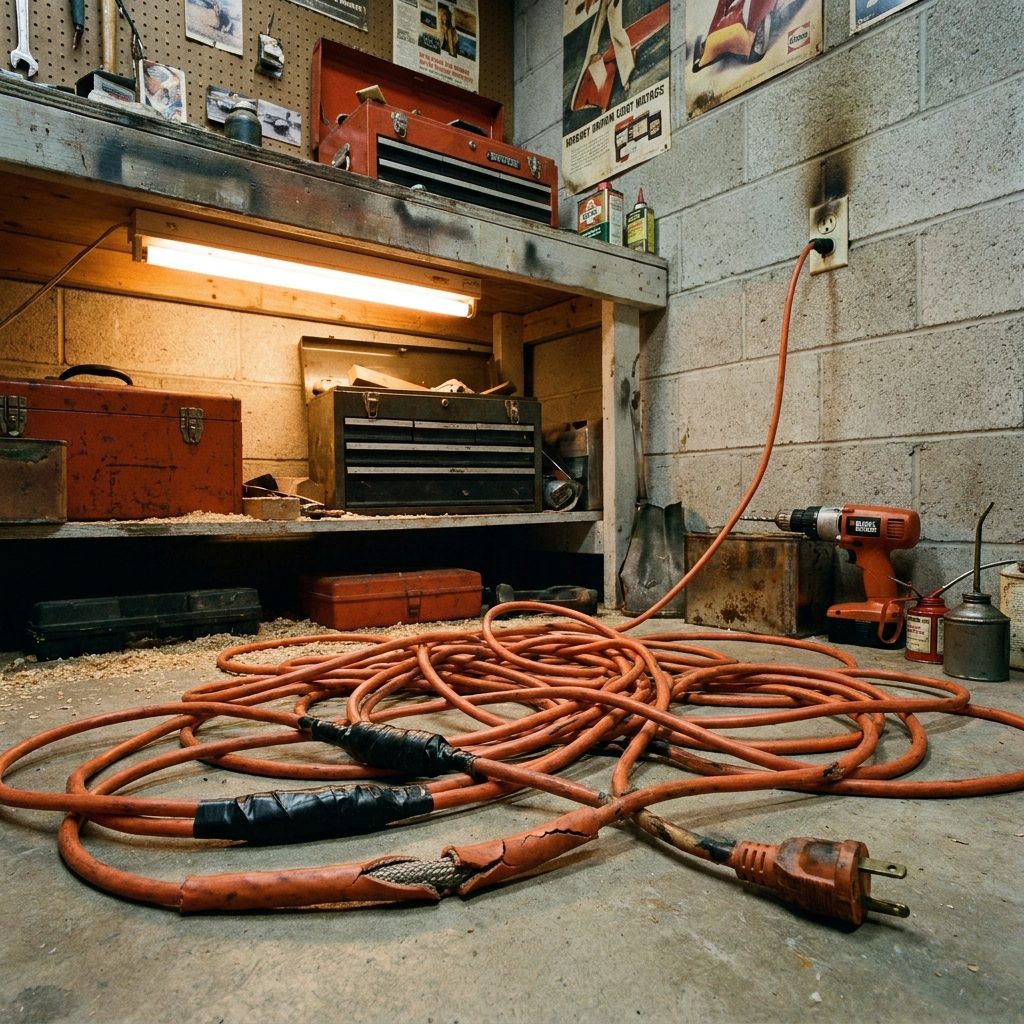
It was wrapped in electrical tape in at least three places, which everyone understood was a perfectly adequate repair. Moving it wrong would cause it to spark. Everyone knew this. It was still the extension cord everyone used.
The thing is, it worked. Mostly. You just had to respect it, which meant you didn’t drag it across the floor too fast, you didn’t plug in anything bigger than a drill, and you absolutely did not mention to Mom that you’d seen it spark last Tuesday near the lawn equipment. Some garage knowledge was for the garage only.
The Push Mower That Started on Pure Stubbornness and Nothing Else
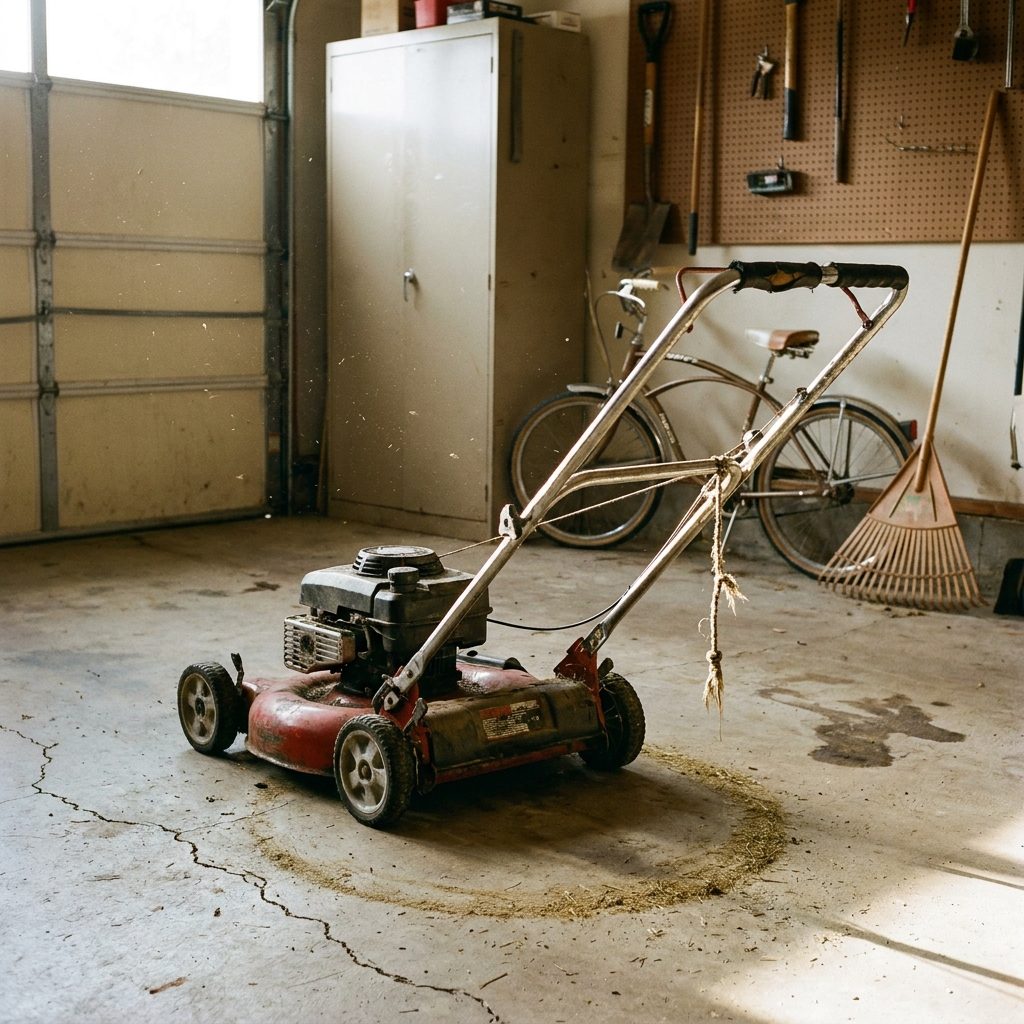
Three pulls to prime it. Two more just to test your commitment. Then one full-body, back-straining, leave-the-ground yank that either started the engine or sent you stumbling into the workbench. That was the deal, and the deal was non-negotiable.
If it started on the first try you told people about it. Casually, like it was normal, but you told them. If it didn’t start after six pulls you had to let it rest, which felt like losing an argument to a lawn mower, which you had, because you had.
The specific smell when it finally caught: hot metal, exhaust, fresh cut grass just beginning. That combination is burned into the memory of anyone who grew up doing yard work in the 1980s. No algorithm will ever replicate it and that is genuinely fine.
The Phone Book So Thick It Had Its Own Gravitational Pull
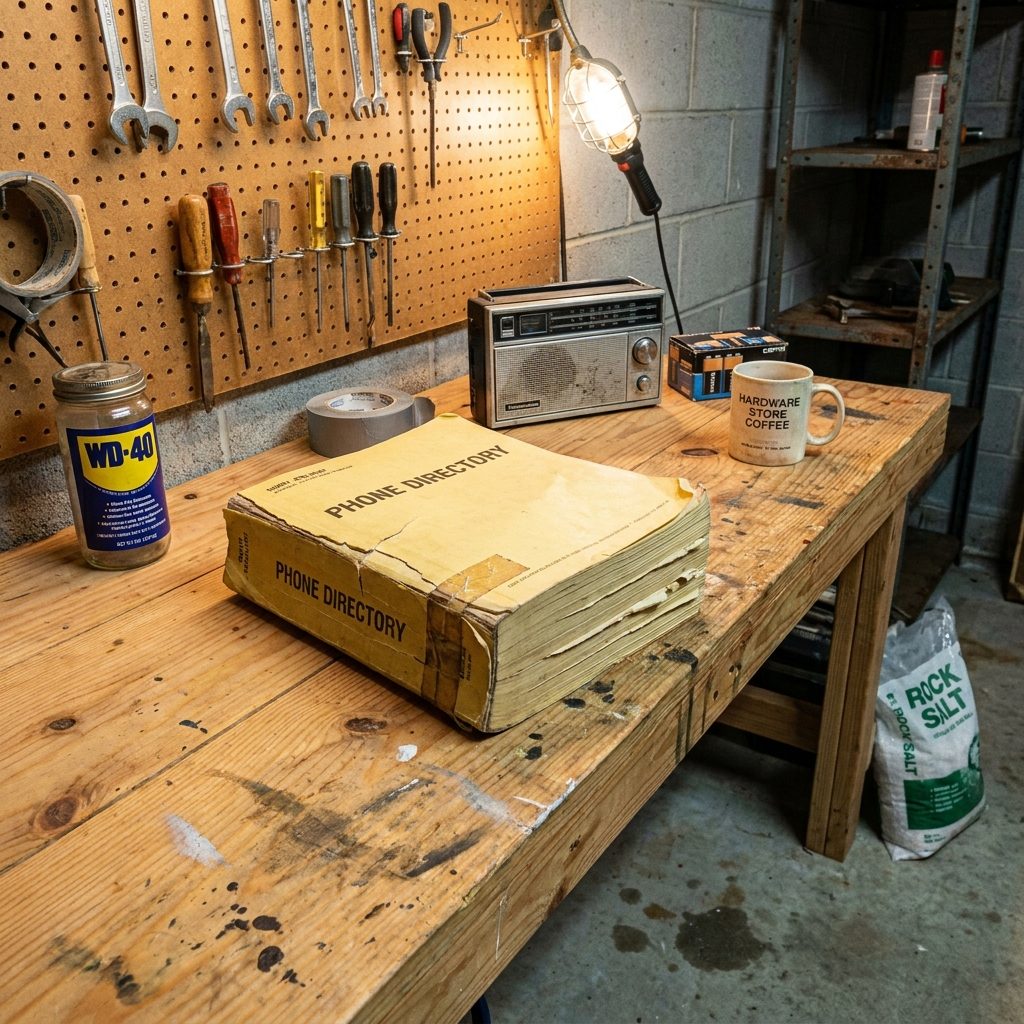
That phone book lived on the workbench not because anyone regularly needed it, but because it was too useful to throw away and too heavy to carry inside. Ours was the 1986 edition, cover crinkled from a slow leak in the roof, a coffee ring on page 400-something in the R’s.
It weighed roughly the same as a toddler. Hardware stores, plumbers, the number for the county dump, all annotated in ballpoint pen by at least two different handwriting styles. A Gen Z kid today would flip through it and genuinely not understand what they were looking at. Which, honestly, tracks.
The Drawer of Dead Batteries That No One Could Bring Themselves to Throw Out
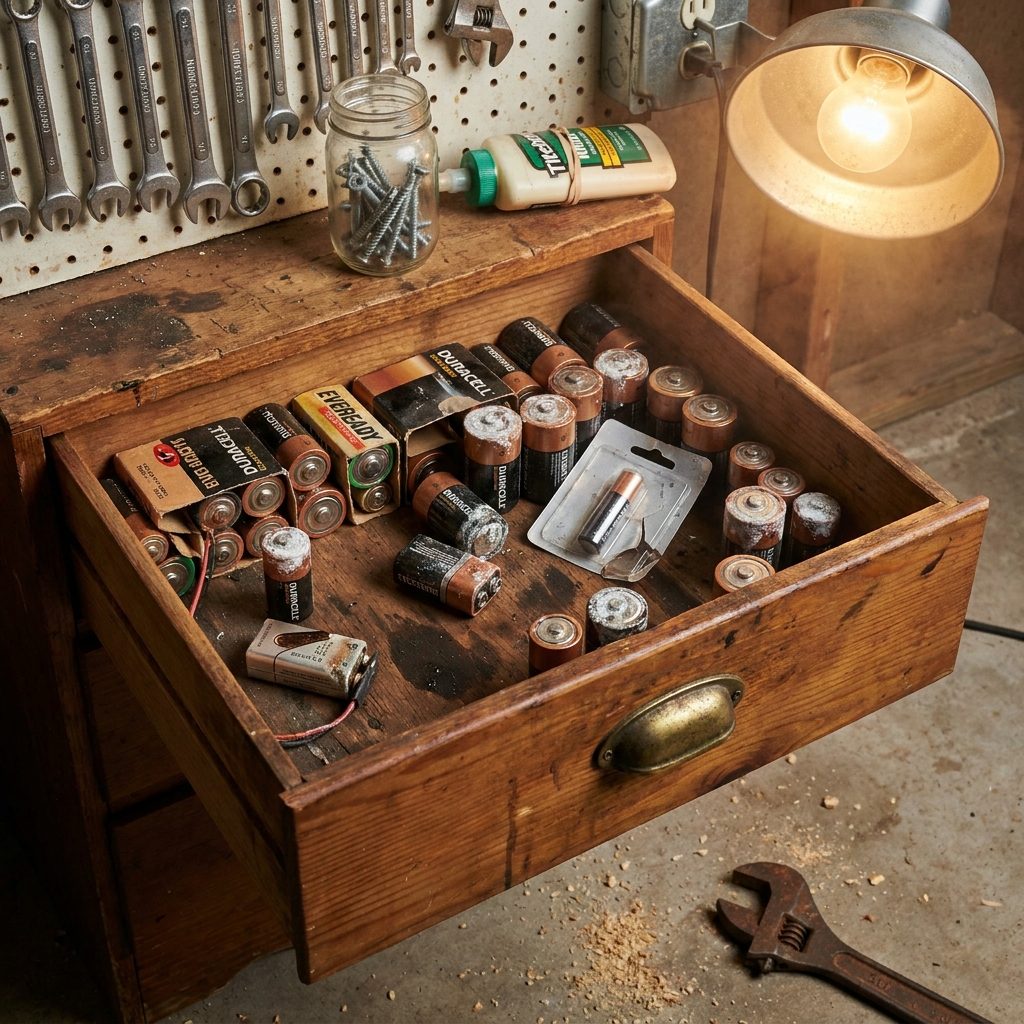
Every single one of those batteries was dead. Everyone in the house knew they were dead. They had been dead since 1984. And yet, every time someone went to throw them out, something stopped them, a small, stubborn voice that said maybe test it first.
Nobody ever tested them. They just went back in the drawer.
This was a universal law of 1980s garages, as reliable as gravity. Dad would shake a D-cell next to his ear like he could hear whether it had anything left. He could not. It did not. Back in the drawer.
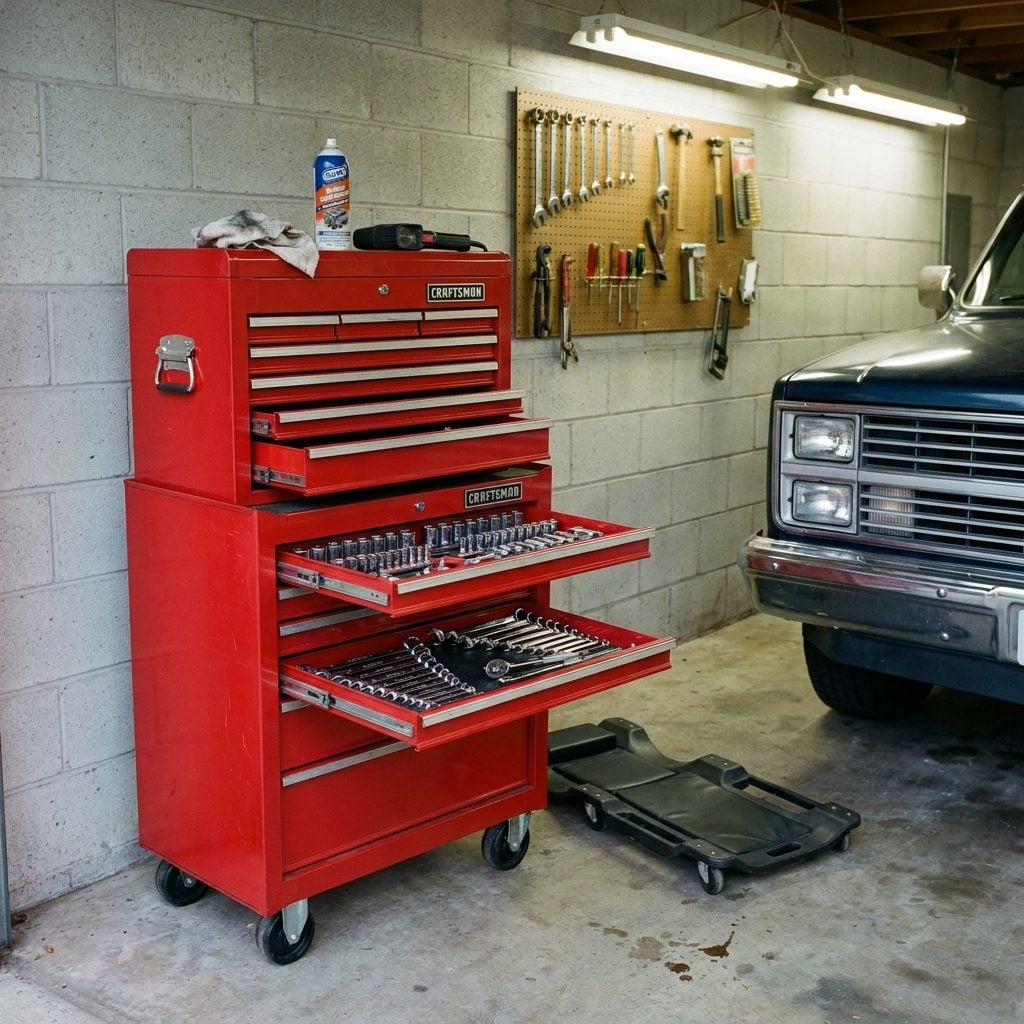
The Sears Craftsman Toolbox You Were Not Allowed to Touch
Would you like to save this?
It sat in the corner of the garage like an altar, red and chrome, and the rules around it were unspoken but absolute. You didn’t put tools back in the wrong drawer. You didn’t leave the lid up. You definitely didn’t borrow a socket and forget where it went.
The Craftsman lifetime guarantee meant Dad had probably replaced a cracked handle or two at the Sears counter, a transaction he recalled with something close to reverence. That toolbox represented a specific idea of competence. Of being the kind of man who owned proper tools and knew what to do with them.
Gen Z inherited the Leatherman and the YouTube tutorial. We inherited this. Both are valid. But only one made a sound like authority when you slid the drawer shut.
Old License Plates on the Wall Like Somebody’s Been Keeping Score
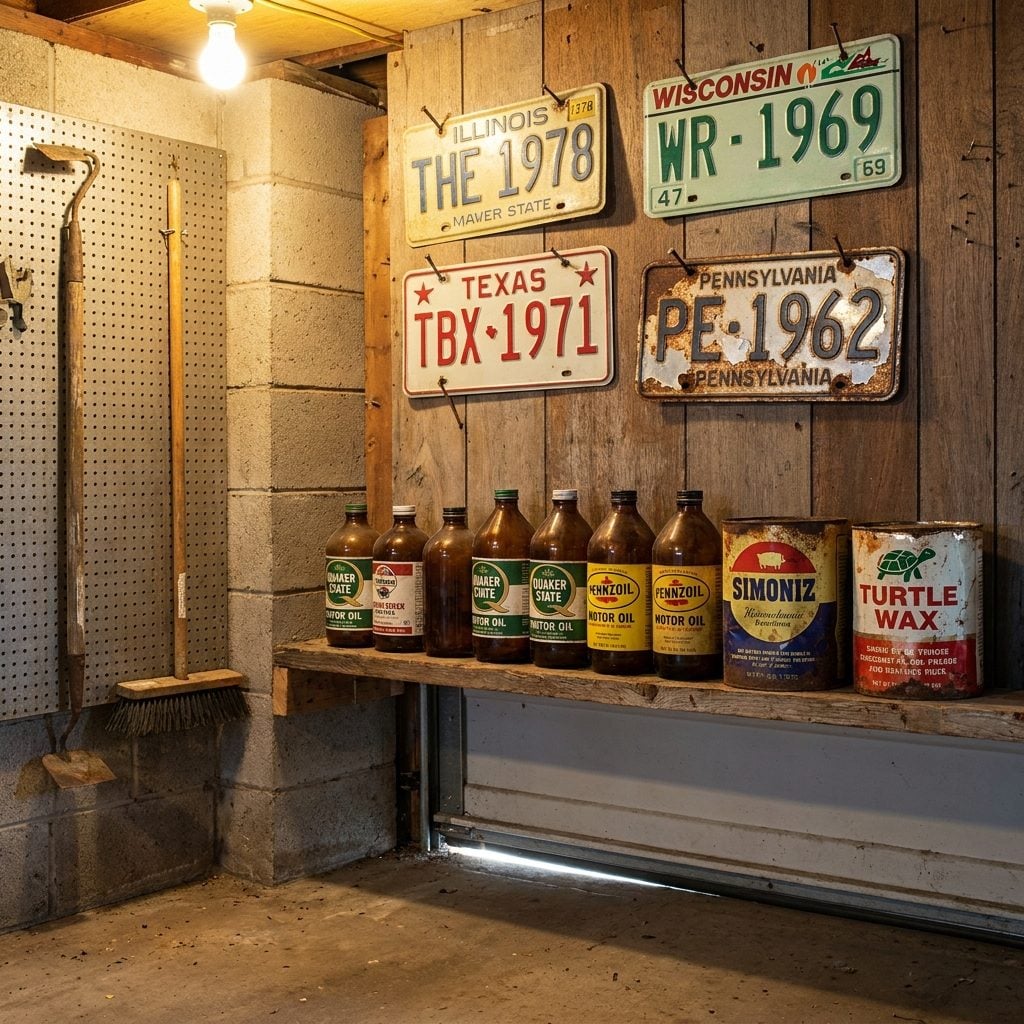
Every plate had a story, or at least Dad claimed it did. The Indiana plate from the old Buick. The one off the camp trailer that finally gave up the ghost in 1979. That Georgia plate nobody could quite account for.
Hanging them on nails wasn’t nostalgia exactly, it was more like keeping evidence. Proof of past vehicles, past miles, past versions of the family. Some garages had four plates. Some had fourteen. The number tracked loosely with how long a man had been driving and how little he threw away.
The Gas Can Sitting Three Feet From the Water Heater Like It Was Fine
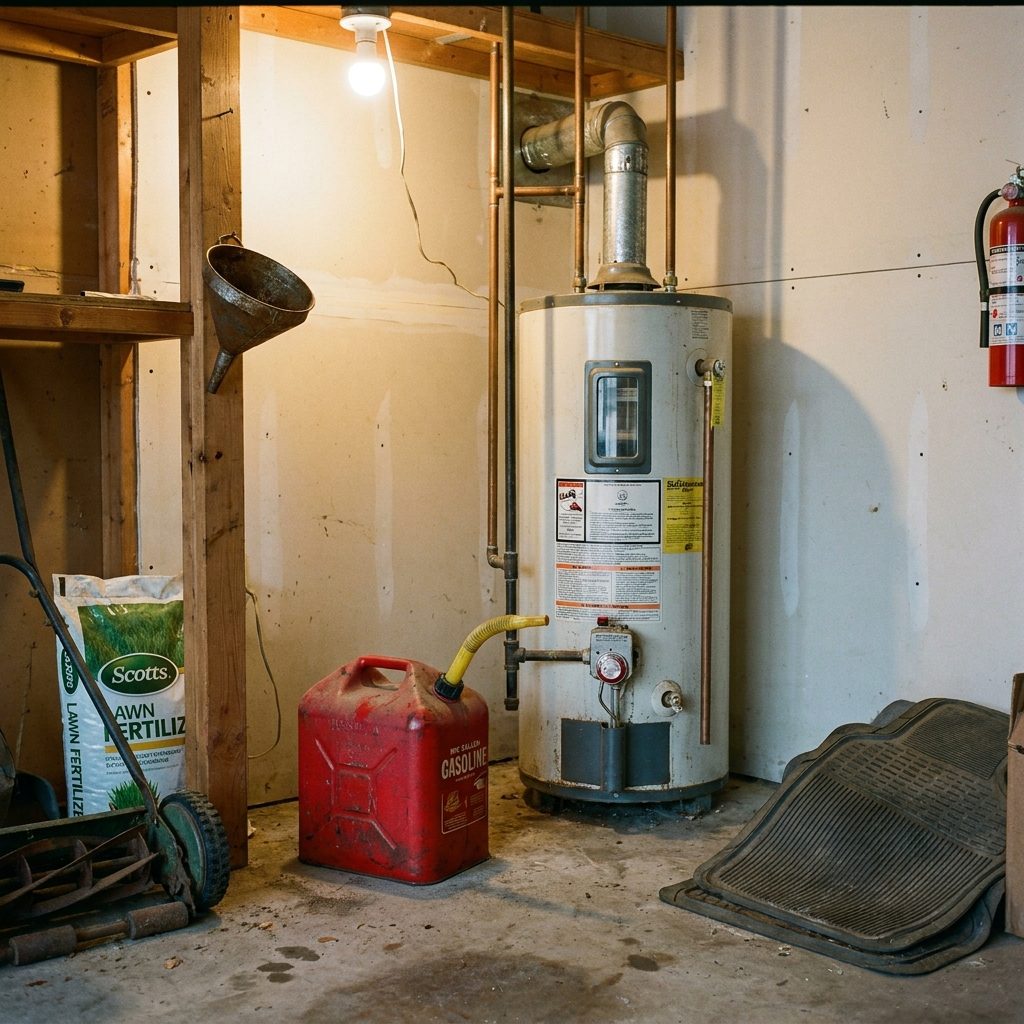
This was just where the gas can lived. Nobody questioned it. The water heater was right there, the pilot light glowing its quiet orange glow, the gas can three feet away with its little yellow spout tucked in its side like a sleeping animal.
Modern fire codes would have something to say about this arrangement. Our fathers had exactly nothing to say about it, because everyone’s garage looked like this and nothing had happened yet. Survivorship bias, running the whole show, decade after decade.
The Milk Crate of Cassette Tapes Kept Exclusively for the Garage
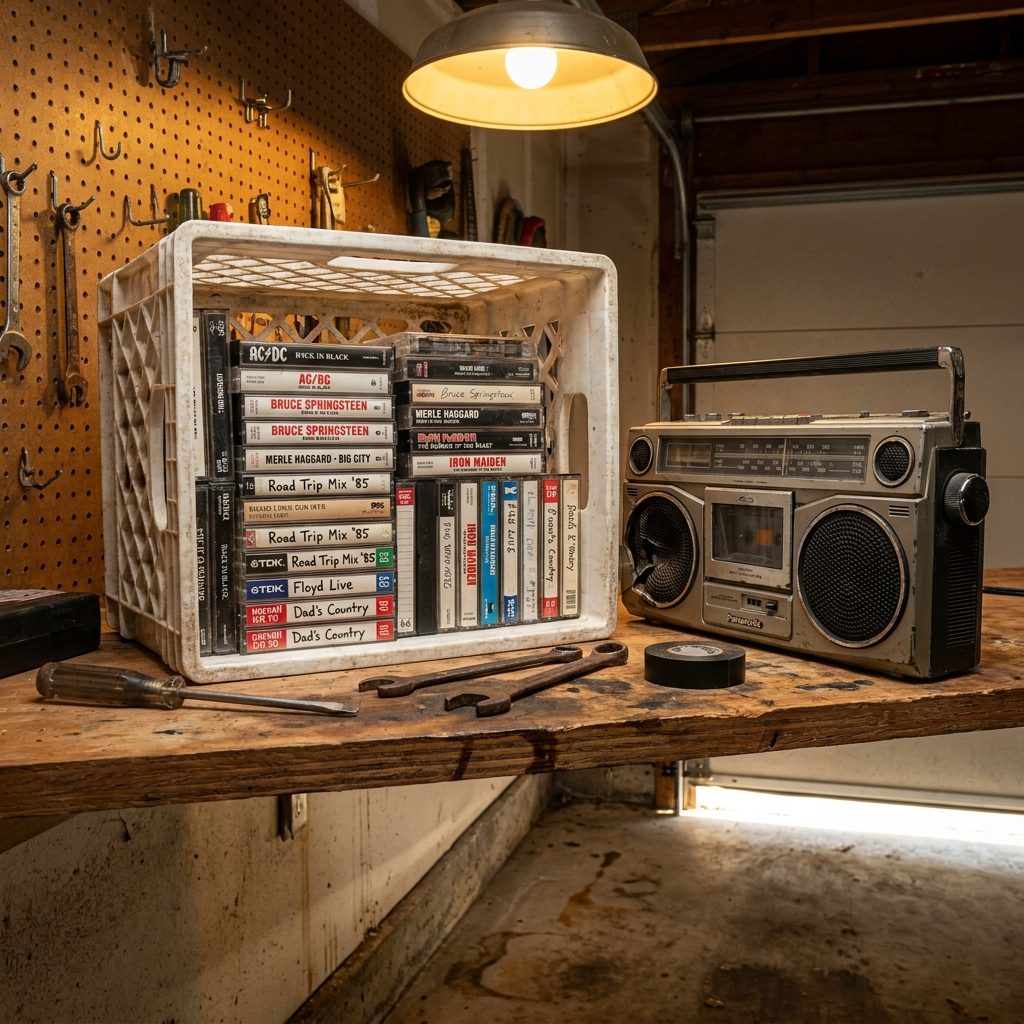
These weren’t the good tapes. The good tapes were inside, in the living room cabinet or the car. This milk crate held the ones that had been demoted: a Foreigner album with a cracked case, three TDK blanks labeled in fading Bic pen, a copy of Born in the USA with the left channel going slightly weird.
The garage cassette player was always a boxy thing with a broken antenna and one speaker that buzzed on the low end. None of that mattered. You were rebuilding a carburetor or sanding something, and Side B of a slightly warped tape was exactly the right soundtrack for it.
“The garage tape collection was its own ecosystem, things that survived the cut, still playing, still worth keeping.”
The Wood-Burning Stove That Turned the Garage Into the Hottest Room in America
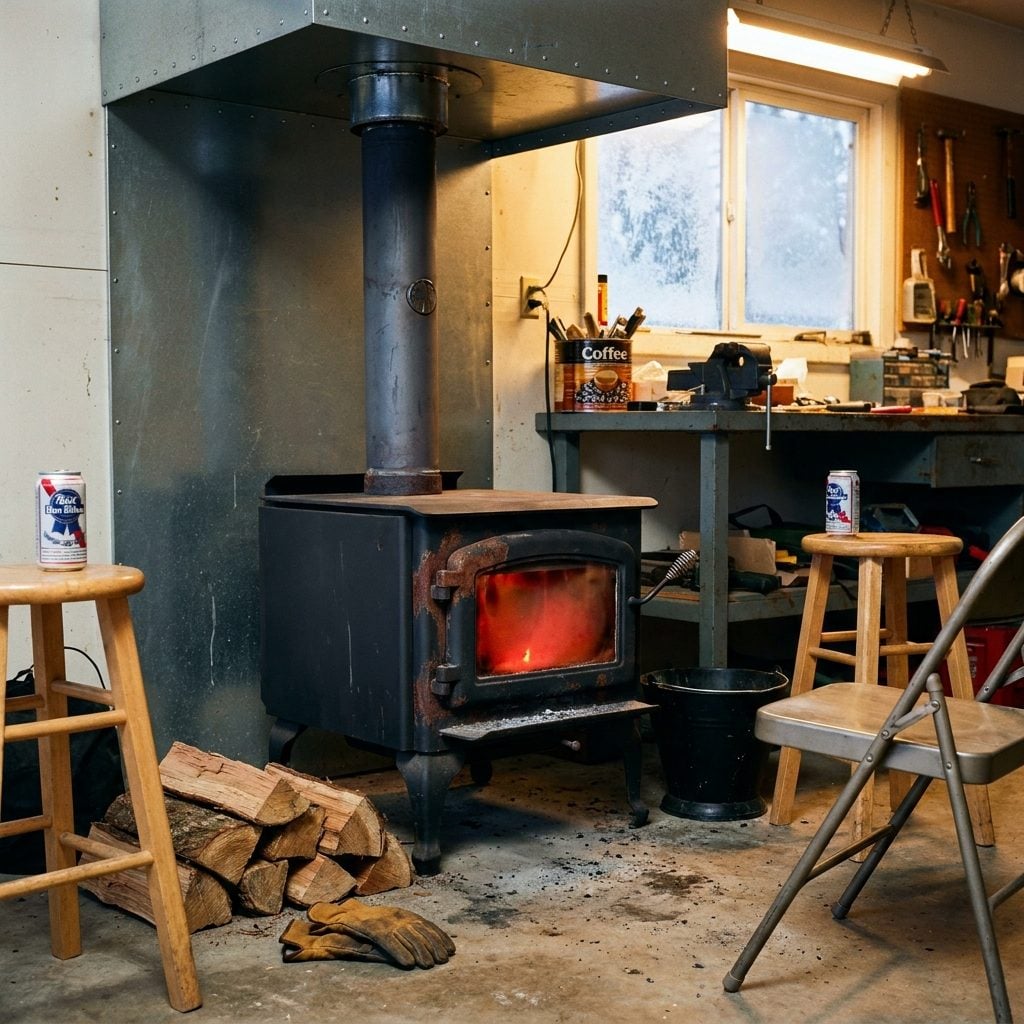
From November to March, this was the only room anyone actually wanted to be in. Not the house, the garage. Because the house had regular heat, and the garage had the stove, and those are not the same thing.
The stove ran hot in a way that felt almost personal. Within twenty minutes of lighting it, you’d have your jacket off. Within forty, you’d be down to a flannel with the sleeves pushed up, arguing about carburetors with someone holding a PBR. The rest of the family, on the other side of that door, was watching TV at a reasonable temperature and having a perfectly fine time. But the garage had the fire, and the fire had its own gravity.
The Stack of Warped Plywood That Was Definitely Going to Be Useful Someday
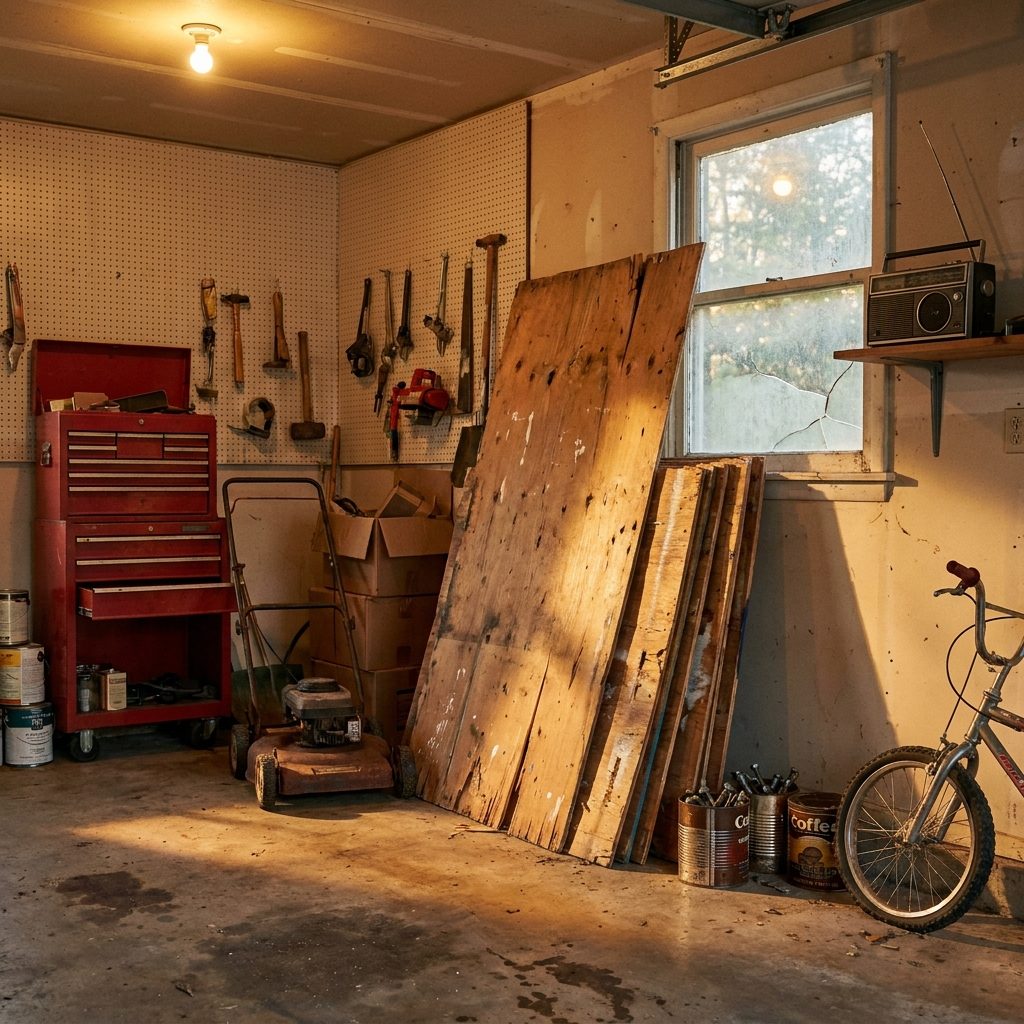
Every 1980s dad had a plywood manifesto. It lived against the garage wall and it never moved, not in eleven years, not once. The sheets were bowed like potato chips, edges fuzzy with splinters, and at least two had been cut with no apparent plan and then abandoned mid-thought. But the promise was sacred: this wood was going to build a workbench, a shelving unit, maybe a shed addition. Possibly all three.
Nobody ever touched it. The plywood stack was essentially a monument to optimism. You stepped around it to get to the lawnmower. You stacked stuff on top of it. The dog slept next to it. And thirty years later, when someone finally cleaned out the garage, there it was, still warped, still waiting, patient as ever.
The Fishing Rods Mummified Together in the Dark Corner
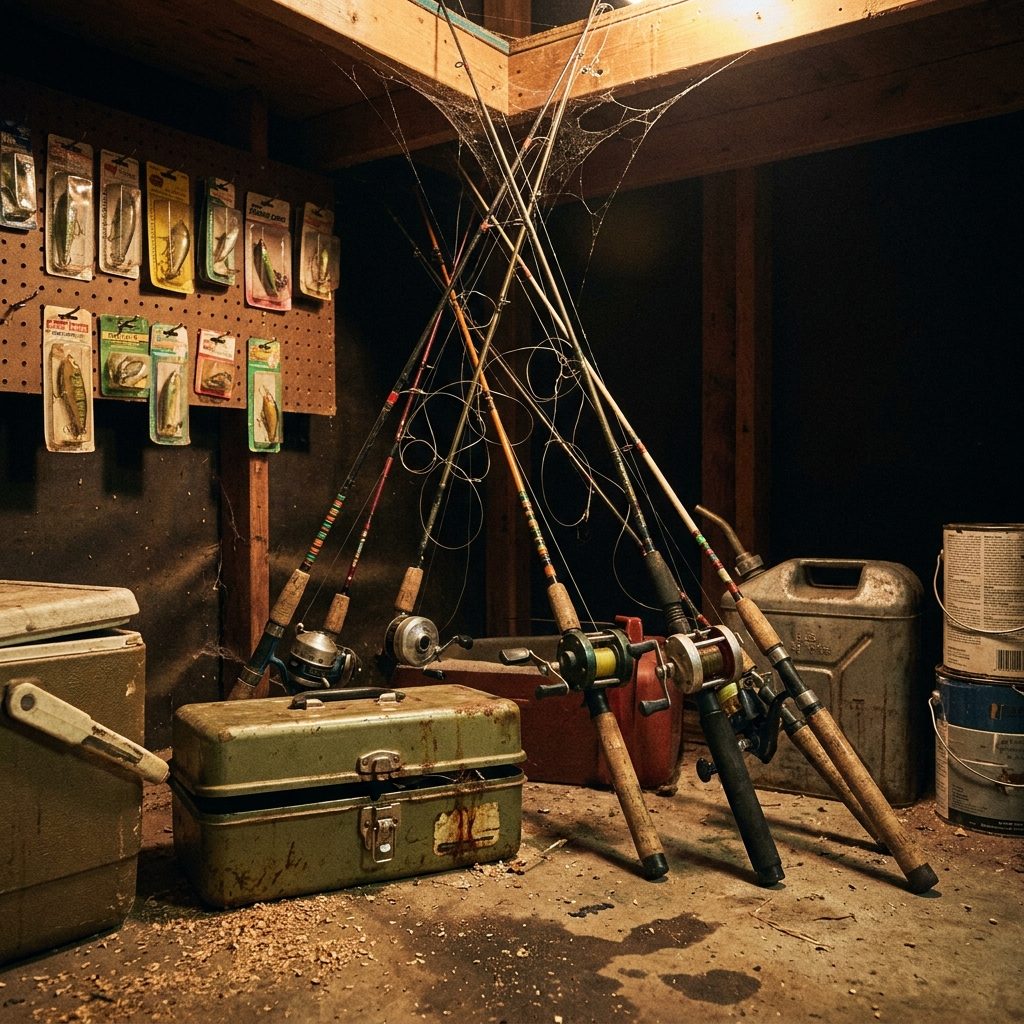
Somewhere between the lawnmower and the hot water heater, there was always a corner that belonged exclusively to the fishing rods. Not stored, exactly. More like deposited. They leaned in a loose bundle, lines crosswired into each other like some kind of monofilament crime scene, at least one reel clicking sadly whenever you bumped it trying to grab a shovel.
The tackle box nearby had one broken clasp and smelled like night crawlers and WD-40. The plan was always to untangle the rods before the next fishing trip. The next fishing trip never came. They stayed in that corner through two different presidential administrations and nobody mentioned it.
The Box Fan So Caked With Dust It Had Basically Become Structural
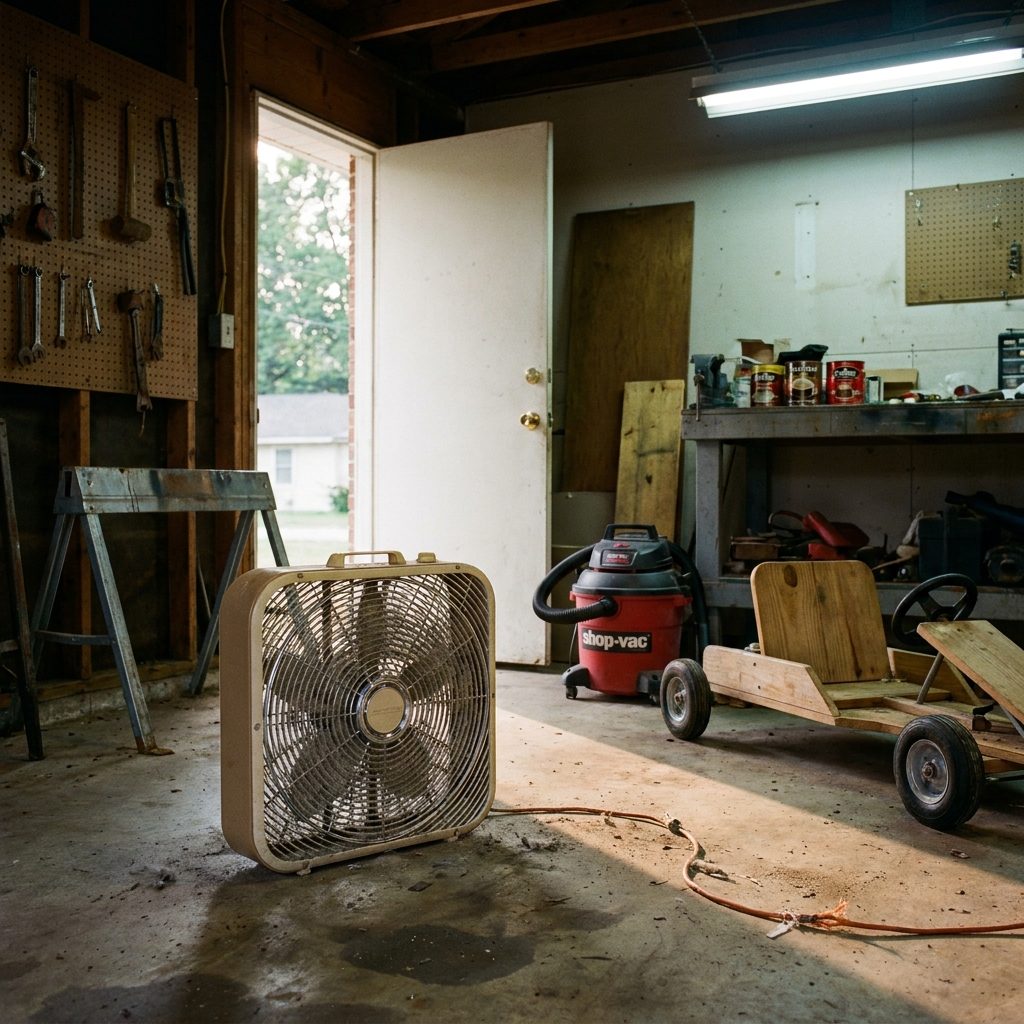
It ran from approximately Memorial Day to Labor Day every single year, positioned in the garage window or propped on a paint can at the corner of the workbench, and it did not move in between. The dust that accumulated on that box fan grille wasn’t seasonal. It was geological. By the mid-1980s it had its own microclimate.
Somehow this bothered nobody. The fan still pushed air, albeit through what was essentially a felt curtain of compressed lint, and that was enough. There’s something almost admirable about that standard of maintenance. Gen Z would not understand. They barely understand a fan that doesn’t connect to WiFi.
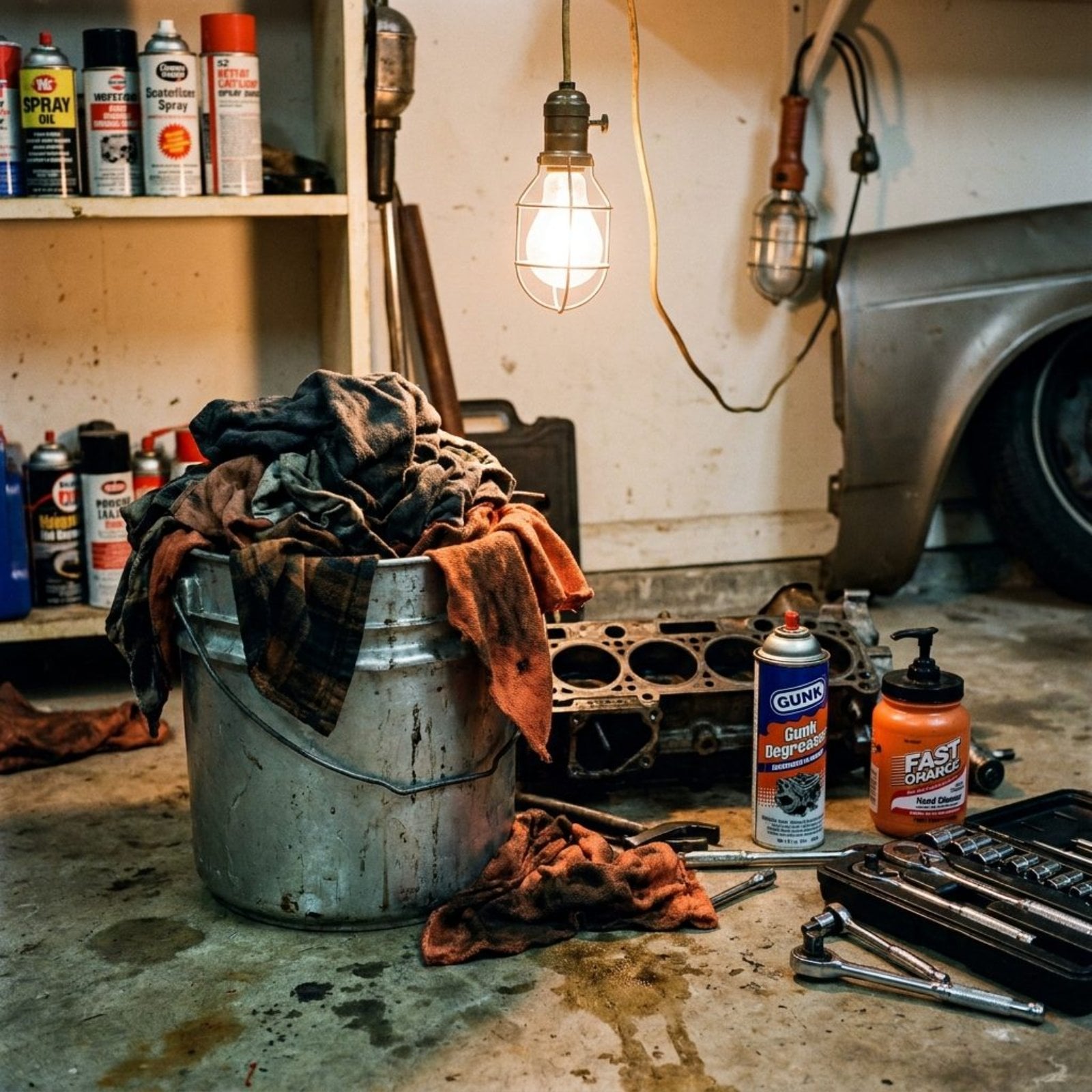
The Bucket of Greasy Shop Rags That Were Absolutely Never Getting Washed
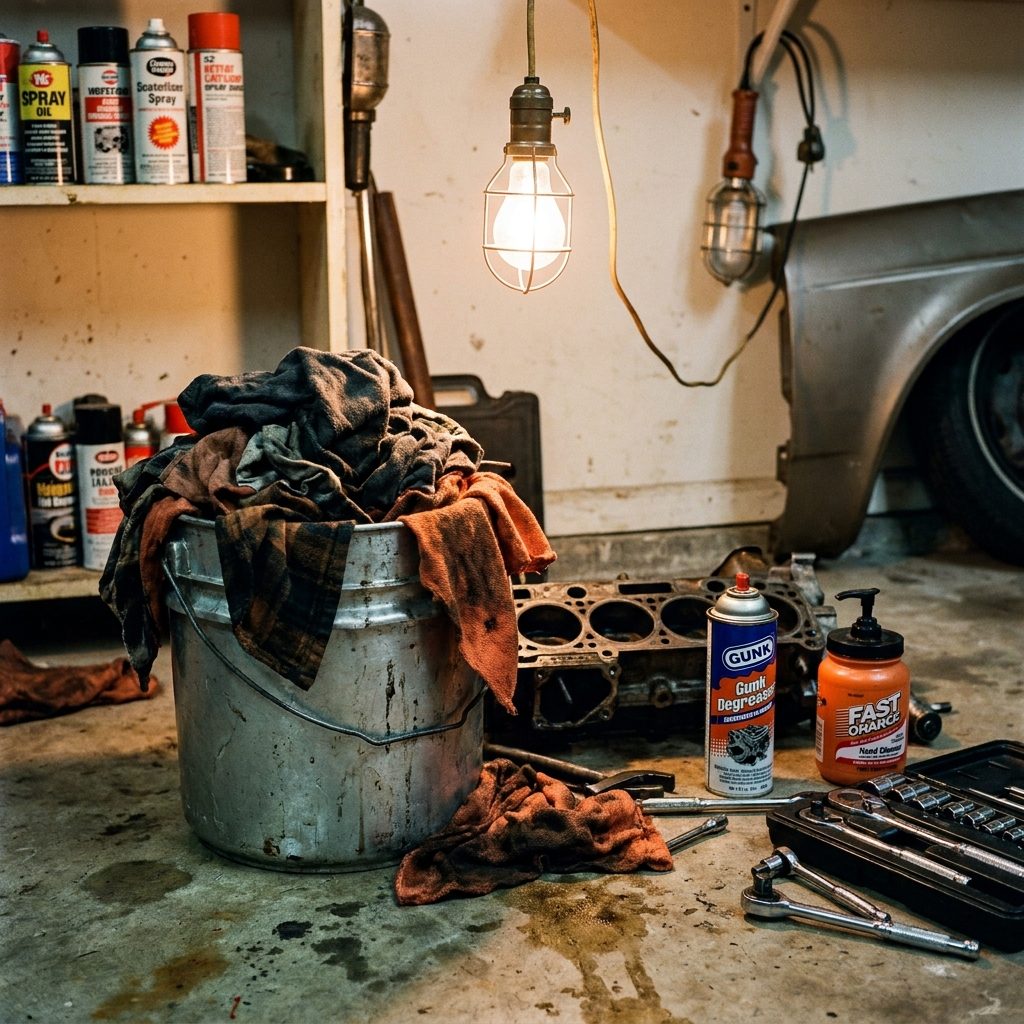
That bucket was eternal. It sat beside the workbench with the quiet authority of something that had always been there and always would be, filled with shop rags at every possible stage of saturation. Some were flannel shirt scraps. Some were old t-shirts. All of them were the same color: oil black, permanent and final.
The concept of washing them existed in theory. There was occasionally vague talk of “taking those to the laundromat,” a suggestion that everyone understood was not going to happen. When the bucket got full, you got a second bucket. This was the system. It worked.
The Air Compressor That Sounded Like the Building Was Having a Medical Emergency
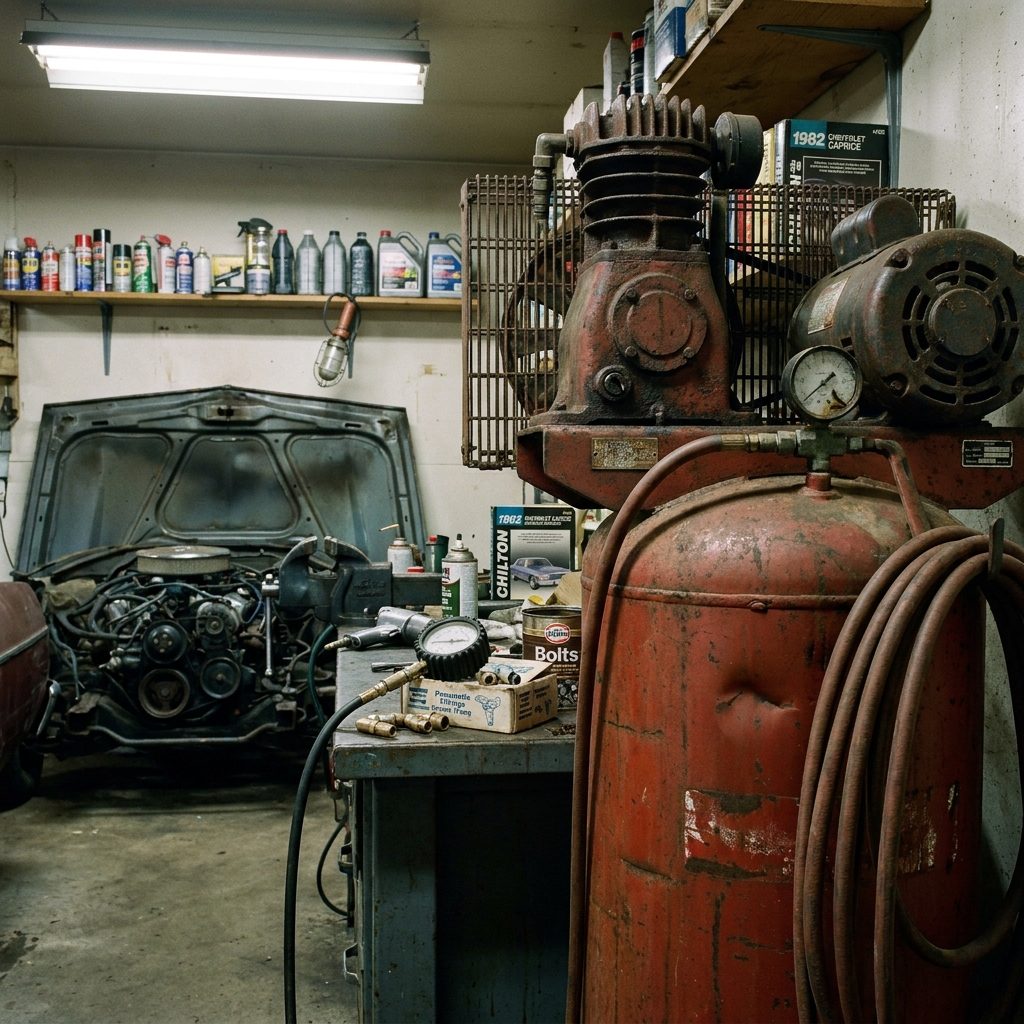
Nothing prepared you for it. You could be standing ten feet away, focused on something else entirely, and then that compressor would kick on and every thought you had would leave your head instantly. It didn’t just make noise. It made a sound like a diesel locomotive trying to start in a very small room.
The tank would rattle. The pressure gauge needle would jump. The whole machine would vibrate against the concrete with a low industrial shudder that you felt in your back teeth. And then it would stop, just as abruptly, leaving a ringing silence and a slightly elevated heart rate.
Took about six months of living with one before you stopped physically flinching when it kicked on. Some people never got there.
The Dartboard Surrounded by Years of Optimistic Near-Misses
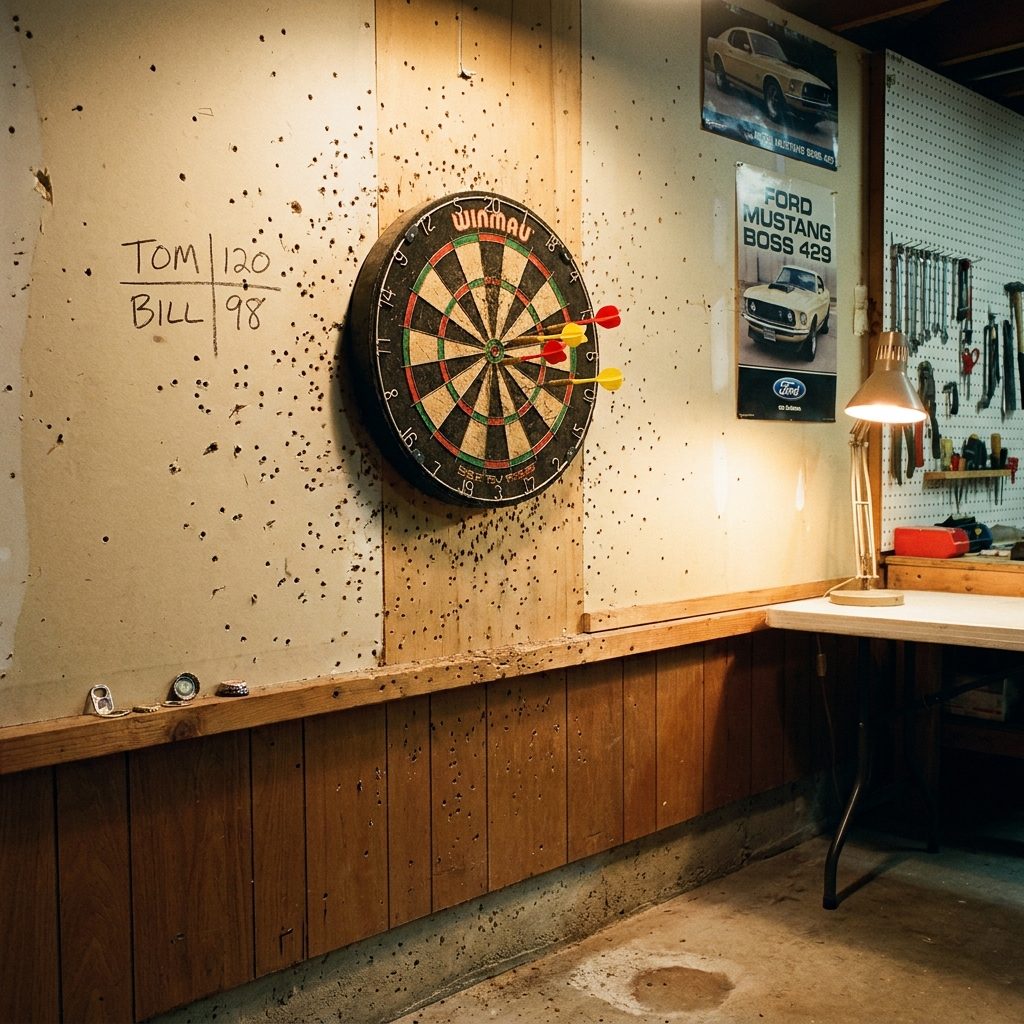
The dartboard itself was almost beside the point. The real artifact was the wall around it, a slowly expanding constellation of holes, gouges, and scuff marks that documented, with great accuracy, about fifteen years of Saturday afternoon confidence.
Someone at some point had drawn a throw line on the floor with a piece of chalk or maybe just a screw dragged across the concrete. The darts were the heavy brass kind with plastic flights, and at least one was missing a tip. None of this mattered. You played anyway, and the wall absorbed everything you missed, which was, statistically, quite a lot.
The Orphaned Car Door Leaning Against the Wall, Awaiting a Project That Would Never Come
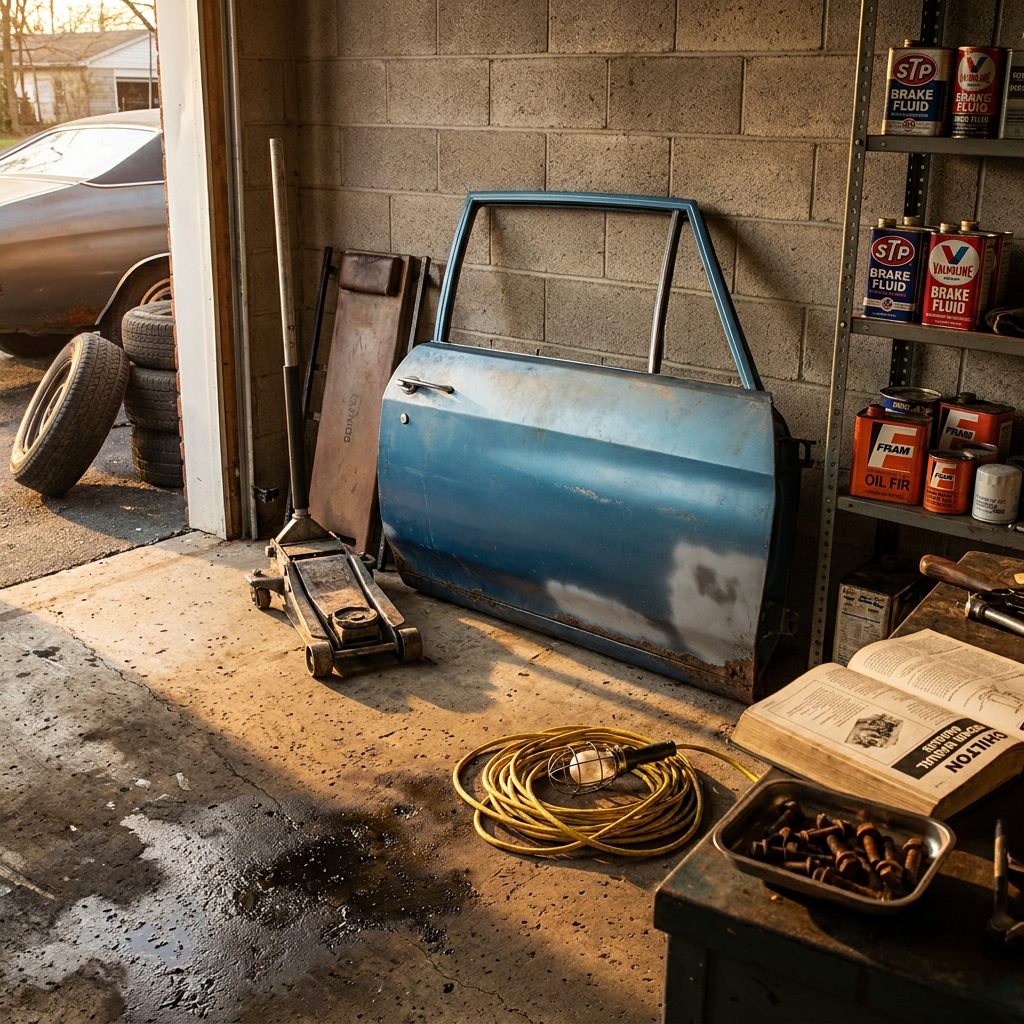
It had a story. Something happened to a car, maybe a fender bender, maybe a rust situation, maybe someone found it at a junkyard for twelve dollars because it was the right color, or close enough. The door came home. It got leaned against the wall. And there it stayed, for years, in that particular angle of optimism that said: I have a plan for this.
The plan involved the car it came from, which also lived in the garage, which also had a plan. The two of them existed in a kind of mutual suspended animation, each waiting on the other, both waiting on a Saturday that had enough free hours in it.
By 1991 nobody remembered which car the door was even for. It had simply become part of the garage, like the plywood stack, like the bucket of rags, like everything else in that space that existed in the future tense forever.
The Transistor Radio Hanging From a Nail, Tuned to AM Talk All Day Long
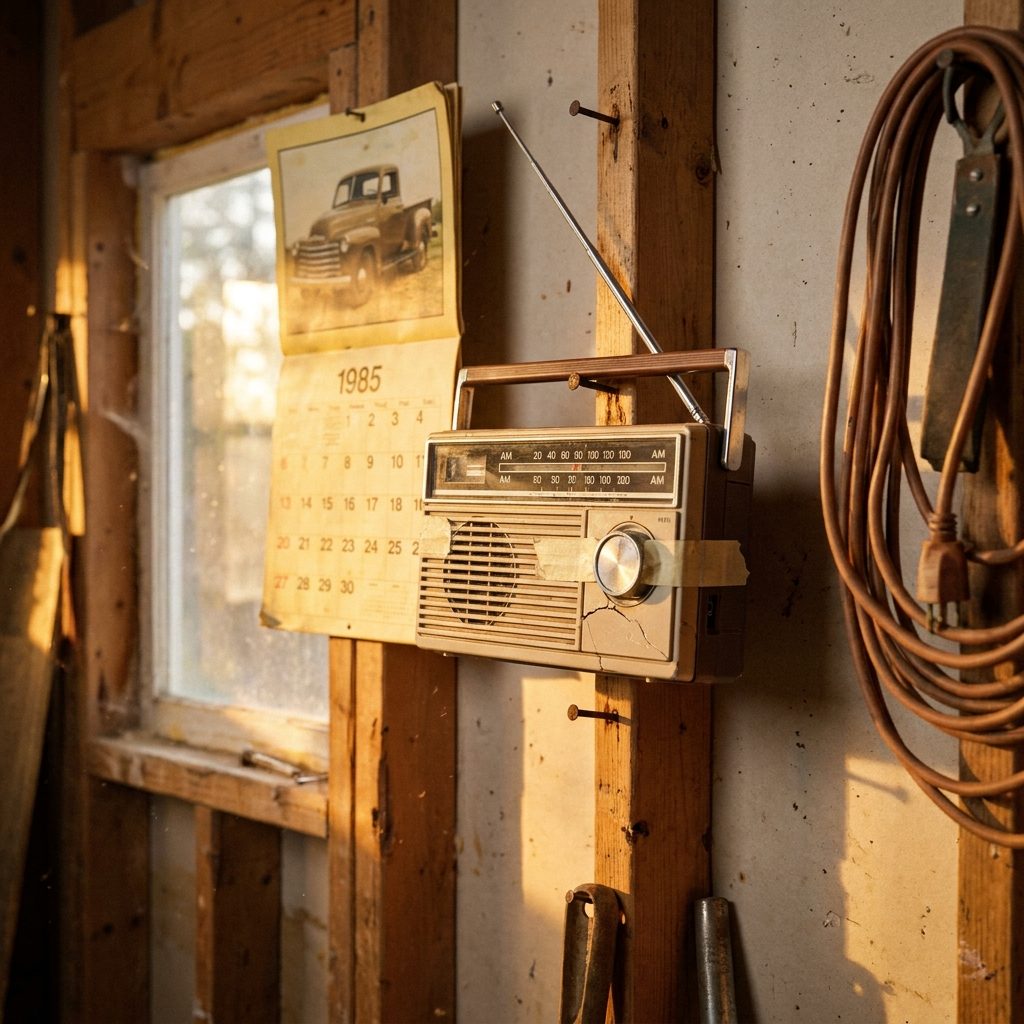
It never moved from that nail. Somebody hung it there in 1983 and there it stayed, locked on the same AM station cycling through weather forecasts, swap-meet ads, and ball games in a sound quality somewhere between a tin can and a marital dispute.
Nobody ever changed the station because the dial was so small you needed watchmaker’s fingers, and the antenna had a sweet spot requiring exactly the right angle northeast. Touch it and you lost the signal. Touch it again — static for ten minutes. So we left it alone.
The Bag of Rock Salt That Outlived Three Winters and Turned Into a Solid Brick
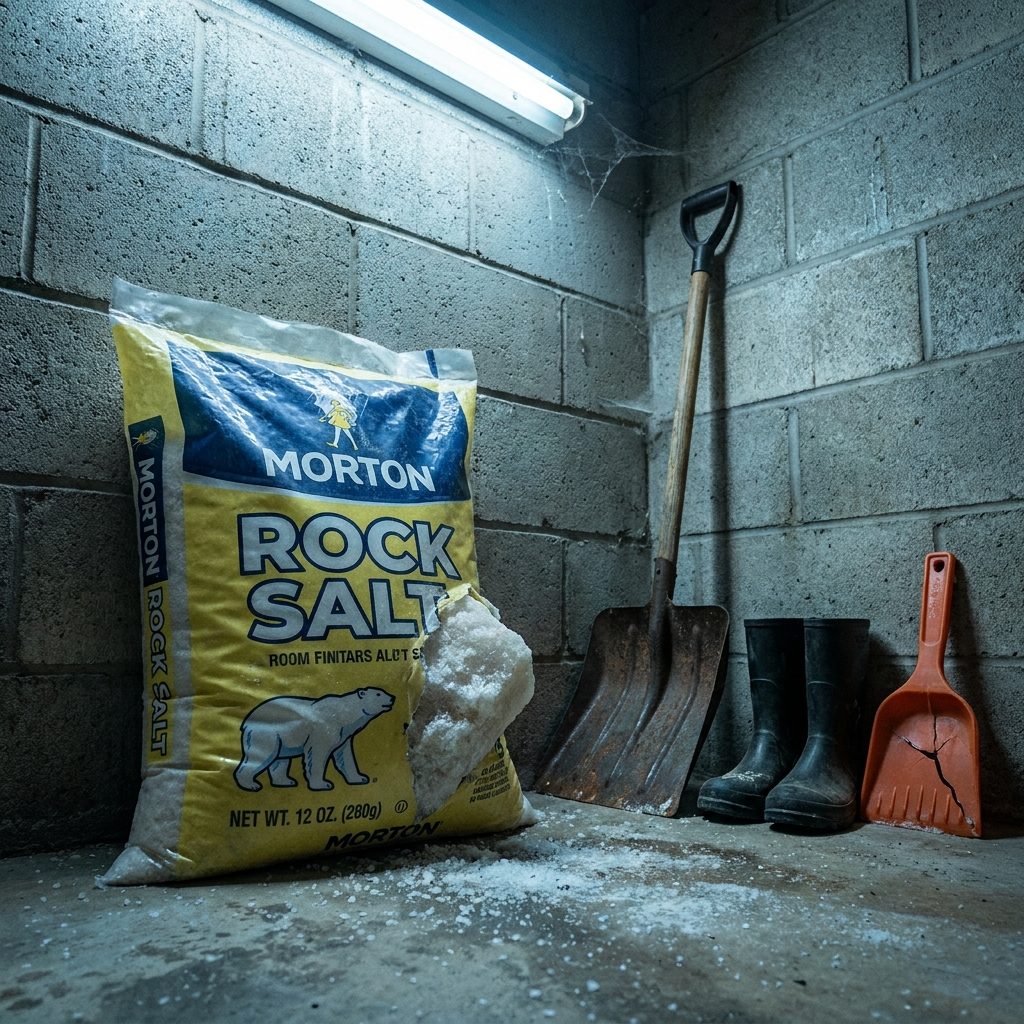
Fifty pounds of rock salt purchased in November 1984, used once, maybe twice, then abandoned on that same concrete patch to absorb humidity until it became a geological formation. By February of any given year, the bottom half was a solid block you could’ve used as a doorstop. Or a weapon.
Ripping the bag open was an event. Top layer — still loose granules. Below that, a crust. Below that, pure concrete. Dad would chip at it with a flathead screwdriver like some driveway archaeologist, freeing just enough chunks to scatter across the front walk before giving up and going inside.
The Bicycle Pump Nobody Could Find the Needle Attachment For
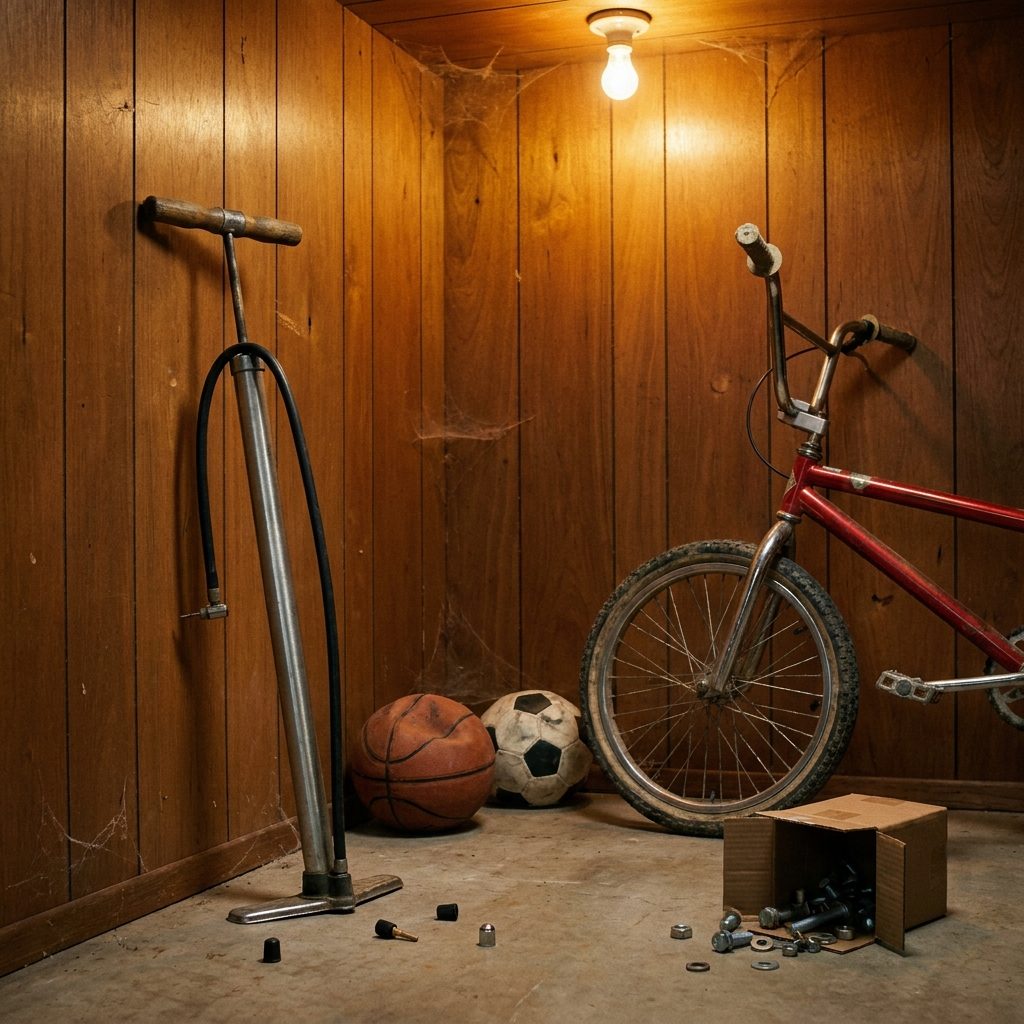
Every garage had the pump. Every garage lost the needle. A law of suburban physics.
Bike tires? The pump handled those fine. But the second you needed to inflate a basketball, a football, or that pool float your cousin sat on wrong, you needed the needle attachment, and it had vanished into whatever dimension swallows single socks and pen caps. Someone — usually a kid pressured into the search — would spend twenty minutes rooting through the junk drawer, the coffee can of screws, and the bottom of the toolbox before everyone gave up and drove to the gas station to use the air hose for a quarter.
The Collection of Mismatched Paint Cans With Drips Down the Sides Like Modern Art
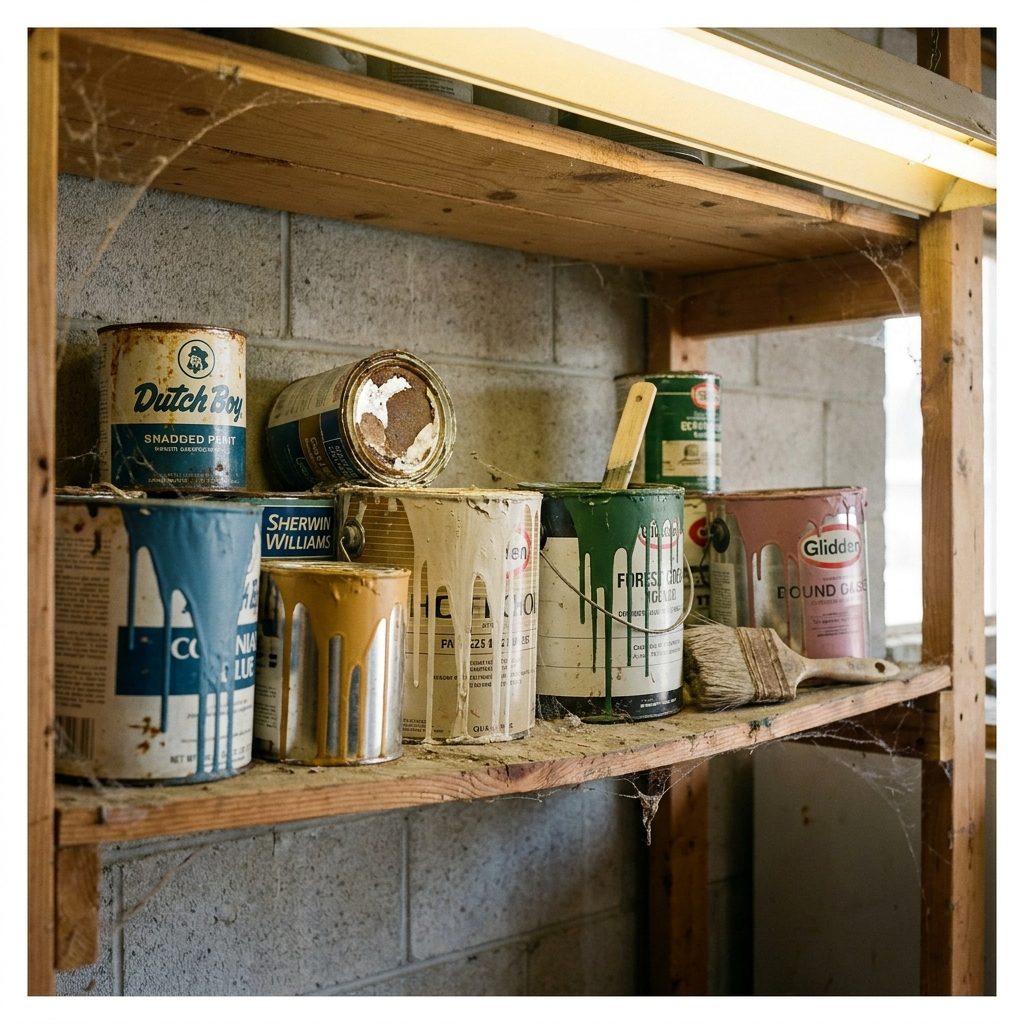
Colonial blue from the bathroom in ’82. Harvest gold from the kitchen in ’79 that nobody wanted to acknowledge ever happened. An off-white labeled “ceiling” in permanent marker. A forest green that matched nothing in the house and possibly never did.
Every lid was welded shut with dried paint, requiring a flathead screwdriver and genuine anger to pry open, and when you finally got one cracked loose the paint inside had separated into a clear liquid floating over thick paste — or it had skinned over entirely, forming a rubbery disc you had to peel off like the world’s worst fruit leather.
Mom kept them all because “we might need to do touch-ups.” We never did touch-ups.
The Charcoal Bag That Was Either Bone Dry or Completely Soggy, No In-Between
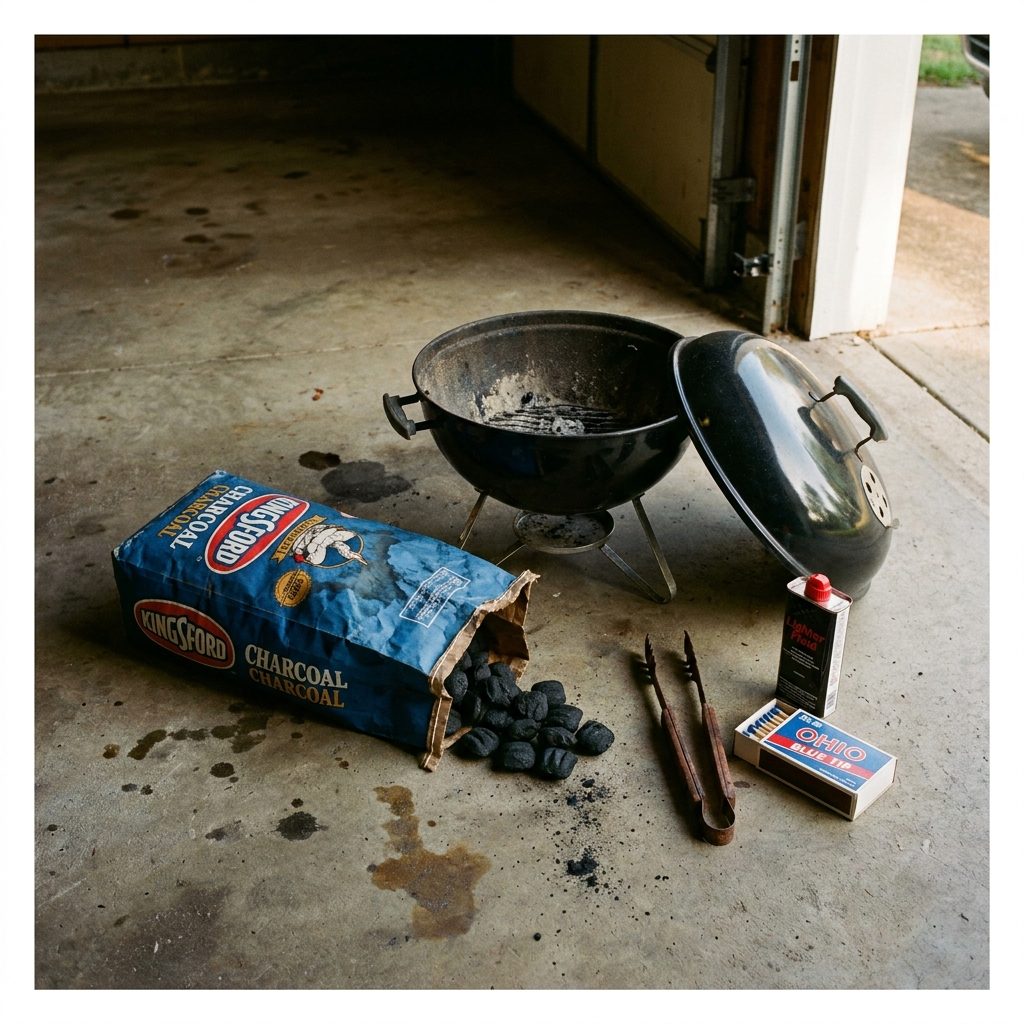
This bag sat on the garage floor from Memorial Day to Labor Day, wicking moisture through the concrete like a carbon sponge. By July Fourth, the bottom third was charcoal soup.
Dad would pour out the briquettes, pick through the damp ones with the concentration of a man panning for gold, and stack the dry survivors into a pyramid inside the Weber. Then came the lighter fluid — a generous dousing, a match tossed from three feet away, a brief fireball, and a noticeable reduction in eyebrow density. The whole ritual ate up the better part of an hour before a single hot dog hit the grill. Nobody questioned any of it. Summer had its protocols.
The Garden Hose Coiled on the Floor Like a Rubber Snake That Wanted to Kill You
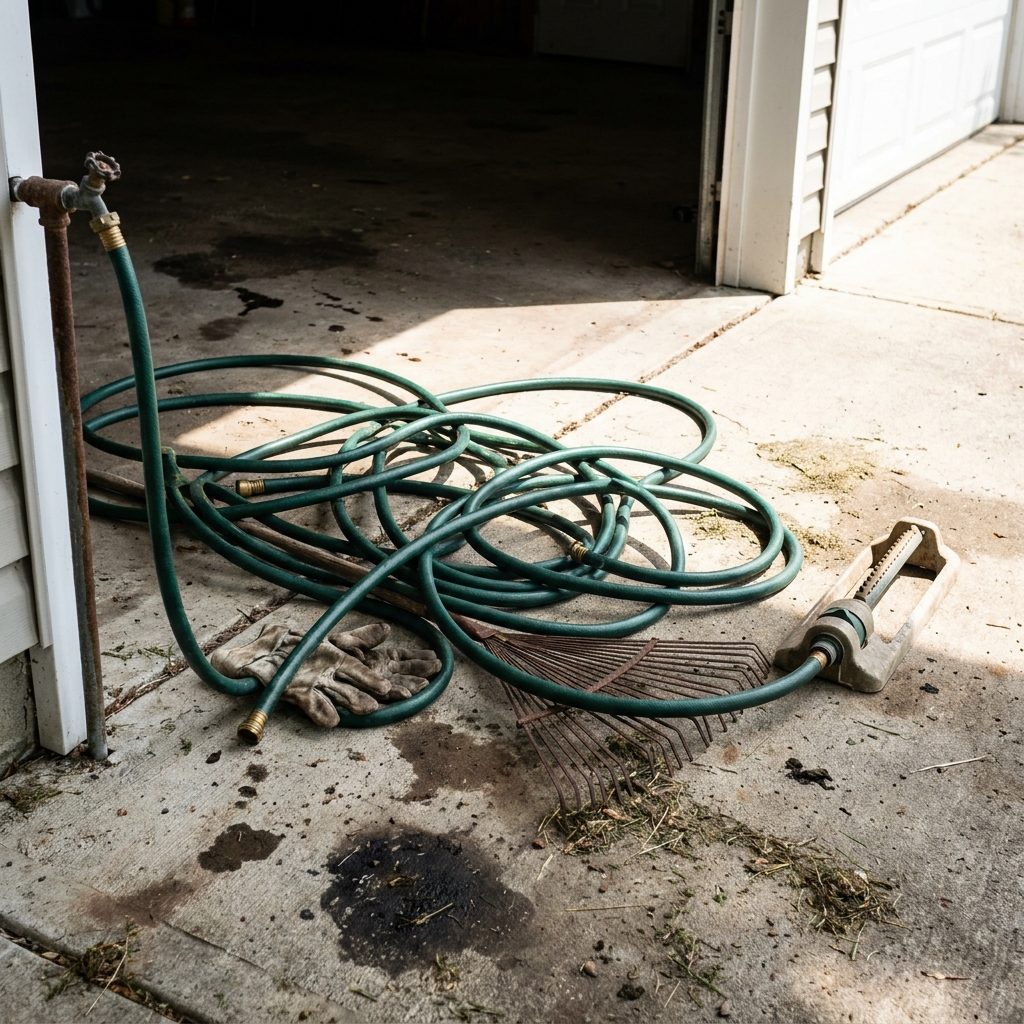
The hose reel existed purely as a decorative wall mount. The hose itself lived on the floor in a tangle that would have impressed a merchant marine.
Walking through the garage at night meant risking your ankles, because this hose caught them with the accuracy of something sentient. And the kinks — lord, the kinks. You’d be watering the lawn and flow would just stop. Dead. Walk back, find the kink, straighten it, take two steps, and a brand-new kink would appear in a completely different spot like the thing was retaliating. I remain convinced it was.
The Bag of Fertilizer That Made the Whole Garage Smell Like a Chemistry Experiment Gone Wrong
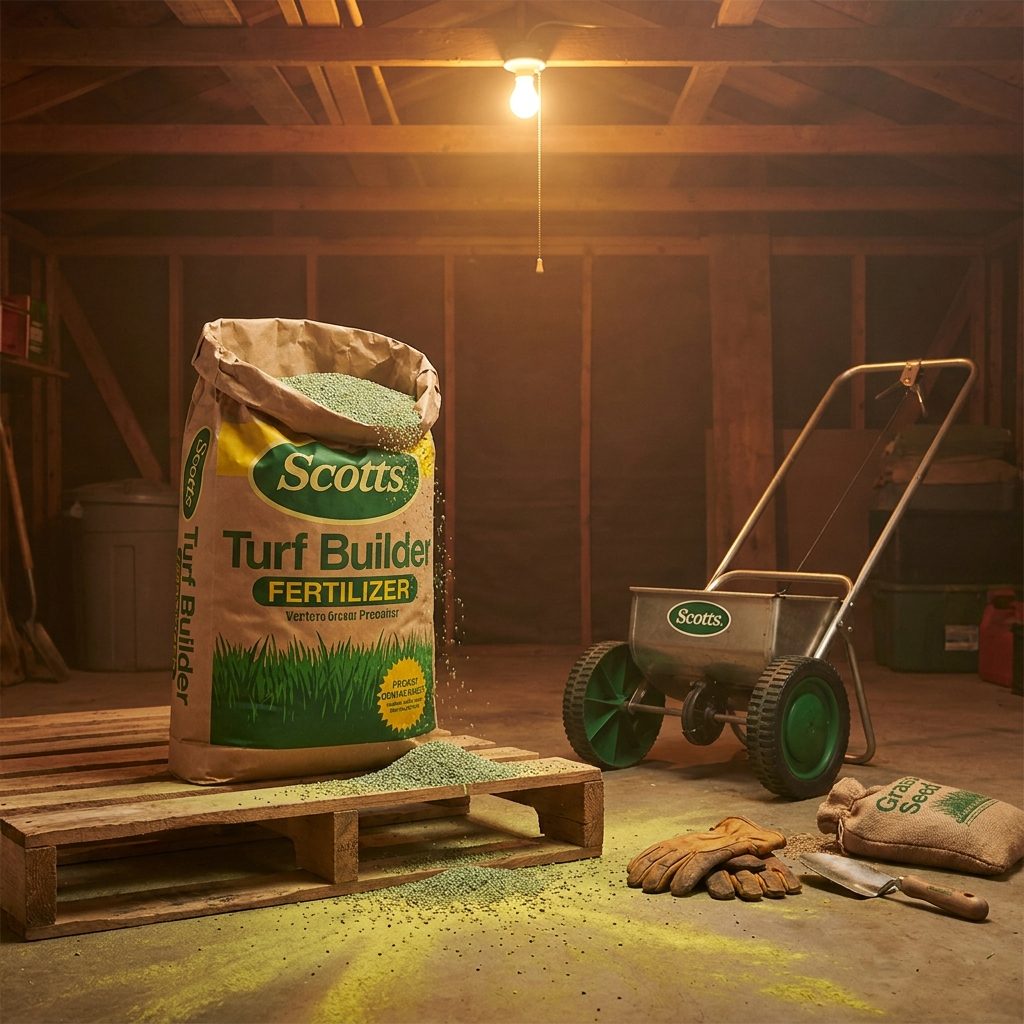
You could smell it from the driveway. That sharp, vaguely ammonia punch that walloped you the second the garage door went up on a hot day — a big bag of lawn fertilizer quietly off-gassing in the corner, committed to making its presence known.
Sitting right next to the charcoal, naturally. And the lighter fluid. A cozy little triangle of things that absolutely should not have been stored together, all perfectly content on their wooden pallet. OSHA would have wept at every residential garage in America circa 1986, but nobody gave it a second thought. Or a first one, honestly.
The Roller Skates Shoved Into a Corner, One Missing Its Stopper, Both Missing Their Laces
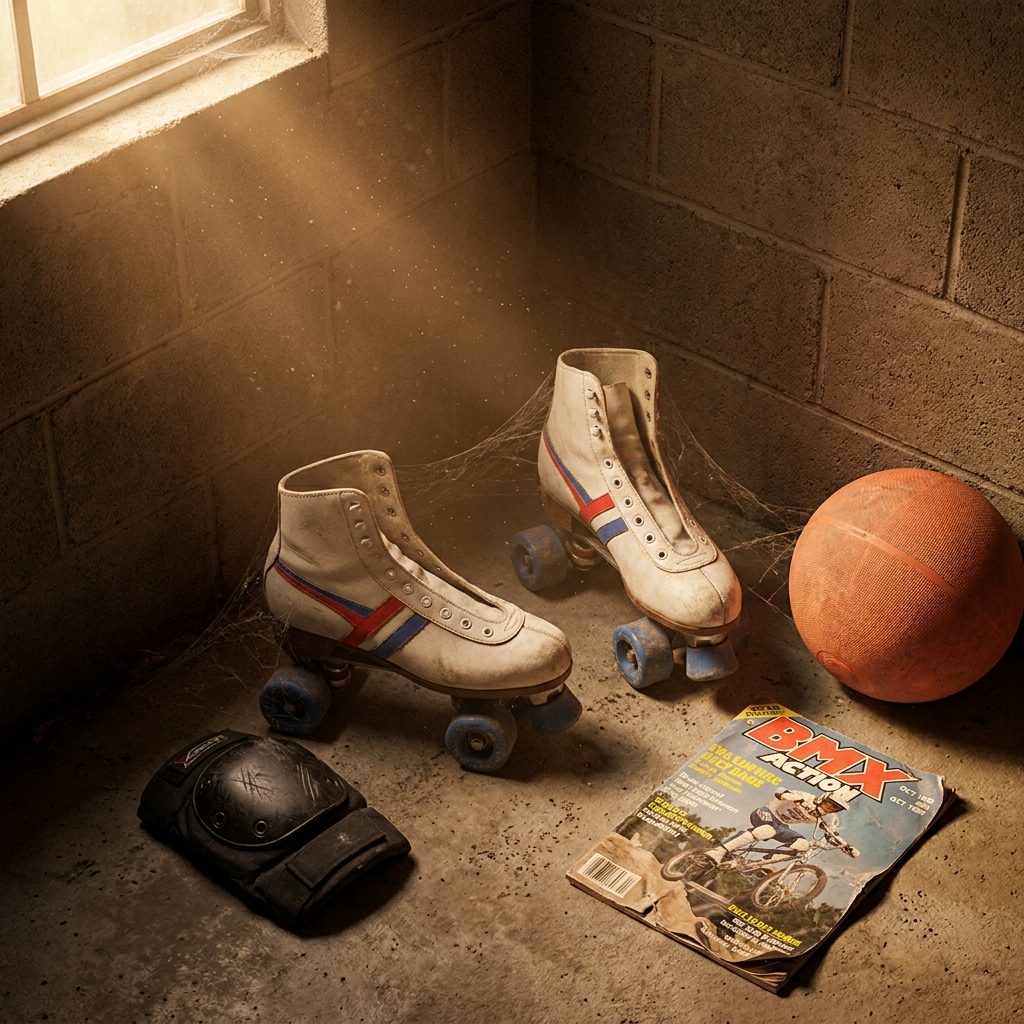
These were a ten-year-old’s entire identity for about six weeks in 1985. Then a wheel locked up at the roller rink, a toe stop ripped off on a sidewalk crack, both laces snapped during one particularly aggressive session, and into the garage corner they went. Permanently.
The plan was always to fix them. Replace the stopper, hunt down new laces, maybe spring for new wheels from the skate shop at the mall. That plan survived approximately as long as the roller skating phase itself — which is to say, until the kid discovered BMX or breakdancing or literally anything else. The skates sat in that corner for the next decade, gathering dust and spider eggs, unmoved, too loaded with nostalgia to throw away but too broken to use.
The Mayonnaise Jar Full of Nails That Was Older Than Most of the Children in the House
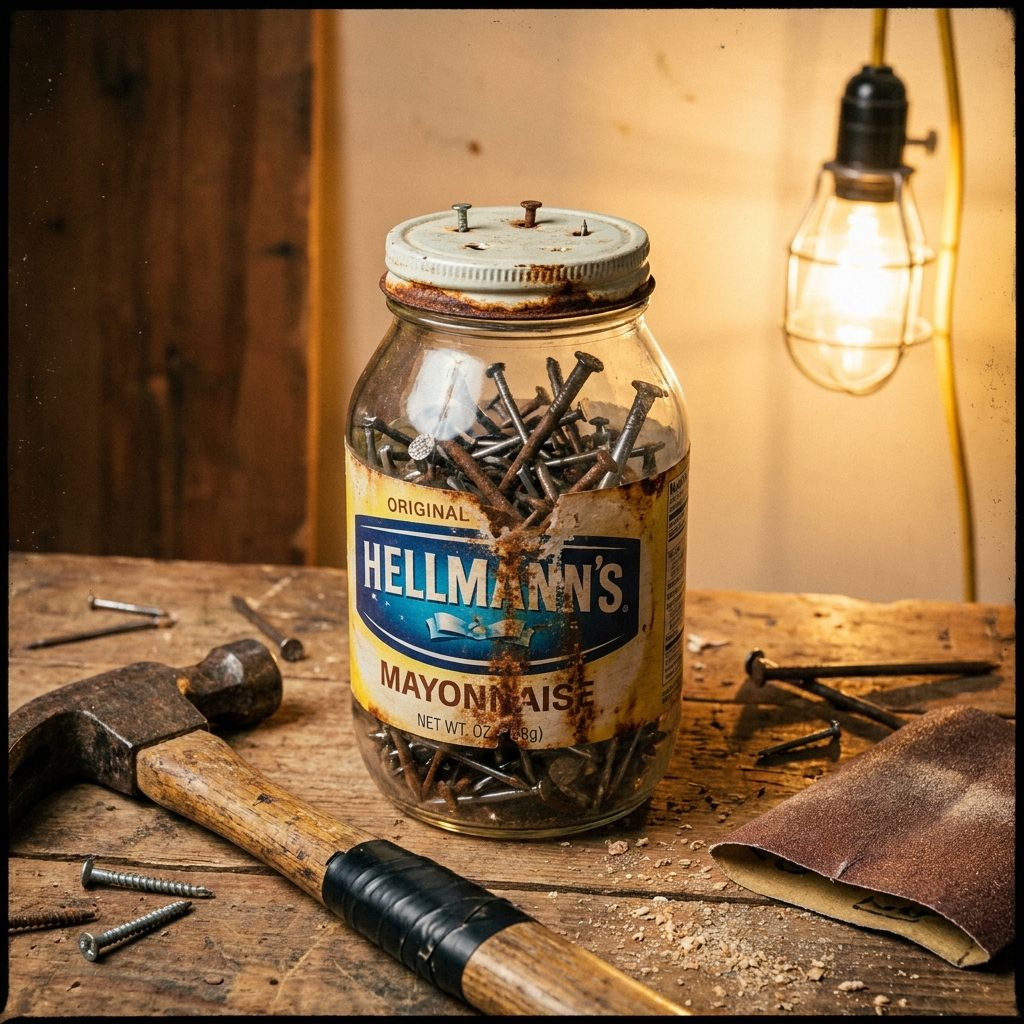
Hellmann’s. Always Hellmann’s. Or sometimes Miracle Whip if the family leaned that direction — which told you something about them, frankly.
The jar had been repurposed so long ago that the label had fused to the glass through some unholy combination of rust water and time. Inside was every nail ever pulled from every project since the Ford administration: finishing nails, roofing nails, framing nails, bent nails somebody had straightened with a hammer and kept because throwing away a nail felt wasteful. Somewhere near the bottom, nails from the Eisenhower years were probably rusting into a single orange mass, slowly merging into one solid lump of oxidized regret.
Need a specific size? Good luck. You’d dump half the jar onto the workbench, pick through the pile with the focus of a jeweler, find three that were close enough, and sweep the rest back in. Worked for decades. Nobody proposed a better system.
Would you like to save this?
Please note that some of the imagery in this article were created with the aid of AI image generators.