
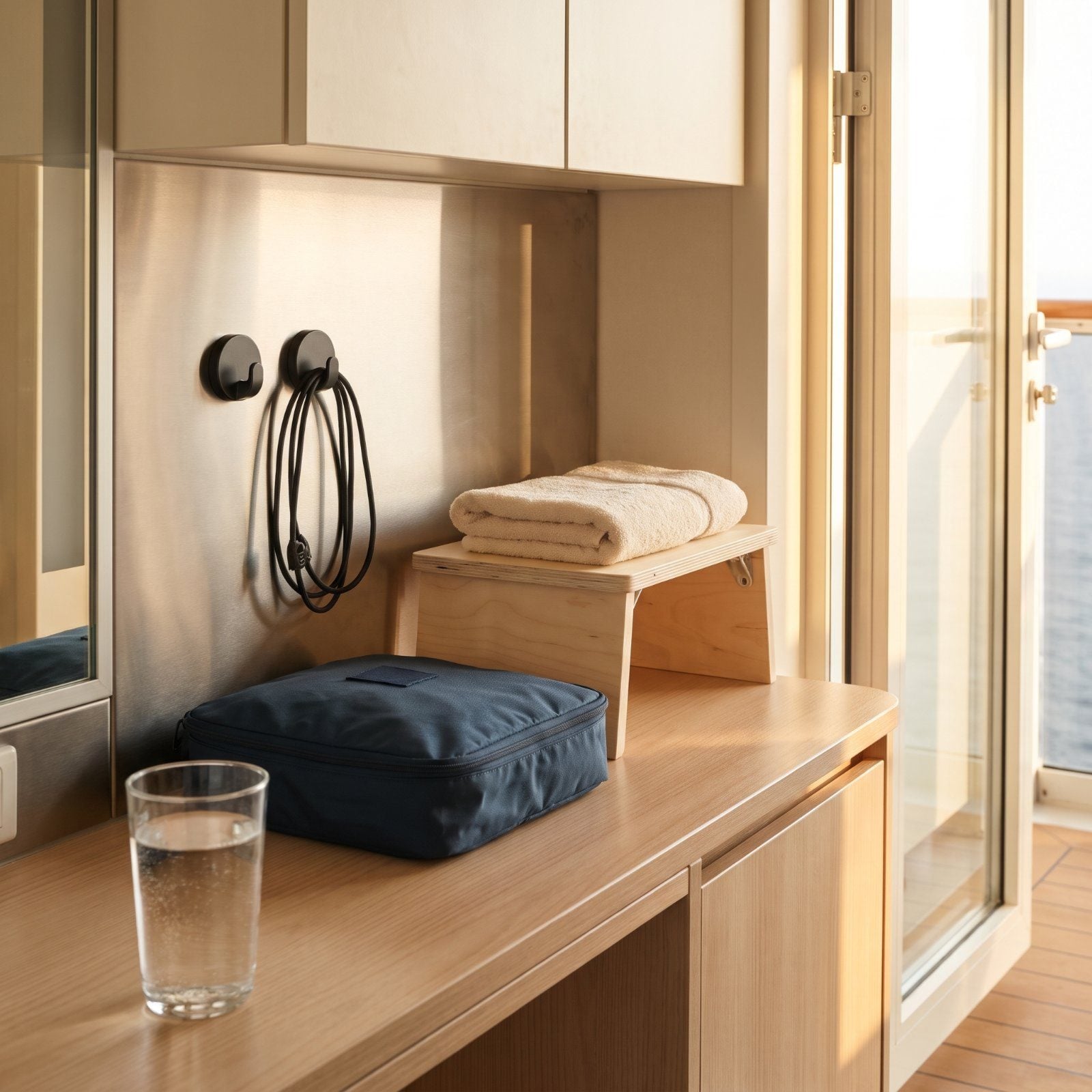
The first ten minutes in a cruise cabin tell you everything. Two suitcases on the floor, a bed that blocks the closet, a walkway you have to turn sideways for. That’s not a small room. That’s an unorganized one. A standard inside cabin runs around 150 square feet, and most of it goes to waste because nobody thinks about the air overhead, the hidden pockets, or the steel walls holding the whole thing together. We cruise a lot, and we learned these tricks the hard way. Here’s how to make the room breathe.
49. Turn Those Steel Cabin Walls Into Free Storage With Magnetic Hooks
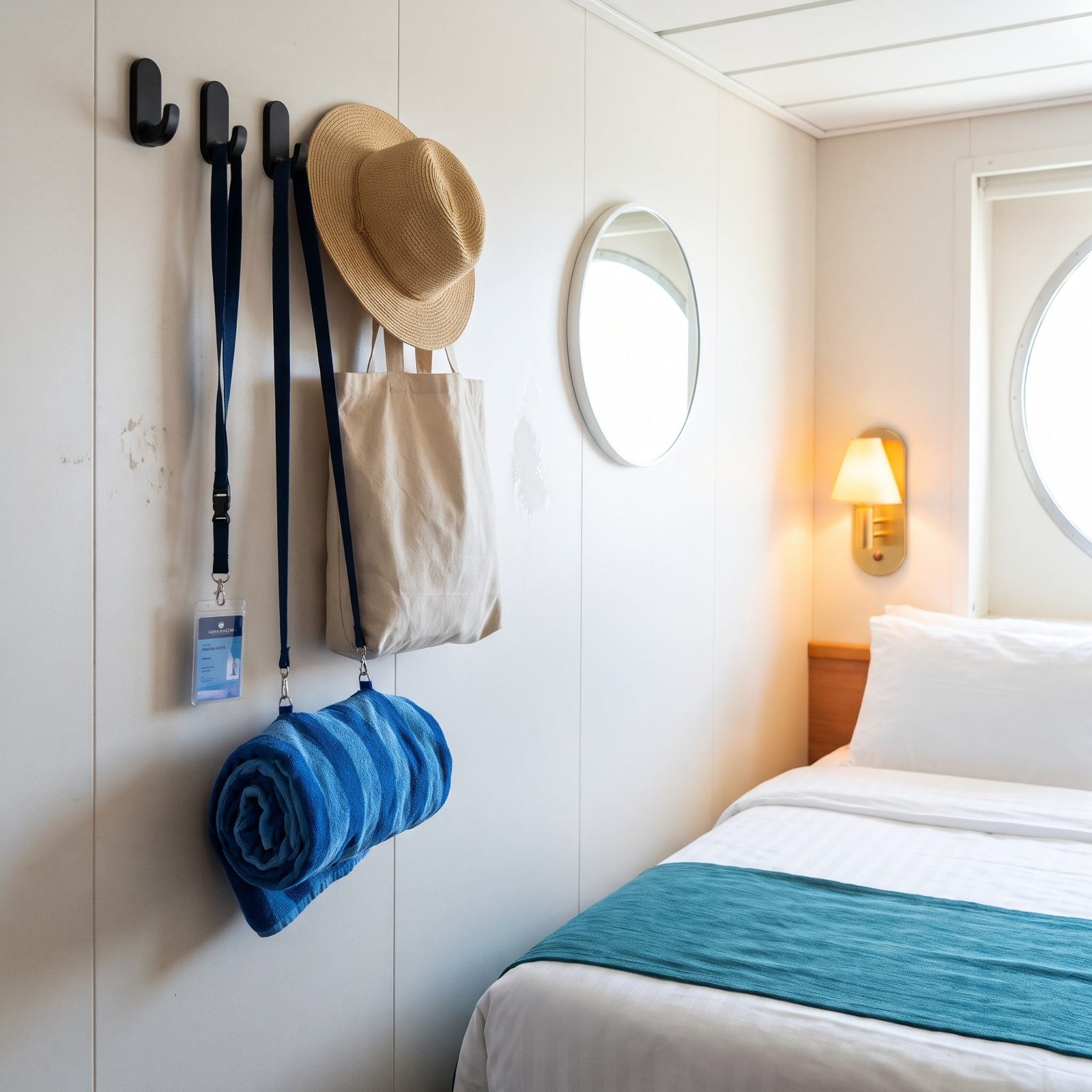
Most cruise cabin walls are steel, and if you run a magnet along one you’ll feel it grab. That’s free real estate nobody uses.
Pack a handful of strong magnetic hooks and you suddenly have somewhere to hang hats, totes, wet swimsuits, lanyards, and the baseball cap that otherwise lives on the floor. Everything comes up off the surfaces, which is the whole game in a room this size.
I bring six every trip and use every one. Skip the flimsy craft-store magnets. You want the heavy neodymium kind that holds a loaded bag without sliding down the wall at 2am and scaring you half to death.
48. Slide the Biggest Suitcase Clean Under the Bed
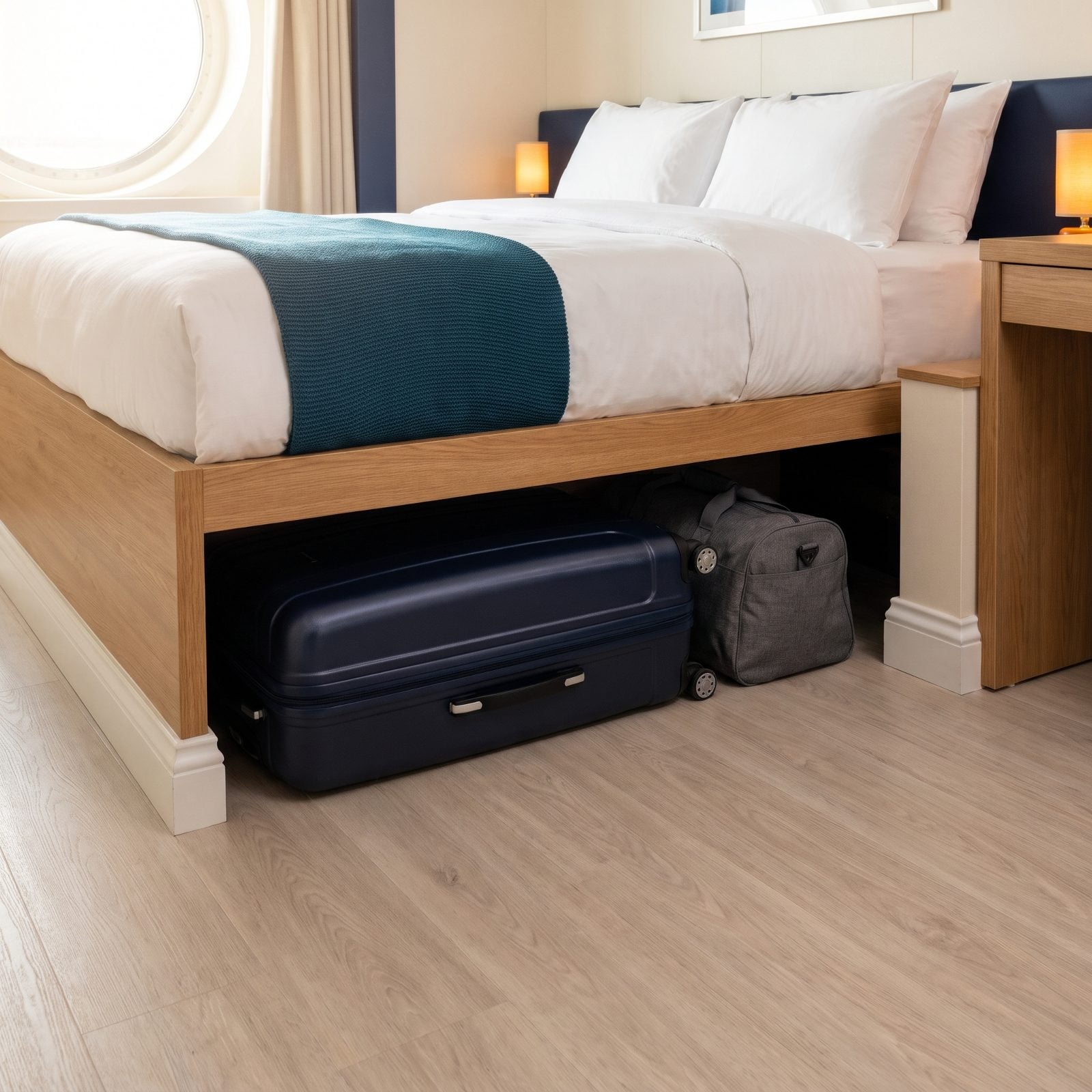
Cruise beds sit high on purpose. The gap underneath swallows a full-size suitcase whole, and that’s exactly where it belongs.
An empty case taking up floor space is the single biggest mistake people make. Collapse it if it’s soft-sided, slide it under, done. You just bought back a square yard of walkway that was doing nothing but tripping you.
Measure before you buy luggage if cruising is your thing. A standard checked bag clears most beds. The giant 32-inch monster sometimes doesn’t, and then it lives in the middle of the room all week, judging you.
47. Unpack Everything Before the Ship Even Leaves Port
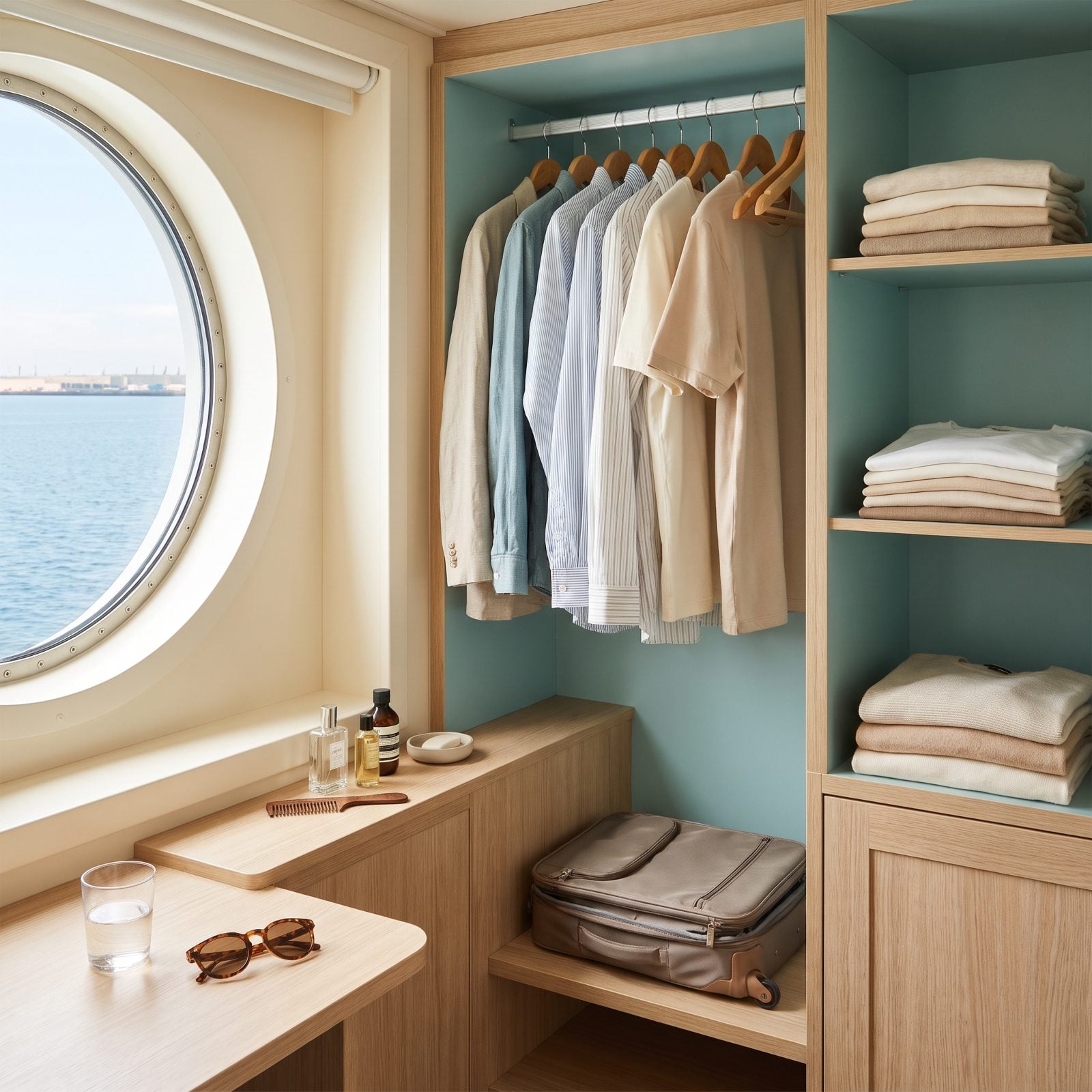
The cabin never feels bigger than the moment it’s fully unpacked. Hang the clothes, fill the shelves, line the toiletries along the ledge, and get those empty cases out of sight. Twenty minutes of work, and the room stops looking like a storage unit and starts looking like somewhere you live.
Do it before sailaway, while you’re stuck waiting anyway. Once the ship moves and the bars open, you won’t want to, and a half-unpacked cabin stays half-unpacked for the whole week. I’ve made that mistake. Living out of a suitcase on the floor for seven nights is nobody’s idea of a vacation.
46. Fold the Sofa Bed Away Every Single Morning
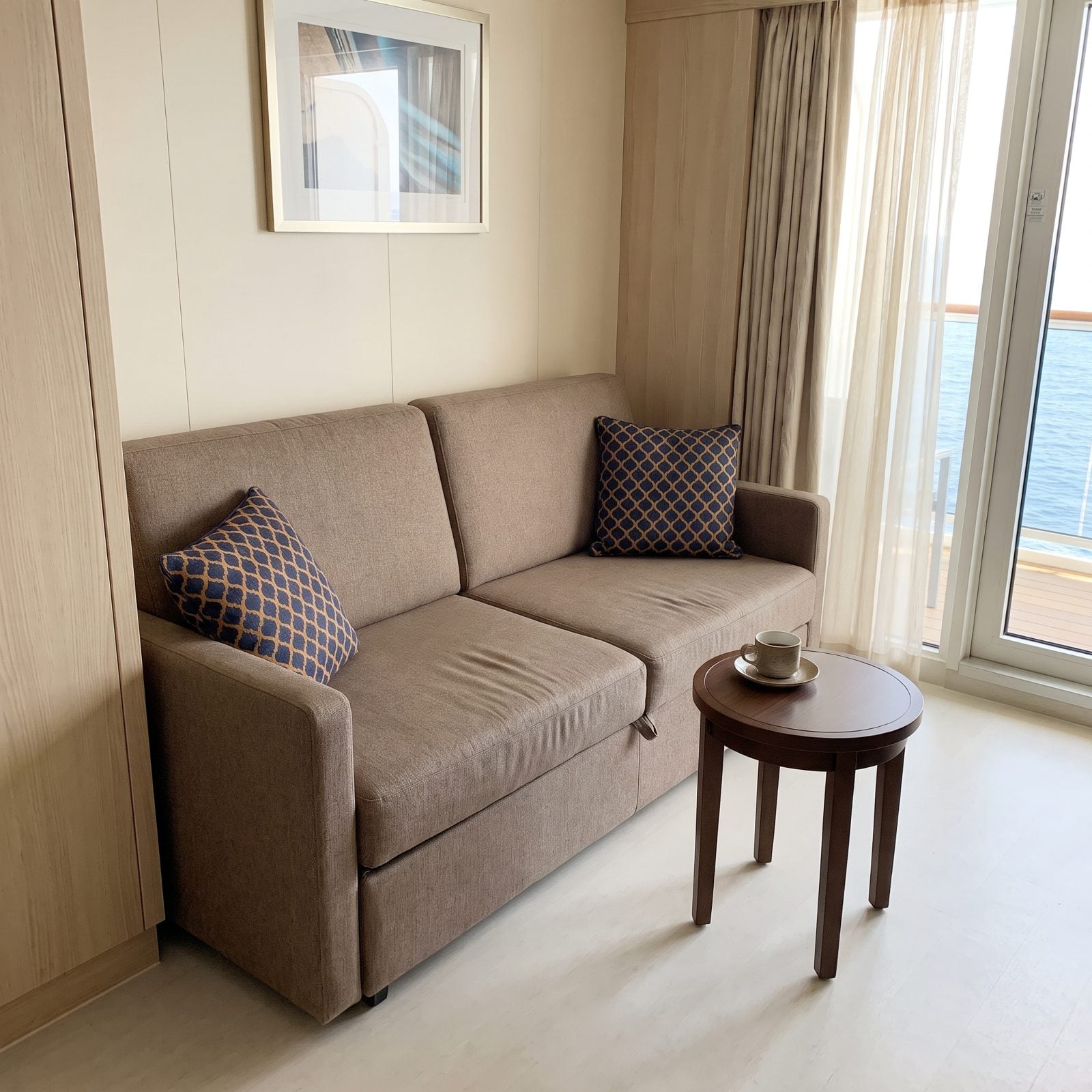
A pulled-out sofa bed eats the entire sitting area, and leaving it down means your cabin has exactly one function: sleeping. Fold it back every morning and you reclaim a couch, a floor, and a place to put your feet up that isn’t horizontal.
Stewards used to flip these without being asked. Some still do. But second-sailing or late-service cabins often get skipped, so just handle it yourself. Thirty seconds of work for a room that does more than one thing before dinner.
45. Have Your Steward Stow the Pullman Berths During the Day
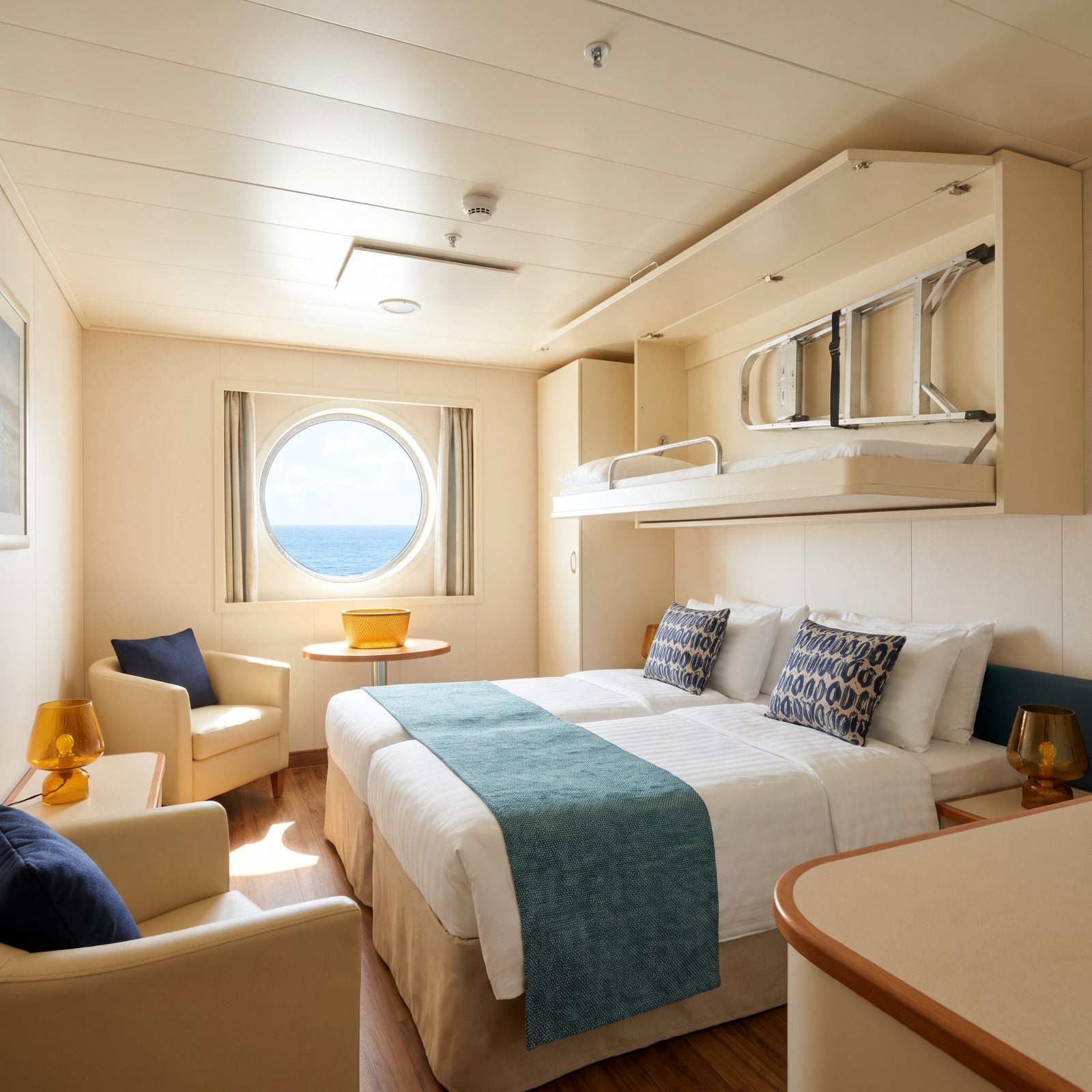
Pullman berths are those upper bunks that fold down from the wall or ceiling. Great for the kids at night. A low-hanging headache all day if you leave them down.
Ask your steward to fold them up each morning and drop them each night as part of turndown. Most are happy to, and a folded berth hands back real headroom plus that open space overhead that keeps a family cabin from feeling like a submarine.
44. Split the Bed Into Two Twins for a Wider Walkway

Nobody thinks of this one. Cruise beds split into two twins, so if you’re traveling with a friend, a sibling, or you just want elbow room, ask the steward to separate them and shove each against a wall.
Suddenly there’s a clear aisle straight down the middle instead of a king-size slab you have to edge around. The room reads bigger because you can walk through it without turning sideways.
Couples usually want the beds together, and that’s fine. But if someone snores or runs hot, twins solve two problems and open the floor at once.
43. Ask Your Steward to Haul Out the Coffee Table and Anything Else You Won’t Use
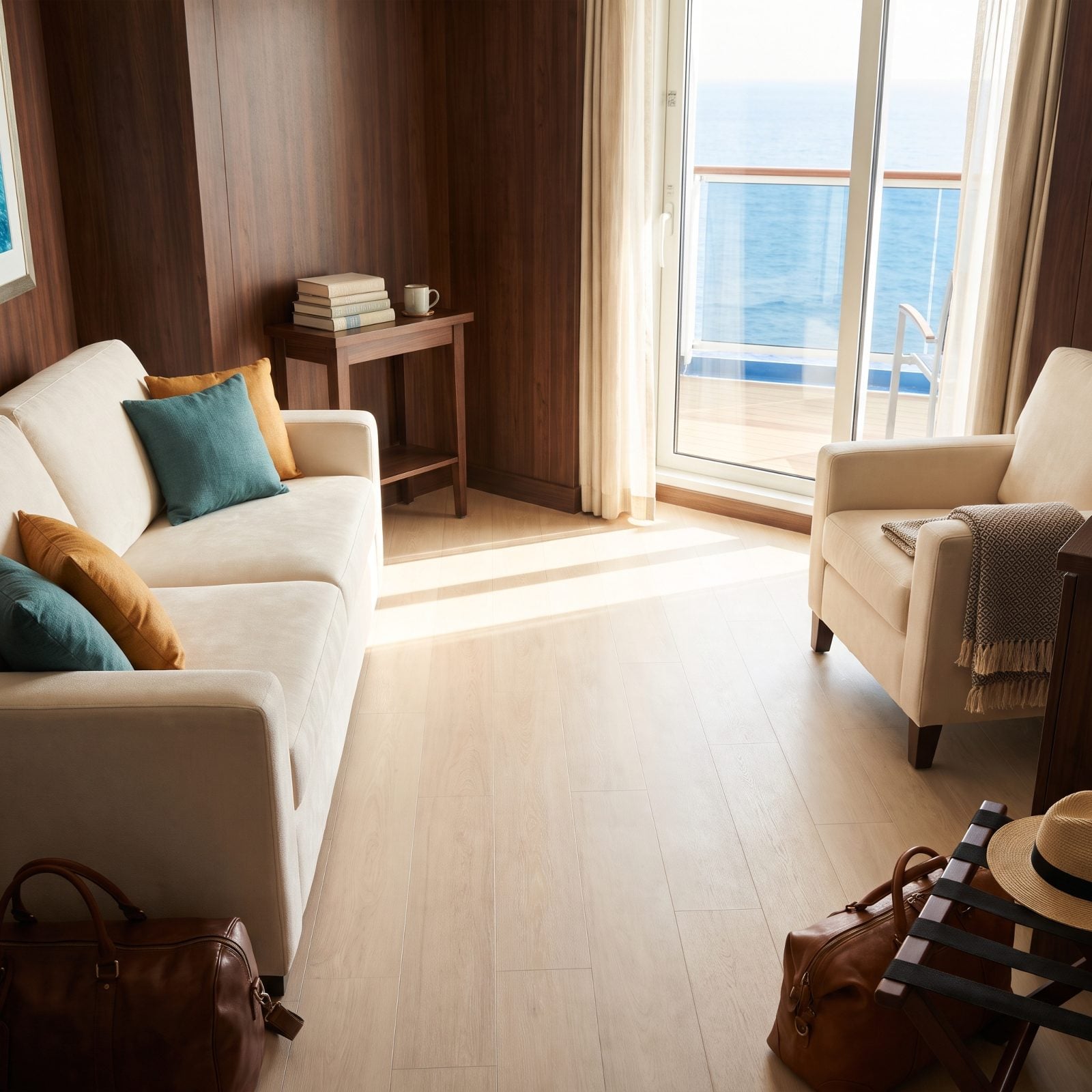
That low coffee table in the sitting area looks lovely in the brochure. In practice it’s a shin magnet and a floor hog. If you’re not using it, ask your steward to carry it off for the week.
Same goes for the ice bucket stand you’ll never touch, the extra chair nobody sits in, or the decorative anything. Stewards tuck this stuff in a back closet and bring it back on the last night, and every piece they remove is floor you get to keep.
42. Nest the Carry-On Inside the Big Checked Bag
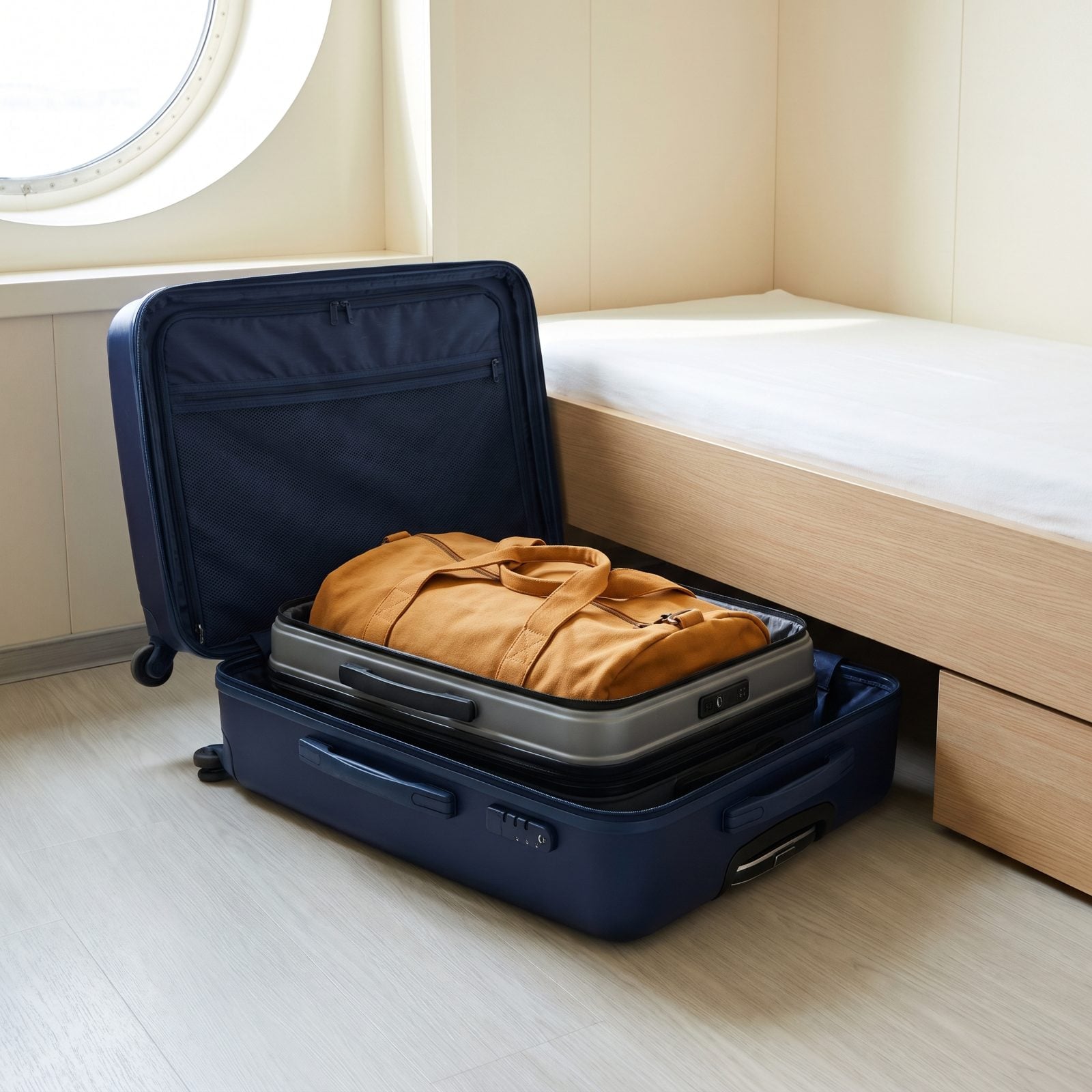
You brought three bags. You need to store three bags. Except you don’t, because they fit inside each other.
Nest the carry-on inside the largest suitcase, then tuck the soft duffel inside the carry-on like Russian dolls — no need to fully empty the duffel, it squashes in fine. One compact unit slides under the bed instead of three separate bags fighting for the floor. Sounds obvious, right? Watch how many cabins have luggage stacked in the corner all week and you’ll see how often people miss it.
41. Pull Packing Cubes Straight Into Drawers as Instant Organizers
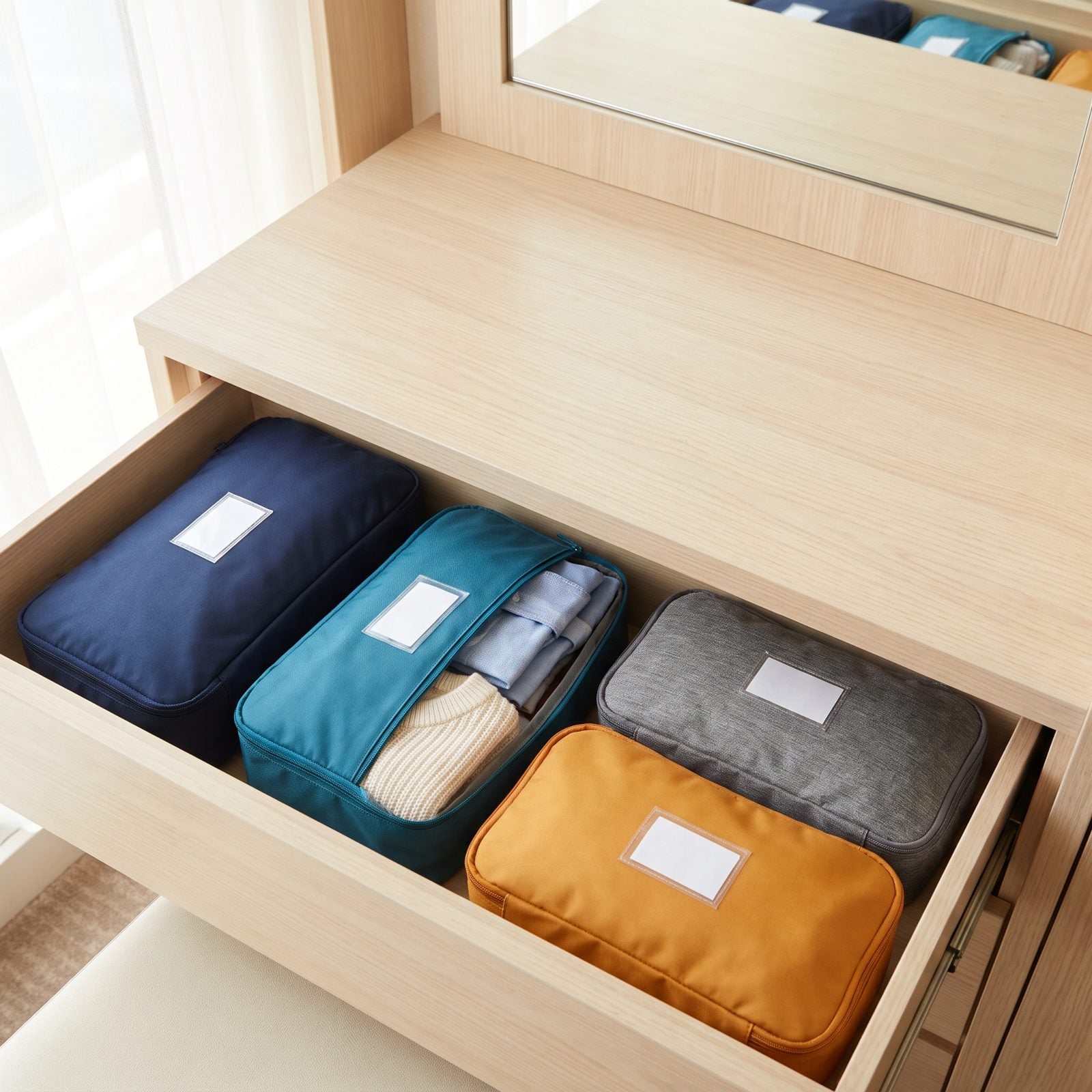
Packing cubes aren’t just for the flight. They’re drawer dividers you already own.
Pack by category — shirts in one packing cube, underthings in another, swim gear in a third — then drop the whole cube straight into the cabin drawer. No refolding, no digging. Need the pool stuff? Lift out one cube, grab it, drop it back.
The drawers in these cabins are shallow and shapeless. Cubes give them structure, and on the last night you just zip and go instead of chasing loose socks around the carpet.
40. Double Your Cabinet Capacity With One Collapsible Shelf Riser
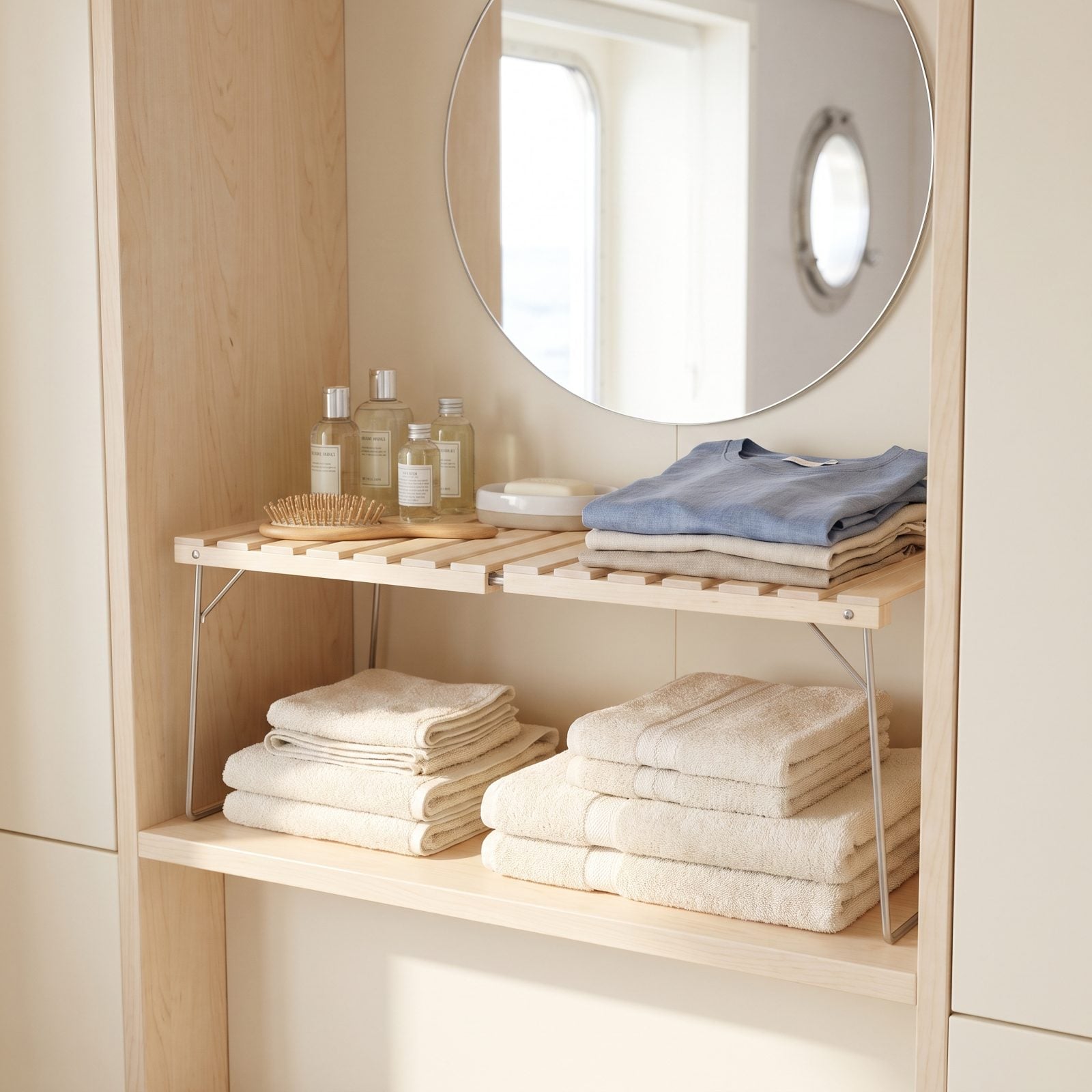
Cabin shelves have a foot of empty air sitting above whatever you set down. A folding shelf riser fills it and gives you a second tier on the spot.
Toiletries on the bottom, folded tops on the riser. Or towels below, sunscreen and sunglasses up top. A collapsible shelf riser packs flat in your suitcase and roughly doubles the usable space in a shallow closet or vanity.
It’s a cheap piece of plastic and metal that solves the one thing every small cabin lacks: vertical storage that actually stacks. Set it up on day one. You’ll wonder why the cabin didn’t come with one.
39. Hang a Fabric Shelving Unit in the Closet
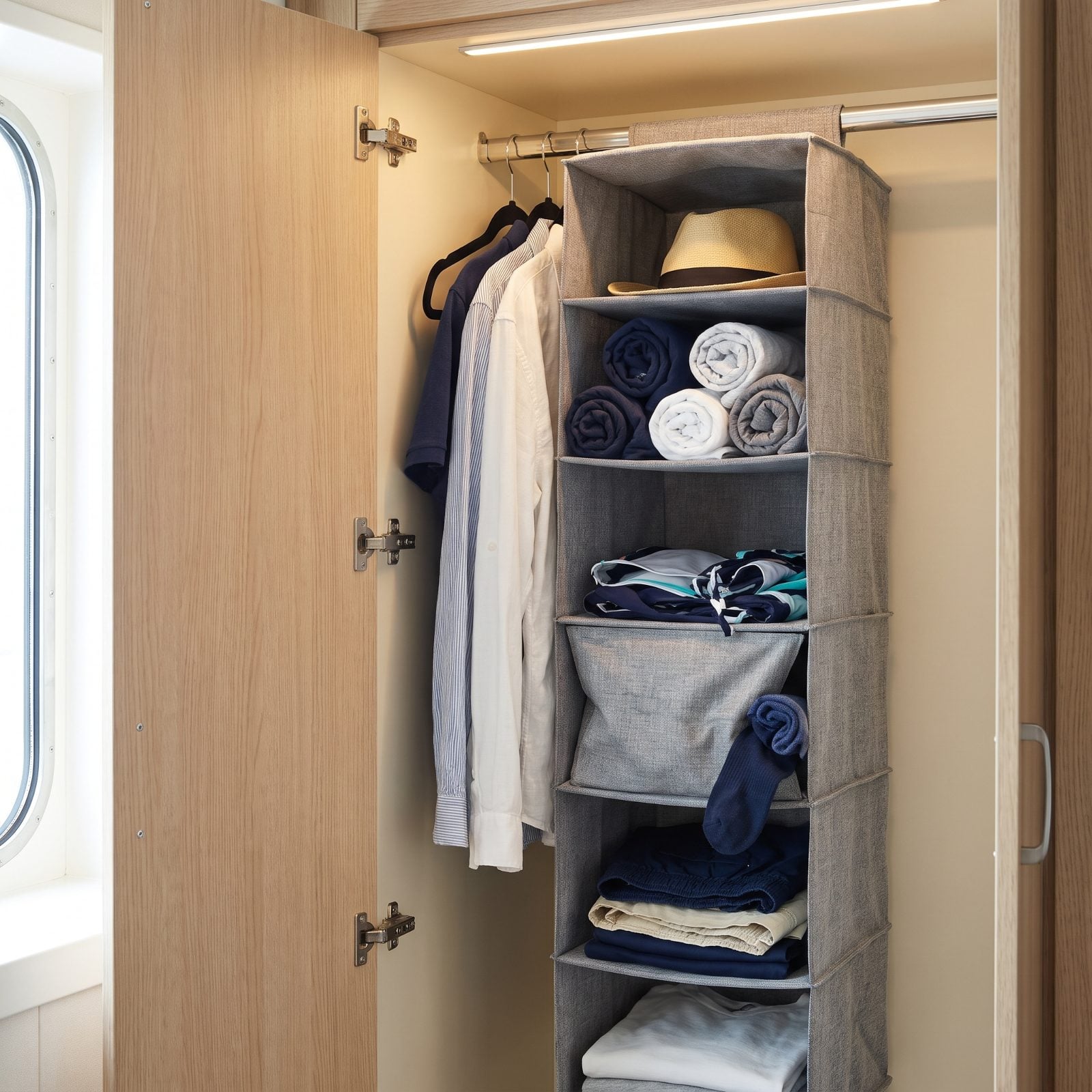
Cruise closets are tall and hollow — one rail at the top, then a void of wasted air all the way down. A hanging fabric shelf fixes that in ten seconds. It clips onto the rod and gives you five or six folded-storage levels where there was nothing but hanging space you didn’t need anyway.
And here’s the part people miss: you stop living out of the suitcase. The bag goes under the bed, flat and gone, and your clothes sit at eye level in soft cubbies you can actually see into. No more digging to the bottom for a shirt.
38. Replace Bulky Hangers With Slim Velvet Ones
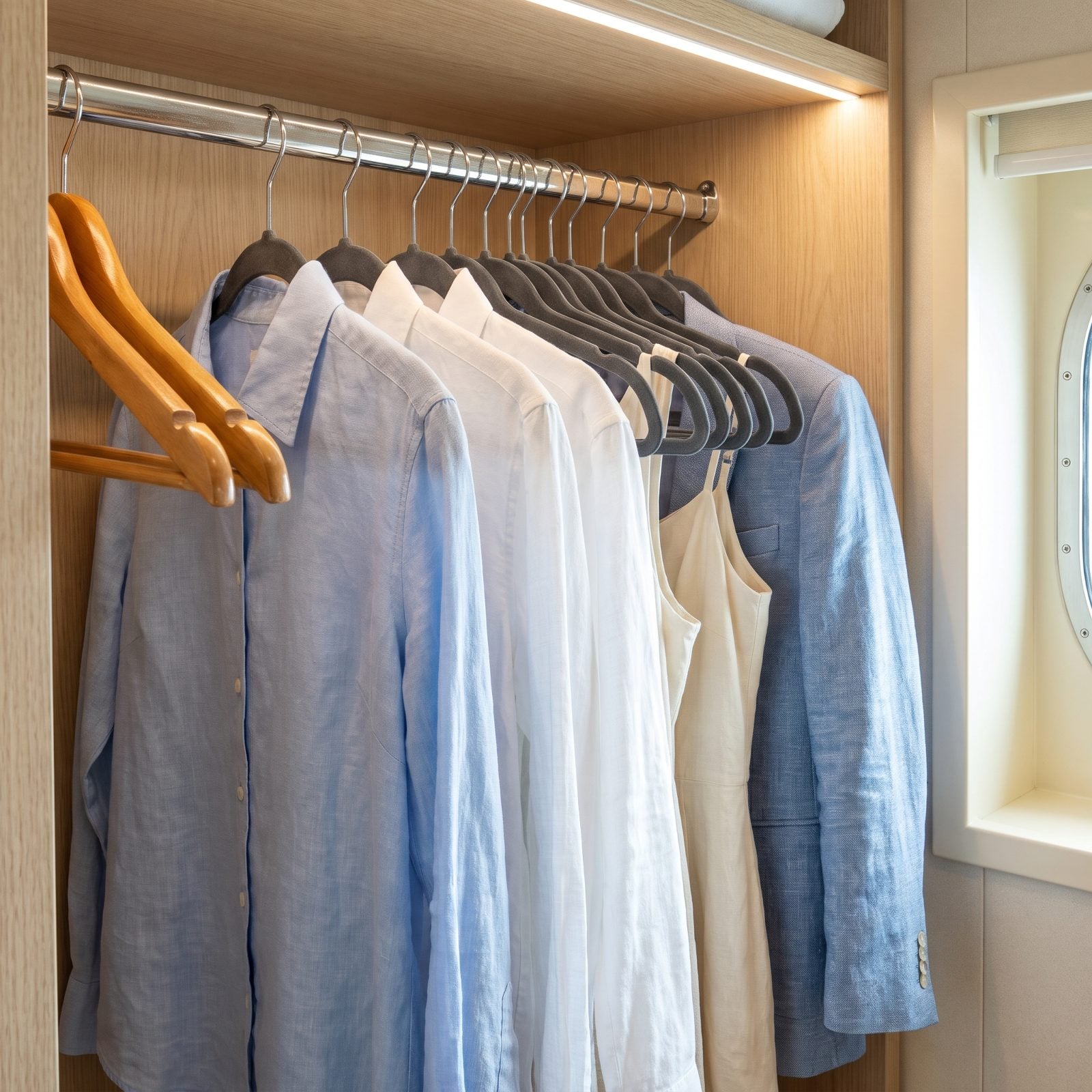
The hangers the ship gives you are the enemy. Thick plastic, or worse, those theft-proof ones with the little loop that only fits the fixed hook. They eat rail space and hold a fraction of what they should.
Bring a dozen slim velvet hangers. The flocked surface grips, so your silk top stops sliding into a heap on the floor, and the slim profile lets you fit nearly double on the same rod. On a seven-day cruise where you packed outfits for every dinner, that extra room is the difference between hanging your clothes and burying them.
37. Use Cascading Hangers to Maximize Vertical Closet Space
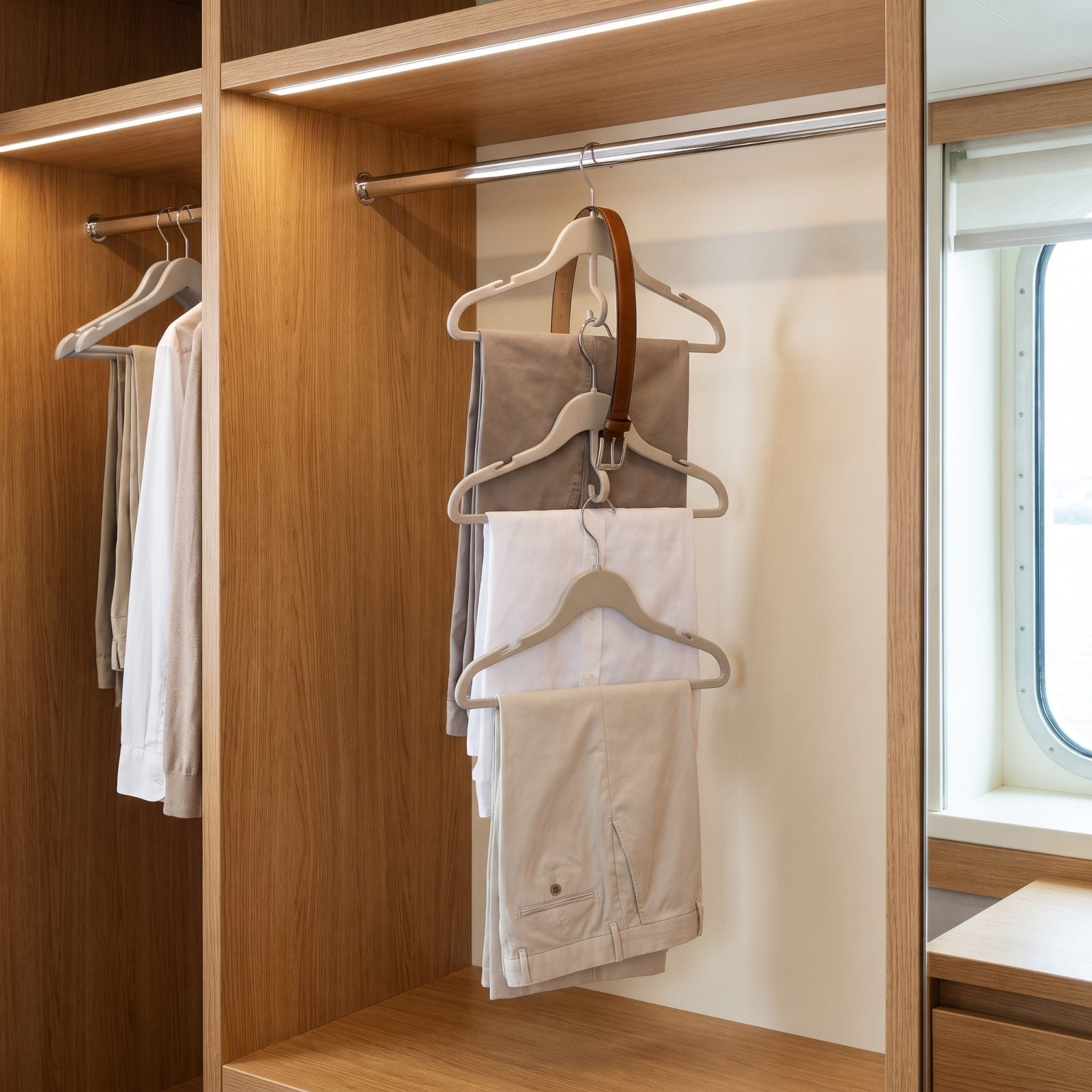
A cascading hanger turns one hook into five. The hangers chain downward, so five pairs of shorts hang in the vertical column that one shirt used to claim.
This is the trick for the stuff that doesn’t crease — shorts, swim trunks, lightweight trousers, tank tops. Stack them down the chain and reclaim your whole rail for the dinner shirts and the one blazer you’ll actually press.
36. Assign Each Traveler a Separate Storage Zone
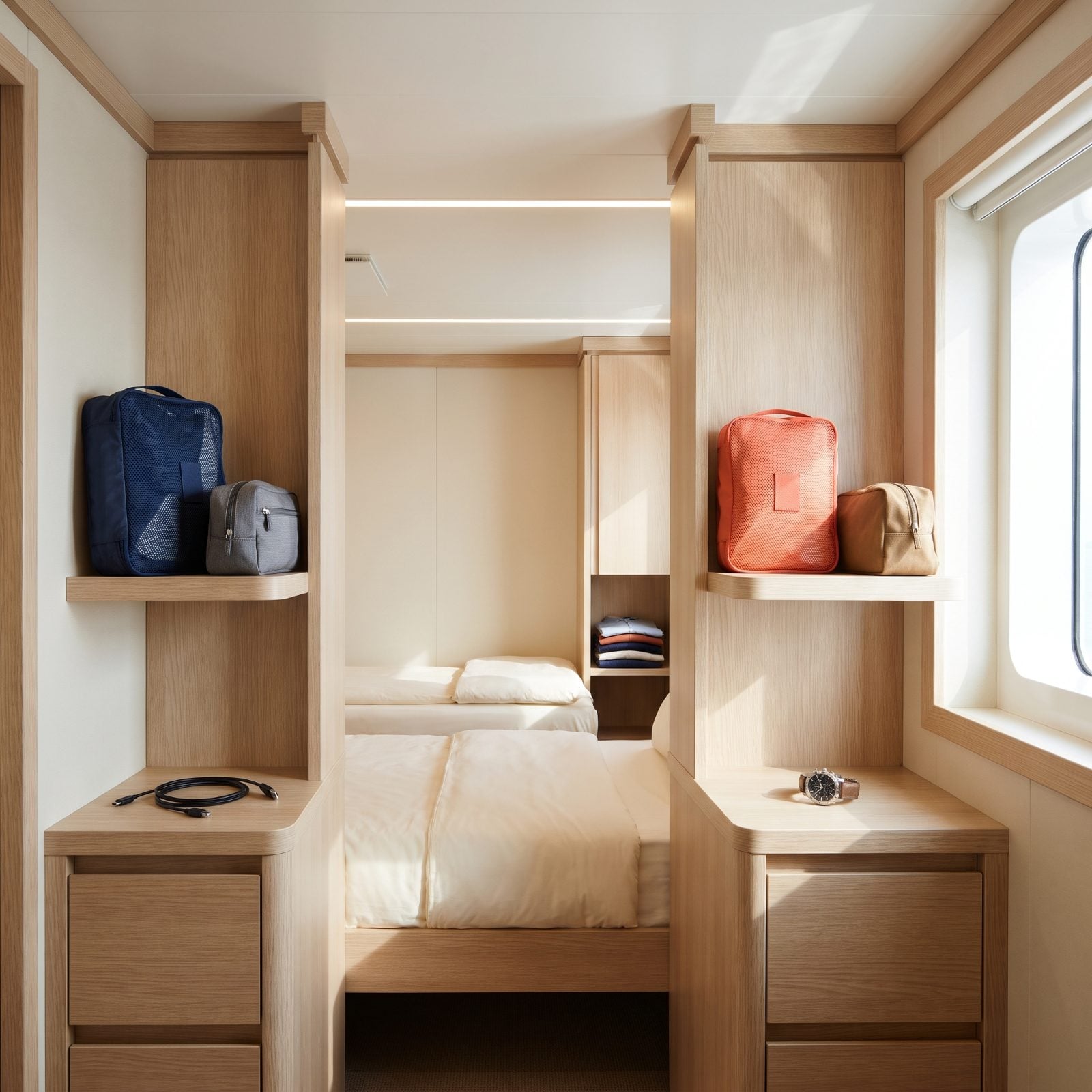
Shared cabins fall apart over territory. Two people reaching into the same drawer for the same seven days ends badly, and you’ve seen how it goes: someone’s socks land in the wrong pile by Tuesday, and by Thursday nobody can find anything.
So draw a line. One person gets the left drawers and the top closet shelf, the other gets the right and the bottom. Color-coded packing cubes make it instant — navy is yours, coral is theirs, nobody debates.
35. Put a Pocket Organizer Over the Bathroom Door
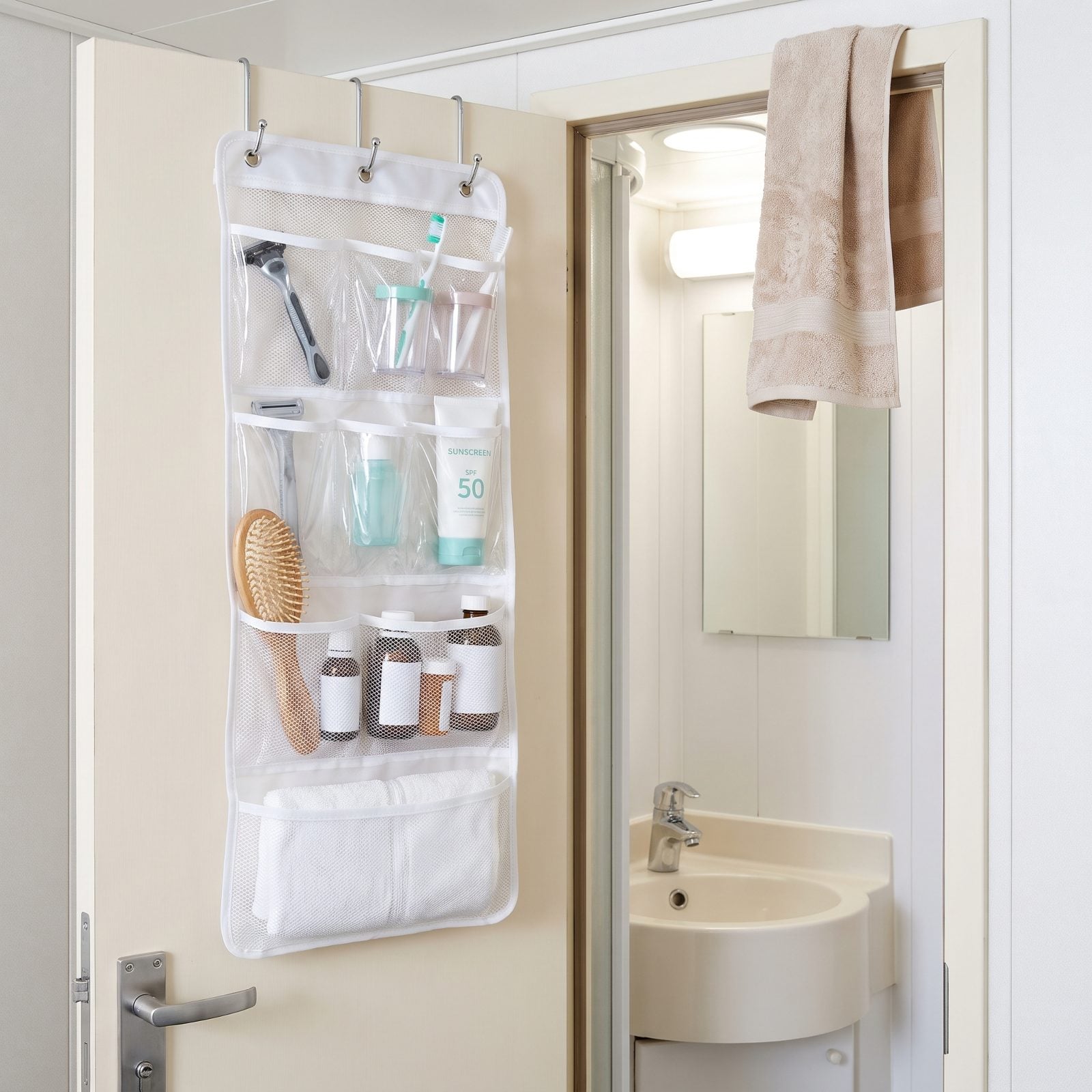
The back of the bathroom door is the single most wasted surface on the whole ship. Nothing lives there. It just swings.
Hang a clear-pocket over-the-door organizer and suddenly you’ve got a wall of compartments where your toiletries used to clutter a sink the size of a cereal bowl. Clear pockets mean you see everything at a glance, no fishing through a bag. The sunscreen, the seasickness tablets, the bandaids you’ll need on day one — all up and visible instead of scattered across a counter you also want to use.
34. Mount Magnetic Baskets for Sunscreen and Sunglasses
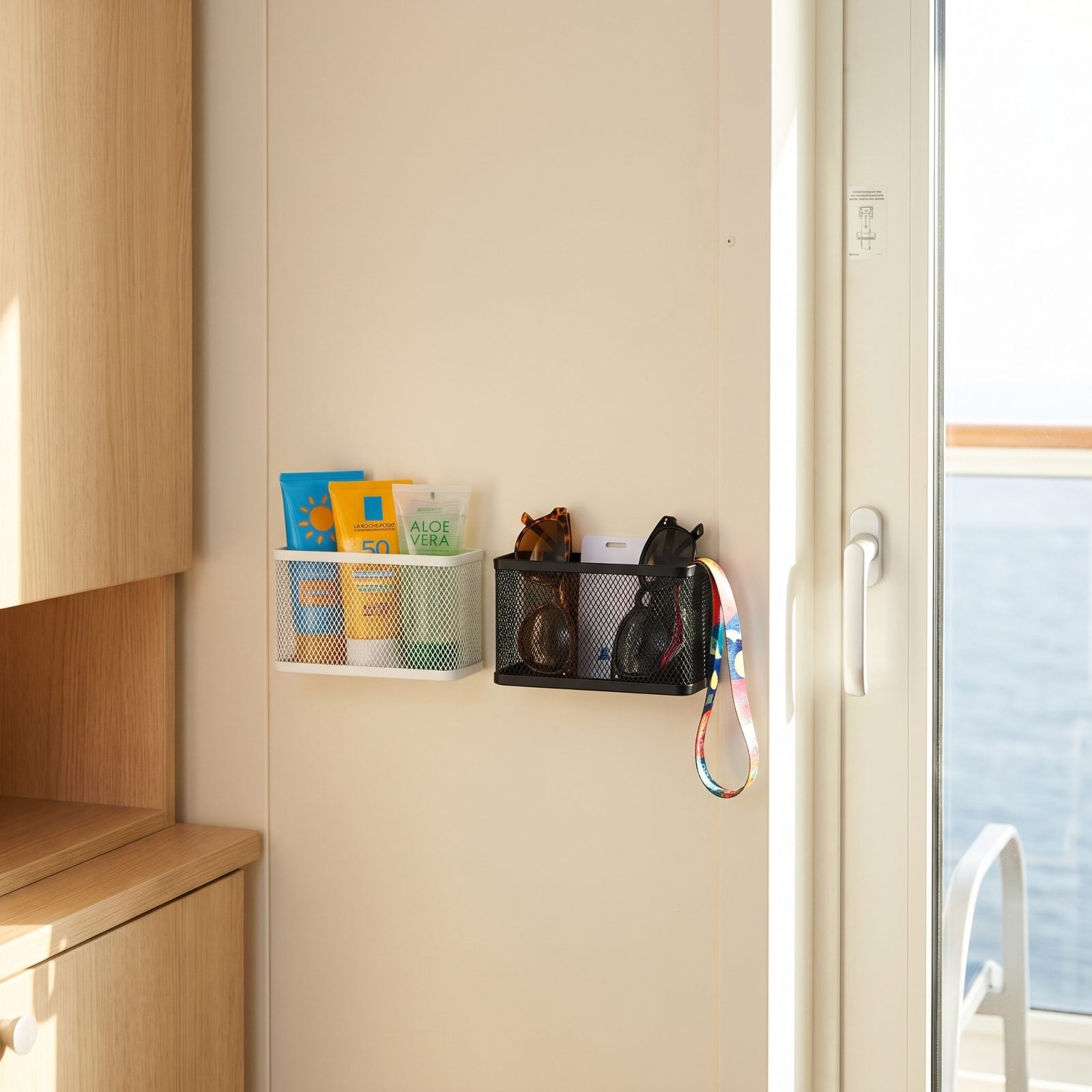
Cruise cabin walls are steel. Most people never realize it until someone tells them, and then it changes everything.
Magnetic baskets snap right onto the wall — no adhesive, no damage. Mount one by the door for sunscreen and sunglasses so you grab them on the way out and never tear the room apart looking. Mount another by the bed for your phone and reading glasses.
33. Slip a Storage Caddy Beside the Bed
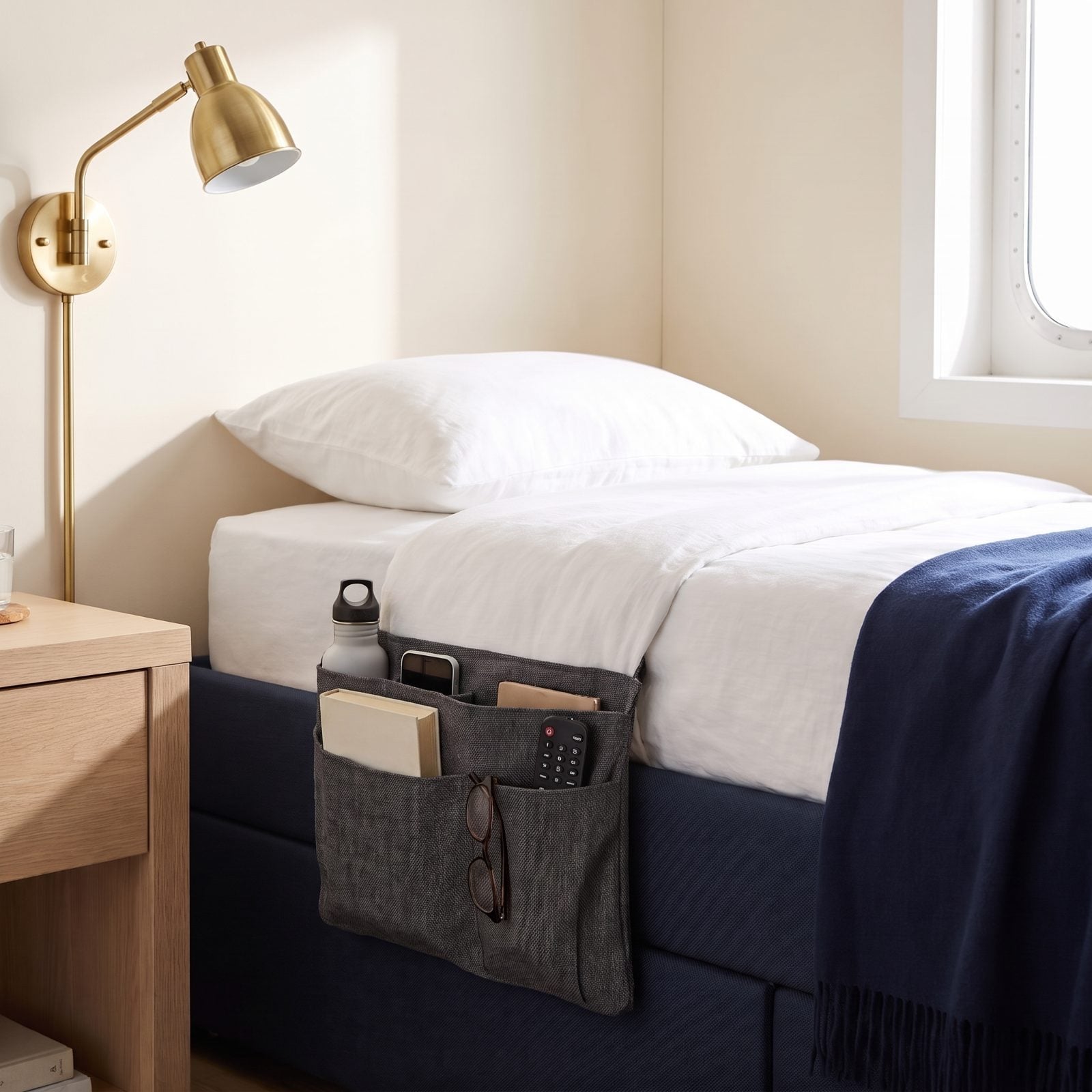
There’s rarely a real nightstand, and the one shelf you get fills up with somebody’s glass of water and that’s it. So where do the glasses, the phone, the book, and the remote go? Usually the bed. Usually under your hip at 2am.
A fabric caddy tucks its top flap under the mattress, its pocket panel hanging flat against the side of the bed, everything within arm’s reach. Everything you want in the night has a home that isn’t the floor or the mattress. Small fix, outsized relief.
32. Keep Toiletries in a Roll-Up Hanging Case
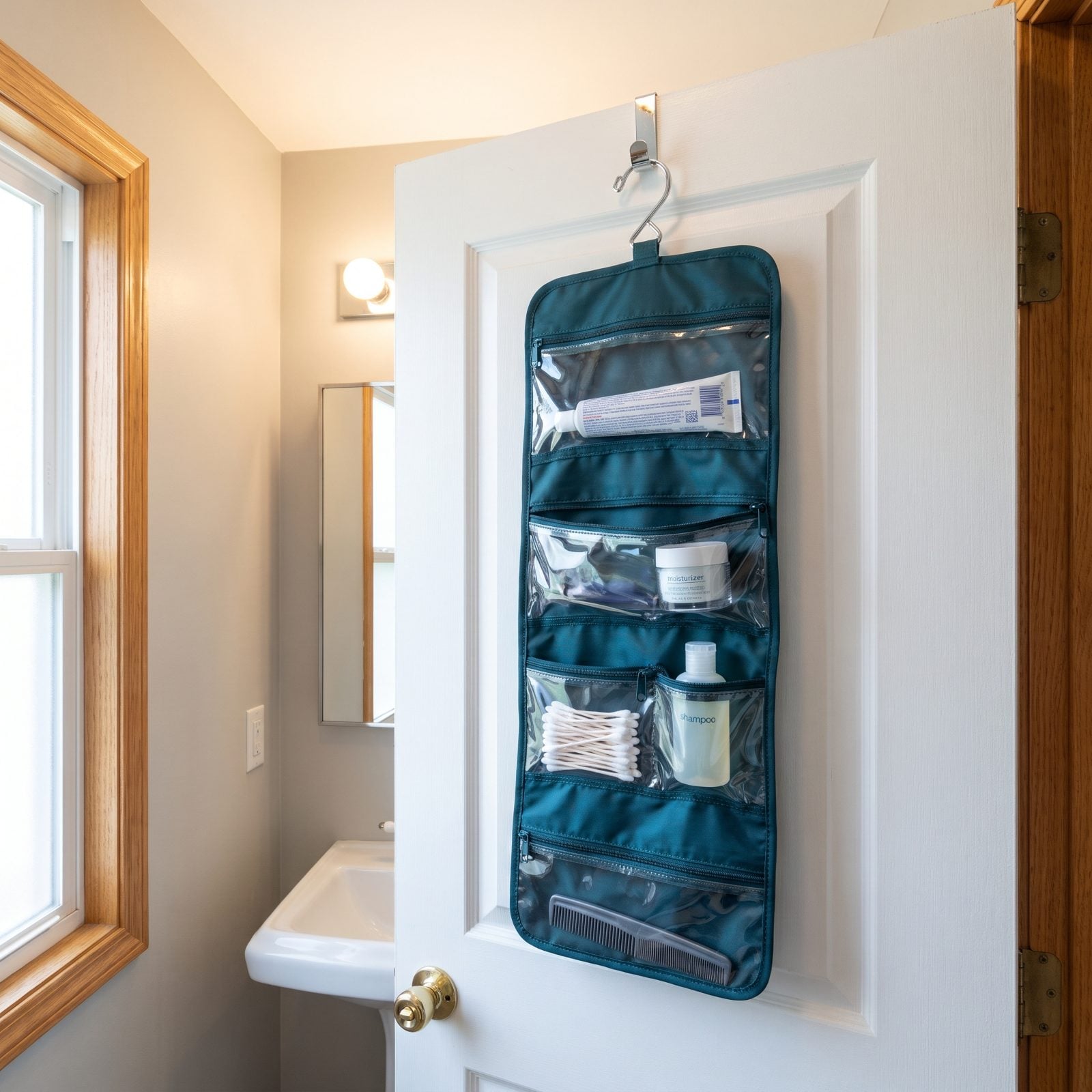
The sink in a cruise bathroom has room for one toothbrush and nothing else. A loose toiletry bag just means a counter you can’t use and a daily hunt for the moisturizer.
A roll-up hanging case solves the whole problem by going up. It unrolls, hooks over the door or a towel bar, and every compartment stays visible and off the counter. When you leave, it rolls back into a tube about the size of a water bottle.
The best cruise storage never touches a flat surface. It hangs, it clips, it snaps to a wall. Flat surfaces are for living, not for stuff.
31. Move Shower Products Into a Corner Caddy
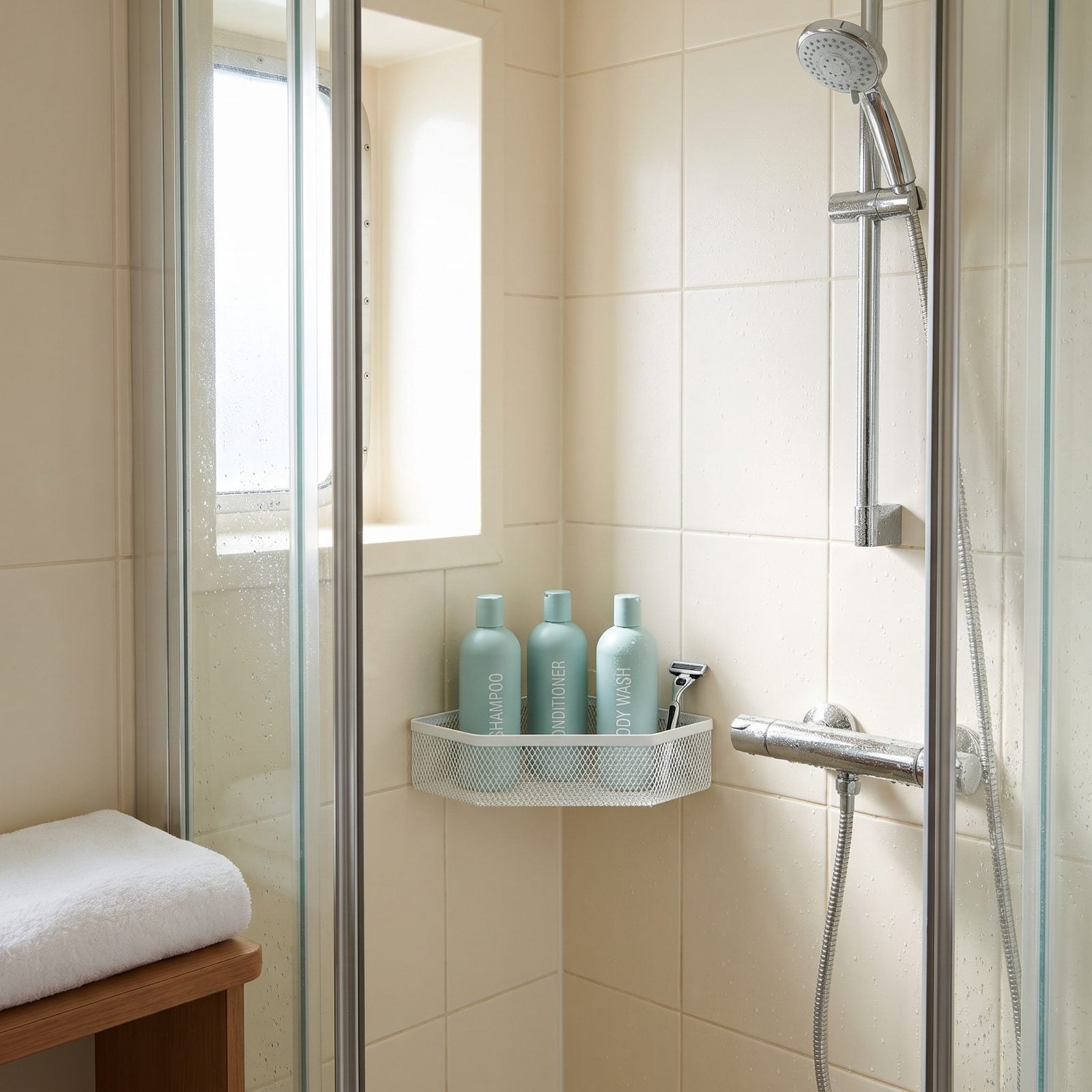
Cruise showers are tight, and the little recessed ledge holds exactly one bottle before everything else lands at your feet. You know the dance — kick the shampoo, chase the conditioner, nearly go down reaching for it.
A hanging corner caddy clips to the shower fixture or sticks to the wall and holds all three bottles and your razor up and off the floor. Your feet stay clear, nothing tips, and you stop playing goalie with your own body wash every morning.
30. Use the Retractable Shower Line for Wet Swimsuits
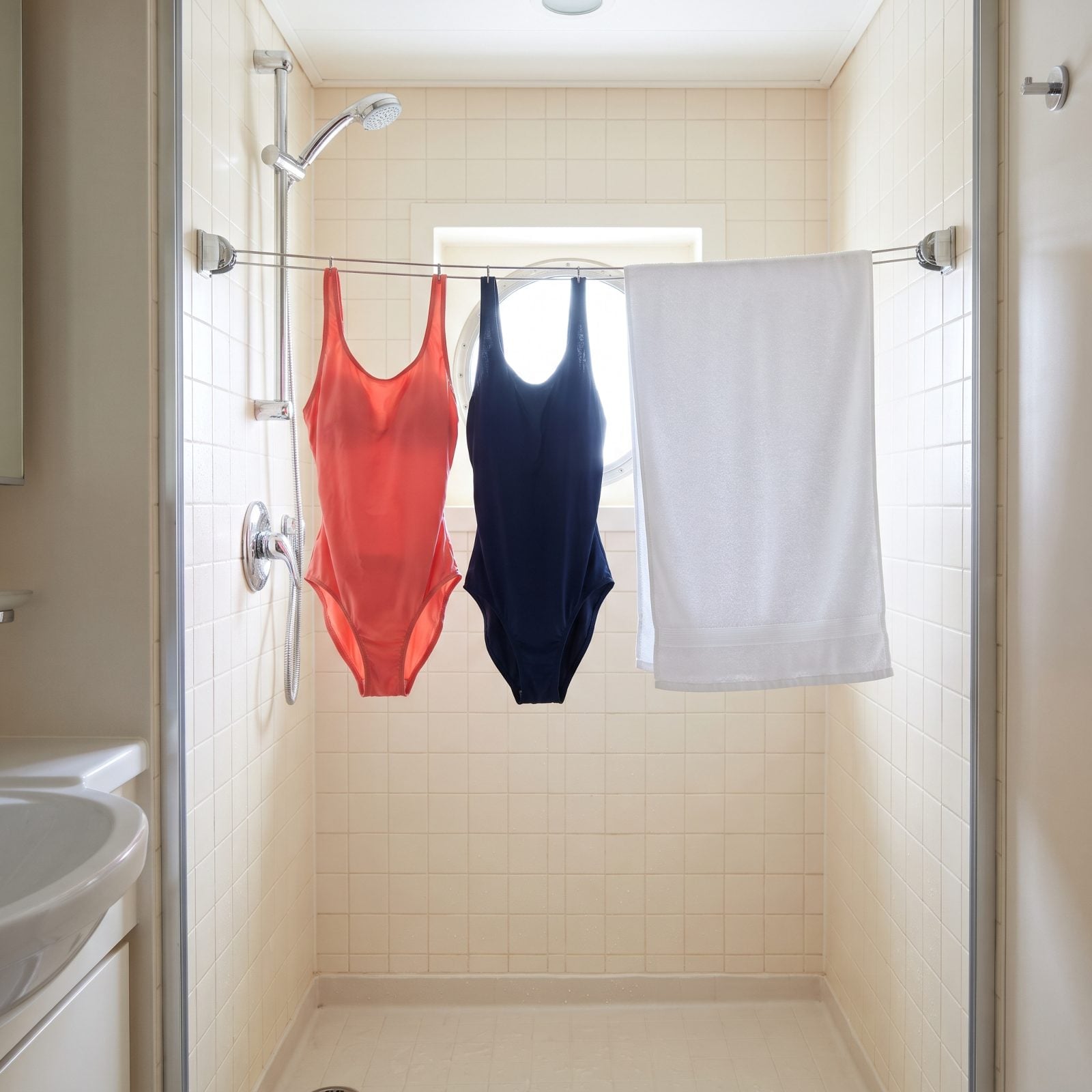
Almost every cruise bathroom has one feature nobody uses because nobody notices it: a retractable clothesline built right into the shower wall. Pull it across, clip it to the catch on the far side, done.
This is where the wet swimsuits go. Not draped over the chair, not stuffed in a bag to sour, not dripping across the only dry floor you have. Try the balcony rail instead and a gust sends your suit into the ocean. On the line, it dries by morning and the cabin never smells like a locker room.
29. Choose a Fold-Flat Laundry Hamper
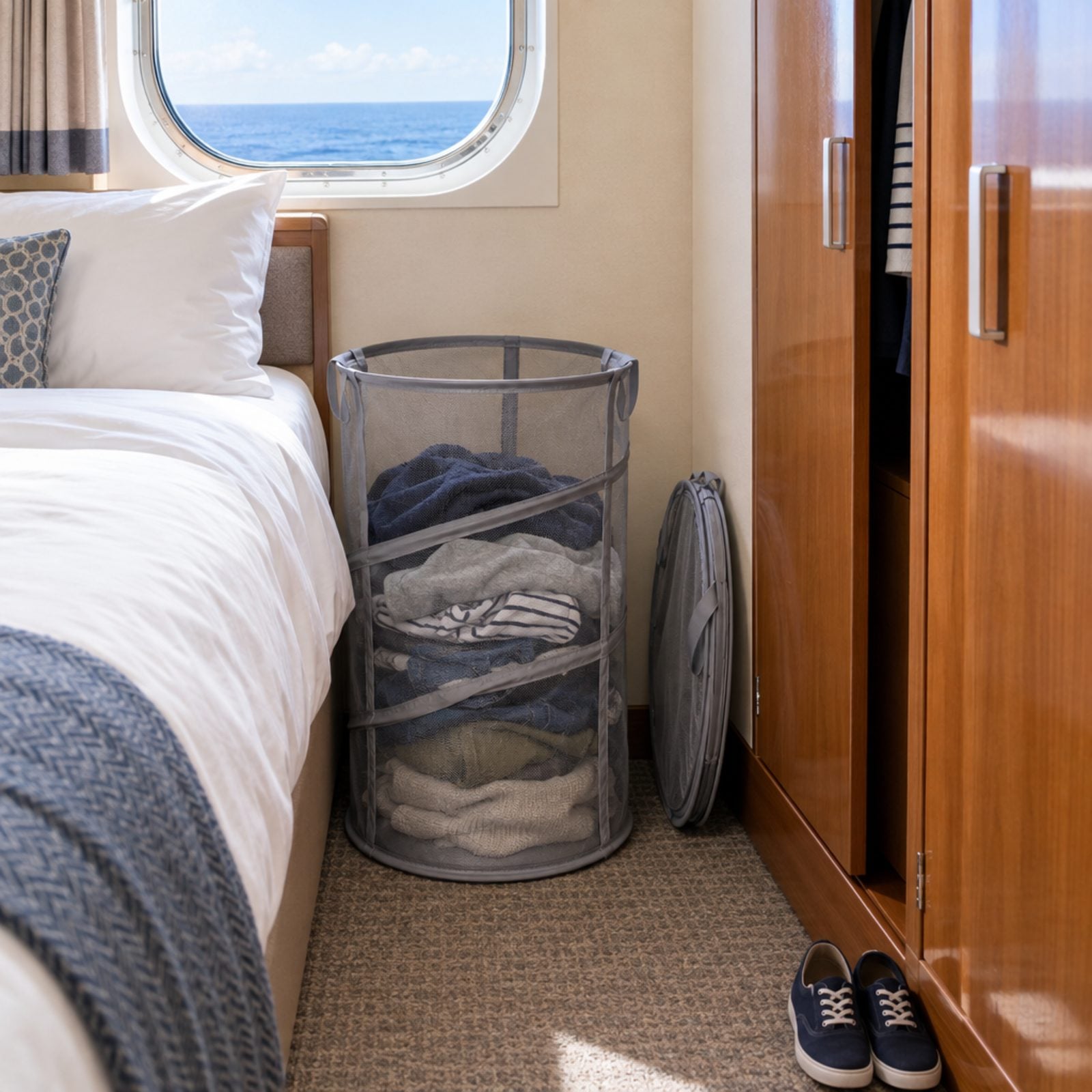
Dirty clothes are the quiet enemy of a small cabin. Let them pile on a chair and the whole room reads cluttered by day three. A fold-flat mesh hamper fixes this for about the price of a drink by the pool, and when collapsed it takes up the footprint of a dinner plate.
It pops open when you need it and flattens against the wall when you don’t, which leaves the single armchair free for actual sitting. For years I swore a drawstring bag did the same job. It never did. The bag always ended up on the floor, trod on, half-open, while the hamper just stands there on its own. That’s the whole trick.
28. Keep Beach Gear in One Collapsible Tote
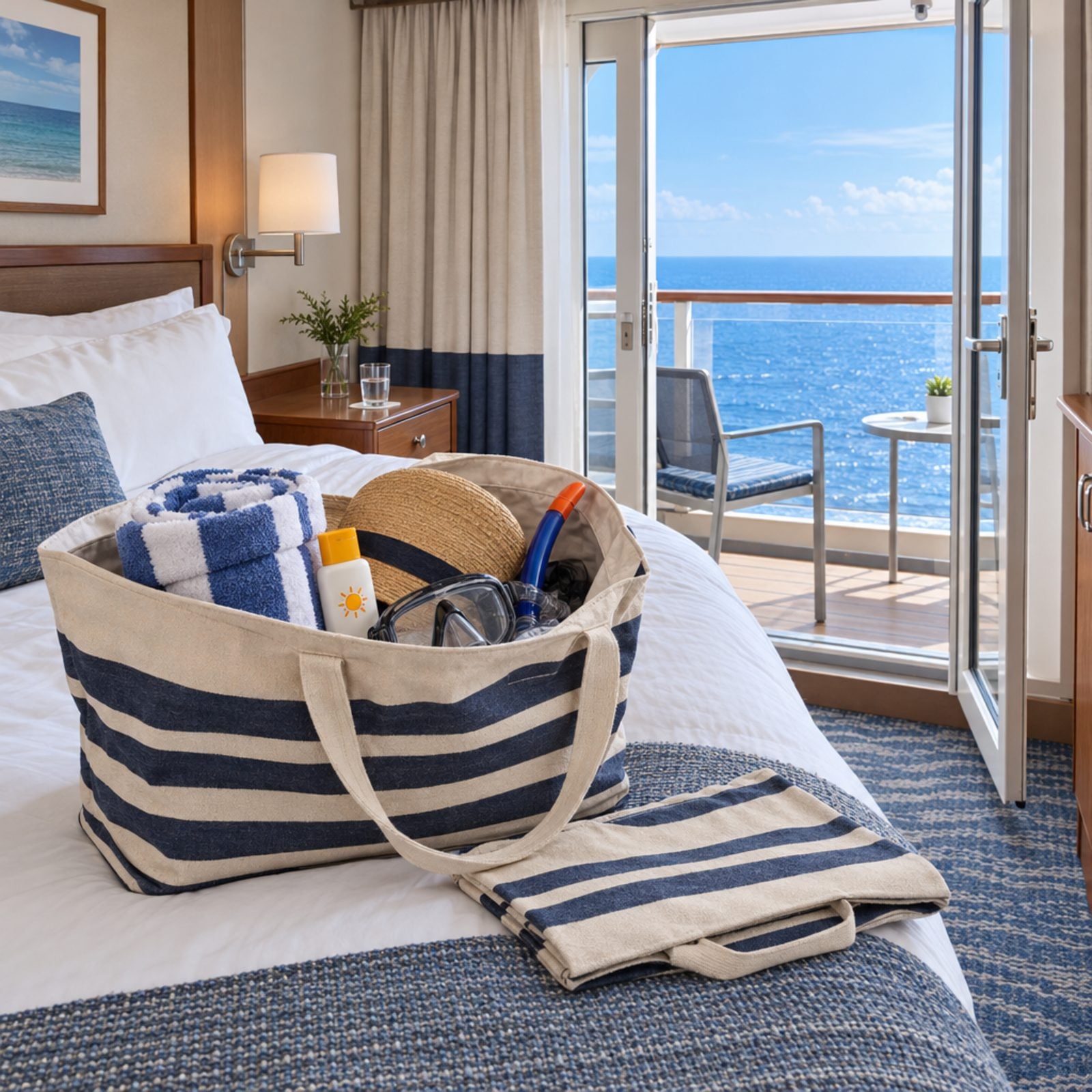
Shore days scatter stuff everywhere. Towels end up on the bed, sunscreen on the vanity, snorkel gear draped over the chair, and by afternoon your cabin looks like a gift shop exploded.
One collapsible tote solves it. Everything beach-related lives inside, comes out at the gangway, and goes back in at night. The tote itself folds flat behind the wardrobe on sea days. No more hunting for your other flip-flop. You always know where the sunscreen is.
27. Pack a Capsule Wardrobe With Interchangeable Pieces
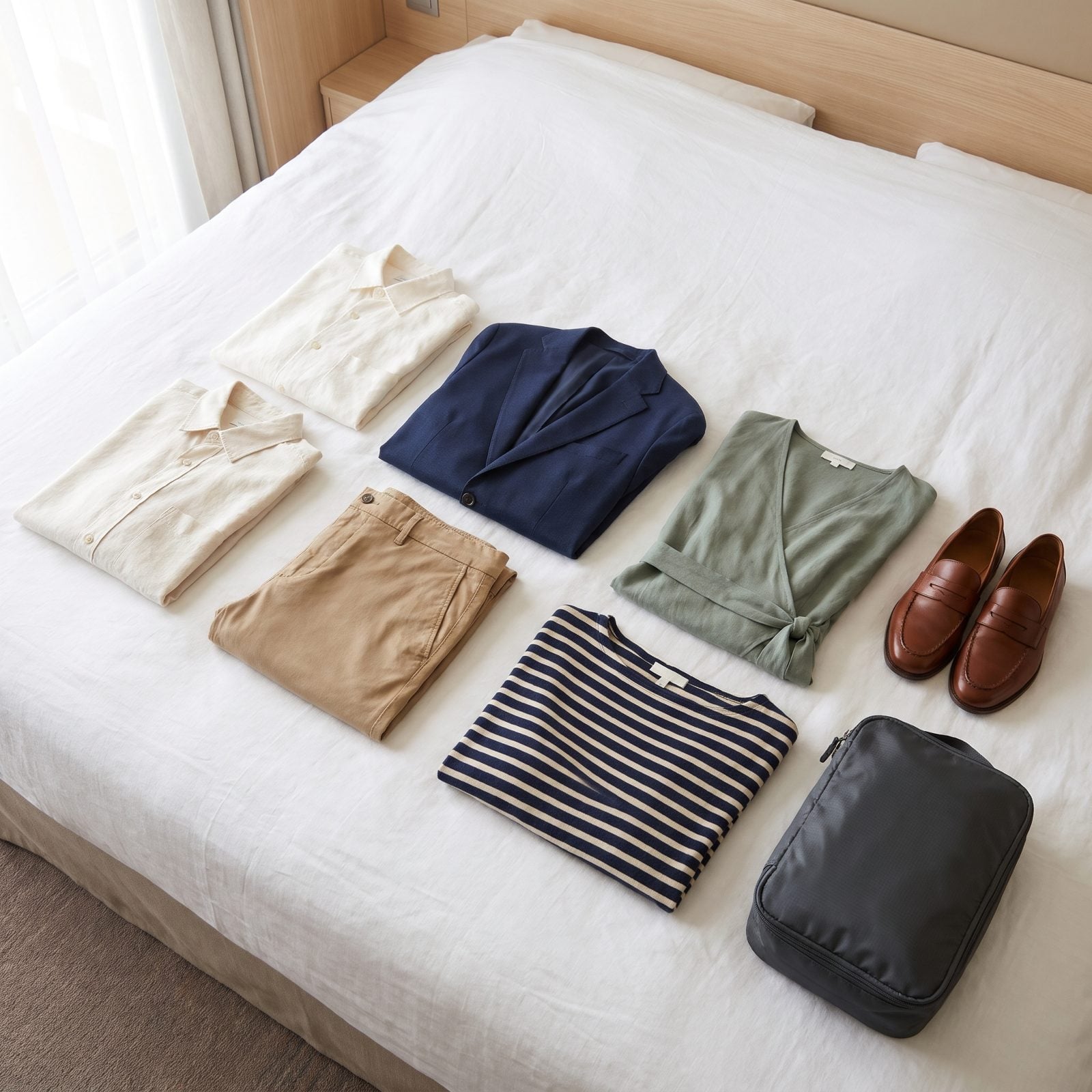
Cruise closets are a joke. One narrow rail, maybe eight hangers, and a shelf you can’t reach without a stool. Overpack and half your clothes never leave the suitcase.
Build a capsule instead. Pick one palette — say navy, cream, and tan — and buy nothing that doesn’t play nice with everything else. A blazer works over the striped top, over the wrap dress, over the linen shirt. Suddenly seven pieces make fifteen outfits and your drawers aren’t straining shut.
26. Share Toiletries Instead of Packing Duplicates
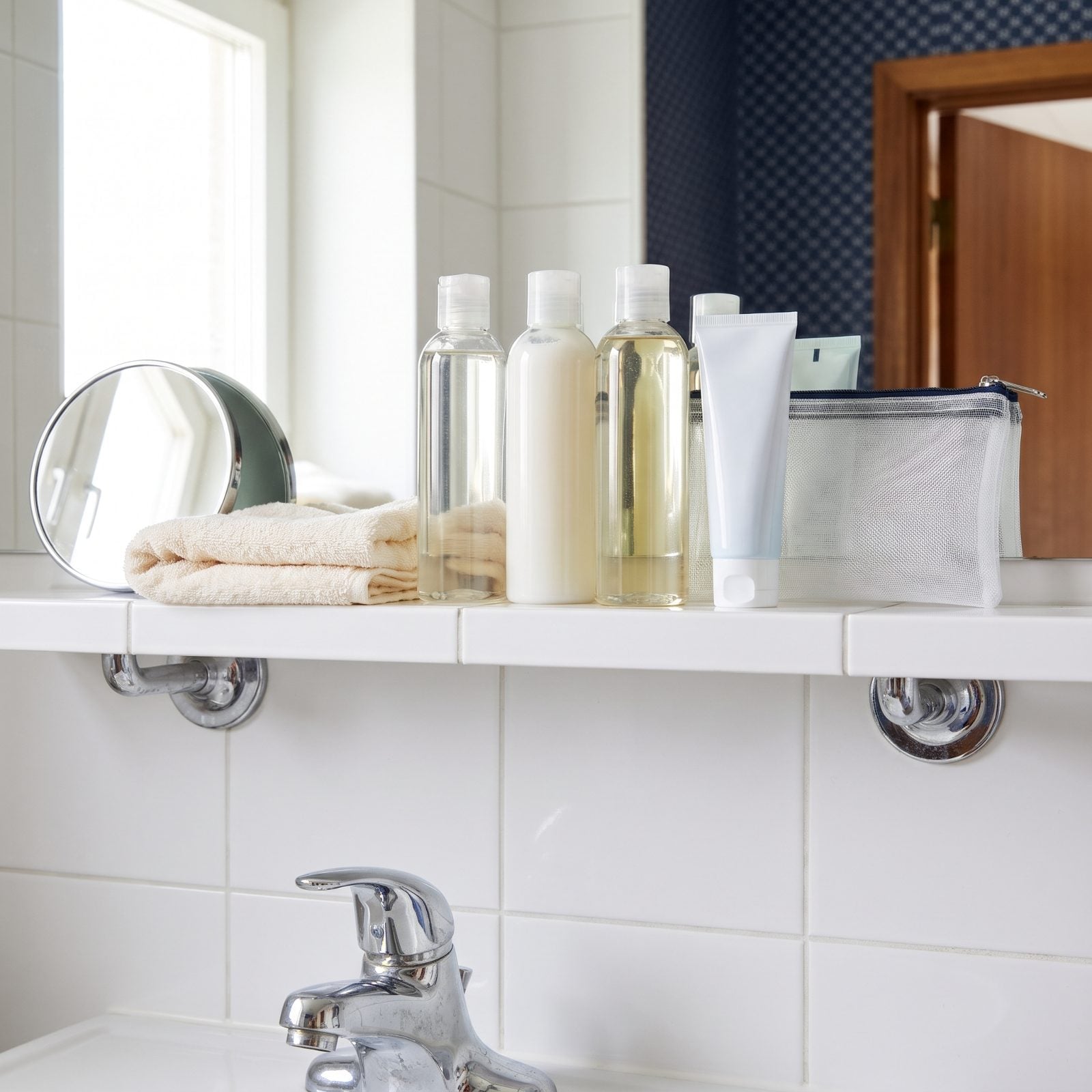
Two people, two full-size shampoos, two conditioners, two body washes. That’s six bottles crowding a bathroom shelf the size of a paperback.
So share. One shampoo serves the whole cabin fine for a week, and the same goes for toothpaste, sunscreen, and body lotion. You halve the bottles and reclaim the only flat surface in the room. The stuff you genuinely can’t share — a specific skincare thing, a razor — stays personal. Everything else goes communal.
Nobody has ever regretted traveling with fewer bottles.
25. Decant Liquids Into Compact Travel Bottles
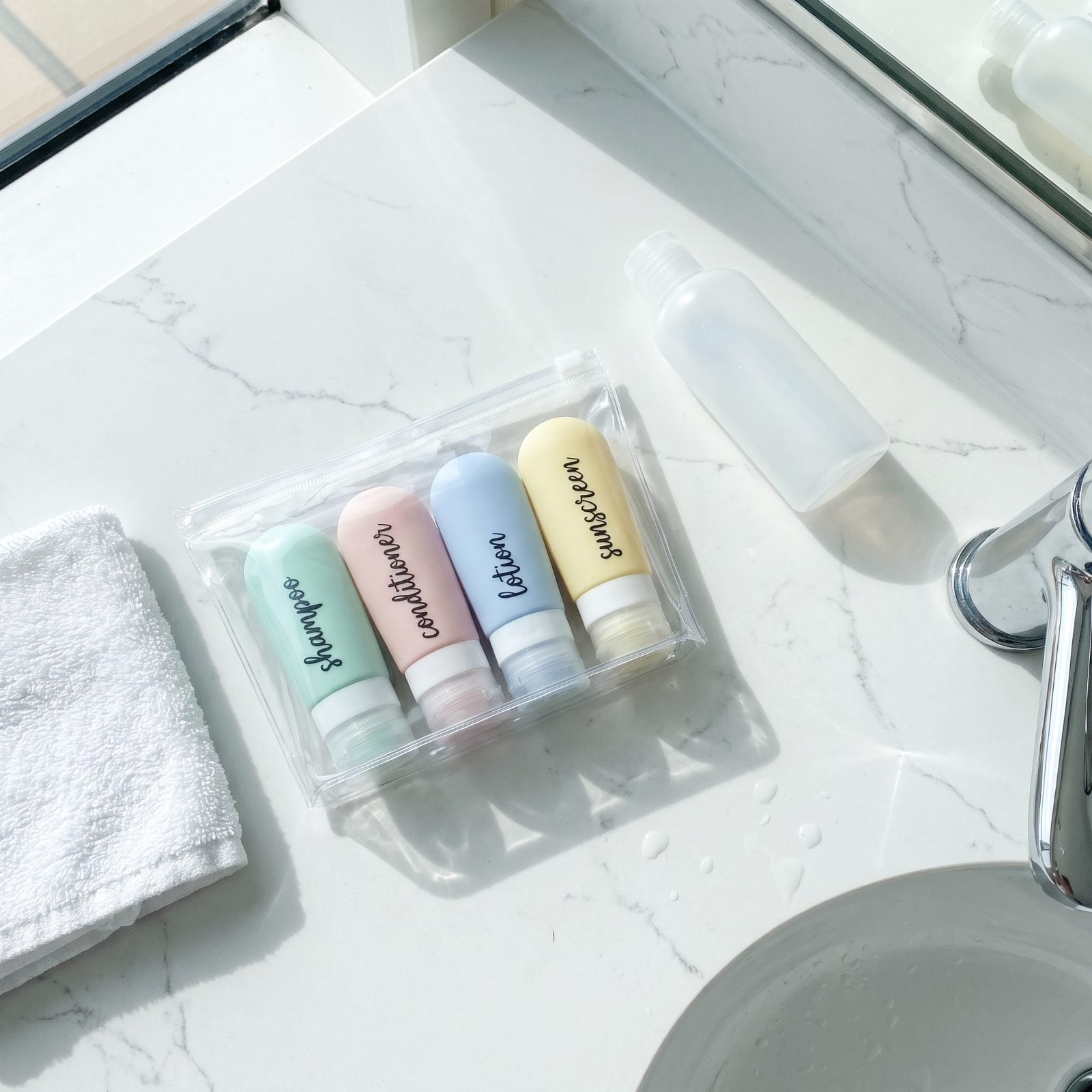
A full bottle of sunscreen for a seven-night sailing is optimism bordering on fantasy. You’ll use a fraction of it and lug the weight both ways.
Decant into small silicone squeeze bottles before you leave home. A couple of ounces of each lasts the week, and the whole set tucks into one small pouch. Go silicone over hard plastic. It won’t crack, and it won’t leak everywhere if it gets squashed in your bag.
24. Replace Paperbacks With an E-Reader
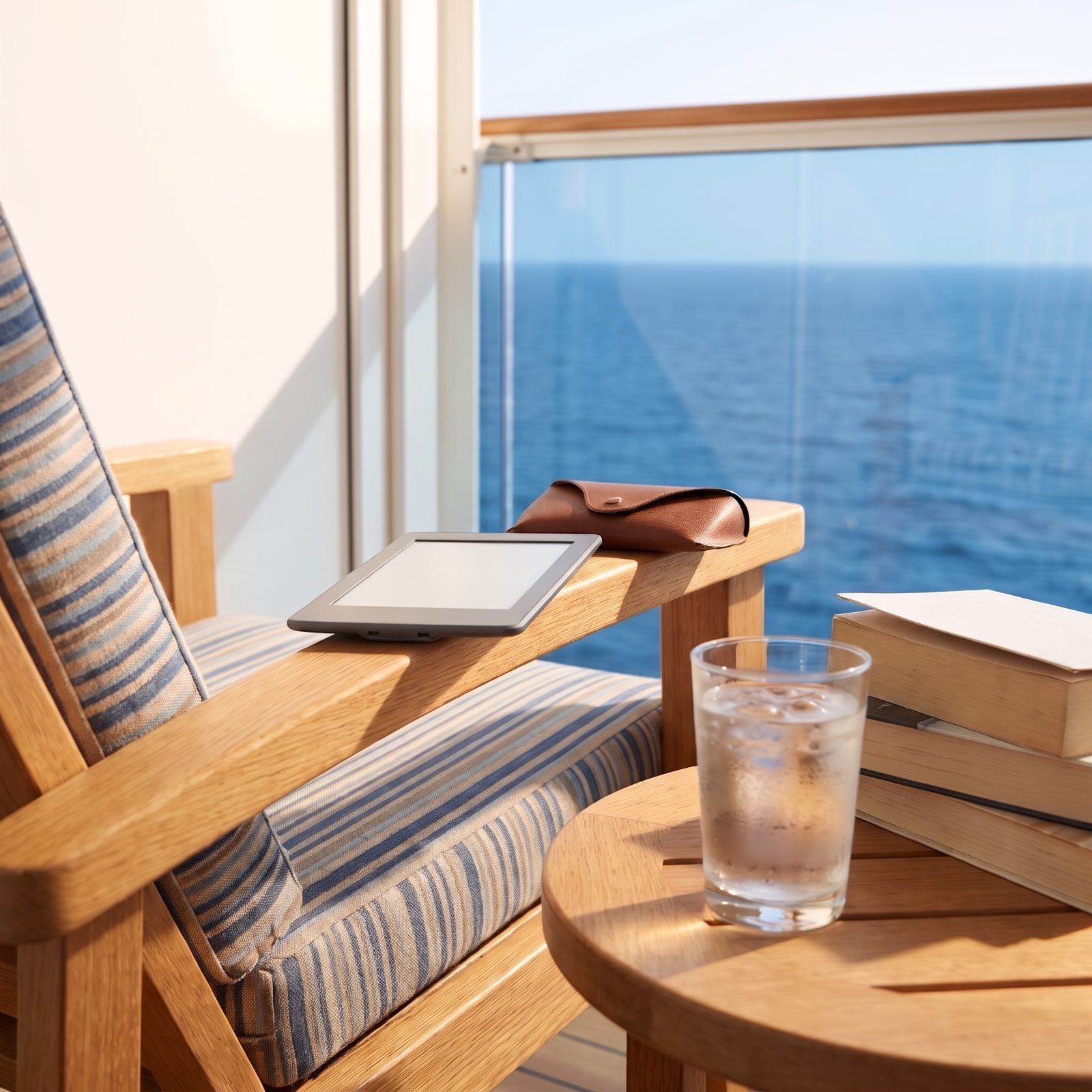
Five paperbacks weigh a few pounds and swallow a chunk of your carry-on. An e-reader holds a whole library and weighs less than one of them.
I held out on this for a long time. Loved the smell of paper, the heft, all of it. Then I spent a transatlantic crossing rationing the two novels I’d packed because I’d badly misjudged my reading speed. Never again. An e-reader means you never run out and never pack too many, and the side table only has to hold a water glass and whatever few paperbacks you can’t quite let go of.
23. Create One Charging Station for Every Device
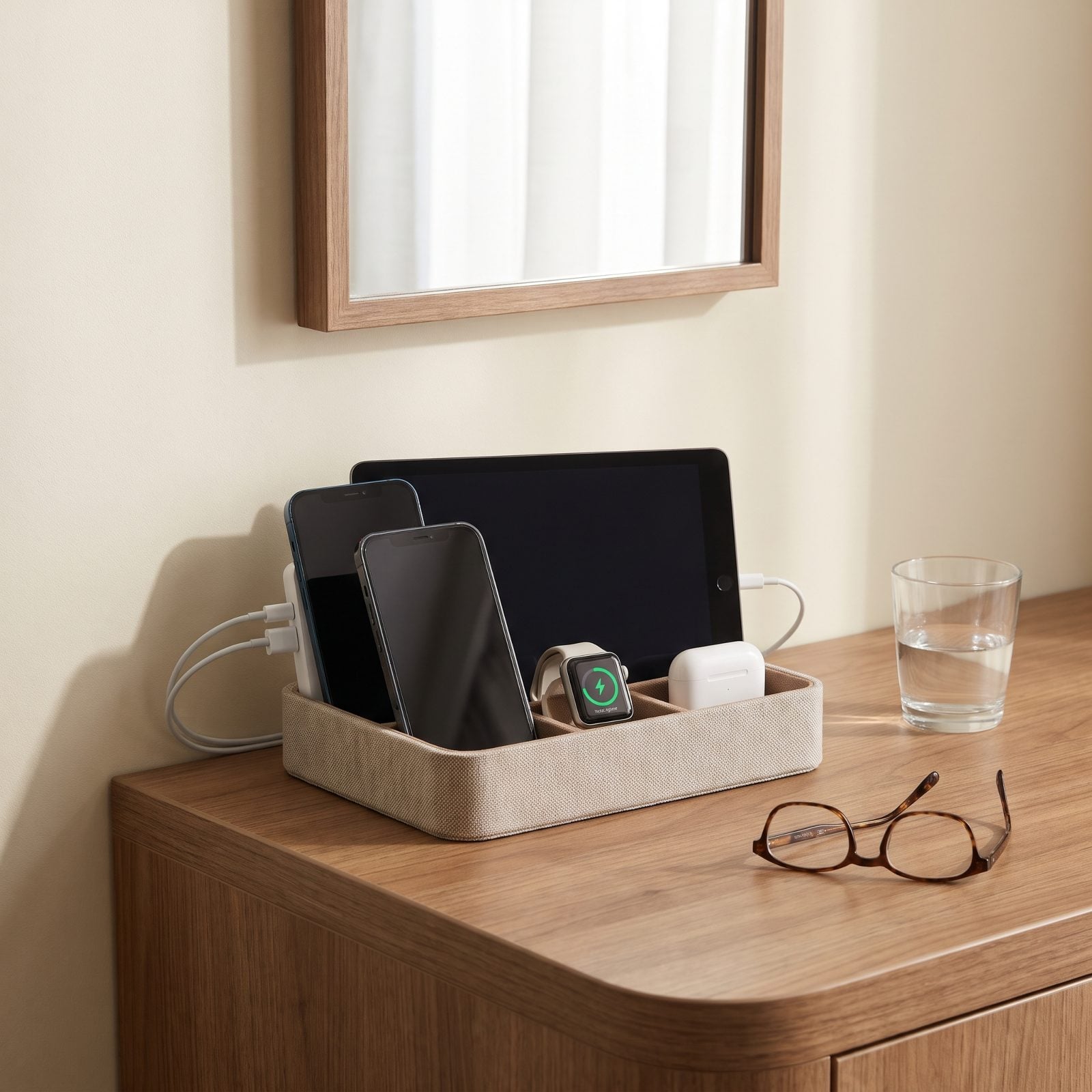
Cruise cabins are famously starved for outlets. One or two by the desk if you’re lucky, and they’re always behind the TV where you’ll smack your head reaching for them.
Designate one spot — a small tray on the vanity where every device charges overnight, every night. No wandering cords, no phone lost in the sheets, no scavenger hunt at 6 a.m. before an excursion. Everything lives and charges in one square foot.
22. Use a Cruise-Approved Multiport USB Charger
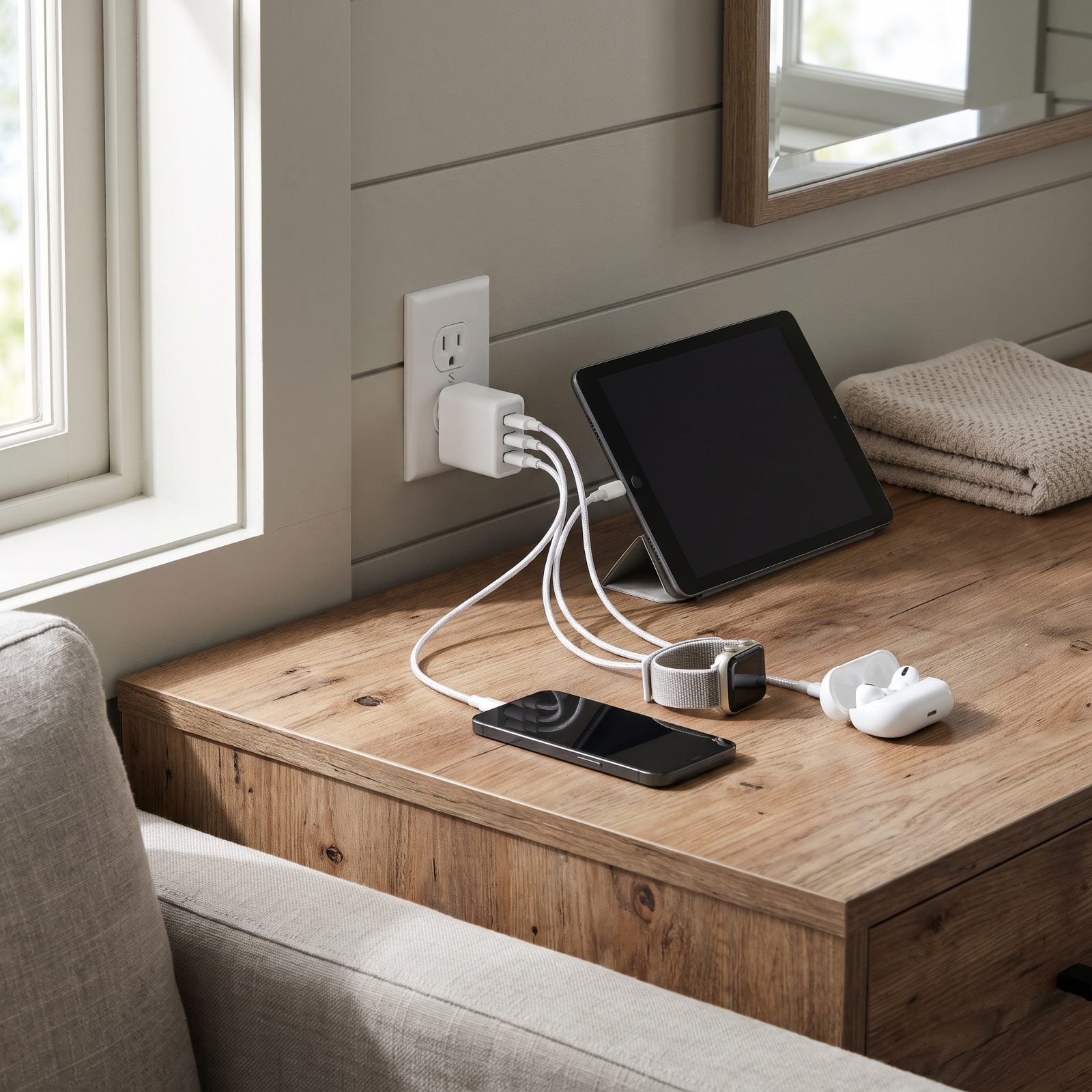
Here’s the part people learn the hard way: most cruise lines ban power strips and surge protectors outright. They count as a fire risk at sea, and security confiscates them right at the terminal. I’ve watched people argue about it. Security always wins.
A single multiport USB charger is the workaround. One plug, four or five USB ports, no surge protection to trip the rules. It turns your one scarce outlet into a charging hub for the whole cabin without breaking a single policy.
21. Swap Long Cords for Short Retractable Cables
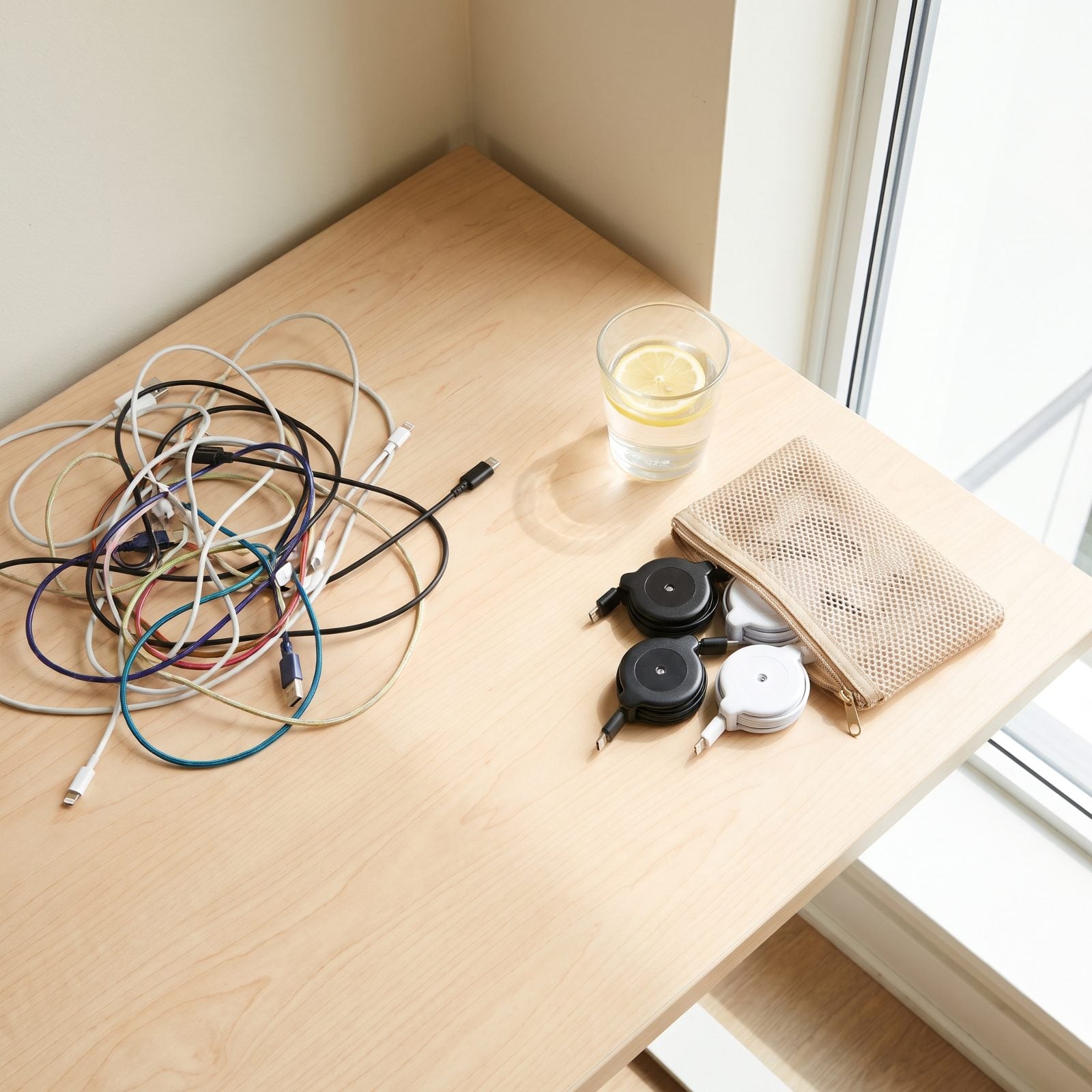
A six-foot charging cable in a tiny cabin is just rope. It pools on the floor, catches your foot, and snakes across the vanity collecting your rings and your watch in its coils.
Short retractable cables fix the whole mess. They pull out to a foot or so, snap back when you’re done, and store as neat little discs. Your phone charges right at the outlet instead of being dragged across the room, and the desk stops looking like a tackle box.
20. Clear the Vanity Before Going to Bed
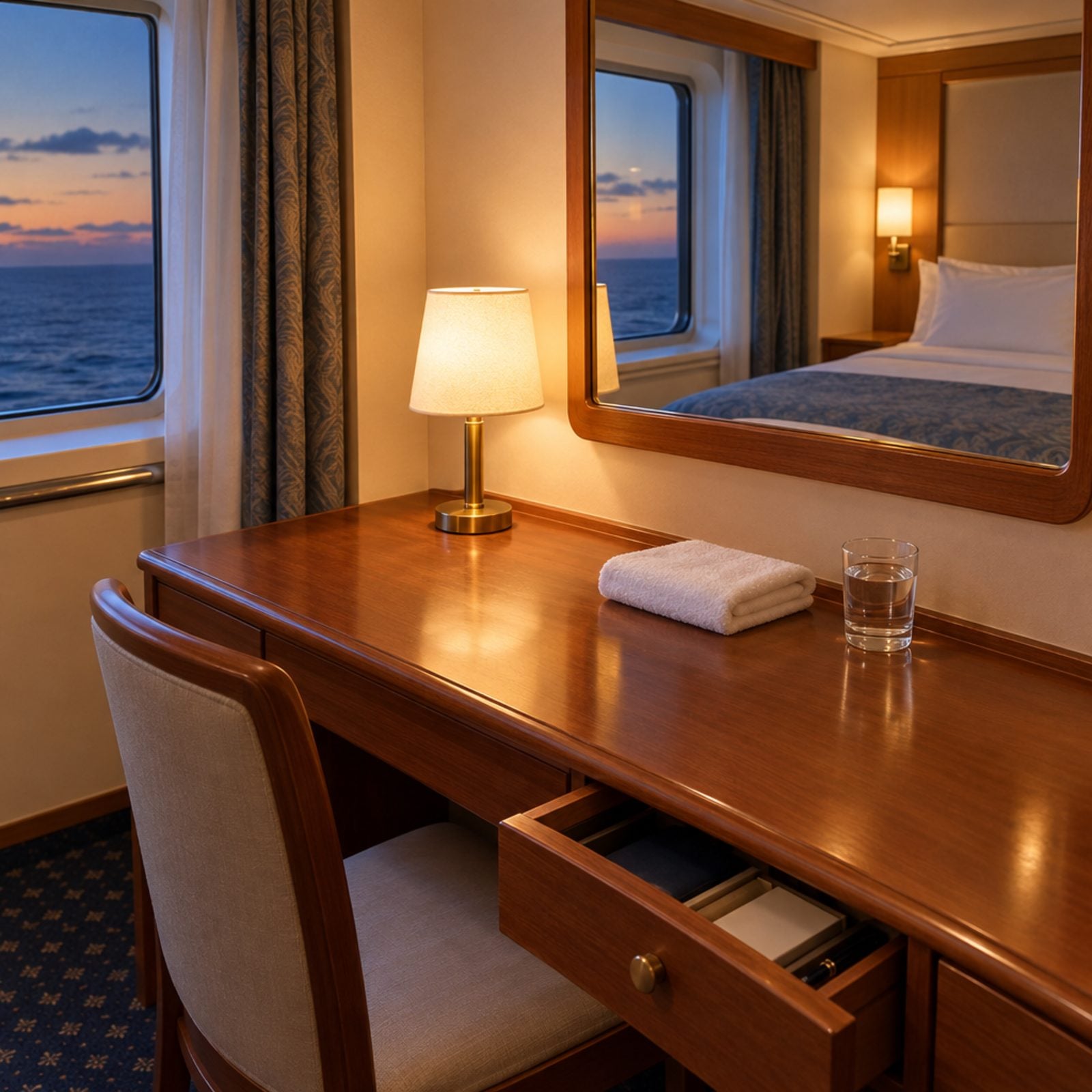
A clear surface is the single biggest thing standing between a cramped cabin and a calm one, and the vanity is where clutter breeds fastest. A folded towel, a glass of water and a lamp are about all that needs to stay out by nightfall.
Clear it every night. Put the jewelry back in its box, sweep the rest into a drawer and shut it before you sleep. You wake to a clean surface, and that sets the tone for the whole day. Thirty seconds of effort, and the room feels twice its size the second you open your eyes.
A tidy room at night is a gift you hand your morning self.
19. Return Room-Service Dishes the Moment You Finish
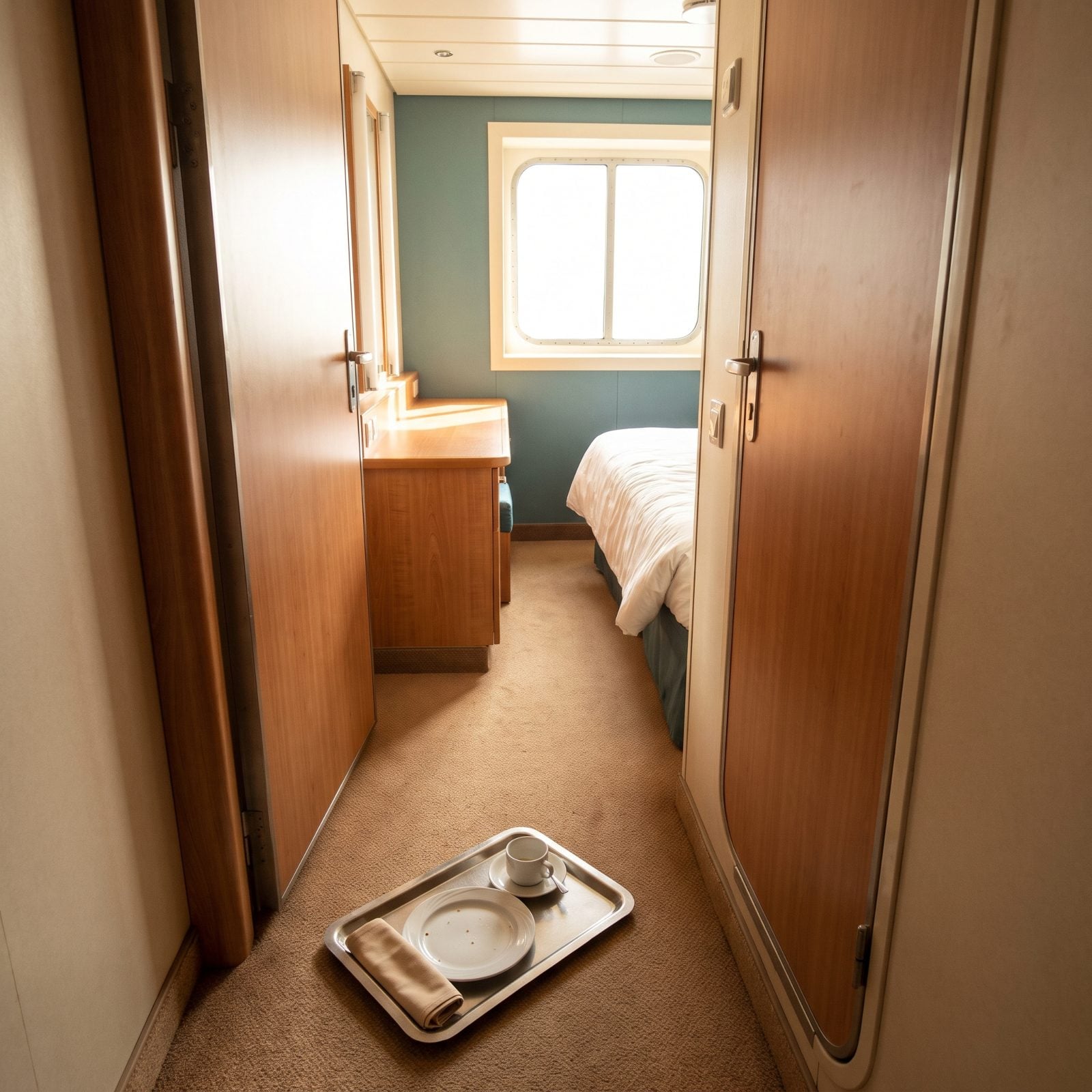
A breakfast tray in a cabin this size is a parked car in a one-car garage. It eats the desk, it eats the walk-through, and by lunch it smells faintly of cold eggs. Call for pickup, or just set it outside the door in the corridor where the stewards collect it on their rounds.
That desk is the only real work surface you’ve got. Keep a dish on it for three hours and you’ve lost your charging station, your sunglasses spot, and your one flat place to repack the day bag.
18. Use the Ship App Instead of Hoarding Printed Guides
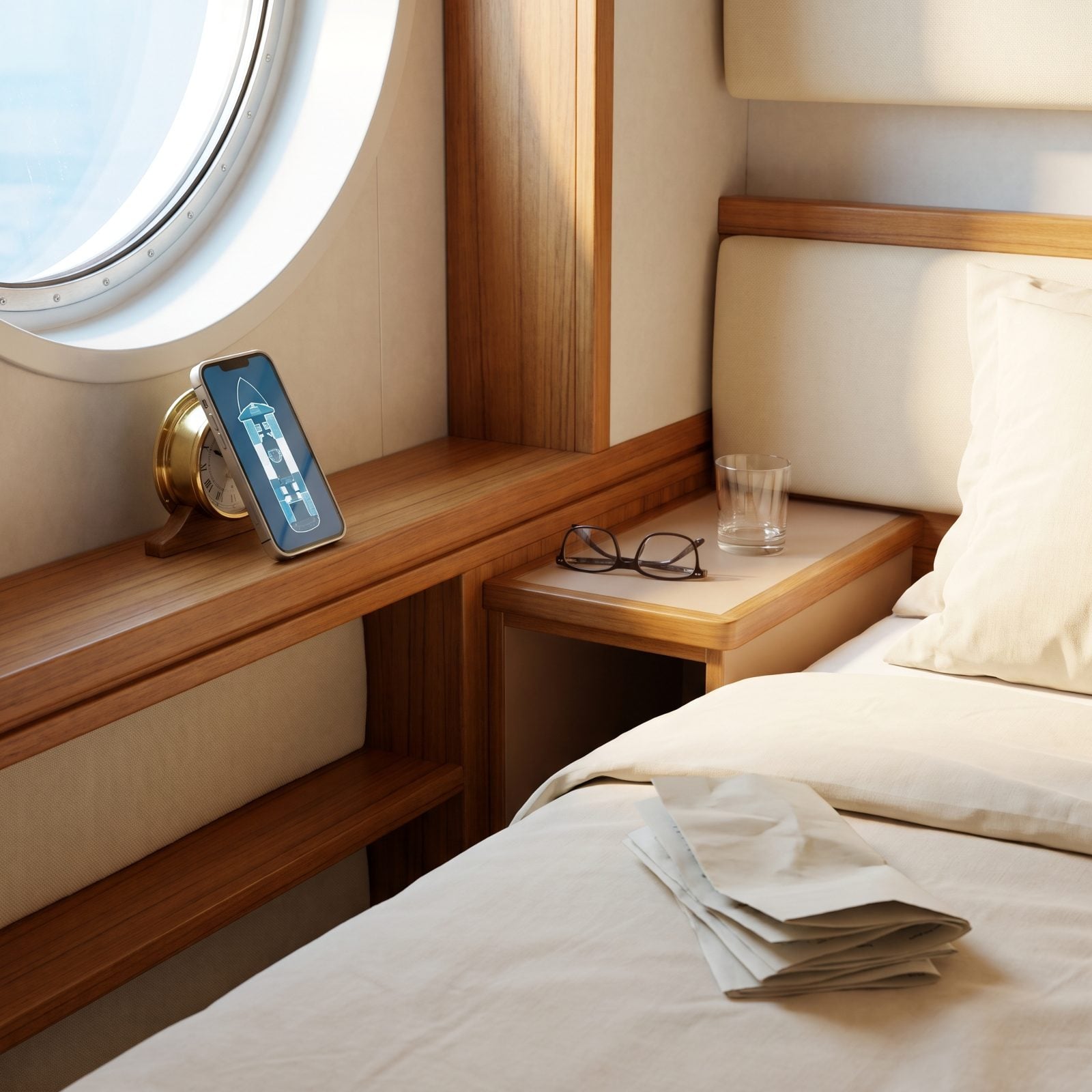
The paper daily schedule breeds. One by Tuesday, four by Friday, a little drift of folded printouts migrating across the desk and the nightstand and the floor by the bed.
Nearly every line now runs a cabin app with the full planner, menus, and deck maps. Pull it up, flag the events you care about, recycle the rest — and you stop playing archaeologist at the bottom of your bag looking for the show time.
17. Shut Every Drawer and Closet Door the Second You’re Done
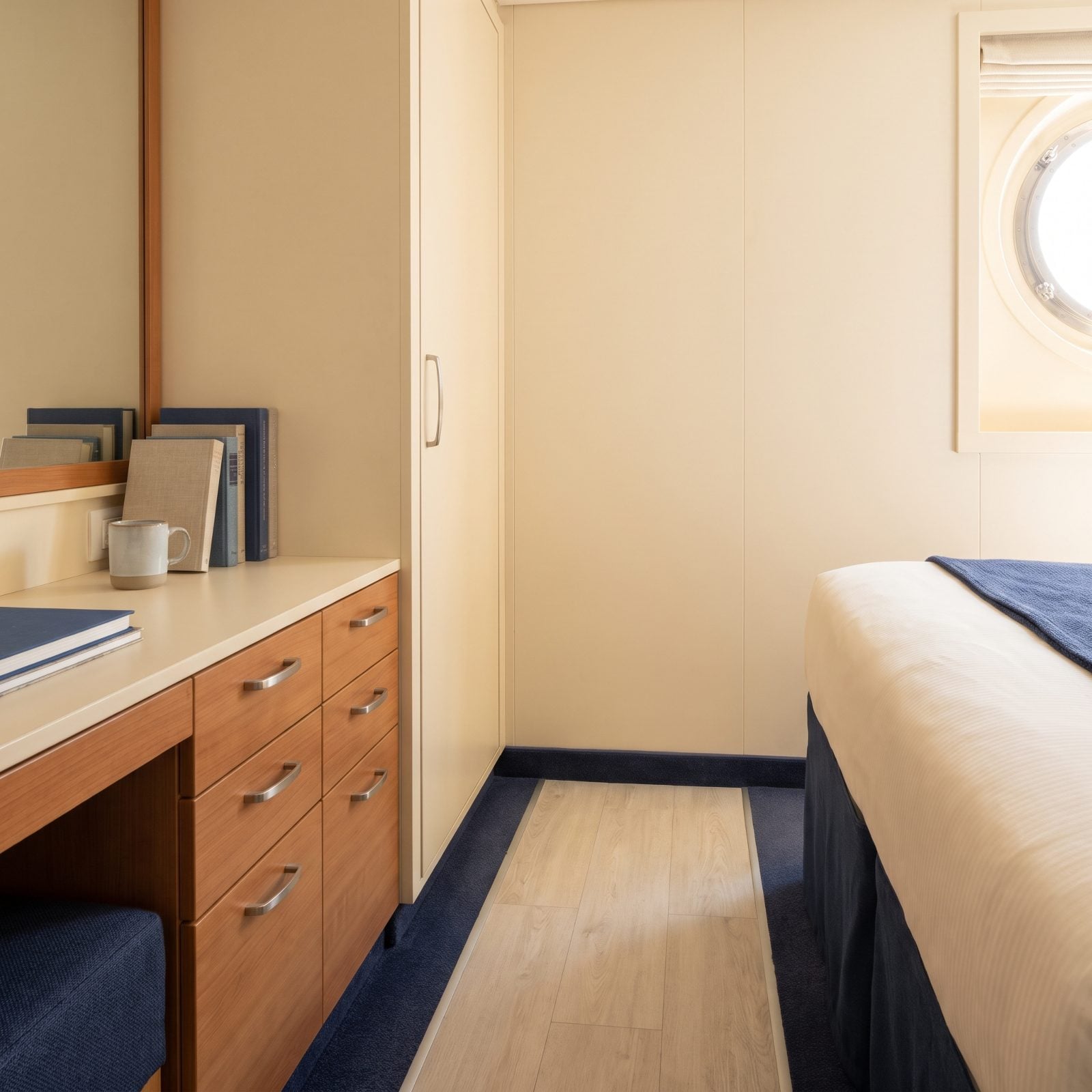
An open drawer in a cabin this narrow is a shin trap set at knee height. Swing the closet door wide and you’ve halved the usable walkway for no reason at all.
Shut everything flush the moment you’ve grabbed what you need. Cheapest spaciousness trick there is, and the one people ignore most.
There’s a quiet psychology to it too. A room reads calm when its lines are unbroken — your eye glides across flush drawer fronts and reports back that things are tidy, roomy, fine. Leave one yawning open and the brain snags on it every single time you glance over.
16. Hang a Removable Mirror Where It Catches the Daylight
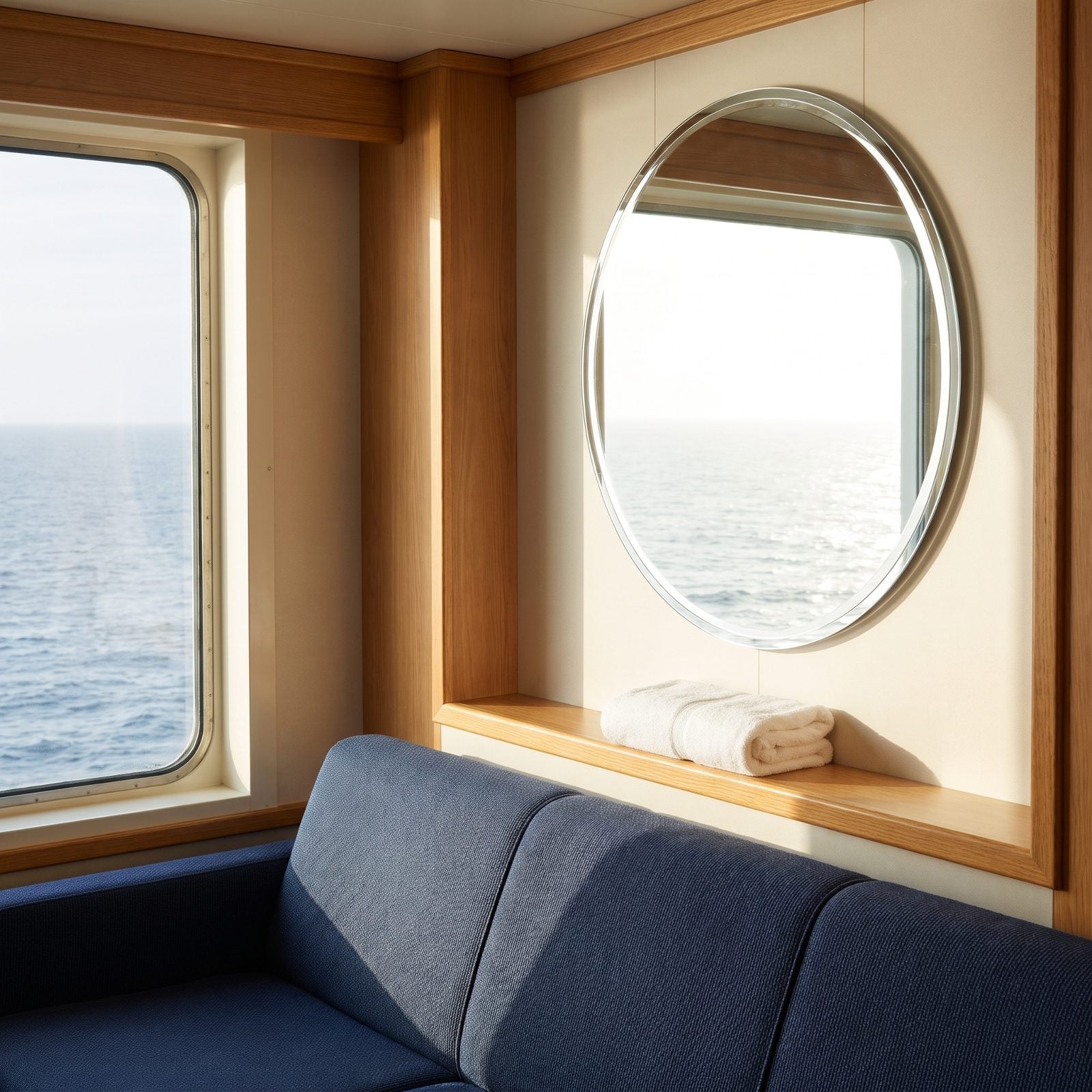
A window-side cabin hands you one real gift: daylight. A mirror doubles it. Stick a small removable one on the wall across from the window with a suction mount or a damage-free hook, angled so it catches the sea light and throws it back across the room.
The effect lands fast. A dim far corner wakes up, the ceiling reads higher, and the cabin stops feeling like a box.
15. Keep the Visible Floor Perimeter Completely Clear
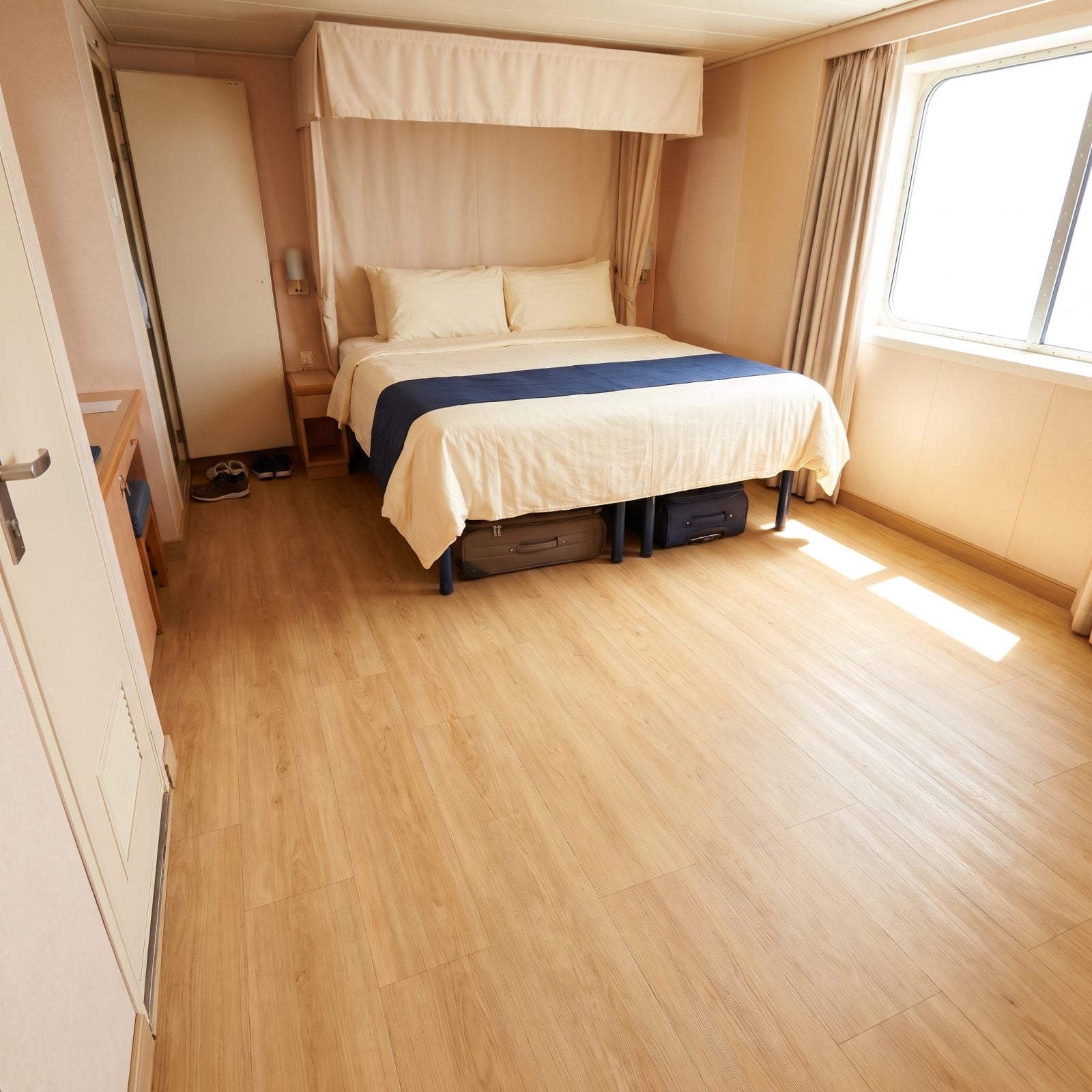
Floor is the one dimension your eye uses to judge how big a room feels. A shoe here, a tote there, a shopping bag leaning against the bed — and the cabin shrinks even though nothing structural has moved an inch.
Get nearly all of it off the deck. Luggage slides flat under the bed, shoes line up neatly in one spot against the closet instead of scattering across the room, and the gift-shop bags get unpacked, not parked.
A wide-open floor is the single biggest spaciousness lie you can tell a small room, and it works every time.
14. Run a One-In, One-Out Rule on Souvenirs
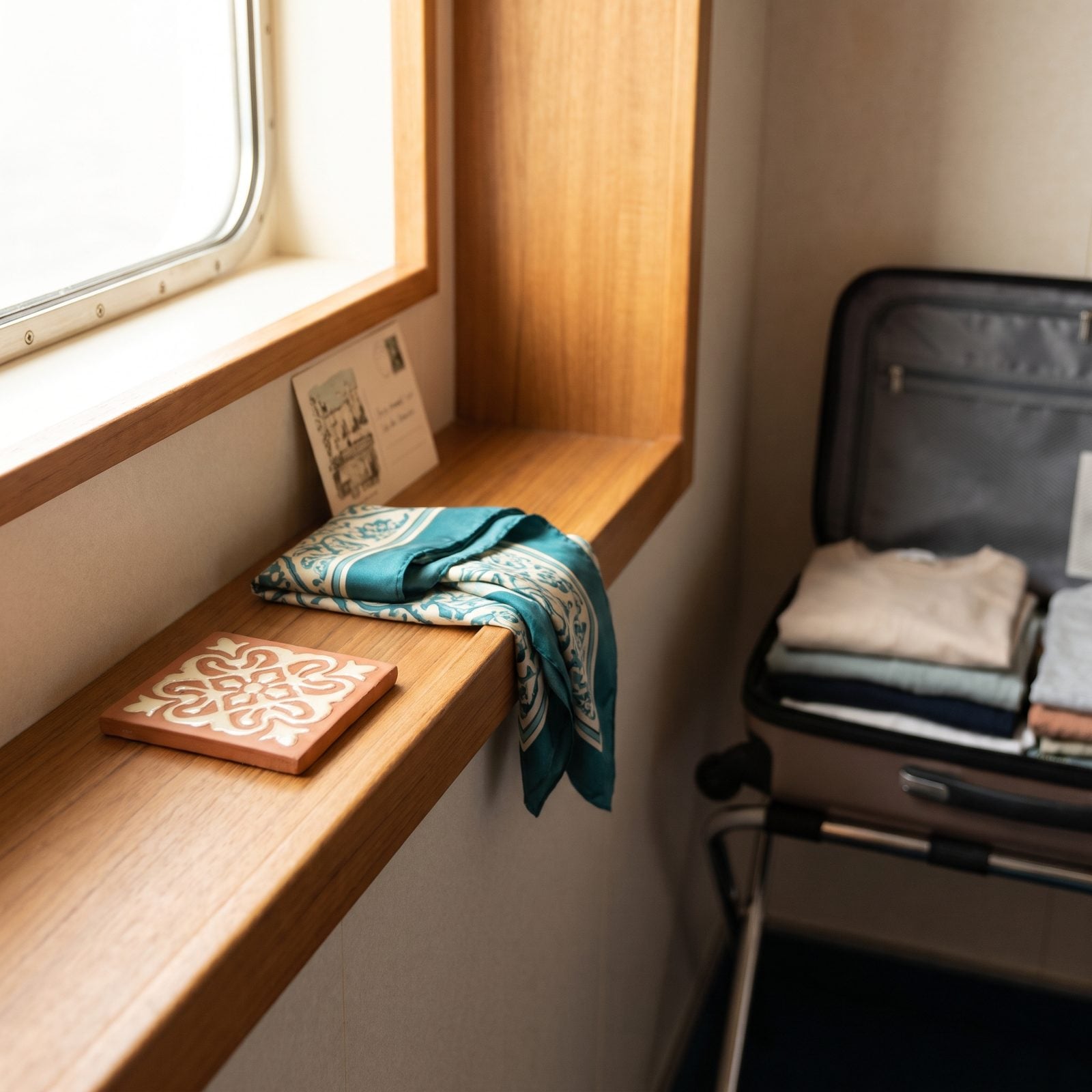
Ten ports means ten chances to buy something you’ll regret stuffing into a carry-on. By day six the cabin ledge looks like a flea market table and you still have four stops to go.
Set a limit before you sail. For every souvenir that comes aboard, something earns its place or goes. A magnet for a magnet. One scarf, not three.
We learned this the hard way, dragging home a bag of carved nonsense that now lives in a drawer we never open. Buy the one thing you’ll actually keep. The cabin stays clear and so does your shelf at home.
13. Pack a Foldable Duffel Flat Until You Sail Home
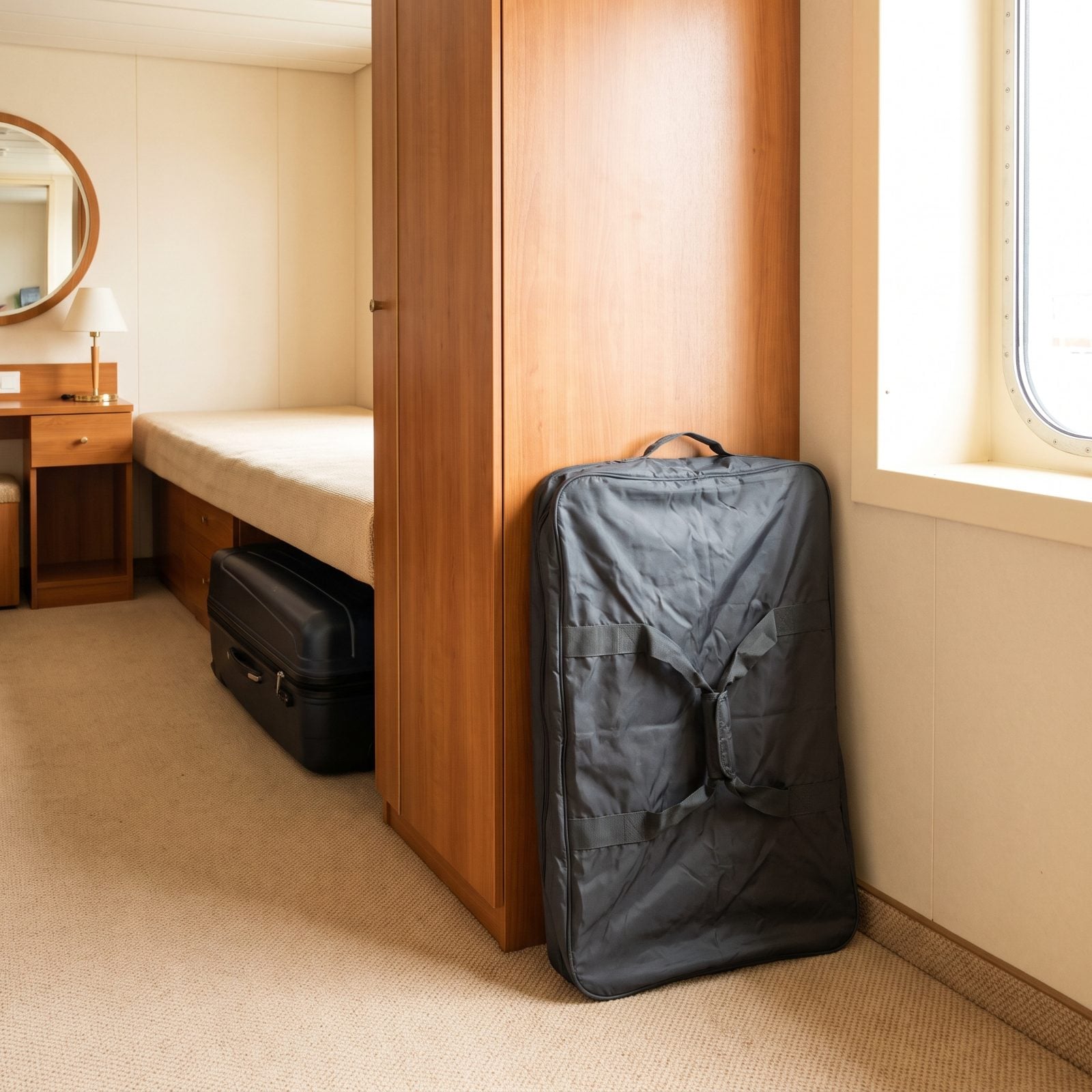
A packable duffel folds down to the size of a paperback and weighs almost nothing. Slide it flat behind the closet or under the mattress and forget it exists.
Then comes the last night — drawers full of newly bought sweaters, a suitcase that no longer zips — and you unfold it, stuff it full and stand it upright against the side of the wardrobe, with the suitcase stowed under the bed, while it swallows the overflow. No cramming, no sitting on the lid, no leaving the robe behind by mistake.
12. Send Out Laundry at the Halfway Mark of a Long Sailing
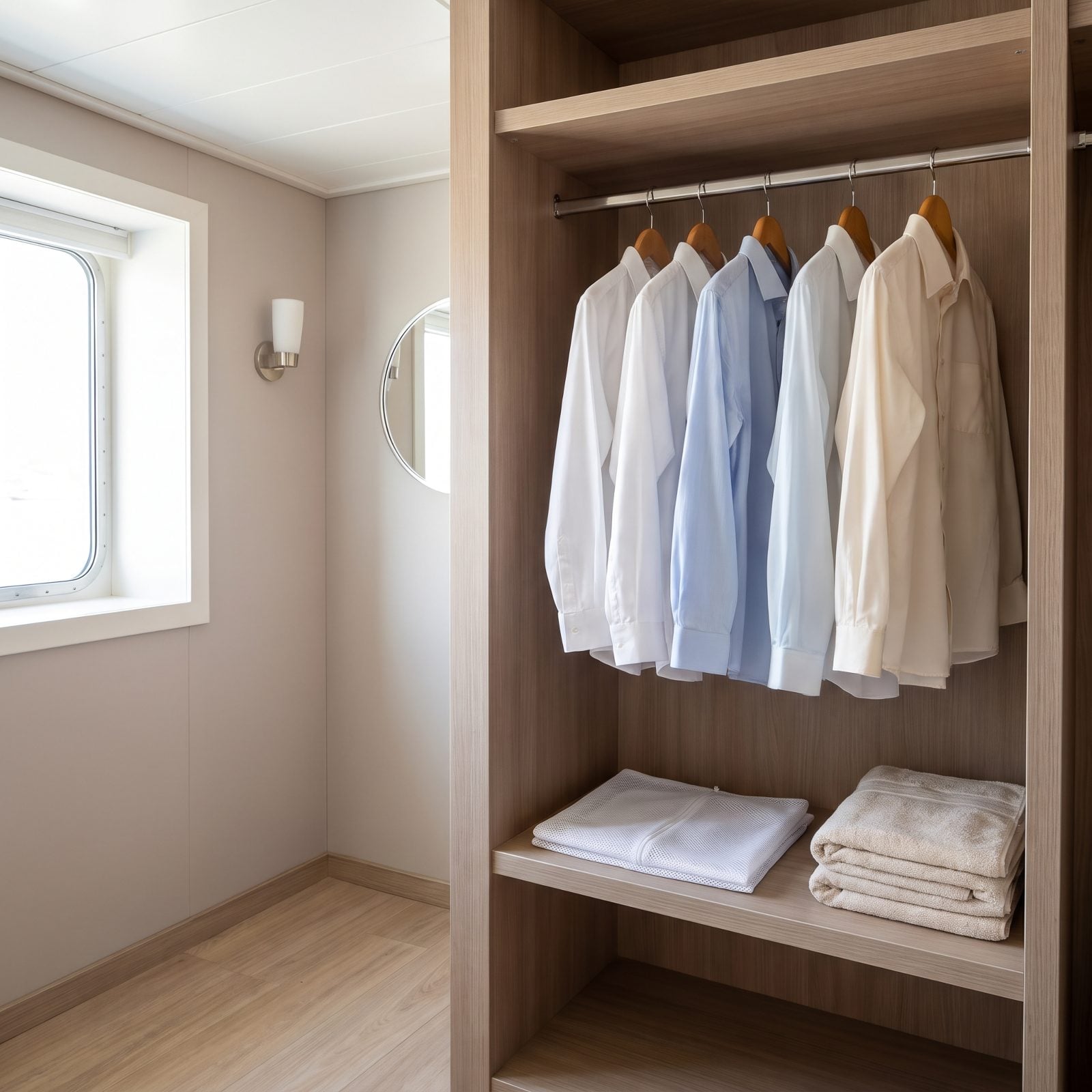
On a ten-day sailing, your laundry pile becomes a second passenger by day five. It colonizes a corner, then a drawer, then the floor of the closet.
Send a bag out at the midpoint. You pack half the clothes you otherwise would, you reclaim the closet floor, and you stop wearing the same two shirts on rotation because everything else is dirty.
11. Hang Tomorrow’s Outfit on a Single Hook the Night Before
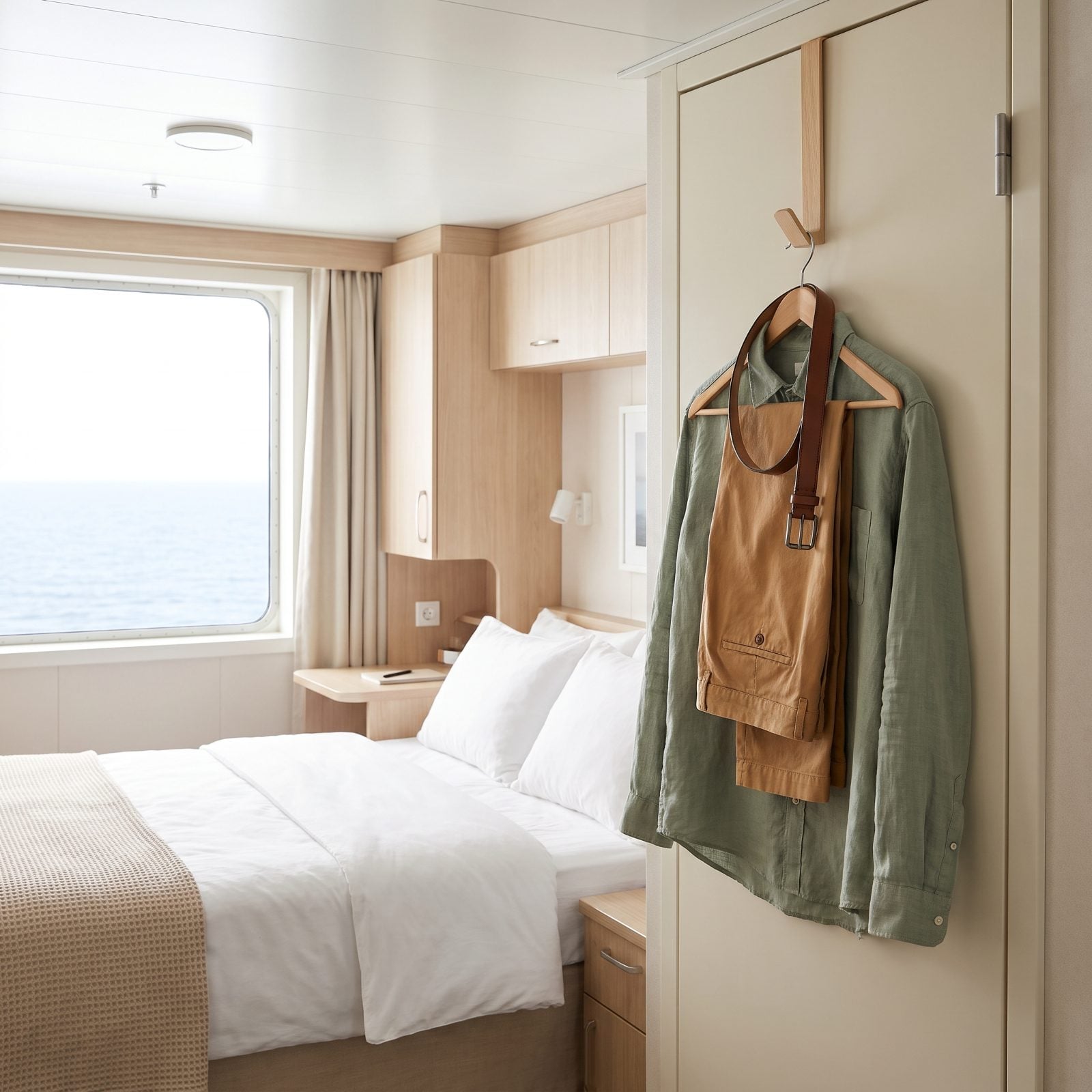
Morning in a tiny cabin is where good intentions go to die. You rummage, you pull three shirts, you drape the rejects on the bed, and now the whole room looks like a dressing room floor.
Set tomorrow out on one hook the night before. Shirt, bottoms, belt, all together, decided. You wake, you grab, you dress, and nothing gets strewn.
10. Use the Spa Shower During the Morning Crush
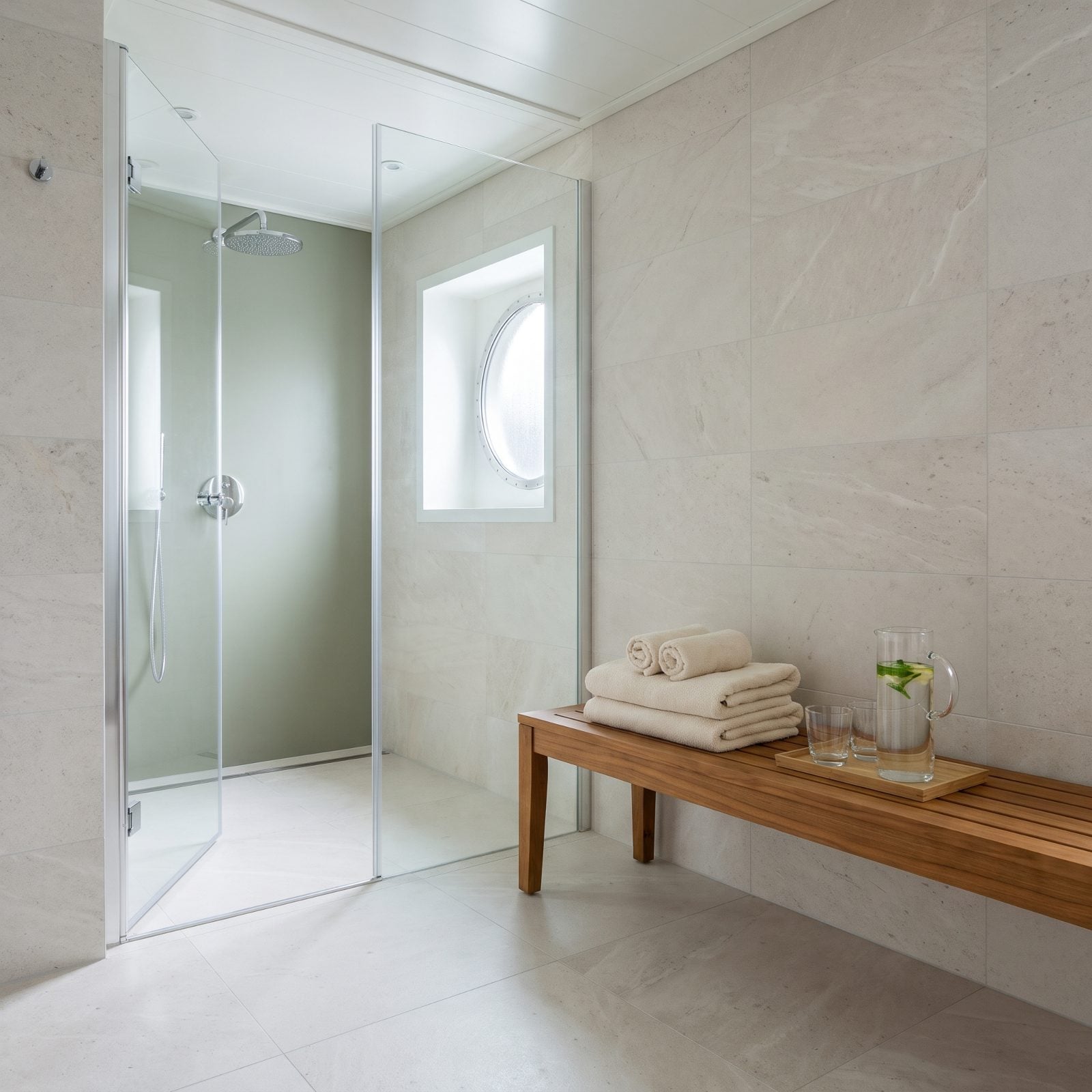
The cabin bathroom is roughly the dimensions of a phone booth, and you’ve done the elbow-in-the-wall shuffle to prove it. At eight in the morning, with the whole ship getting ready at once, it’s the least pleasant square foot aboard.
Bought a spa or thermal suite pass? The showers up there are a different world — room to turn around, hot water that doesn’t quit, towels folded by someone else. Go up during the rush and let the rest of the deck fight over the cabin bathrooms while you stand under a rain head with your elbows free.
9. Stagger Get-Ready Times in a Shared Cabin
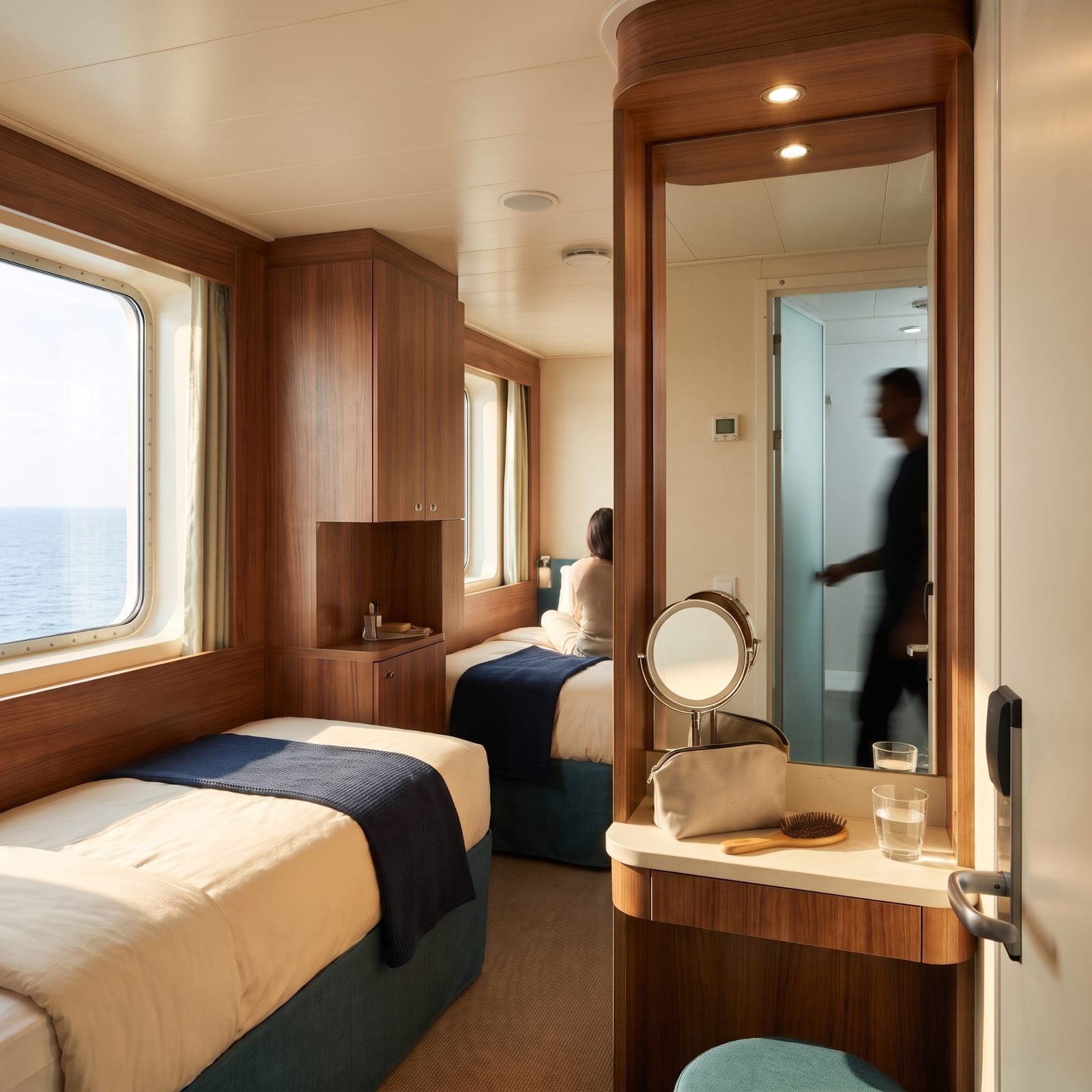
Two people, one mirror, one bathroom the size of a phone booth. You already know how this goes if you’ve ever shared a cabin and watched the whole morning jam up at the same sink.
The fix costs nothing. One person gets up and ready while the other stays horizontal, then they swap, so nobody’s doing a shoulder-to-shoulder shuffle in a space that barely fits one set of elbows. The cabin feels twice as big because only one body is moving through it at a time.
8. Tuck the Vanity Stool Fully Under the Desk
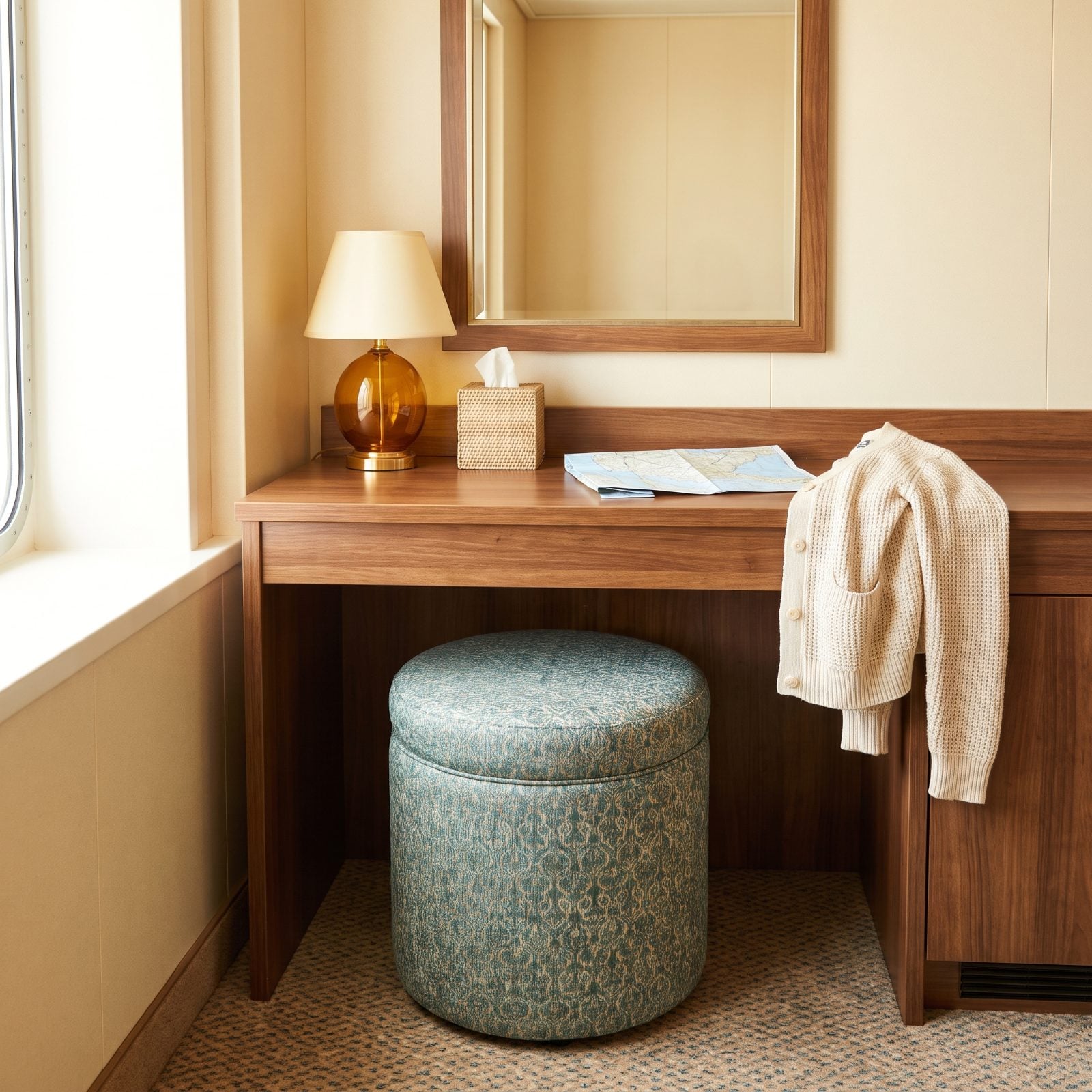
A stool sticking two inches into the walkway doesn’t sound like much. Then you catch your shin on it at 2am heading to the bathroom and reconsider your whole life.
Push it all the way under. Every time. The desk swallows it, the path clears, and suddenly there’s an open lane running the length of the cabin instead of an obstacle course. Floor you can see is floor your brain counts as space. The stool hasn’t gone anywhere — it just stopped announcing itself.
7. Move the Wastebasket Beneath the Vanity
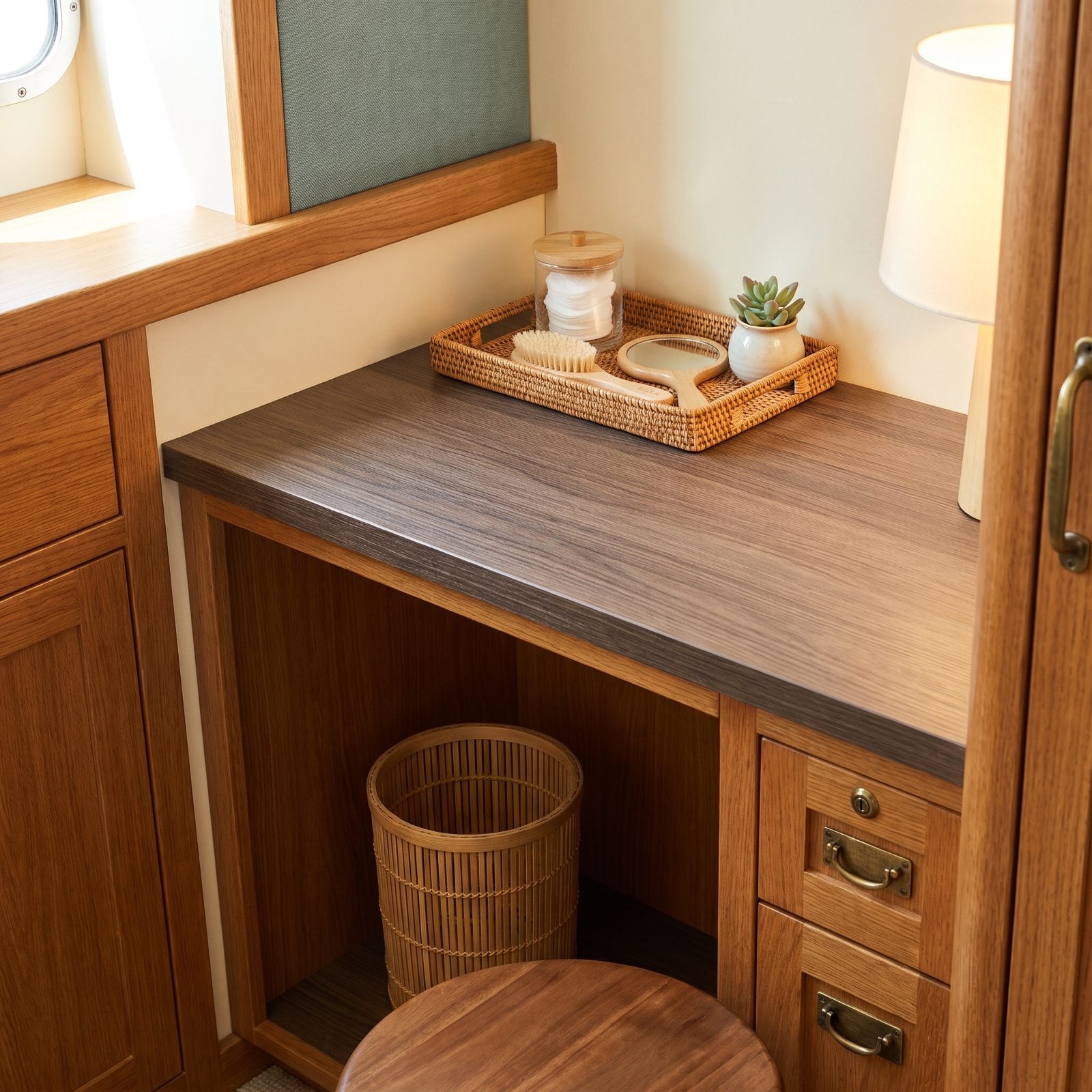
Cabin wastebaskets love to sit right in the middle of the walking path, usually where a bare toe finds them first.
Slide it into the empty cavity under the vanity instead. Still reachable from the desk, where most of your trash gets generated anyway, and completely out of the traffic lane. That recess is almost always dead space. Give it a job.
6. Consolidate Snacks in One Lidded Container
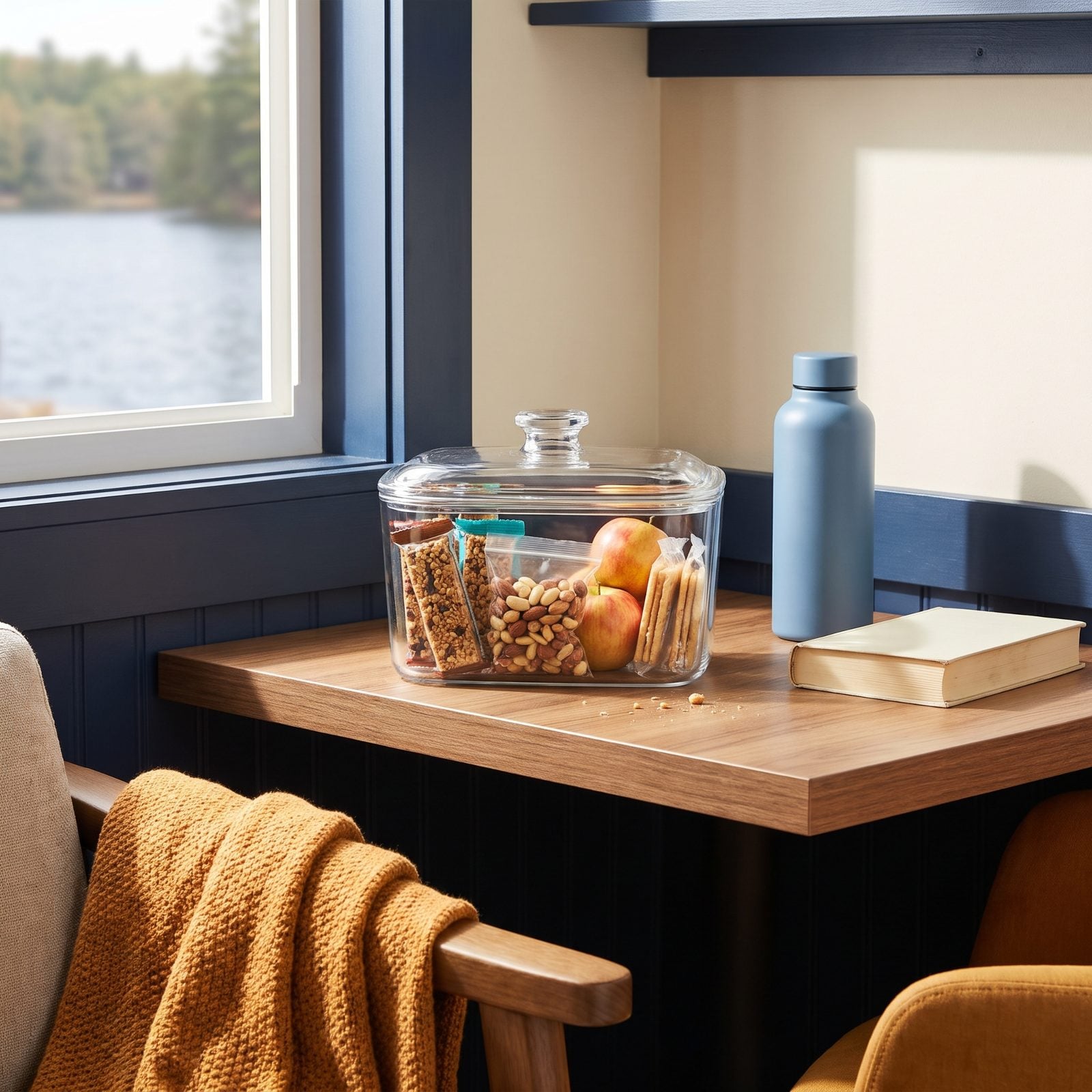
Loose snacks breed. One bag of pretzels becomes a desk full of half-open packets, a rolling apple, and three granola bars nobody remembers buying by day four.
Corral all of it into one lidded bin — the clear ones work best so you can see what you’ve got without excavating. A single contained object reads as order, while fifteen scattered wrappers read as a mess, and a messy surface makes the whole cabin feel smaller than it is. One container, one glance, done.
5. Mount Individual Bedside Pockets for Children
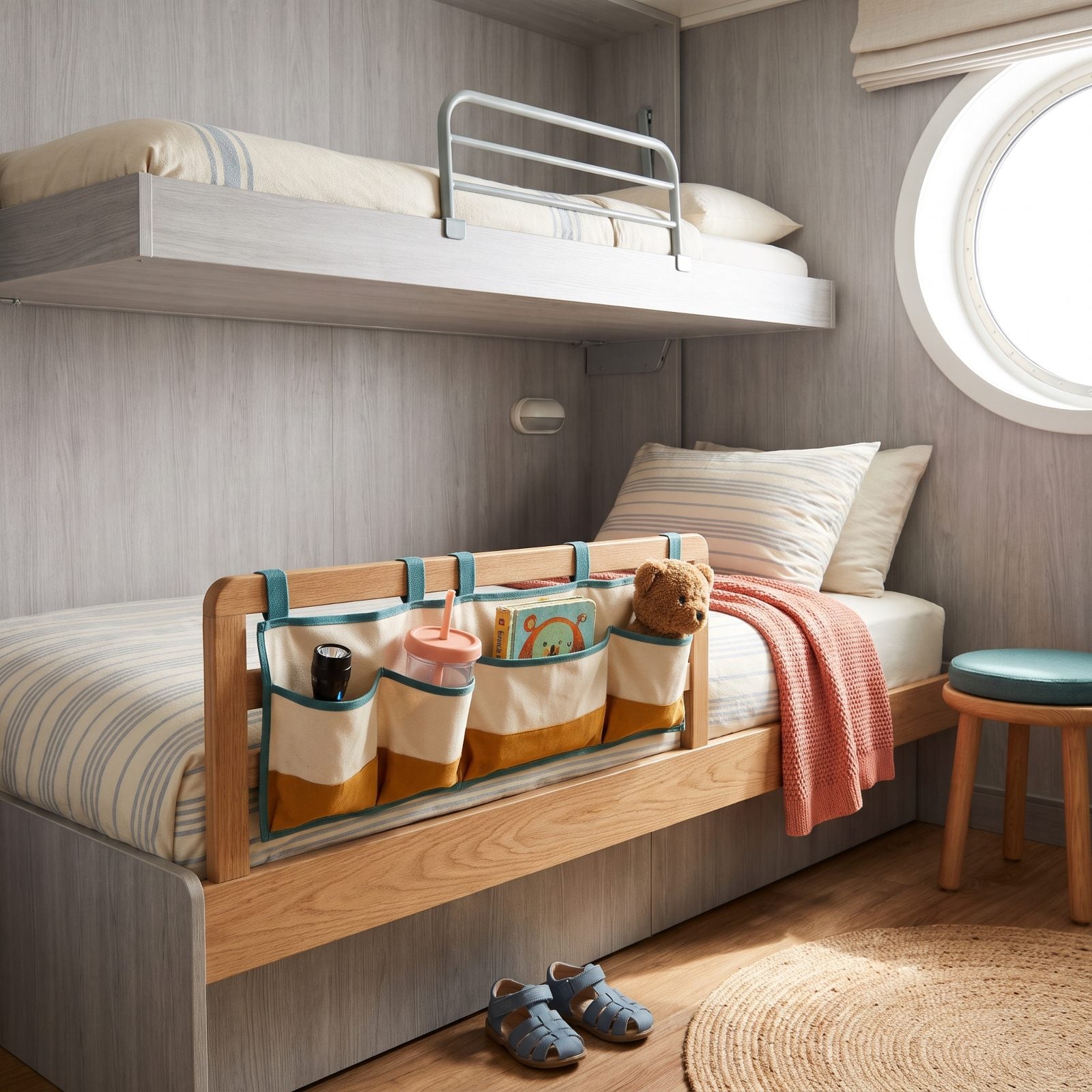
Give every kid their own bedside pocket and watch the midnight chaos drop by half. Flashlight, water cup, a small book, the one stuffed toy that cannot be lost — everything within arm’s reach of the bunk.
What this really buys you is nobody climbing down in the dark, nobody rummaging through a shared pile, nobody waking the whole cabin to find a cup. Each child gets a defined square of territory, which matters more than it sounds in a room where four people are stacked on top of each other.
4. Keep Small Toys in a Zippered Under-Bed Case
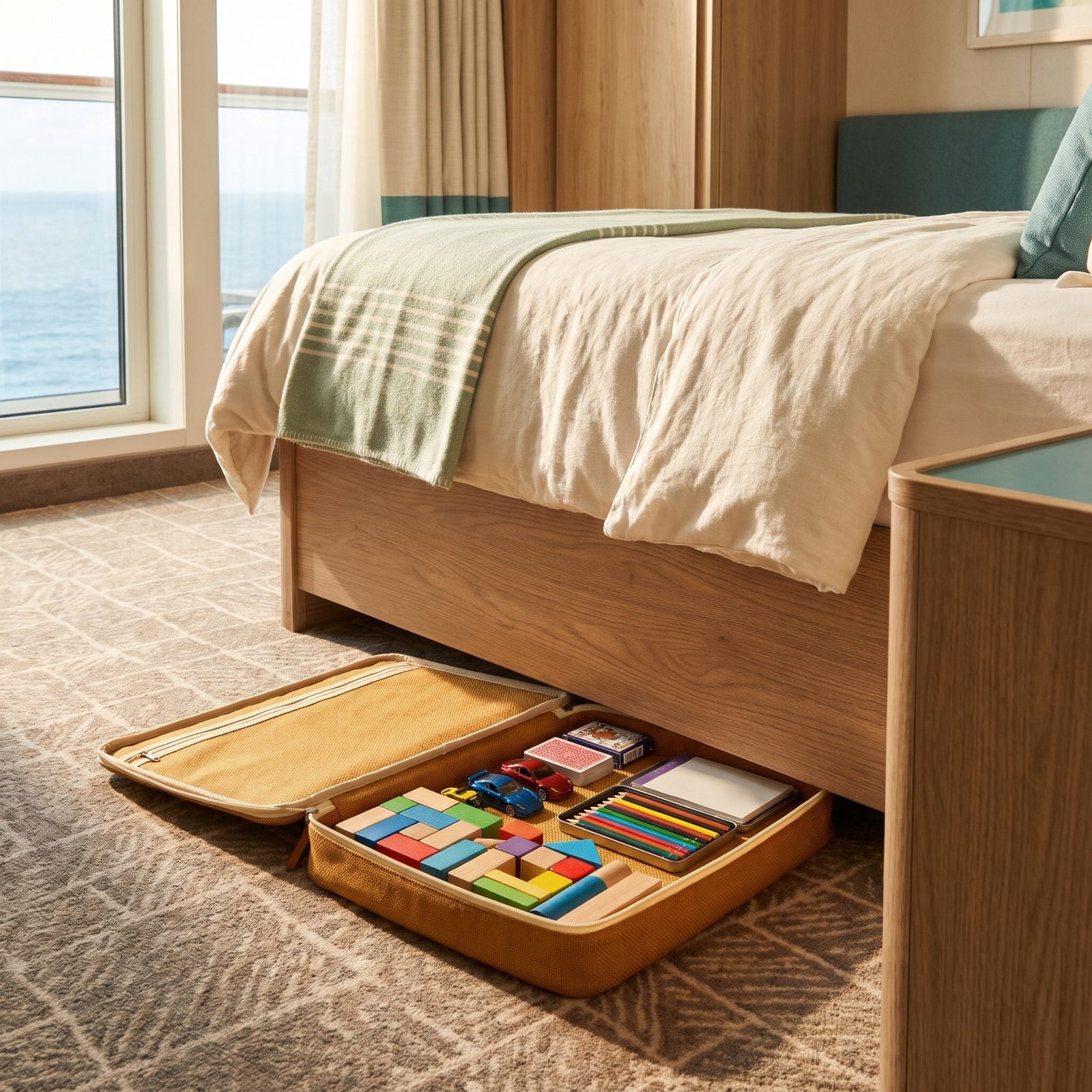
The space under a cruise bed is the most wasted real estate on the ship. Beds get raised specifically to fit luggage, which means a flat zippered case slides right in.
Load it with the small stuff — blocks, cards, little cars, coloring things — then zip it, slide it, and forget it until someone’s bored at sea. The toys stay off the floor, off the beds, and out of the single walking lane. A closed case under the bed takes up zero visible space. Twenty loose cars on the carpet take up the whole room, mostly in the arches of your feet.
3. Choose Matching Organizers to Reduce Visual Clutter
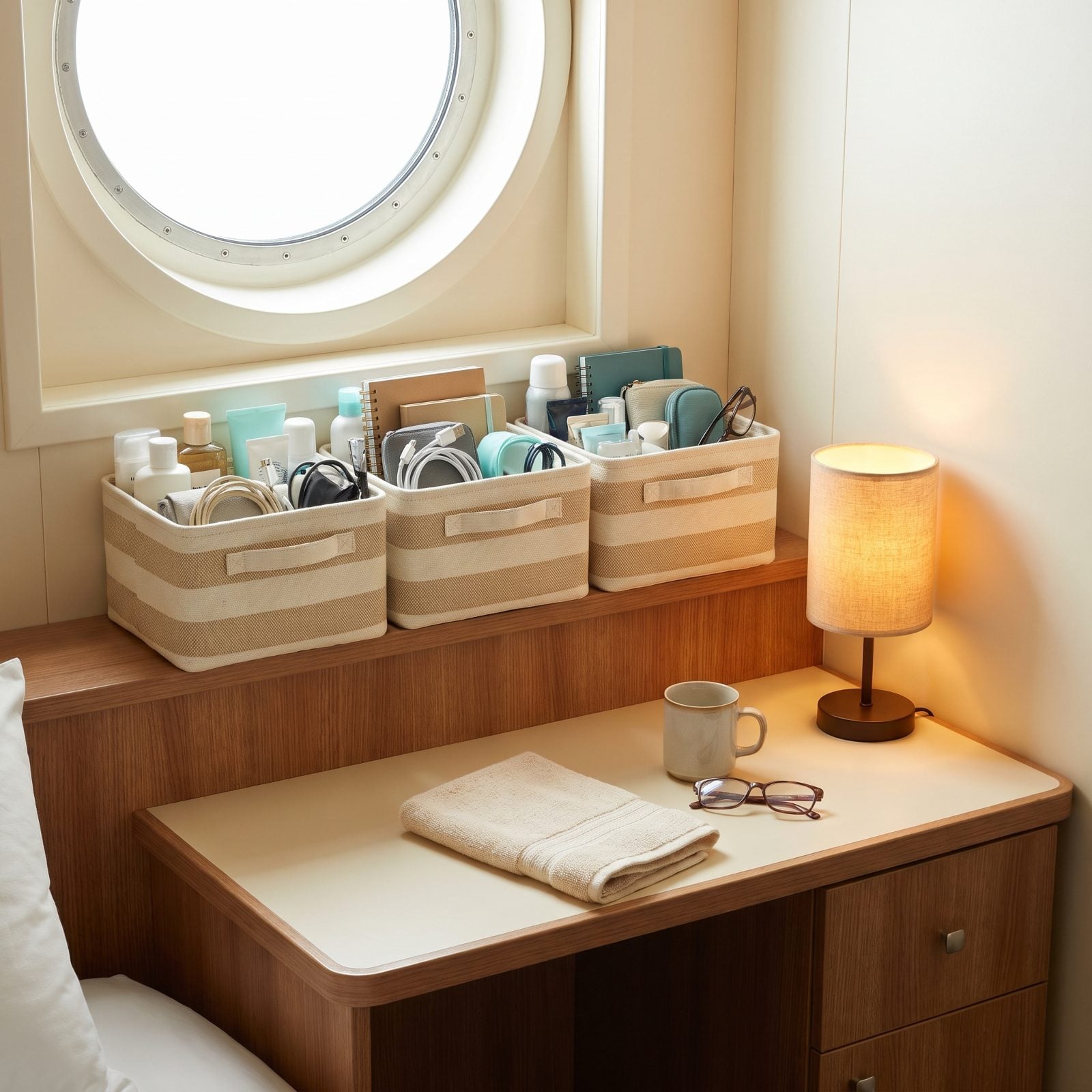
The eye does something without asking permission: it reads a row of matching containers as one object and a jumble of mismatched ones as twelve.
So pack your bins, pouches, and cubes in one color family. Suddenly the shelf looks designed instead of dumped. The clutter is still there — you’ve just stopped broadcasting it. A unified surface calms a small room the way a made bed calms a messy house. It’s the cheapest spatial trick there is, and it works every single time.
2. Tie Curtains Fully Back to Expose the Entire Window
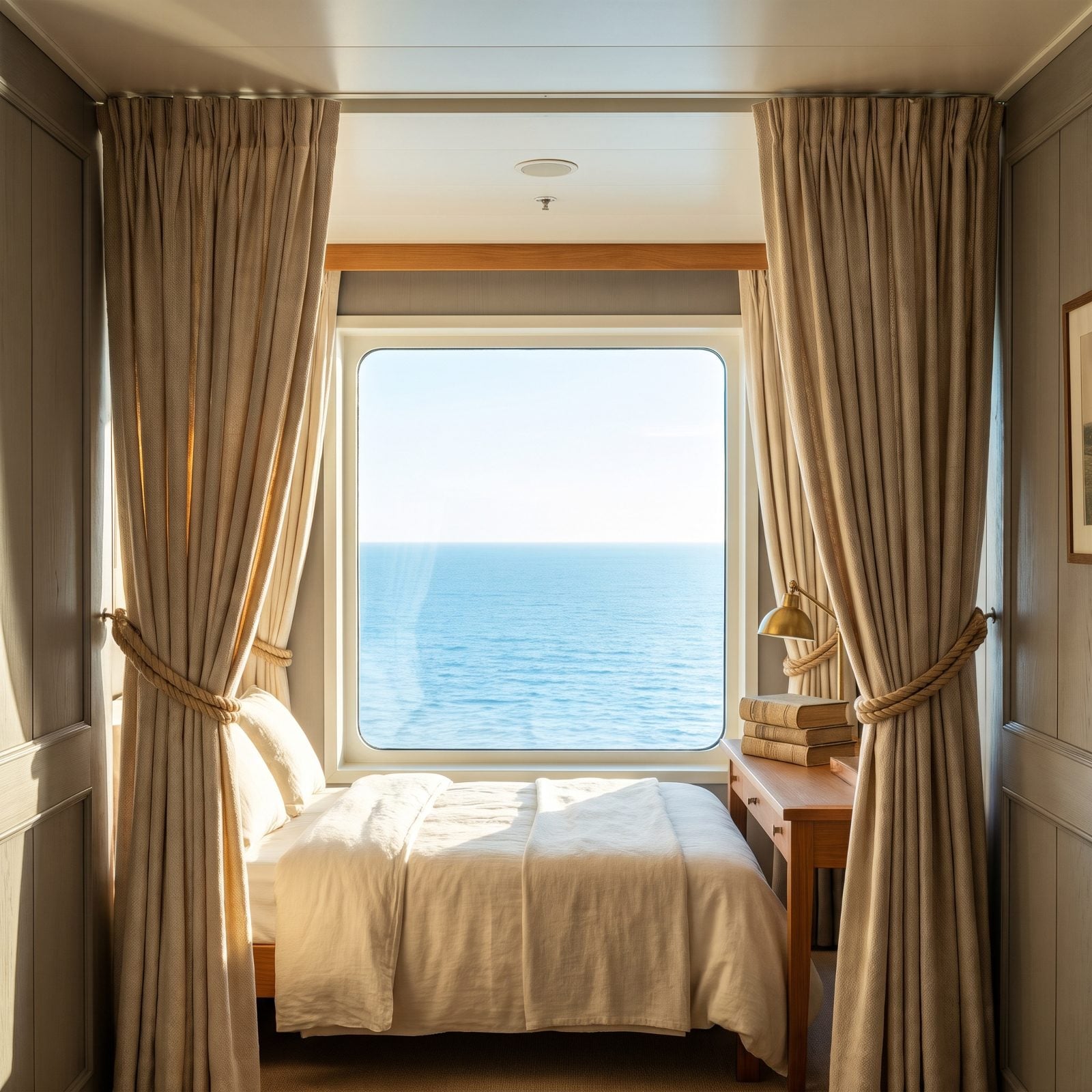
A half-drawn curtain is a small room’s worst enemy. It eats the one thing a cabin has going for it — a window onto the whole ocean.
Pull them all the way back, both sides, and tie them off if the ship gives you ties. The glass becomes a wall-sized view and the horizon does the work of making the room feel endless. Daylight bounces off every surface and the ceiling lifts. There’s no cheaper square footage than borrowed distance, and the sea hands it to you for free.
1. Treat the Balcony as a Second Sitting Room

Most people underuse the balcony. They step out for a photo, then retreat inside and leave it empty all week.
Flip it. Keep the sliding door open in good weather and the balcony becomes your living room, the cabin your bedroom. Morning coffee happens out there. The afternoon book happens out there. You’ve doubled the footprint by letting the ocean be your largest wall, and no interior cabin can compete with that.
Please note that some of the imagery in this article were created with the aid of AI image generators.