
🔥 Would you like to save this?
Flight delays happen to everyone, but not everyone knows how to turn that frustration into a comfortable night’s sleep on the airline’s dime. Legally, you aren’t owed a free hotel stay for most delays in the U.S.—but the reality is a lot messier than that.
Truth is, airlines often provide hotel accommodations for overnight delays—if you know what to say and when to ask. Your odds depend on airline policies, the reason for your delay, and how you advocate for yourself. US airlines don’t hand out hotel vouchers for delays outside their control, but there are exceptions and workarounds that seasoned travelers use.
Getting a hotel voucher (instead of a night on a plastic bench) often hinges on your approach, timing, and knowing what triggers an airline’s compensation. From using the right phrases at the counter to having the right credit card, there are ways to boost your odds.
Understanding Flight Delays and Passenger Rights
Flight delays trigger different compensation rules depending on where you fly and why your flight is late. Your rights shift a lot between U.S. domestic and international flights, and the airline’s fine print usually decides what you actually get.
What Qualifies as a Flight Delay?
Airlines don’t all see delays the same way, which affects whether you get anything at all. Most consider it a delay if your flight leaves 15 minutes or more late.
The FAA says airlines must update flight status every 30 minutes during a delay. That keeps you in the loop, but it doesn’t mean you’ll get compensated.
Significant delays are what matter for your wallet. Usually, that means:
- 3+ hours for domestic flights
- 1-6 hours for international flights (depends on distance)
Some airlines offer automatic refunds for canceled flights and big delays. But “significant” is the magic word—a 30-minute delay won’t get you a hotel.
Controllable vs. uncontrollable delays is the big split. Weather delays? Don’t expect much. Mechanical or crew issues? That’s usually when you have a shot.
Your Rights Under U.S. and International Law
Where you are matters a lot. For U.S. domestic flights, no federal law says airlines have to pay for delays.
U.S. flights run on the airline’s own policies. You can ask for compensation for delays over an hour with some airlines, but there’s no law forcing them.
International flights are a different story. The EU, for example, requires compensation up to €600 for certain delays. You also get meals, hotel stays, and transportation if you’re stranded overnight.
Delay rights vary by country. Canada has compensation for controllable delays, and the UK kept EU-style rules after Brexit.
Refunds are a bit more straightforward. If your domestic flight is delayed more than three hours and you cancel, you can get your money back.
The Small Print: Airlines’ Contract of Carriage
Your ticket comes with a legal contract—the “Contract of Carriage”—that spells out what the airline owes you. This is where the real rules live, not the stuff on the website.
Hotel accommodations aren’t a given for all delays. Most airlines only provide a room for overnight delays they caused—so not for weather or air traffic issues.
Every airline’s policy is a little different. Some hand out meal vouchers after two hours, others after four. Hotel eligibility might kick in at six hours, or not until twelve.
Documentation matters. Airlines might ask for receipts or have deadlines for claims. Hang on to all your paperwork and ask for help as soon as you can.
Usually, the contract protects the airline when it comes to “extraordinary circumstances” like bad weather or security. It helps to know these terms before you’re stuck.
How Airlines Decide on Compensation for Delays

Airlines have pretty specific policies for compensation, but those rules can change dramatically depending on whether you’re flying within the U.S. or abroad. Your location and the reason for your delay both matter.
Standard Compensation Policies
U.S. airlines must compensate for cancellations and big delays under DOT rules, but only if the delay is their fault.
Weather delays get you nothing, basically. That includes storms, fog, snow, or the ever-popular “air traffic control” excuse—even if the sky looks clear.
Mechanical issues, crew problems, or overbooking are where compensation kicks in. Airlines might offer:
- Meal vouchers after 3 hours
- Hotel accommodations if you’re stuck overnight
- Ground transportation to the hotel and back
- Free rebooking on the next flight
But every airline defines “controllable” a bit differently. Some are generous, some barely meet the minimum.
It pays to know your airline’s policy before you fly. Most post their customer service plans online, but you might have to dig for them.
When Do Airlines Offer Hotel Stays?
Hotels enter the picture when your delay stretches overnight, but you’ll usually have to ask for a room. Airlines don’t hand out hotel keys automatically.
Overnight delays from mechanical issues usually qualify for a hotel. The airline considers this their responsibility.
Crew scheduling problems can also get you a room. If the pilot times out or the crew’s stuck, that’s on the airline.
Weather delays? Don’t count on a hotel, even if you’re stranded all night. Airlines say that’s out of their hands.
International flights play by different rules. Many countries require hotels no matter why you’re delayed. That’s why you might get better treatment on a European trip.
Ask at the gate or customer service counter. Gate agents have some authority, but a supervisor can often do more for you.
Differences Between U.S. and European Carriers
Flight delay rights are all over the map. European travelers get much stronger protections than Americans.
EU rules say airlines owe you cash for delays over 3 hours—€250 to €600, depending on distance. This covers EU airlines and any flight leaving from an EU airport.
U.S. rules focus more on refunds. If your delay is over 3 hours and you bail, you can get your money back, but cash compensation is rare.
Hotels and meals are also handled differently:
| Region | Meals Required | Hotel Required | Cash Compensation |
|---|---|---|---|
| EU | 2+ hours | Overnight delays | €250-€600 |
| US | Varies by airline | Controllable delays only | Rare |
| Canada | 2+ hours | Overnight delays | $125-$1,000 |
Canadian airlines land somewhere in the middle, with some compensation and hotel coverage for controllable delays.
Flying internationally? You’ll probably get better protection, even on a U.S. airline, if you’re under foreign rules.
The Magic Words: What to Say When Seeking a Free Hotel Stay

Scoring a hotel room instead of a stiff airport bench is often about knowing what to say and when to say it. It’s about confidence, timing, and using language that shows you know the rules.
Timing Your Request for Maximum Impact
Don’t wait for the gate agent to announce the delay. Head to the counter as soon as you see your flight status change. Hotel vouchers are limited and go fast.
The sweet spot is within 30 minutes of the delay announcement. After that, you’re competing with a crowd that’s just as annoyed as you.
Ask right after you’re rebooked. That’s when the agent is already in your reservation and can add accommodations more easily.
Try to avoid shift changes or peak chaos. Gate agents usually have more leeway than ticket counter staff when things get crazy.
Phrases That Actually Work (and Those That Don’t)
What works:
- “What accommodations can you provide for this overnight delay?”
- “I need overnight accommodations due to this delay.”
- “Can you please add hotel accommodations to my reservation?”
- “This delay requires overnight accommodations—what are my options?”
What doesn’t:
- “You owe me a hotel room.”
- “This is unacceptable.”
- “I demand compensation.”
- “Other airlines would give me a hotel.”
“Accommodate” is a keyword in airline speak. They know they’re supposed to provide hotels for overnight delays they control.
Be direct, not emotional. Try, “I have a medical condition that requires proper rest,” or “I have an early morning meeting,” instead of venting about the delay.
Approaching Airline Staff with Confidence
Stay calm and make eye contact. Agents deal with angry people all day, so a friendly, steady approach stands out.
Act like your request is routine, not a special favor. Say, “I need to arrange overnight accommodations,” the way you’d ask for an aisle seat.
Have your confirmation number ready and your phone charged. It shows you mean business and want to get things sorted quickly.
Jot down the agent’s name. That tiny move signals you’re paying attention, and you’ll often get better service.
If you get a “no,” politely ask to speak with a supervisor. Don’t argue—just say, “I understand, but I’d like to speak with someone who can authorize overnight accommodations.”
Stick to facts and policy, not emotion. The agent needs to justify their decision, so give them solid reasons they can pass along.
The Role of Credit Cards and Travel Insurance
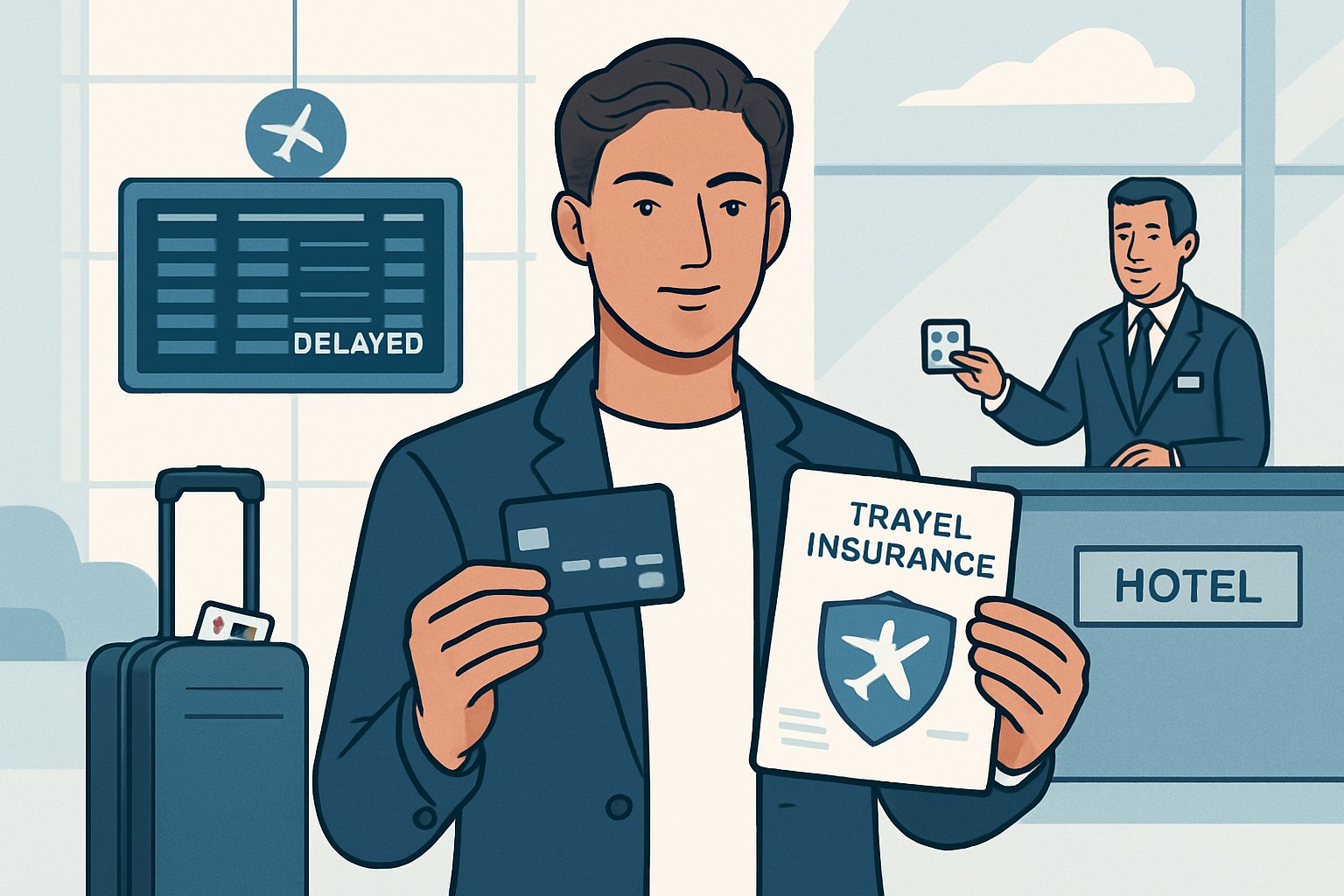
Many premium credit cards come with trip delay insurance baked in, covering hotel stays, meals, and other costs when things go sideways. Knowing how to file a claim can make the difference between eating the cost yourself or getting reimbursed for your trouble.
Benefits Offered by Premium Cards
Premium travel credit cards often throw in trip delay coverage when you use the card to book your travel. Most cards make you wait out a 6-12 hour delay before the benefits kick in, though a few start helping after just 3 hours.
Covered Expenses Usually Include:
- Hotel accommodations
- Meals and drinks
- Essential toiletries and meds
- Rides to and from hotels
- Phone calls to rearrange your plans
Chase and American Express cards have a reputation for solid trip delay benefits. Coverage limits usually sit between $300-$500 per day, with max payouts from $1,500 to $2,000 per incident.
To activate coverage, you’ll need to pay for your trip with the eligible credit card. Some cards cover family traveling with you, but others stick to just the cardholder.
How to Initiate a Claim After a Delay
When your flight gets delayed, call your credit card’s benefits administrator right away—don’t wait for the airline to help. You’ll usually need to call a claims hotline within 24-48 hours.
Required Documentation:
- Original travel itinerary
- Boarding passes or stubs
- Official delay notice from the airline
- Receipts for your expenses
- Filled-out claim forms
Hang onto receipts for eligible expenses like hotels, food, and toiletries. Most insurers want claims within 30-90 days.
Claims usually take 2-6 weeks for approval. Card issuers sometimes ask for more documentation or clarification, so respond quickly if you want your reimbursement on time.
Special Circumstances That Improve Your Odds
Some types of delays really boost your chances of scoring a hotel room—mechanical issues usually beat out weather delays. And if you’re on a connecting flight, that can change the airline’s responsibility too.
Weather vs. Mechanical Issues
Airlines treat weather delays and mechanical problems completely differently when it comes to hotel compensation. It matters more than you’d expect.
Weather delays fall under the dreaded “act of God” excuse. Most U.S. carriers will say they’re not responsible for your hotel when Mother Nature acts up. Gate agents will often explain that storms, snow, or fog get them off the hook.
Mechanical issues are another story. When something breaks on the plane, airlines are more likely to admit fault and offer you a hotel. This could be anything from engine trouble to busted air conditioning.
It’s simple: airlines can’t control the weather, but they’re responsible for their planes. Airlines only offer accommodation in certain situations, and mechanical failures usually count while weather doesn’t.
So, don’t be shy—ask what caused your delay. If it’s mechanical, you’ve got a stronger case.
Connecting Flights and Missed Connections
Missing a connection because your airline delayed you? That can really help your odds for hotel compensation. The trick is knowing when airlines actually take responsibility.
Same-airline connections are your best bet. If your first flight arrives late and you miss your next one with the same airline, they usually take care of the whole trip. That means you’re more likely to get a hotel.
Partner airline connections get murky. If you’re on a codeshare or alliance partner, carriers might blame each other while you’re stuck waiting.
Getting a free hotel from your airline during a delay is easier if you can show that the airline made you miss your connection. Keep records of your original arrival and your connection’s departure.
Try this: “Your delay caused me to miss my connection.” It draws a clear line and puts the onus back on the airline.
Myths and Misconceptions About Free Hotel Stays
Online travel hacks make it sound easy, but honestly, separating truth from myth is tough. Plenty of travelers believe things that just aren’t true—and end up stuck.
The “Magic Words” Myth There’s no secret phrase that guarantees you a free hotel. Airlines don’t have hidden codes that unlock compensation. What really matters is why you’re delayed and what the airline’s policy says.
The “All Delays Equal Hotels” Fallacy You’re not owed a free hotel just because your flight is delayed. Weather, air traffic control, and other things outside the airline’s control usually don’t get you a room.
Other Common Misconceptions:
- Yelling works – Nope, being aggressive rarely helps
- Every overnight delay counts – Only delays the airline causes typically qualify
- International rules apply in the US – US and EU compensation laws are totally different
- Credit card benefits kick in automatically – You have to actually file a claim
The Reality Check Airlines sometimes offer free hotels if the delay was their fault, like with mechanical or staffing issues. But every carrier’s policy is different.
Honestly, your best bet is to know the actual policy—not rely on some viral tip. Gate agents have limited power, and what they can do depends on the situation, not how convincing you are.
Real Stories: Successes and Face-Palm Moments

The Golden Ticket Winner
Sarah’s flight from Chicago to London got hit with an 8-hour mechanical delay. She walked up to the gate agent, explained she had nowhere to stay, and asked for help.
The airline set her up at a four-star airport hotel with meal vouchers. Her secret? She just asked nicely and mentioned she was a frequent flyer. No drama.
The Oversharer’s Mistake
Mike figured honesty was the way to go after his connection got canceled. He told the airline rep he lived 20 minutes away.
Big oops. Their policy excluded locals from hotel rooms. Mike wound up on an airport bench instead of his own bed.
The Documentation Winner
Lisa’s regional flight was canceled for weather. She snapped photos of the departure board and saved every delay notification.
When the airline first refused a hotel, she pulled up their policy: weather delays over four hours qualify for accommodation. She got her free night.
The Tantrum Backfire
Robert started yelling at the gate agents after a six-hour delay. He demanded a hotel and ranted about “knowing his rights.”
The agents denied his request and called security. Meanwhile, other passengers with the same delay quietly got hotel vouchers.
The Timing Master
Jennifer’s delay dragged past midnight, technically making it the next day. She pointed out that overnight stranding qualified for a hotel under the contract of carriage.
Her timing know-how landed her a hotel room that others missed. Sometimes it pays to read the fine print.
Final Thoughts on Turning Delays Into Hotel Perks

Knowledge is your best weapon when delays strike. Airlines rarely spell out their policies, so knowing the difference between controllable and uncontrollable delays gives you a real edge.
How you handle the situation honestly matters a lot. Being polite, firm, and prepared can open doors, even when policies sound set in stone.
Don’t just hope for airline generosity. US airlines aren’t required to hand out hotel vouchers if weather or other uncontrollable stuff causes a delay. That’s when backup plans really matter.
Credit cards sometimes bail you out when airlines won’t. Premium travel cards offer trip delay reimbursement—honestly, that can turn a headache into just another story to tell.
Your preparation checklist:
- Check your airline’s specific delay policies
- Bring a premium travel credit card
- Snap photos and keep every receipt
- Try a different agent if the first one turns you down
Here’s the bottom line: You’re usually not owed a free hotel in the US—no matter how long you’re stuck. But if you come armed with some know-how, a bit of grit, and a solid backup, you can take chaos and make it, well, just a hassle.
And hey, gate agents have more wiggle room than they let on. Sometimes it’s not about quoting policy—it’s about connecting, human to human.
🔥 Would you like to save this?
Please note that some of the imagery in this article were created with the aid of AI image generators.