

🔥 Would you like to save this?
It starts innocent. One hotel tab becomes nine, then thirty, and somewhere around midnight you’re comparing thread counts in a country you can’t point to on a map. You tell yourself it’s research. It isn’t. It’s the same itch that makes a person suddenly want a motorcycle, or bangs, or a whole new life in a place with better light.
Vacation planning and the midlife wobble run on the exact same wiring — the hunger for control, the urge to reinvent, the quiet panic that the clock is louder than it used to be. The good news? A plane ticket is a lot cheaper than a sports car and nobody judges you at the gate. Here are the planning behaviors you’ll recognize instantly, and the human machinery humming underneath each one.
18. You Open 37 Hotel Tabs and Call It Research

Thirty-seven tabs. You’ve compared the same ocean view from eleven angles and still booked nothing, and you’ve read a one-star review from 2019 about a hairdryer three separate times. This is not research. It’s your brain trying to guarantee a perfect outcome in a world that offers no such thing.
Same reflex that hits around the midlife mark, when the big unchangeable stuff starts feeling permanent and the small controllable stuff gets gripped twice as hard. You can’t fix the years. You can absolutely verify whether the rooftop bar closes at ten. Psychologists call it choice overload — the more options you pile up, the less satisfied you feel with any of them, and the longer you stall.
Pick one that’s good enough and shut the laptop. Good enough is a place you’ll actually go.
17. You Build a Spreadsheet Because Life Has No Itinerary

Column A: destinations. Column B: flight times. Column C: a formula that calculates cost-per-hour-of-sunlight. You’ve built a trip-planning spreadsheet so detailed it has its own tabs, and you’ve titled it something hopeful like “Freedom 2025.”
But here’s the tell. The spreadsheet isn’t really about the vacation — it’s about the comforting illusion that something, anything, can be controlled down to the cell. Life at this stage stops handing out itineraries. Kids leave, careers plateau, the body files complaints you didn’t authorize. So you build the one schedule you can actually command: a gridded little universe where the departure gate is known and the outcome is yours.
And the irony writes itself. The best travel moments never make it onto the spreadsheet — the wrong turn that led to the best meal, the rained-out afternoon that became a three-hour conversation. You can plan the plane. You cannot plan the magic, and the magic is the whole point.
16. You Ask Everyone’s Opinion, Then Book the Opposite
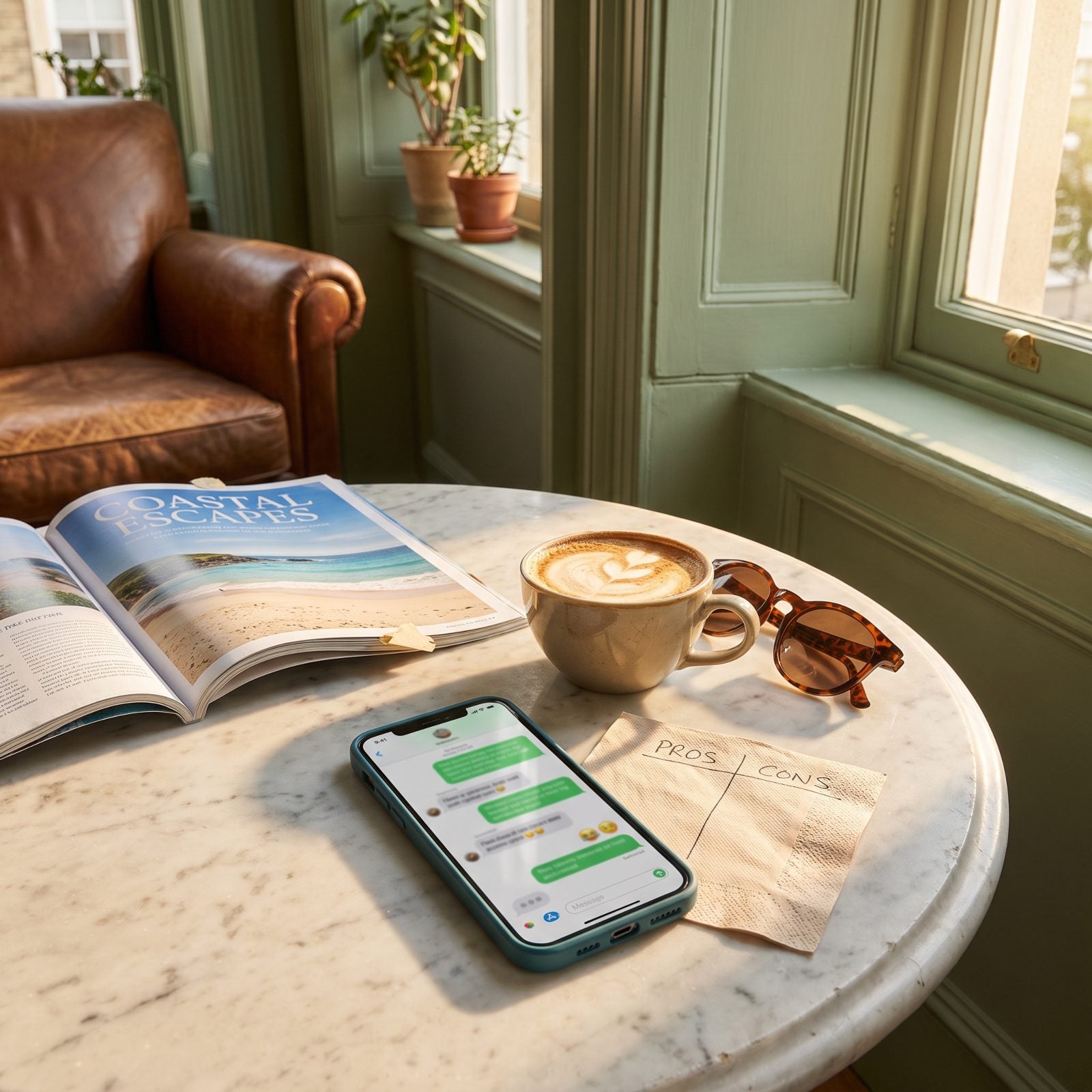
You polled the group chat. You asked your sister, your coworker, the neighbor who’s been everywhere, collecting opinions like seashells and nodding gratefully at each one. Then you booked a place nobody mentioned.
What you wanted wasn’t advice. It was permission, and the quiet thrill of not needing it. Asking around is a way of testing the waters of a decision you’ve already half-made in your gut, and the moment someone pushes the “safe” choice, your contrarian streak flares and the one you secretly wanted suddenly becomes the one you must have.
Asking a dozen people what to do is often just the sound of someone working up the nerve to ignore all of them.
Same engine drives the midlife pivot everyone warns you against. The louder the chorus of “are you sure?”, the more certain you get — not because you’re reckless, but because for once you’d rather answer to yourself than to the committee.
15. You Pick Bali Because the New You Apparently Surfs

You don’t surf. You’ve never surfed. But somewhere between the second glass of wine and the ninth Instagram reel, you decided that the person on the other side of this flight does surf, eats dragon fruit for breakfast, and is deeply at peace.
Destinations become costumes. You’re not booking Bali — you’re booking a version of yourself who is calmer, braver, and fifteen years less tired. That’s the reinvention fantasy at its purest: the belief that a change of scenery is a change of self. Recovery circles have a dry name for the heartbreak that follows: the geographic cure. Wherever you go, you unpack the same brain at baggage claim.
Go anyway. Just go as yourself. That person deserves the beach too.
14. You Pack Linen for a Person You’ve Never Been

The linen trousers are a confession. So is the straw hat you’ll wear exactly once, and the stack of literary novels for a person who, back home, reads two pages of anything before falling asleep. You’re not packing for the trip. You’re packing for the you that the trip will supposedly create.
There’s a name for this — enclothed cognition, the idea that what we wear quietly shapes how we behave and feel. Slip on breezy linen and you half-expect to become breezy. Maybe, for a weekend, you do. The outfit is a down payment on a future self, folded neatly into a carry-on.
The espadrilles with the tags still on tell the real story. Those are the shoes of your aspiration, not your actual feet, and you’ll wear the comfortable ones every single day. Which is fine. The linen was never about the linen. It was about believing, for one hopeful afternoon at the closet, that a softer, slower version of you was just a packing list away.
13. You Book the Volcano Hike to Prove You Still Can

The 4 a.m. volcano hike. The one that promises a sunrise, a brutal incline, and a cardiologist’s polite concern. You booked it the way other people buy convertibles — as a dare issued to your own body.
This is urgency wearing hiking boots. Somewhere around the midlife mark the body starts sending memos: a knee that clicks, a back that negotiates. The response, for a certain kind of person, isn’t to slow down. It’s to book the hardest thing on the menu and summit it out of sheer spite. Proof, printed in sweat, that you’ve still got it.
Honestly? Good. There’s a healthy version of this. Research on awe experiences — those moments of standing dwarfed by something vast — shows they genuinely shrink anxiety and stretch out your sense of time, and a sunrise from a crater rim delivers exactly that. Just pace yourself on the way up, and maybe skip the part where you race the twenty-somethings. You’ve got nothing to prove to them. The mountain already knows.
12. You Call It Bucket-List Travel When You Mean Now or Never

The phrase sounds breezy — a bucket list, a cheerful inventory of someday. But say it slowly and you’ll hear what’s underneath. Bucket. As in, before you kick it. The whole concept is mortality in a party hat.
Around a certain age, the word “someday” quietly loses its elasticity. You used to have infinite somedays. Now you can feel the edges of the thing. So the trips you kept filing under “eventually” suddenly get urgent, booked, paid for, non-refundable — not because you grew spontaneous, but because the arithmetic changed.
So book the trip. The one you keep postponing for a better, richer, less busy year that keeps failing to arrive. There is no better year coming to collect you. There’s only this one, with its open calendar square and a flight that still has seats.
11. You Consider a One-Way Ticket During the Tuesday Commute

Stuck in the same window seat, the same Tuesday, the same rain-streaked skyline for the third time this week, your thumb drifts to the flight app on your lap and toggles it to one-way. You don’t book it. But for ninety seconds you let yourself imagine a version of this day that ends somewhere with better air.
That little toggle is escapism in its rawest form — a pressure valve your brain opens when routine gets too tight. And it’s not a malfunction. The daydream of walking away is how the mind reminds itself it has options, even when it has no intention of using them. The fantasy itself is the relief.
Here’s the kind thing to know. Most people who fantasize about the one-way ticket don’t actually want a new life. They want a small dose of the old feeling of possibility, the one that made every map look like a door. You can get that from an actual weekend away, no quitting required. Book the round trip. The fantasy’s great. Coming home to your own pillow is underrated.
10. The Business-Class Upgrade Starts Feeling Like Personal Growth

Somewhere above the Atlantic, reclined flat with a warm towel and a glass of something with bubbles, you have a thought that feels suspiciously profound: “I deserve this. This is who I am now.” In a single swipe of a credit card, you’ve confused comfort with character development.
The upgrade is the convertible of the sky — status signaling to an audience of exactly one, you, and the audience is thrilled. There’s real psychology here. We buy experiences and markers that signal the self we want to be, then we feel the purchase as proof of becoming it. The lie-flat seat is evidence, soft-lit and catered, that you’ve arrived somewhere in life, not just in Lisbon.
9. You Ignore the Budget Once the Suite Has a Balcony

The budget was real. Written down, agreed upon, color-coded even. It survived right up until the listing showed a suite with a private balcony and a sliver of sea, and then it quietly died. You upgraded. You’ll figure out the money later. You always do.
This is the sunk-cost fallacy’s cheerful cousin. Once you’ve committed to the trip, the mental math flips — you’ve already spent so much, so what’s a little more for the view? Loss aversion finishes the job. The thought of looking back and regretting the cheaper room with the parking-lot view stings worse than the credit card bill ever will.
Nobody on the flight home ever wished they’d gotten the room without the balcony.
And honestly, the balcony room usually wins. Not because it’s smart. Because the memories we keep aren’t line items. You won’t remember the number on the invoice. You’ll remember the morning coffee with your feet up and the water going gold — the thing the spreadsheet never could price, and the one purchase a future you rarely regrets.
8. You Expect the Resort Pool to Deliver Actual Happiness

🔥 Would you like to save this?
You booked the resort with the famous pool. The one from the brochure, with the swim-up bar and a horizon that bleeds into the ocean. You were certain that the moment your shoulders hit that warm water, something inside you would finally loosen.
Then you get there. The water’s nice. You’re still you. That low hum you’ve been carrying for months followed you onto the plane, through customs, right up to the pool steps. It’s the same trick a new sports car plays on a man who thought it would fix him — the object was never the problem, so the object can’t be the cure.
Psychologists call this the arrival fallacy, the quiet shock of reaching the thing you wanted and feeling about the same. We expect a destination to do emotional work that only time and attention can do. The pool is beautiful. It just isn’t a personality transplant.
7. You Compare Your Beach Hotel to Everyone Else’s Maldives

Your toes are in warm sand and the waves are doing exactly what waves do. Then you open your phone and there it is: someone you half-remember from a holiday party, floating in a glass-bottomed villa over turquoise water, hashtag blessed.
Suddenly your perfectly good hotel feels like a consolation prize. The coffee tastes a little thinner. You start mentally drafting an upgrade for next year before this year’s trip is even over.
This is social comparison, the same engine that has people in middle age measuring their house, their marriage, and their waistline against a classmate’s highlight reel. The problem isn’t your beach. The problem is that you’re grading your real afternoon against someone else’s edited one.
Nobody posts the mosquito bites or the four-hour delay. You’re comparing your whole trip to their best three seconds.
Took me years to learn this one. The vacation you’re actually standing in is the only one that can make you happy. The one on the screen can’t get your feet wet.
6. You Add Three Cities Because One Transformation Feels Insufficient

The plan started simple. A week in Spain. Reasonable. Then you figured, well, Paris is right there. And if you’re in Paris, how can you skip the Channel coast. And honestly, isn’t Poland sort of on the way? Then Budapest, Bulgaria, and somewhere out past the Baltic. Now you’ve got a nine-day trip with seven circled stops, a dozen train changes and a spreadsheet.
One city felt too small to carry the weight of what you wanted this trip to mean, so you kept adding, hoping the sheer scale would add up to a bigger version of yourself. It’s the same reach that has people in their forties signing up for a marathon, a new language, and guitar lessons in the same month. When you want a big change, moderation feels like giving up. But seven cities in nine days isn’t a vacation. It’s a logistics job you assigned yourself.
5. You Schedule Every Hour, Then Resent the Schedule

Day one: 8:00 breakfast, 8:45 walk to the museum, 9:00 timed entry, 10:30 cathedral, noon lunch (reservation made), 1:15 the famous bridge for photos. You built this at your kitchen table weeks ago, proud and in command.
By the second afternoon you’re sprinting past a gelato shop you’d kill to stop at, because the itinerary says you’re due at a church in eleven minutes. The plan that was supposed to free you has become a boss you can’t quit.
Control is the comfort we reach for when life feels unsteady. A packed itinerary promises that nothing will be wasted and nothing will surprise you. But a vacation with no empty hours leaves no room for the thing you actually traveled for — which is usually the thing you didn’t plan.
I used to be the kitchen-table general with the laminated schedule. The best hour of any trip I’ve taken? Never on it.
4. One Rainy Forecast Threatens Your Entire Reinvention

You check the forecast one more time and there it is. A little cloud with three rain droplets sitting right on the day you’d mentally reserved for your big beach afternoon. The whole trip, in that instant, feels ruined. Doomed. A waste of money and hope.
Notice the size of the reaction versus the size of the problem. One cloudy day shouldn’t collapse an entire week. But it does, because you’ve quietly loaded this vacation with a job it can’t do: proof that you’ve still got it, that you can still pull off joy on command.
This is catastrophizing, the leap from a small setback to total failure. It’s the same wiring that turns one bad birthday into evidence that life has peaked. The rain isn’t the threat. The weight you put on the week is.
3. You Recheck Fares After Booking and Ruin Your Mood

The tickets are booked. Done. Confirmed. A good price, you decided, and you closed the tab feeling capable. Then, two days later, your thumb drifts back to the search bar. Just to look. And there it is: the same flight, a little cheaper. Now your whole good decision tastes like a mistake.
You can’t unbook it. You can’t claw the difference back. All you’ve done is poison a choice you were happy with two days ago.
This is anticipated regret chasing you after the fact, the same itch that has people revisiting the job they didn’t take or the house they didn’t buy, scanning for proof they chose wrong. Second-guessing a locked decision is a tax you volunteer to pay.
A decision you can’t change isn’t a decision anymore. It’s a fact. Treat it like one.
Here’s my rule, and I had to make it a rule because I’m as guilty as anyone. Once it’s booked, I don’t look at fares again. Not once. The handful of dollars you might have saved isn’t worth a week of sulking.
2. You Keep the Awful Flight Because the Deposit Is Gone

The flight has a six-hour layover in a city you don’t want, lands at two in the morning, and leaves from a gate so far it’s practically another time zone. You knew it was a bad itinerary a month ago. But the airline’s page spells it out in big red letters: cancelled means no refund. So you grit your teeth and fly it.
The money is gone whether you suffer or not. Eating the cost and booking something sane would actually leave you better off. Yet you can’t bring yourself to “waste” what you’ve already spent.
This is the sunk-cost fallacy, pure and simple — the exact logic that keeps someone in a dead stretch of a relationship or a career because of the years already poured in. The years are gone either way. So are the dollars.
1. You Fight Over the Hotel, but It’s Not the Hotel
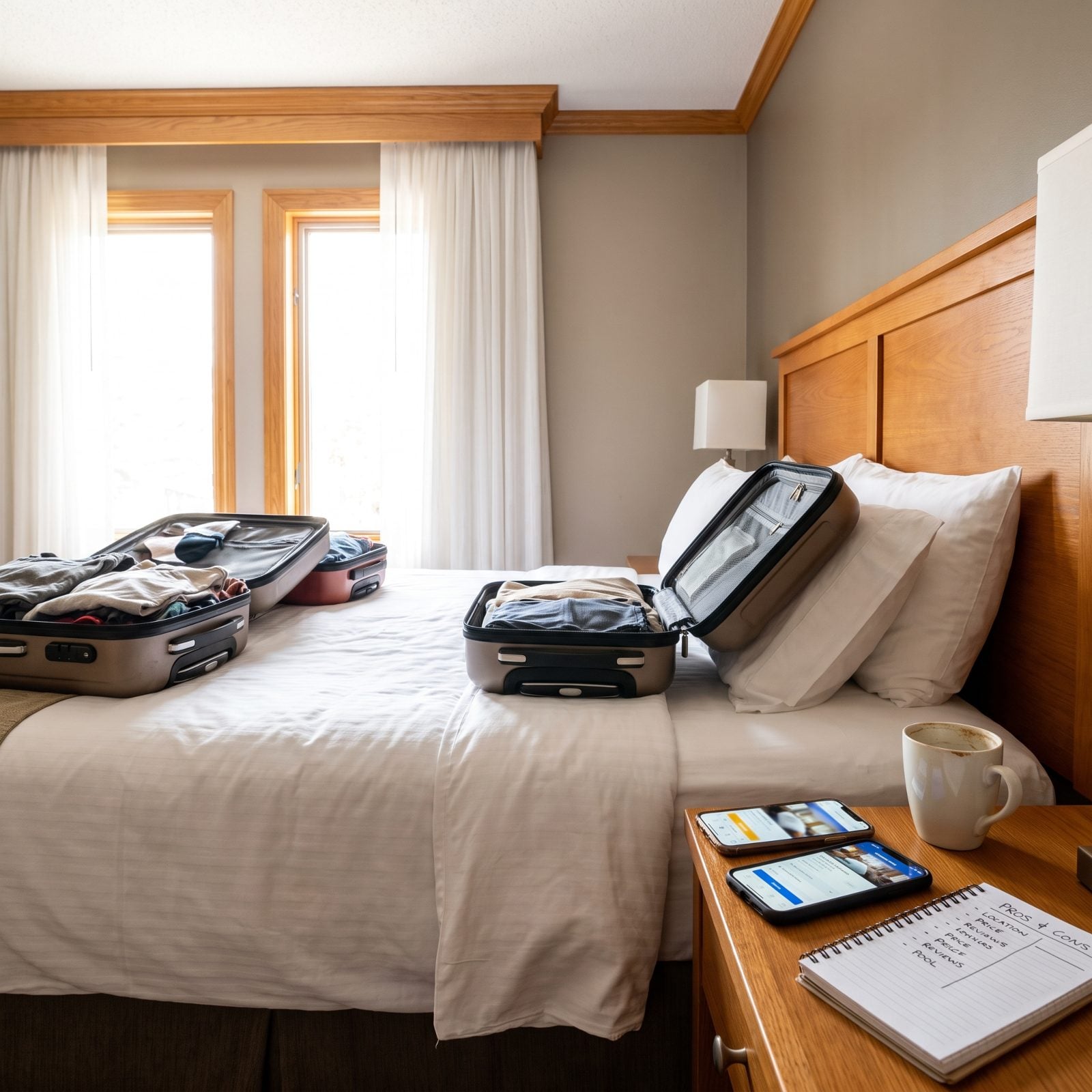
It starts as a reasonable talk about hotels. One of you wants the place near the old town with the squeaky charm. The other wants the modern one by the water with reliable air conditioning. Twenty minutes later the volume is up and nobody’s really talking about thread counts anymore.
Because the hotel was never it. It’s the stand-in for a bigger, harder question neither of you wants to name out loud: what is this trip actually for, and did we even want the same thing from it?
Displacement is the name for this — the way a small concrete disagreement carries the current of a larger unspoken one. People do it over the thermostat, the in-laws, the restaurant. The fight you’re having is rarely the fight you’re having.
When the hotel argument gets strangely hot, that’s the tell. Stop negotiating square footage and ask the real question. What do we each need this trip to feel like? Answer that, and the hotel practically picks itself.
🔥 Would you like to save this?
Please note that some of the imagery in this article were created with the aid of AI image generators.